DWFI welcomes Joe Sanders as new executive director | | |
Joe Sanders has been appointed the new executive director of the Daugherty Water for Food Global Institute (DWFI) at the University of Nebraska.
DWFI is one of three University of Nebraska (NU) institutes in which talented experts across all four campuses come together to find innovative solutions to challenges facing our state, nation and world. DWFI addresses the complex challenges of water and food security, and its work directly supports the university's commitment to local impact with global reach.
Sanders will officially assume the executive director position on Feb. 1, 2026, and brings more than 27 years of experience as an international development leader, designing and managing large-scale programs across Africa, Asia and Latin America. The university conducted an international search after Peter McCornick announced he would be stepping down from the role after 2025.
“The Daugherty Water for Food Global Institute represents the very best of the University of Nebraska,” said NU President Jeffrey P. Gold, M.D. “DWFI is a model of collaboration – among campuses, among the public and private sectors, and among disciplines – throughout Nebraska and around the world. I am excited for Joe Sanders to guide this incredible institute into its next era.”
Throughout his career, Sanders has led eight major initiatives totaling over $330 million, with a focus on agricultural market systems, food security, climate resilience, irrigation, youth livelihoods and governance. His work is rooted in locally led solutions and long-term institutional strengthening. Sanders has mobilized over $240 million in leveraged resources and worked closely with governments, civil society and the private sector in complex, multi-stakeholder environments.
“I am thrilled to welcome Joe Sanders to Nebraska and to work alongside him to advance water conservation, water use and food security,” said Tiffany Heng-Moss, interim Harlan Vice Chancellor for UNL’s Institute of Agriculture and Natural Resources. “Joe brings incredible experience to this position, and I’m excited for him to begin in his role and meet with the team members and partners across Nebraska who have contributed to the local and global success of this important institute.”
Sanders earned his Master of Science degree in managing rural development from the University of London and a Bachelor of Science degree in biology from Catholic University of America.
As DWFI executive director, Sanders will provide leadership, strategic direction and oversight for the institute’s three primary missions of research, education, and policy, while continuing to build DWFI as a global leader and partner in the international water and food communities.
"I am honored to join the University of Nebraska and to serve as executive director of the Daugherty Water for Food Global Institute. DWFI’s commitment to collaboration and applied, science-based research brings together world-class expertise in research, education, and policy to address one of the most urgent challenges of our time—how to sustainably manage water to feed a growing world. I look forward to working with faculty, partners, and communities to scale practical solutions that strengthen resilient water and food systems in Nebraska and around the globe."
| | |
2026 Seminar Series to consider community impacts of water management
The Nebraska Water Center (NWC), in partnership with the University of Nebraska-Lincoln’s School of Natural Resources, will begin its annual Spring Water Seminar Series in January.
This year’s series will explore how water management shapes our communities, a theme designed to bring together perspectives from across the state to discuss the shared water challenges facing Nebraskans.
The Series is open to the public and will be held in Room 901 in Hardin Hall on the University of Nebraska-Lincoln East Campus at 3:30 p.m. The seminar will also be streamed online via Zoom for attendees who are not based in Lincoln and posted on our website. Please contact Ann Briggs at annbriggs@nebraska.edu if you’d like to attend via Zoom.
The seminar dates and topics are listed below.
January 21: Nirupam Aich, UNL. Community impacts of PFAS
February 4: Bonnie Keeler, Minnesota Water Resources Center. How water quality affects rural communities
February 18: Amanda Grint, Papio NRD; Lyndon Vogt, Central Platte NRD; and Mike Murphy, Middle Niobrara NRD. Water management and community engagement across Nebraska: A Natural Resources District panel
March 4: Elizabeth Elliot, City of Lincoln. An update on Lincoln’s Water 2.0 project
March 25: Elli Rogan, UNMC. AltEn’s community impact
April 8: Jesse Bradley, Nebraska Department of Water, Energy, and Environment. Governor’s water task force update
April 22: Krista Brown, UNMC. Water quality, public health, and education
Established in 1968, the series provides a forum to increase awareness and allow for meaningful conversation regarding these issues. The series is a cornerstone of NWC’s mission to help the University of Nebraska become an international leader in water research, teaching, extension, and outreach.
| | |
New report examines not-for-profit financing of smallholder irrigation
In sub-Saharan Africa, smallholder farmers often face a "finance gap" that prevents them from investing in the irrigation tools needed to survive erratic weather and boost crop yields. While traditional banks often view these farmers as too risky, a new DWFI report highlights how not-for-profit financing models are stepping in to bridge the divide. By offering flexible loan terms, lower interest rates and integrated support services, these mission-driven organizations are helping farmers transition from rain-dependent subsistence to year-round commercial production, effectively turning irrigation into a tool for long-term economic resilience.
The report emphasizes that for these programs to be successful, they must look beyond just providing equipment. The most effective models combine affordable credit with technical training and market access, ensuring that farmers can actually profit from their increased yields to pay back their loans. As weather variability makes water management more critical than ever, these not-for-profit initiatives offer a scalable roadmap for investors and policymakers to make irrigation more accessible for millions of small-scale producers, fostering a more food- and water-secure future for the region.
| | |
Course on drought risk and impact attracts nearly 300 participants in first week after launch
Often referred to as a “creeping phenomenon,” drought events have widespread and cascading effects on a wide range of sectors, resulting in economic, agricultural and public health challenges across the globe.
To prepare professionals and decisionmakers with the skills needed to address the growing challenges associated with drought, the United Nations Convention to Combat Desertification (UNCCD), Global Water Partnership (GWP) and World Meteorological Association (WMO) have launched a new online course featuring expert contributions from Jesse Bell, DWFI’s Director of Water, Climate, and Health. Expert also included partners from the National Drought Mitigation Center and the University of Nebraska Medical Center.
Launched in early December 2025 at the UNCCD’s CRIC23 conference in Panama City, Panama, the free course, Drought Risk and Impact Assessment, features six interactive learning modules from cross-sector experts designed to prepare participants to conduct drought risk and impact assessments. Dr. Bell’s contributions to the course focus on the broad public health impacts of drought seen across the globe, including associations with increased respiratory, gastrointestinal and mental health impacts.
In its first two weeks, the course attracted nearly 300 participants across the globe, underscoring the growing commitment to drought resilience. A third course further highlighting the many health impacts of drought will be released later this year with additional contributions from faculty within the DWFI's Water, Climate and Health Program.
| |
|
New podcast episode explores Irrigation as a Service concept
In the first episode of the Water for Food Podcast in 2026, host Frances Hayes discusses a unique approach to supporting access to irrigation for smallholder farmers with Erin Anders, Senior Program Manager at the Daugherty Water for Food Global Institute.
Farmers of all sizes in all parts of the world need access to water, inputs and financing to grow food. Irrigation as a Service (IaaS) is an emerging business model to expand irrigation access, especially to smallholder farmers, and ultimately grow more food.
Irrigation as a Service (IaaS) has a broad definition but generally refers to the concept of third-party providers of irrigation in which the farmers do not own or maintain the equipment. The companies that arise under this business model can look very different and employ a variety of methods. However, they all unlock vital irrigation access to millions of smallholder farmers globally without the burden of high upfront costs.
Erin and her team have been working closely with and supporting entrepreneurs across the globe who are pioneering and providing this essential irrigation as a service, including those featured in the DWFI’s recent series on IaaS. In this episode, she gives an insider's look at the challenges and potential of this growing movement.
| | Nourishing a healthy future: The role of irrigation in a changing world | |
In a recent issue of Irrigation Today, Nicole Lefore, DWFI associate director, summarized key messages from the Heuermann Lecture delivered by Claudia Ringler of the International Food Policy Research Institute earlier this year.
As the world faces an increasingly unpredictable climate, irrigation is evolving from a simple farming tool into a vital safeguard for global health. While it currently supports 40% of our food supply, its new mission is to combat malnutrition by enabling the year-round production of nutrient-dense fruits and vegetables. By providing a reliable water source, irrigation allows farmers to move beyond basic grains, ensuring that communities have access to the diverse diets necessary for a healthy future.
The path forward focuses on "smart" irrigation—pairing precision technology with sustainable management. This approach emphasizes water quality and empowers local growers to produce more with less, turning agricultural efficiency into a foundation for better nutrition. Ultimately, modern irrigation is about more than just watering crops; it is about building resilient food systems that can nourish a growing population in a changing world.
| | |
Seven new members added to DWFI Faculty Fellow Cohort
The Daugherty Water for Food Global Institute (DWFI) has welcomed seven University of Nebraska (NU) faculty to its Faculty Fellow cohort. The new Fellows expand the network to a total of 141 researchers across all four NU campuses who contribute to the institute’s mission-related research, scholarship, engagement and education programs.
DWFI Faculty Fellow status gives formal recognition of an individual’s accomplishments and expertise and includes the Fellow in a community of faculty with complementary interests. Additionally, Faculty Fellows are eligible to apply for DWFI student support to fund an undergraduate, graduate or doctoral student.
The cutting-edge research DWFI Faculty Fellows and supported students conduct greatly enhances and expands the institute’s work at home and around the world. They have engaged in hundreds of research projects that improve water and food security, as well as public health and the environment, with expertise across a range of disciplines.
New DWFI Faculty Fellows are:
-
Krista Brown, Associate Director, Center for Metrics and Evaluation; Assistant Professor, Department of Environmental, Agricultural and Occupational Health, College of Public Health, University of Nebraska Medical Center
-
Dipti Dev, Betti and Richard Robinson Associate Professor and Childhood Health Behaviors Extension Specialist, Department of Child, Youth and Family Studies, College of Education and Human Sciences, University of Nebraska–Lincoln
-
Michael Kaiser, Associate Professor, Department of Agronomy & Horticulture, College of Agricultural and Natural Resources, Institute of Agriculture and Natural Resources, University of Nebraska–Lincoln
-
Julie Petersen, Assistant Professor, Department of Epidemiology, College of Public Health, University of Nebraska Medical Center
-
Sarah Elizabeth Scales, Faculty, Water, Climate and Health Program; Faculty, Center for Preparedness and Emergency Response Solutions (CPERS); Assistant Professor, Department of Epidemiology, College of Public Health, University of Nebraska Medical Center
-
Yeyin Shi, Associate Professor and Agricultural Intelligence Engineer, Department of Biological Systems Engineering, College of Engineering, Institute of Agriculture and Natural Resources, University of Nebraska–Lincoln
-
Cory Walters, Associate Professor, Department of Agricultural Economics, College of Agricultural and Natural Resources, Institute of Agriculture and Natural Resources, University of Nebraska–Lincoln
| | |
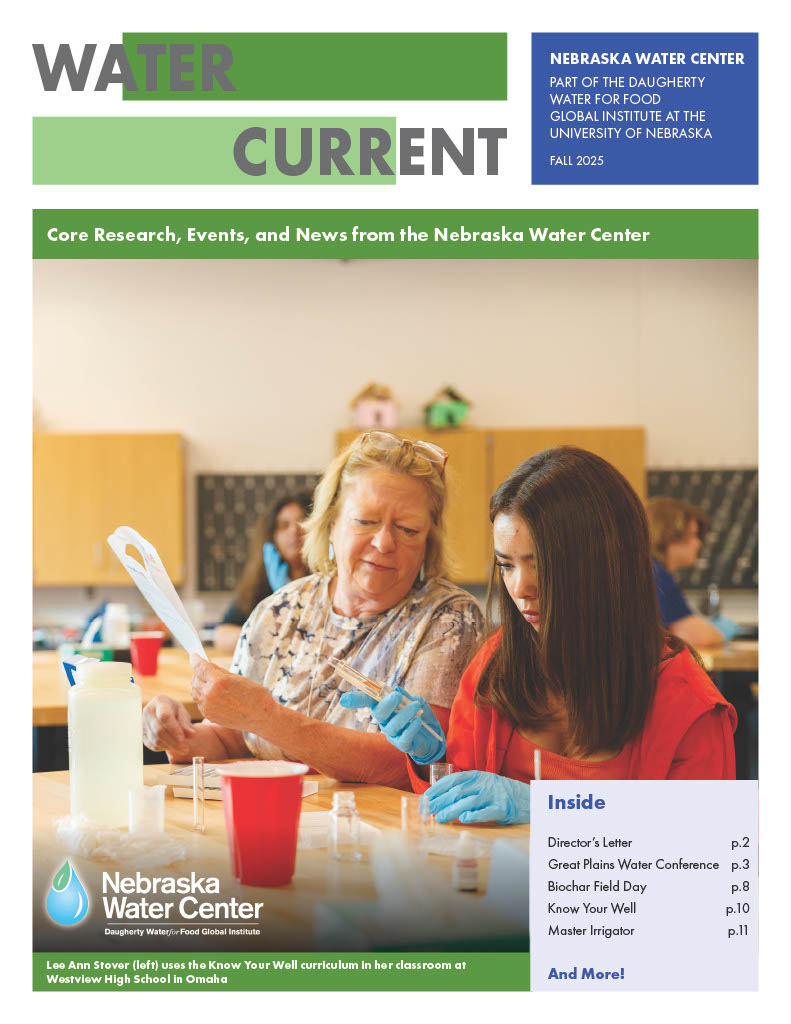
Nebraska Water Center releases Fall 2025 Water Current
The Nebraska Water Center, part of DWFI, recently published its Fall 2025 Water Current Newsletter.
The newsletter summarizes key themes from the 2025 Great Plains Water Conference; highlights an op-ed by University of Nebraska President Dr. Gold on how water science partnerships strengthen Nebraska's agriculture and environment; shares outcomes of the biochar field day, which showcased Nebraska research and redcedar management; recaps a Know Your Well PhD student's trip to Washington, D.C. to advocates for science funding; and provides a brief update on the Nebraska Master Irrigator Program.
| |
|
Can agricultural water management support both adaptation and mitigation?
In an opinion piece following their SIWI Seminar Series at World Water Week 2025, DWFI’s Nicole Lefore and Petra Schmitter of the International Water Management Institute explain that global climate goals, and even more so, climate finance mechanisms, prioritize mitigation, while farmers and governments tend to focus on adaptation to ensure food and nutritional security. Through examples of rice cultivation, peatland management, and solar irrigation, they show that achieving co-benefits for adaptation, mitigation, and water security can rarely be achieved simultaneously. The authors argue that progress requires policies and investments that reflect local priorities and provide greater support for adaptation, paired with strong data and evidence to guide decisions. Co-benefits are possible, but they require intentional planning, coordinated action, and increased adaptation investment at every level.
| | |
Shifting to 'farmer-first' solutions for sustainable groundwater in South Asia
Soumya Balasubramanya, DWFI Global Fellow and adjunct professor at the University of Waterloo in Canada, recently wrote an opinion piece in Dialogue Earth in which she discusses the need to protect farmers’ livelihoods while encouraging adoption of water-saving tech in South Asia.
Groundwater is the lifeline of South Asian agriculture, supporting food security for over a billion people and millions of smallholder farmers. However, this critical resource is being depleted at a worrying rate. While government subsidies for electricity have historically empowered farmers to pump water and increase yields, they have also inadvertently fueled wasteful irrigation and the financial insolvency of power utilities.
To address this crisis, experts argue that management strategies must shift from top-down regulation to "farmer-first" solutions that align economic incentives with conservation. Innovations like solar-powered pumps, which can provide a new source of income through grid-sharing, and cash-for-energy-saving programs have shown promise in reducing extraction without harming crop yields. By prioritizing the livelihoods of smallholders and fostering collaboration between researchers and local communities, policymakers can create sustainable water systems that are resilient to the growing pressures of climate change.
| | |
Bodlak receives Water for Food/IALC Student Impact Award
Former DWFI Policy Intern Lexi Bodlak recently received the Water for Food – International Arid Lands Consortium (IALC) Student Impact Award.
The Water for Food/IALC Student Impact Award supports undergraduate students at the University of Nebraska studying water and food related issues and is awarded by DWFI to recipients who have made a meaningful contribution to the institute’s mission and to collaborative endeavors relating to sustainable agriculture and natural resource practices in arid and semiarid regions of the world.
Bodlak, a DWFI policy intern in Fall 2025, is the second recipient of the Water for Food/IALC Student Impact Award. She has made meaningful contributions to the institute’s mission and to collaborative efforts that advance sustainable agriculture and natural resource practices in arid and semiarid regions around the world. Bodlak's creative and passionate work on the complex issues related to legal agricultural water management frameworks across the U.S. has made a significant impact on ensuring food security without compromising human and environmental needs. She has led research and engagement efforts to better understand the intricacies of groundwater management in Arkansas, exemplifying effective collaboration by engaging with various stakeholder groups important to the Institute’s work. Lexi’s research results are relevant in a variety of contexts across the U.S. and internationally.
The Water for Food/IALC Student Impact Award is just one of many provided by DWFI that support more than 30 students at the University of Nebraska each year.
| | Staff, Fellow and Supported Student Publications | | |
Drought Management in Zambia: Insights from the 2023/2024 Drought
Mwape, Andrew; Hayes, Michael; Bathke, Deborah J.; Smith, Kelly Helm; Mahmood, Rezaul
Land application of beef cattle manure facilitates the transmission of antibiotic resistance genes from soil to lettuce
Sun, Yuepeng; Snow, Daniel; Walia, Harkamal; Li, Xu
Current Trends and Future Scenarios: Modeling Maximum River Discharge in the Zhaiyk–Caspian Basin (Kazakhstan) Under a Changing Climate
Alimkulov, Sayat; Makhmudova, Lyazzat; Davletgaliev, Saken; Talipova, Elmira; Snow, Daniel
Land use land cover change, irrigation and their impacts on Bi-hourly evolution of convective environments during GRAINEX
Whitesel, Daniel; Mahmood, Rezaul; Flanagan, Paul; Phillips, Chris; Pielke, Roger A
Soil management legacy provides resiliency to salinization: Insights of soil processes and indicators from a case study
Aaron Lee M. Daigh, Umesh Acharya, Bijesh Maharjan, Thomas DeSutter
Optimizing in-season nitrogen management through satellite-guided fertigation in field-scale maize production
Amori, Precious N.; Heeren, Derek M.; Balboa, Guillermo R.; Puntel, Laila A.; Shi, Yeyin
| |  | |
Characterization of irrigation timing using thermal satellite observations, a data-driven approach
Jalilvand, Ehsan; Kumar, Sujay V.; Truong, Charles; Haacker, Erin; Mahanama, Sarith
Combining two sources of on-farm experimentation data to predict optimal site-specific nitrogen rates
Patterson, G. Cole; Brorsen, B. Wade; Poursina, Davood; Mieno, Taro; Edge, Brittani K.
Water and food: from invisible flows to accountable action
McInnes, David; Goswami, Shubham; Mekonnen, Mesfin M.; Sanderson, Matthew R.; Ray, Chittaranjan
Water governance to increase agricultural resilience
Rimšaitė, Renata
Intercomparison of Earth Observation products for hyper-resolution hydrological modelling over Europe
García-García, Almudena; Stradiotti, Pietro; Di Paolo, Federico; Filippucci, Paolo; Fischer, Milan
Prithvi-EO-2.0: A Versatile Multi-Temporal Foundation Model for Earth Observation Applications
Jalilvand, Ehsan; Kumar, Sujay V.; Truong, Charles; Haacker, Erin; Mahanama, Sarith
Critical Precipitation Months Across the Western United States
Campbell, Grace; Haigh, Tonya
| | |
UNL Spring Semester Begins
January 21
DWFI Student Support Welcome Back Networking Event
2:30-3:30 p.m. CST
January 21
Nebraska Water Center Spring Seminar Series
3:30-4:30 p.m. CST
January 21
Nebraska NRD Legislative Conference
January 27-28
Nebraska Water Center Spring Seminar Series
3:30-4:30 p.m. CST
February 4
| |
The Daugherty Water for Food Global Institute at the University of Nebraska was founded in 2010 by the Robert B. Daugherty Foundation to address the global challenge of achieving food security with less stress on water resources through improved water management in agricultural and food systems. The institute is committed to ensuring a water and food secure world while maintaining the use of water for other human and environmental needs.
The Nebraska Water Center, established by Congress in 1964, focuses on helping the University of Nebraska become an international leader in water research, teaching, extension and outreach by facilitating programs that will result in UNL becoming a premiere institution in the study of agricultural and domestic water use.
| | | | |