|
Bumble Bee Watch eNews
January 2026
| | |
Remembering Dr. Sheila Colla
1982 - 2025
| | |
We’d like to begin this newsletter by mourning the passing of our dear friend and colleague, Dr. Sheila Colla. A professor at York University in Toronto, Sheila was among the first North American scientists to dedicate her work to the problem of native bee declines. She mentored many students interested in native bee conservation and published extensively on this topic. Sheila was a co-founder of Bumble Bee Watch and a key partner of the Xerces Society and Wildlife Preservation Canada in our collective efforts to conserve bumble bees. She was unrelenting in her commitment to conserve wild bees, as well as in her work to bring bee science and conservation to all people, not just those reading scientific journals. Beyond these accomplishments and contributions, we remember Sheila as a wonderful friend who took the world seriously but laughed easily, and who cared deeply for people and the world around us.
In Sheila’s honour, please consider planting a flower or tree native to where you live; or uploading a bumble bee sighting to Bumble Bee Watch, the community science project she helped found; or find the best cannoli in your town and bring some to a friend; or write your government officials and ask them to implement a pollinator protection plan; or sit quietly and contemplate the overwhelming beauty of this world even as it breaks your heart. Or all of those. Because that’s what Sheila would do.
To read more about Dr. Sheila Colla and where to make a contribution, please visit www.savethebumblebees.ca/celebrating-sheila.
| | |
In the United States, Bumble Bees Thrive on Public Lands!
by Xerces Society
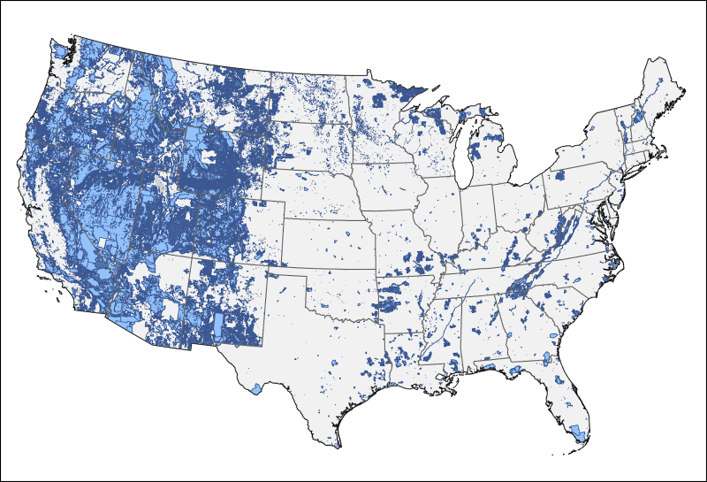
| | Public lands are important areas of habitat for wildlife, including invertebrates. In the U.S. the federal government manages roughly 640 million acres of public lands, most of which are National Parks, National Forests, Bureau of Land Management areas, and U.S. Fish and Wildlife Service lands. Much of this land is in the western U.S., as demonstrated by the map below. These lands serve multiple purposes–including recreation, resource extraction, ecosystem service provision, and habitat protection–but their role as habitat for wild bees has often been overlooked. | |
So just how important are these lands to bees? The Bumble Bee Watch (BBW) database can give us a window into this question. Since 2014, BBW users have submitted more than 250,000 bumble bee observations to the platform, both through formal surveys in our Bumble Bee Atlas projects (active in 20 U.S. states) and incidental or casual observations across North America. These observations take place in all sorts of places, from backyard gardens to cities and wilderness areas.
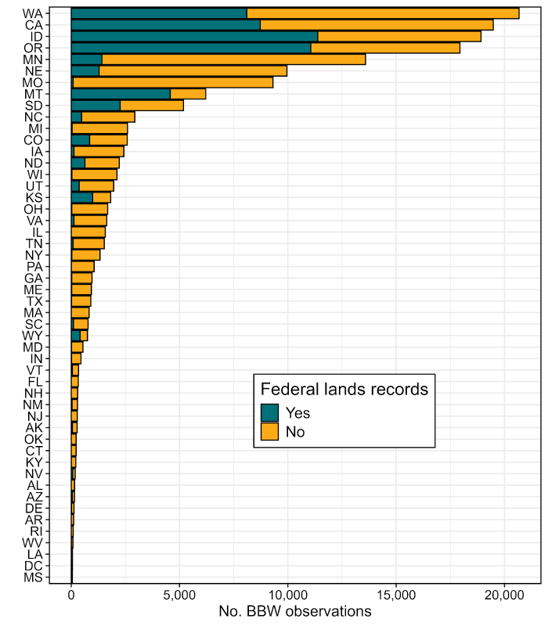
Our data show that approximately 37% of all of these observations took place on U.S. federal lands, making these lands integral to our collective efforts to understand the status of native bumble bees. The graph below shows that federal lands are particularly important as bee habitat in western United States.
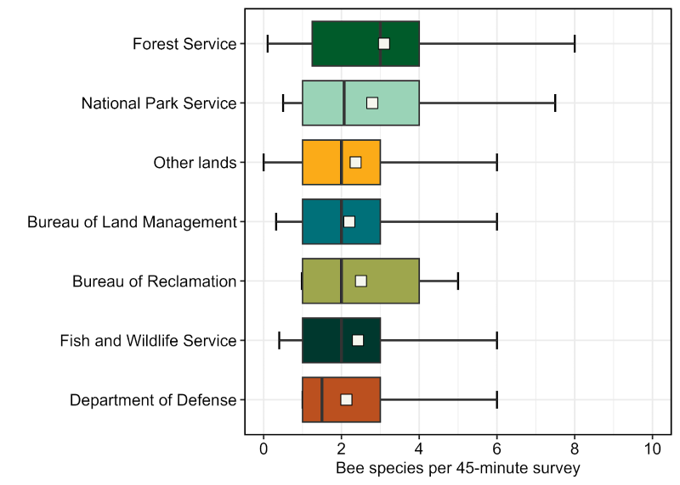
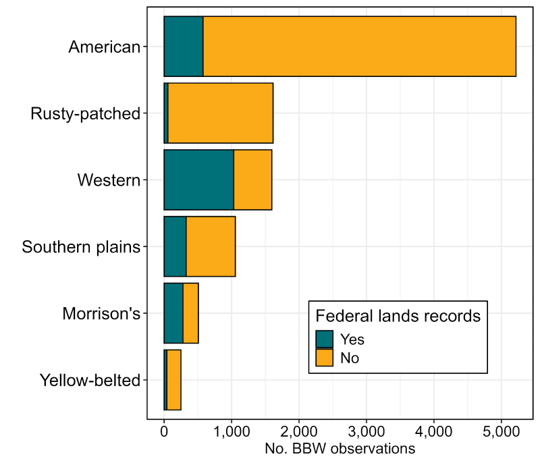
| So how do the many uses of our public lands affect bee habitat and populations? We can glimpse these impacts by comparing Bumble Bee Atlas surveys on the various federal lands ownerships to each other and to those conducted on private and other land jurisdictions. Using records from our Bumble Bee Atlas program, one pattern that we see in the data is that the land managed by different agencies appears to have a different capacity for the numbers and types of bumble bees they support. For example, we have found that U.S. Forest Service lands generally have more species than other jurisdictions. Interestingly, U.S. Forest Service lands also had the highest number of bees per survey. We don’t know exactly what is driving these differences, but it’s likely a combination of differing geographical patterns of land acquisition across the agencies, varying ecosystem types, and differences in habitat management practices. The graph below uses box plots* to make this comparison, with the white squares representing means or averages. | *Explanation of box plots: A boxplot represents a set of data records by showing the median value (vertical black line in box), the interquartile range, in which 75% of the records occur (the colored box), and the range in which 95% of the values occur (the horizontal lines extending from box, i.e. whiskers). We have added white squares to signify the mean (average) value for each set of records in this plot. | Not surprisingly, our federal lands are also important refuges for our most imperiled bumble bee species. Below we see a selection of six rare bumble bee species and the number of times they were observed on federal and other lands. Generally, these lands provide important habitat for these species, some of which are the objects of concerted efforts to recover their populations. Species with more western distributions (e.g., western bumble bee, Bombus occidentalis) are disproportionately found on federal lands, while eastern species (e.g., the rusty-patched bumble bee, B. affinis) have been observed primarily on private and other lands. | | Among their many values, U.S. federal lands provide critical habitats for bumble bees and other invertebrates. Patterns of land ownership mean that ranges of some species–including High Country bumble bee (Bombus kirbiellus), a species from western North America found only at high elevations–are restricted almost entirely in National Parks and National Forests. More generally, these lands may provide refuge for bumble bees from exposure to pesticides and pathogens common in agricultural and developed environments. Xerces has a range of publications describing the values of such lands to bees, as well as management strategies that may promote them. These include publications on rangeland management for pollinators, pollinator-friendly parks, and management of bumble bee populations in the Pacific Northwest states. Please join us in advocating for U.S. public lands as important sites for bumble bee conservation! | | When you participate in Bumble Bee Watch, be assured that your submissions contribute to something meaningful. There are many conservation efforts that benefit from your submissions, and experts are working diligently to find new and unique ways to use them. We are grateful for your participation in this initiative, and it is participants like you that help make all of this possible! | | |
Become a member of The Xerces Society by making a tax-deductible contribution at
xerces.org/donate.
Credits: Cover Photo: Xerces Society/Katie Lamke; Sheila Colla Photo: https://www.savethebumblebees.ca/celebrating-sheila/; Main content graphics: Xerces Society/Leif Richardson
Copyright © 2026 The Xerces Society. All rights reserved.
| | | | |