Campaigning for Democracy And Socialism | | |
Feb. 20, 2026: The Week in Review
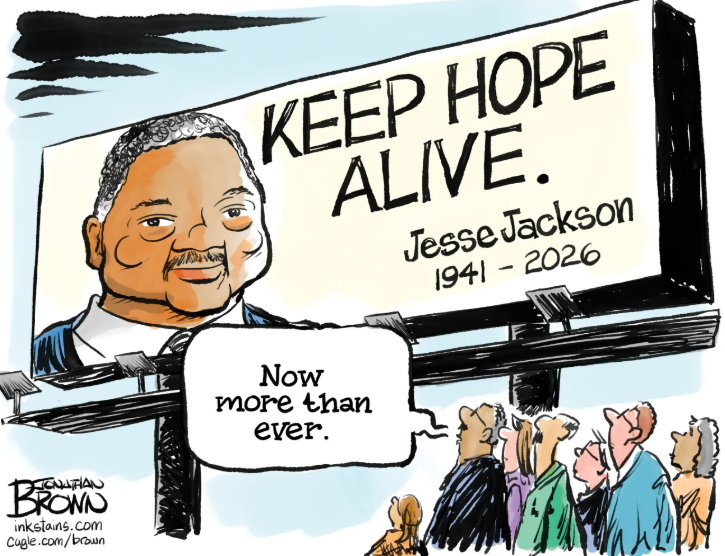
Jesse Opened a Rainbow Path Forward,
Now We Must Build And Walk A New Road
| |
|
Rev. Jesse Jackson, a formidable leader of both the civil rights movement and the U.S. left, has passed on. All those familiar with his situation were not caught unaware, but were saddened nonetheless.
Jesse, or ‘The Rev’ to close workers and friends, left deep impressions on all of us and the entire country. Tributes to his impact on our time are appearing everywhere. Jesse was ‘a force of nature’, insisting on giving us agency with ‘I am somebody!’ chanted by millions. And by insisting on our agency, he kept hope alive.
I won’t attempt to sum up, in this short space, Jesse’s profound impact on the country and the world. Others will do that far better than I. Instead, I will just tell my personal stories.
I can’t recall the first time I met Jesse. But like many Chicago longtime activists, there were dozens of times when our paths crossed on common projects in our local peace and justice movements and in Chicago’s elections. From time to time on a Saturday or Sunday I would also make my way to his church, Operation PUSH, just to hear a sermon and hear the music. I was always uplifted.
Rev. Jackson once invited me to PUSH to receive an award, along with 10 others, who had a hand in registering a large number of new registered voters—in my case 20,000—and I found out I was the sole white guy up front. All the others had faced greater difficulties. It was humbling.
But I got to know Jesse in a few unique ways. In my early years as a TA and grad student in philosophy at the University of Nebraska, I had hooked up with a number of left-wing farmers, especially Merle Hansen of the North American Farm Alliance. Merle and I stayed in contact over the years, and when Jesse was building his ‘rainbow,’ Merle suggested we work together to get Jesse out to farmers, and we did.
I’ll never forget one evening in Western Iowa where Merle, Jesse, and I went into a barn with some 50 farmers eager to hear Jesse. They weren’t disappointed. As a Minister of the Gospel, Jesse knew exactly how to speak to this group, and when he was done, it was a standing ovation without a dry eye in the barn.
‘When farmers get radical,’ Merle explained to me, ‘they go one way or the other, not too many in the middle. Some will go with the right and the anti-Semites. And some will go with Jesse and the Rainbow.’ As a result of the effort, we put the ‘green’ stripe in the rainbow flag.
A few months later, I got another call from Merle. ‘How would you like to be a delegate to the Farmers and Ranchers Congress in St Louis? Jesse will be there, and about 10,000 delegates. My Chicago comrade, Ivan Handler, and I were on the road in a flash, up for a powerful experience for both of us. I also gathered material for a pamphlet I was working on, ‘Blood on the Plow,’ plus we got to hear a great concert with Willie Nelson, and I made my way to shake Willie’s hand, too!
We then headed to the crowded hotel bar, where I ended up Standing between Merle and Jesse. How was that for a peak experience, meeting Willie and hanging with Jesse that same night!
I had another somewhat amusing experience. My group at the time, the League of Revolutionary Struggle, was heavily engaged in Jesse’s campaign. Jesse built his Black base and won over Chicago Latinos. My LRS local leader was holding a campaign meeting with Jesse’s key ally, Luis Gutierrez, at her house. She told me to write up a ‘talking points’ memo on how Jesse would win the national election. ‘Are you kidding?’ I asked. ‘I doubt even Jesse thinks that.’ No, she said, ‘that’s the line. Get to work. I need it it a few hours’ So I turned to all my research files and clippings, and stretched out the most optimistic (and unlikely) string of wins along the way that ended with Jesse in the White House..
It got over, sort of, in her packed living room. Luis asked me later, laughing, ‘Davidson, remind me to call you when I have a tough argument to spin!, I laughed in return. But in a way, the memo had served a purpose that evening. The talking points challenged us to think outside the box at times and that the future was always open.
Another point worth noting: My friend Ivan, mentioned above, was a computer guy, and with a small assist from me, he went to work organizing the best use of networked portable computers at the convention site for Jesse. It was a big deal then, even if today it's all easily done in a Signal room on Smartphones. But then? Even Newsweek reported that Jackson had the best computer networks of anyone else running.
My antiwar ‘co-conspirator' and close friend, Marilyn Katz (peace be upon her) was also close to Jesse, and a ‘force of nature’ in her own right. She had him help us in many ways in building the anti-Iraq war movement in Chicago, including getting Obama involved. Rev Jackson was very helpful working with us to get the Chicago City Council to vote twice against the war, both before it started and after it was underway.
Some on the left were critical of Jesse for pulling his part of the Rainbow back into Operation Push locally, forgoing a lasting national organization. I’m not among them. Jesse always told us, ‘My job is to shake the cherries from the trees. Your job is to gather up the harvest.’
But we were weak in doing so. We overemphasized our role as ‘building a movement,’ rather than building base organizations within movements, a subtle but important difference. As a result, when the campaigns and the voting ended, it all evaporated. We had a small number of new LRS recruits, but nothing like what we might have had with a better approach on our part, not Jesse’s part. Keep this in mind in the upcoming ‘No Kings’ and other events going forward.
Rev Jesse Jackson will be missed. He had a large impact on the left of our country, and his insistence on our agency from below made waves that are still moving outward, in ever-wider circles, now in Minneapolis, Chicago, Los Angeles, and elsewhere. Peace be upon him as well. Keep hope alive!
[All LeftLinks editorials, unless otherwise designated, express the views of our stalwart editor, Carl Davidson, and not necessarily any organizations he is connected with. Everyone, of course, is welcome to steal them and shamelessly pass them around, far and wide, with or without permission. A thank you note would be welcome, though!]
| | | | |
WE ARE INVITING FEEDBACK!
Please send us your letters, comments, queries, complaints, new ideas. Just keep them short and civil. Longer commentaries and be submitted as articles.
Click Here to send a letter
DIFFICULTY READING US?
View as Webpage
Food for thought: Our weekly format is missing too much of vital ideas in the news. What do you think of 'Daily Extras!' once or twice a week?
We're also considering 'Friday Night at the Movies' for 1940s Noir classics, as well as vital new films yet to gain top Hollywood status. Would you project us from a laptop onto your big screen TV and invite friends for popcorn and a 90-to-120 minute show?
Let us know.
| |
We're going to try something new, and you are all invited.
Saturday Morning Coffee!
Started in August 2022, then going forward every week.
It will be more of a hangout than a formal setting. We can review the news in the previous days' LeftLinks or add a new topic. We can invite guests or carry on with those who show up. We'll try to have a progressive stack keeper should we need one.
Most of all, we will try to be interesting and a good sounding board. If you have a point you would like to make or a guest to invite, send an email to Carl Davidson, carld717@gmail.com
*****************
Continuing weekly, 10:30 to Noon, EDT. Here's the ongoing link:
*******************
NEW FEATURE: A summary and transcript of the previous week:
Full Text and Zoom Summary AVAILABLE HERE
******************
Meeting ID: 868 9706 5843
Let's see what happens!
| |
llustration Credit...Sammy Harkham
In the Resistance,
We Drive Minivans
By Will McGrath
New York Times via anti-confederacy_ipo_discussion
Mr. McGrath is an essayist. He wrote from Minneapolis.
In the resistance we drive minivans, we take ’em low and slow down Nicollet Avenue, our trunks stuffed with hockey skates and scuffed Frisbees and cardboard Costco flats. We drive Odysseys and Siennas, we drive Voyagers and Pacificas, we like it when the back end goes ka-thunk over speed bumps, shaking loose the Goldfish dust. One of our kids wrote “wash me” on the van’s exterior, etched it into the gray scurf of frozen Minneapolis slush. Our floor mats smell like mildew from the snowmelt.
In the resistance we play Idles loud, we prefer British punk, turn the volume up, “Danny Nedelko,” please and thank you — we cast that song like a protective spell across our minivans: Let us be bulletproof, let us be invisible. We double-check the address, two new kids in the car pool today, three more families requesting rides in the Signal chat. We scan our phones to see which intersections to avoid: armed ICE action in Powderhorn; saw a protester get pushed down. This is in the weeks following the killing of Alex Pretti by federal agents. Following the killing of Renee Good by a federal agent.
In the resistance we drive the high school car pool, that holy responsibility, the ferrying of innocents among the wolves. We drive kids we’ve never met before from families afraid to leave their houses, and most mornings we’re in our pajamas, a staling doughnut grabbed with yesterday’s cold coffee, teeth unbrushed — and OK, fine, that might just be me. You wouldn’t be the first to cock an eyebrow at my personal hygiene.
And OK, fine, I don’t even drive a minivan, if you’re going to be pedantic — it’s a dark Chevy Traverse that looks just like an ICE truck. So in those subzero mornings, when I pull up in front of a new address, I roll the window down and shine my smiley pink face into the day — I know how this looks, sorry, sorry! — and I wave wave wave my cartoon wave right up to the point where those eyes peering from behind bent mini blinds register the thought: No… no, I do not think that man could be ICE.
We’ve been doing this since December, eight weeks-going-on-nine-going-on who knows. Kids stopped going to school when thousands of ICE officers arrived in Minnesota. They didn’t want to take the buses anymore, their parents too nervous to release their children onto the block, lest they get swept up by masked agents in flak jackets. This was before the 5-year-old in the blue bunny hat got taken, before a fourth grader in Columbia Heights disappeared, before my middle child’s middle school went into lockdown because ICE trucks were prowling outside her algebra classroom. A network of neighborhood moms and dads bloomed organically, divvying rides, vetting newcomers. There were no open calls, just friends talking with other friends, seeing who might want to help.
Today I’m driving a boy with big bright eyes and floppy hair and golden retriever vibes. He’s got his guitar case this afternoon, performed something for the class, and when I ask about it he smiles and nods and looks down at his seat. (I won’t name any of the kids I drive out of fear of government reprisal.)
Sign up for the Opinion Today newsletter Get expert analysis of the news and a guide to the big ideas shaping the world every weekday morning. Get it sent to your inbox.
Today I’m driving a girl with red lipstick and a gentle, cautious smile. Today I’m driving those sweet, shy sisters who politely take doughnuts from my proffered box even though they never eat them in the car. Today I’m driving the dignified and serious girl who told me English is her favorite class. They’re reading “Romeo and Juliet,” they’re writing sonnets. She told me next year she wants to take A.P. English. Today she’s going downtown to the protest, going because her parents can’t leave the house. Her father came out to shake my hand the first day I picked her up. Most mornings her mother waves from behind a cracked door. They’ve postponed her quinceañera for now; Mom says it’s going to be a Sweet Sixteen next year.
Today I’m driving a boy with braces and unstylish glasses, a dazed and daffy air. He’s always smiling about something. He is last on my drop-off list, four different stops today, and he was squeezed into the far back next to a girl in his grade. Am I wrong to think that neither was leaning away from the other, may in fact have been scrunching in a little closer? A gentleman never tells. Just before we reach his house I ask how his day went and he jolt-snorts awake, laughing. Oh, man, I was up so late last night, playing video games with my friends, he says. He’s bashful now. My friends are too funny. I pull up to his place and we scan the area for suspicious vehicles. I watch him turn the doorknob, step inside.
What they don’t often tell you is how beautiful the resistance can be. In the evening, on the day that Alex Pretti, an I.C.U. nurse, was shot to death by federal agents in front of Glam Doll Donuts, my wife and I drove through Minneapolis. There were candlelight vigils on nearly every corner we passed, some corners with four or five people cupping tiny flames, some corners with 50 neighbors milling about, communing, singing, stoking a firepit hauled to the sidewalk, lighting up the little Weber grill, just hanging out in the frozen dark. ...Read More, it's much longer
| |  | |
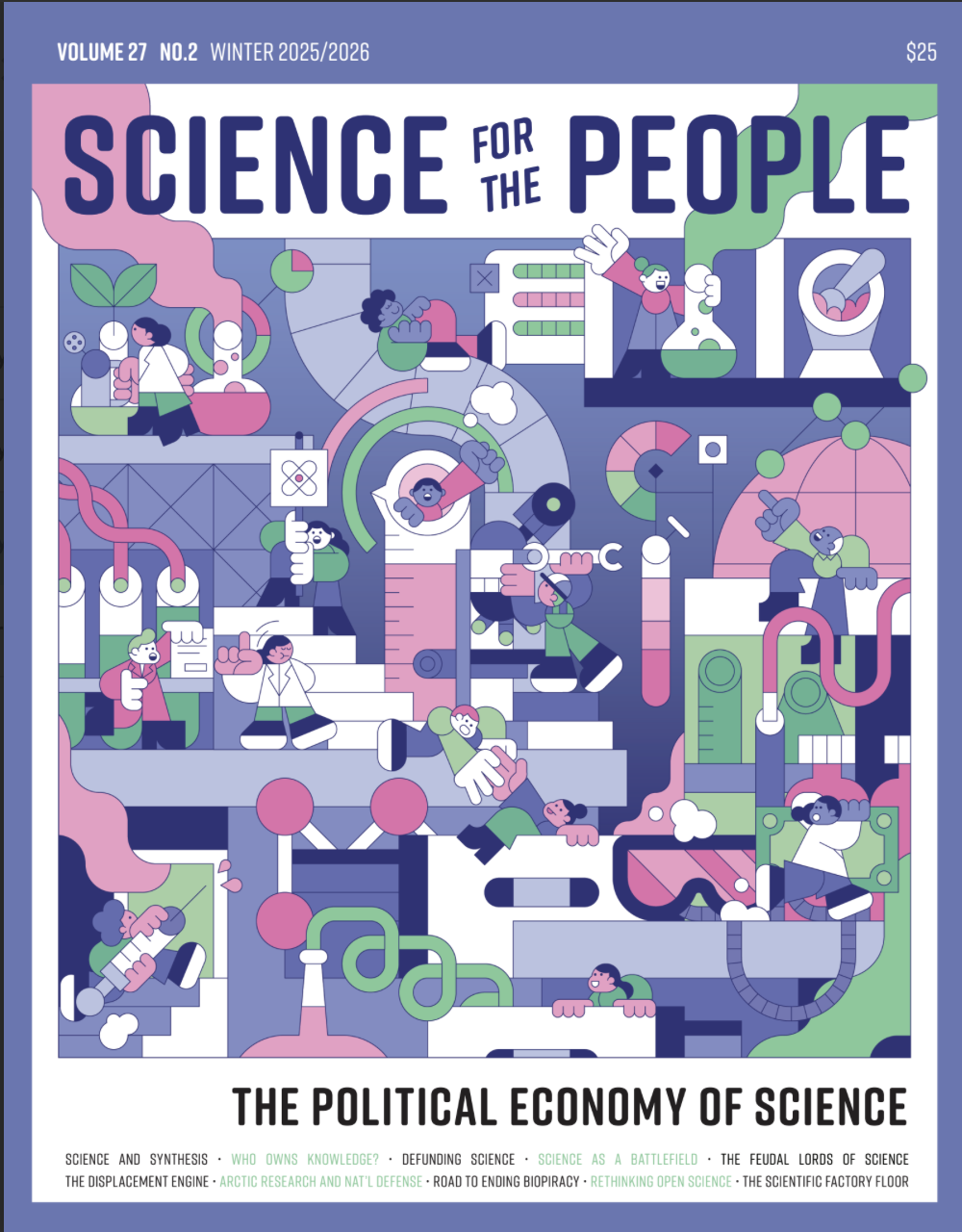
Science for the People Is Back!
Political Economy of Science
Volume 27 - Issue 2
Our Winter 2025/2026 issue, “The Political Economy of Science,” featuring ten new articles and two book reviews covering topics like biopiracy, the corporate agendas of "open science,” military funding of arctic research, scientific labour, the scientific publishing industry, and other examples of science under capitalism.
Buy here $25.00
| |
Photo: White House press secretary Karoline Leavitt refuses to rule out ICE agents at polling places during November's midterm elections. Seen here forgetting that's illegal. Photo left: George Kelly, CC BY 2.0. Photo right: CC BY 4.0
I’m Trying to Convince Friends and Family to Vote in the Midterms, But They Have Questions
The big lie about noncitizen voting is ruining elections for us all.
By Jennifer Thomas
The New Liberator
Feb 17, 2026 - The 2026 midterm elections will be a turning point in the American experiment. Will we continue facing military occupation of cities, Klan-level racism in the White House, pillaging of federal agencies, foreign wars, and an unsustainable affordability crisis? Or can we return to the normal problems we used to worry about, like climate change, run-of-the-mill police violence, school shootings, foreign wars, and an unsustainable affordability crisis?
Like you, I’m concerned. I’m asking my friends, neighbors, and family members to commit to voting in November, but they keep bringing up questions. I’m compiling the ones I’m hearing, with an eye toward a FAQ on the subject at some point. Here’s what I have so far. I’m guessing there will be more the closer we get to the midterms.
An ICE agent took a picture of my license plate when I stopped behind him at the Circle K. He said I was following him so I would be added to the database of domestic terrorists. Will I still be able to vote?
My boyfriend spends too much time with his loser friends on Discord and says women shouldn’t vote. He says even Pete Hegseth agrees. What should I do?
My Congressman spends too much time with his loser Republican colleagues and wants to pass the SAVE Act. Then my voter registration would have to match my birth certificate or passport. I don’t have a birth certificate/I don’t have a passport/I changed my name last year when I got married. How am I supposed to track down all the paperwork?
My last name is Díaz. Will I be removed from the voter rolls?
My last name is Díaz. Will ICE agents go to my home and abduct my family while I’m out voting?
I look Latina. Will ICE agents pull me out of the voter line and send me to a detention camp in Texas?
My last name is O’Connell. I plan to accompany my neighbor Maya Díaz to the polls to help keep her safe. Will ICE agents pull us both out of the voter line
and send us to a detention camp in Texas?
If ICE agents surround the polls, wouldn’t that be illegal? Who would I call to make them go away?
My grandpa says when he went to register to vote in Alabama in 1949, he was asked questions like “How many windows in the White House?” If they ask me that, I feel like it would be a trick question—before or after the East Wing demolition?
My grandpa also says it would be nothing new for armed thugs to surround the polls to stop certain people from voting. But didn’t the Voting Rights Act of 1965 take care of that? ...Read More
| |
CCDS Call for
a Study Group
It's not too late! The first session just reviewed the introduction.
Next meeting, Wednesday, Feb 25, 8pm EST
Go Here
Passcode: 627283
Co-authored by William Hartung and Ben Freeman,The Trillion Dollar War Machine: How Runaway Military Spending Drives America into Foreign Wars and Bankrupts Us at Home, was released late last year. This book provides a wealth of background and other relevant information about the economic and public policy domination of weapons manufacturers and related contractors, how that control deforms domestic spending and other priorities, and what the authors believe should be done about all this.
The book includes an epilogue and 15 chapters. If we tackle three chapters per week for discussion purposes, it should take us five weeks to read and consider what these authors have to say.
The book is available in hardcopy at $30.00. You may be able to find it at your local book retailer. If not, it can be ordered online. An e-book version at $19.00 is also available. Another possibility is to find it at your local public library or through interlibrary loan.
It is not required that you read the book in order to join the study group, but is strongly recommended. Our discussions will be stronger if as many as possible are informed by the reading.
If interested, send us an email
| |
Indivisible
We Fight On, Together
Our democracy is under threat.
But we will not yield to fascism.
We will stand together and we'll fight back in defense of our rights, our communities, and our values.
Join Our Weekly Chat
Every Thursday, Indivisible co-founders Ezra Levin and Leah Greenberg help wade through the week’s news, answer your questions, and provide timely calls to action.
Upcoming Actions:
Register for Event
| |
The Marxist Education Project provides quality, nonsectarian education based broadly on anticapitalist traditions.
We present classes, reading groups, book launches, and other events of interest to the left and the public. We build on a legacy established over 40+ years by the School for Marxist Education, the New York Marxist School, and The Brecht Forum. (Also allied with the Online University of the Left).
...Read More
| | | |
News of the Week, Plus More
Our News Editor Team for the week:
Bill Fletcher, Jr., Jerry Harris, Alan Minsky
Harry Targ, Janet Tucker, Susan Weiss
| | |
Photo: Rev. Jesse Jackson, Sr. speaking at the rally From Memphis to Madison, April 4, 2011. The gentlemen next to him were sanitation workers from Memphis on whose behalf Rev. Martin Luther King came to Memphis in 1968. Photo: Peter Gorman, CC BY-NC-SA 2.0
The Iconic Jesse Jackson and the Rainbow Potential
Breakthroughs and pitfalls on the way to a Third Reconstruction
By Bill Fletcher Jr
The New Liberator
Feb 19, 2026 - Jesse Jackson’s two presidential campaigns (1984 and 1988) represented the pinnacle of the Black-led electoral upsurge which began in the late 1970s. This upsurge symbolized a transition in the struggle for Black political power, but also much more. Arising at a point when neoliberalism was beginning to cohere, the Black-led upsurge challenged the failure of the “1960s” movements to introduce substantive structural reforms.
The Jackson campaigns represented an introduction of what we have come to understand as “Third Reconstruction politics.” At the time, some of us described the politics of Jackson and the Rainbow as “pro-equality populism,” i.e., a mass, progressive populist movement that saw the battle against social injustice—including but not limited to race and gender—as central to a re-envisioned US.
The Jackson campaigns and the Rainbow Coalition articulated the need for a mass democratic movement that was truly inclusive. Though Black-led, the campaigns reached out to various constituencies, especially those sectors of the population that had been regularly marginalized. Jackson’s working-class orientation was a marked contrast with mainstream Democratic Party politics. But it was the way that Jackson could speak to the people—white workers in Jay, Maine; Chicanos in Los Angeles; African Americans in St. Louis; farmers in Missouri—and articulate a common, progressive message, that was almost mind-bending.
The 1988 campaign drew together many forces on the Left, some of which—like the Democratic Socialists of America—had shied away from the 1984 campaign. It articulated messages on domestic and foreign affairs that broke new ground, including but not limited to the Palestinian liberation struggle and the relationship to Cuba. On so many levels the 1988 Jackson campaign was one of the closest we have seen to a social democratic effort within the context of US electoral politics, at least in the era since the beginning of the Cold War in the 1940s. In that sense, the Jackson campaigns and the Rainbow Coalition felt like an obvious home for the broad Left.
After 1988: The Rainbow at a Crossroads
The National Rainbow Coalition (NRC), which held its first convention in 1987, was to be a mass democratic organization and operate as an organization working inside and outside of the Democratic Party. During the 1988 campaign, the question of the future of the NRC was put on hold, but after the election discussions unfolded regarding the future. Between November 1988 and March 1989, it became clear there were two very different visions developing regarding the future of the Rainbow. One, represented by much of the Left and by certain Rainbow chapters, was to advance the Rainbow as a mass democratic organization, fighting for both local and national political power.
The other vision, which struck so many of us as incongruous, was that the Rainbow should become the personal organization of Rev. Jackson. In March 1989, apparently on the recommendation of some of his key advisors and, particularly, Democratic Party establishment individuals, the decision was made to transform the Rainbow into Jackson’s personal organization. At that moment, the Rainbow began its slow path towards death.
In the 1980s Rev. Jackson and the Rainbow, through his campaigns and through the initial work of building the Rainbow, demonstrated the possibilities for Third Reconstruction politics in the US and an alternative to the rising right-wing populist movement which would ultimately become neofascist. But the moment was lost.
Lessons for 2028 and Beyond
Today, we must learn from the Jackson campaigns’ strengths and weaknesses. A progressive presidential campaign can have a catalyzing effect on the growth of a social democratic politics rooted in a “pro-equality populism” that brings together struggles for racial, gender, and economic justice. But we need this politics to be much more than just a candidate campaign. We must cultivate a genuine mass democratic organization capable not just of winning elections, but of growing the social and political power needed to win a Third Reconstruction.
Absent such an orientation, the Rainbow faded. Icarus flew too close to the Sun. The Left must learn from Daedalus and reach the shore of the Third Reconstruction with all deliberate speed. Thanks for reading The New Liberator! Subscribe for free to receive new posts and support our work.
Bill Fletcher, Jr. is a longtime socialist, trade unionist, and international solidarity activist. For more on lessons regarding Jackson and the Rainbow, please see my article in Convergence.
| | |
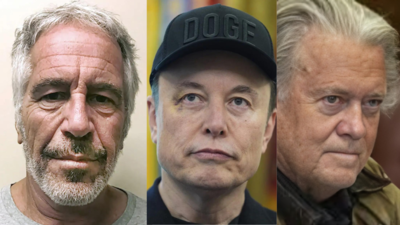
Photo: Epstein, Musk and Bannon.
Ro Khanna Is Shaken by What He’s Learned From the Epstein Files
By Ezra Klein
The New York Times
Opinion Columnist
Feb 15, 2026 - Ro Khanna’s congressional career has been an ongoing attempt to reconcile what others might see as irreconcilable. He represents a swath of Silicon Valley that includes the headquarters of Nvidia and Intel. He won his seat in 2016 with endorsements from tech titans like Sundar Pichai, Eric Schmidt and Marc Andreessen. He is, himself, one of the richest members of the House. But he is also a stalwart of the House Progressive Caucus, was the co-chair of the 2020 presidential campaign of Bernie Sanders and is backing a proposed wealth tax in California.
To Khanna, there was no contradiction here, just a single polity that had to be reminded of its common interests. “We have to make sure every American has a stake in the success of Silicon Valley, and that Silicon Valley doesn’t become an island unto itself,” he told me in 2019. “Or we’re going to see a rebellion against some of the forces that I think are good for society.” Now Khanna may have reached the end of what can be reconciled.
Pandora's box?
Back in July, Khanna, along with Representative Thomas Massie, a Kentucky Republican, introduced the Epstein Files Transparency Act. He and Massie were eventually joined by MAGA luminaries like Lauren Boebert, Marjorie Taylor Greene and Nancy Mace and together they defied President Trump and Speaker Mike Johnson and used a discharge petition to force the bill to the House floor, where it passed overwhelmingly.
With millions of files now released, Khanna sounds shaken by what he’s learned — and what he hasn’t. About 3.5 million pages of emails, text messages and court records have been released, but the government has announced that in total more than six million pages exist. What the public has seen was first reviewed and redacted by lawyers from Pam Bondi’s Department of Justice. Todd Blanche, the deputy attorney general overseeing the process, was previously one of Trump’s personal lawyers. “We still don’t have the most potent thing, which is the survivors’ statements to the F.B.I. over who raped them and who committed these acts,” Khanna told me on Tuesday.
The result is we know much more about Epstein’s network than we did before, but not much more about the crimes he committed — or who he may have committed them with. The Department of Justice and the F.B.I. say Epstein “harmed over one thousand victims.” Did he really do all of that alone, with just the help of Ghislaine Maxwell? Much of what we want to know would not have been put in emails by Epstein or his friends. “Send me a number to call I dont like records of these conversations,” Epstein wrote to Steve Tisch, the billionaire co-owner of the New York Giants. (Tisch says the women he discussed with Epstein were all adults.)
There are constant references, even in the documents we have seen, to secrets and experiences that cannot be shared. I keep thinking of the 50th birthday note to Epstein that appears to be signed by Trump: “May every day be another wonderful secret.” What were those secrets, exactly? (Trump denies writing the note.)
A network of power without boundaries, brokering information
But there is much that the Epstein files do reveal. Epstein’s network crossed the categories we’re used to using to divvy up American life. He was chummy with Noam Chomsky and Peter Thiel; with Steve Bannon and Kathryn Ruemmler, Barack Obama’s White House counsel; with Deepak Chopra and Howard Lutnick. This is not a network bounded by politics or industry or place.
I have long been mystified by how Epstein kept so many different kinds of people close, and how he did so long after he became a risk to those around him. The files, from that perspective, are clarifying. Epstein emerges as a broker of money, introductions, information — and human beings. He has a talent for sniffing out what his correspondents want most. The rich want to be taken seriously, the not-so-rich want the trappings of wealth, many of the men wanted sex and everyone wanted connections.
To read the files is to watch Epstein calibrating his correspondents’ desires in real time. In September 2013, he writes Elon Musk to say that “the opening of the general assembly has many interesting people coming to the house.” Musk is unimpressed. “Flying to NY to see UN diplomats do nothing would be an unwise use of time,” he responds. Epstein changes tack. “Do you think I am retarded,” he shoots back. “No one over 25 and all very cute.” (Musk appears to have ignored Epstein’s invitation.)
What Epstein is always offering, in all directions, is connections to the rest of his network. A 2014 email exchange with Ruemmler is particularly baldfaced. “Most girls do not have to worry about this crap,” she writes, in a conversation in which she appears to be weighing whether to accept being nominated for attorney general. What follows is a note that appears to combine Epstein joking about their shared knowledge of his abuses — he was by then a convicted sex offender — and then dangling a dazzling array of contacts.
“girls?” responds Epstein. “careful i will renew an old habit, . this week, thiel, summers, bill burns, gordon brown, jagland, ( council of europe and nobel chairman ). mongolia pres , hardeep puree ( india), boris ( gates). jabor ( qatar ). sultan ( dubai, ), kosslyn ( harvard), leon black, woody. you are a welcome guest at any.” (Ruemmler’s dry response: “Doesn’t look like you are prioritizing your schedule very effectively.”)
Epstein is constantly tossing out offers. Would Peter Thiel like to have dinner with Noam Chomsky? Would Steve Bannon like to meet Sebastian Kurz, then the chancellor of Austria? Would Ariane de Rothschild like to have dinner with Bill Gates? Would Larry Summers like to have dinner with Ehud Barak? Would Steve Tisch like to meet a woman whose name I’ll leave out, but whom Epstein describes as “tahitian speaks mostly french, exotic”?
Epstein had money — much of it scammed off others — but connections were his most universal currency. And their breadth was self-reinforcing. Plenty of people saw Epstein for what he was and stayed far away. But for others, his proximity to the rich and the powerful were evidence that whatever he had done, it couldn’t be that bad. After all, look who he was dining with! The network made Epstein both legitimate and valuable. It enabled his abuses and, for a time, insulated him from their consequences.
The Times’s investigation into Epstein’s relationship with JPMorgan Chase paints a particularly clear picture of how Epstein used his network to protect himself from potential consequences. Epstein’s pattern of cash withdrawals and transfers raised internal suspicions at the bank about sex trafficking. His conviction for soliciting a minor would seem to confirm those fears. But Epstein proved himself so valuable to JPMorgan — connecting the bank to Sultan Ahmed bin Sulayem and Sergey Brin, and helping it find its way into the hedge-fund business — that the institution overrode its own doubts to keep him as a client for years. The bank eventually cuts ties with him, but right up until the end, his internal allies were arguing that he was “still clearly well respected and trusted by some of the richest people in the world.” How could they be wrong?
“These billionaires, these superelites, these superlawyers are working on a whole different kind of system,” Anand Giridharadas, author of “Winners Take All: The Elite Charade of Changing the World,” told me. “Their system has to do with how loaded with connections you are in this network, how high your stock is on a given day in this network. What Epstein figured out was how to game this. He figured out the vulnerability of this entire network, which is that these people are actually not that serious about character. In fact, character may be a liability for some of them, may be an unnecessary source of friction.”
Rise of the Epstein class
Khanna has begun speaking of an “Epstein class,” his term for “the rich and powerful people who act and think like they’re above the law and, and perhaps above morality.” At first, I struggled a bit with Khanna’s coinage. What makes Epstein specifically loathsome is his pedophilia, and how many in his network really knew of that side of his life?
But the more I read the files, the harder I found it to deny the class solidarity evident within them. Epstein’s predilections were no secret. “It is even said that he likes beautiful women as much as I do, and many of them are on the younger side,” Trump told New York magazine — in 2002. The choice was made, by many, to overlook or disbelieve them.
In 2008, Epstein was convicted of soliciting sex from a minor. “I think the world of you and I feel hopeless and furious about what has happened,” wrote Peter Mandelson, then the European commissioner for trade. Jes Staley, then head of J.P. Morgan’s private bank, wrote to Epstein to say, “I hope you keep the island. We all may need to live there.” This was during the financial crisis. “Its ok, there is always room for all of you,” Epstein replied. (In 2023, JPMorgan sued Staley over what it claimed was his potential failure to alert the company to Epstein’s wrongdoing. The case was settled out of court for an undisclosed sum.)
In 2018, The Miami Herald published a stunning investigation that “identified about 80 women who say they were molested or otherwise sexually abused by Epstein from 2001 to 2006.” Larry Summers, the former Treasury secretary, emailed Epstein the next day: “U have returned to the press,” he wrote. They moved onto discussing other matters.
In 2019, Steve Bannon texted Epstein a link to a Daily Beast story, “Court Orders Release of Sealed Docs About Jeffrey Epstein’s Alleged Sex Ring.” Epstein doesn’t respond, at least not by text, and Bannon follows up with, “My guy is in Israel — can we connect him to erhud ???”
Epstein’s network may not have known everything, but many of them knew enough. Whether they believed his denials or didn’t care about the crimes, there was a solidarity, or at least a transactionalism, that protected Epstein and enabled his abuses.
Toward the end of our conversation, Giridharadas made a point I keep thinking about. Power and prestige were once conferred by land or title or family. But power, today, “consists of your position and your number of connections and the density and quality and lucrativeness of those connections in the network.”
How does that change the behavior of today’s elites? “I just wonder if courage is a value that has suffered in a network age, because to be courageous is to break ties,” Giridharadas continued. “And the more valuable ties become — the more exponentially valuable more ties become — the more exponentially expensive it is to cut off that tie, to burn that bridge.”
It is worth emphasizing that Epstein’s network, as broad as it was, remained narrow in the scheme of both American and global life. We have been offered a window into a particular slice of the global elite — the slice that chose to deeply associate itself with Jeffrey Epstein. We are not seeing the way the many, many people who stayed far away from Epstein comported themselves, precisely because they are not in these files.
Still, even for those who thought themselves familiar with the workings and mores of the wealthy and powerful, the files have come as a shock. For Khanna, they have forced a confrontation with the possible limits of his own project, as he understood it.
“I certainly don’t want pitchforks,” he told me. “I don’t want pitchforks even against people who are billionaires.” But, he said, “I used to think, ‘Let’s just have a positive vision of Medicare for All and child care and a Marshall Plan for America.’ I am more in the camp now that there has to be some accountability. You need people’s faith in a democratic project. And what I’m realizing is that accountability for the elite, having some sense of justice, is essential to build trust for the broader vision.” ...Read More
| | |
Video: AOC Speaks at the 62nd Munich Security Conference on 'The Rise of Populism'
What AOC Wants For The World
The overwhelming majority of her critics are vapid; but there is one potential vulnerability in her vision of a better future.
By Brian Beutler
Offmessage.net
Feb 18, 2026 - If you’ve been on the fence about breaking up with mainstream political news to support independent journalism, do me a quick favor and Google AOC + Munich. Open a new tab and do it right now. No leading words, just enter AOC + Munich and scroll the headlines.
You’ll likely notice a slight bias. We live in the Trump era, yet for some reason Democrats must meet a very high standard of gaffe-avoidance. You’ll see that establishment media (Google included) still enjoys the power to define politicians, and is simply selective about who’s subject to this kind of treatment. Alexandria Ocasio-Cortez fell short of an arbitrary bar, freeing political journalists to depict a topsy-turvy world in which one of the Democratic Party’s most articulate leaders is an incoherent amateur. Their imputation that clarity and polish are essential political skills is left unstated, because that might raise some questions about double standards.
Essentially all substantive criticism of AOC has come from the left. Her progressive critics detected a dissonance between her appeals to economic egalitarianism and her participation in a security conference of, by, and for the global elite—with all of its assumptions about the international trading system, and the defense alliances that undergird it.
“[F]or a politician that has built a progressive platform on criticism of US military interventionism and domestic policies aimed at benefitting the working class,” tut-tutted The Nation, “her presence at [the Munich security conference], widely considered to be the biggest international annual security event in the West and a major hub for hawkish military elites, seemed at first glance out of line with her values.”
In AOC’s defense, I believe these critics misapprehend the ambitious vision she drew in her remarks. But it’s important to probe the limits of that vision.
Democracy and class solidarity
What AOC wants to see in the world, apparently, is U.S. moral leadership stripped of contradictions, and sustained by global, pro-democratic class solidarity. When we fail to live up to enlightened values, we breed contempt; when democracy doesn’t deliver people a decent standard of living, they will be tempted by the false promises of strongmen. Those vulnerabilities imperil both freedom and prosperity.
It’s a highly ambitious, idealistic vision of a better future. And there’s nothing in it for most progressives to dislike. To be a little flip, it’s a two step process of, first, global class war.
“We are moving in this direction of increased recognition that we have to have a working class centered politics if we are going to succeed, and also if we are going to stave off the scourges of authoritarianism,” which she defined as “political siren calls to allure people into finding scapegoats to blame for rising economic inequality, both domestically and globally.”
…and, second, benevolent U.S. participation in the new class-conscious community of democracies.
[W]e are in a new day and in a new time. But that does not mean that the majority of Americans are ready to walk away from a rules based order, and that we're ready to walk away from our commitment to democracy. I think what we identify is that in a rules based order, hypocrisy is vulnerability, and so I think what we are seeking is a return to a rules based order that eliminates the hypocrisies around when, too often in the West, we look the other way for inconvenient populations to act out these paradoxes, whether it is kidnapping a foreign head of state, whether it is threatening our allies to colonize Greenland, whether it is looking the other way in a genocide. Hypocrisies are vulnerabilities, and they threaten democracies globally. And so I think many of us are here to say, we are here and we are ready for the next chapter, not to have the world turn to isolation, but to deepen our partnership on greater and increased commitment to integrity to our values….
When you have a rules based order where you carve out exceptions to our values, exceptions to our rules, eventually the exceptions become the rules. And I think that to your original point, over the last five years, we've seen such a breaking and such a fraying of these alleged western values that people wonder if it ever existed in the first place. So I don't know if it's necessarily that we are in a post-rules based order, I think it's possible that we were in a pre-rules based order, and we have an opportunity to explore what a world would look like if we upheld democracy, human rights, trade that actually centers working class people, instead of accruing overwhelmingly the benefits of trade to the wealthiest. But if we reoriented a new era that could actually help people and show how foreign policy and healthy foreign policy can show up and help them in their lives.
There is no tension, in this view, between an international liberal order and social democracy. She has not aligned with dread globalists at the expense of workers. She wants to forge an international popular alliance of workers and their progressive allies, to counter the bourgeoning alliance of nationalists and kleptocrats—and for the resulting governments to helm more honorable, humane alliances.
You may think this is all pie in the sky. Moving the world in this direction is the undertaking of lifetimes. But it is a good vision, and perfectly defensible.
My main question is to what extent she presents this idea in this manner because she thinks it can be fashioned into a strong domestic and international political appeal, and to what extent she actually believes the underlying analysis—that fascism is an outgrowth of working class economic disaffection, and thus that economic policy is our best weapon in the fight against authoritarianism.
To my mind, it’s a strong, high-brow appeal, and a good guide star for the people who will build the future. It does not, however, strike me as an accurate assessment of the social underpinnings of authoritarianism, and would thus be a poor guide star for the more immediate challenge of defeating fascism.
This is a tricky dance for left-leaning politicians, because the politics of rules, norms, and democracy have become viewed with suspicion and contempt, particularly on the left. In shorthand, leftists want to wage class war, but get thwarted by sell-out centrists who appeal to norms and rules as a crutch, because they can’t admit that their governing ideas are too milquetoast to appeal widely. The reality is a bit different. Leftists and centrists alike believe anti-Trump politics have failed, and should be jettisoned, in favor of economic appeals. Leftists believe this for Marxist reasons; centrists believe it because they spend the most time listening to pollsters. But as a tactical matter, they agree.
In between and all around these two factions are idealists and optimists (myself included) who think democracy must be protected—first and on its own terms—because democracy is prior to everything else, and humans clearly form politics on the basis of more than just their bank accounts. It’s an argument about sequencing and priorities, and the power of abstract appeals, rather than the substance of any policy.
AOC’s left-wing critics have little interest in U.S.-led global anything and wish she would stick to domestic egalitarianism. Our view is that beating fascists and holding them accountable is a predicate to everything, and that this is now a global challenge: What work does left-populist economic rhetoric or policymaking do in societies where rightists control all the levers of power and won’t give them up without a fight?
Donald Trump has been effectively disciplined by bond traders, and, in his most fascist adventure, the community of freedom-loving people in Minneapolis. Not by increasing class consciousness. It’s true that Trump has quickly squandered the cross-racial working-class support he built in 2024, but there’s good reason to believe these voters have defected not simply because he broke his economic promises. They walked away because his whole schtick is an affront to liberty and decency, without any upside.
In our view, authoritarianism must be crushed using every available means, if we are to make the world safe again for egalitarian policymaking. I think AOC is trying to signal solidarity with us, but not agreement. In her telling, economic egalitarianism must come first, and it will usher people away from authoritarianism on its own.
To see things that way, you have to believe MAGA and the rise of far right parties throughout the democratic world are principally economic phenomena, and that defeating them is a matter of fixing what’s broken about economic policies—at which point the allure of conspiracy theories and hatreds will ebb.
It is a commonly held view. There is much, much less evidence for it than I’d like there to be:
- We’ve lived through worse economies that did not prefigure the rise of global fascism.
- We just experienced Biden’s economy, which did more to compress inequality than most people realize, faster than almost anyone thought possible, and it did not create cross-racial class solidarity. Indeed, it prefigured a swing of working-class people of color toward the GOP.
- The appeal of far-right politics has grown even in social democracies, notwithstanding their robust safety nets and benefit systems.
- The one variable that changed everywhere all at once is the proliferation of disruptive new information technology.
Convincing people that the future can and will be better actually is an essential component of politics, much more so than clarity and polish in extemporaneous speaking. Trump probably couldn’t muster the phrase “strategic ambiguity” from memory, let alone explain its importance, but he promises a return to greatness in just about every public appearance.
In that sense, an optimistic vision can help political talents like AOC draw popular support. But to succeed—to stem the tide of authoritarianism—they will need to increase mass consciousness of the poisonous effects of algorithmic media, including of A.I. technologies that proliferate fabrications and incitement at industrial scale. At the very least, we need people around the world to become better at compartmentalizing internet and non-internet, and to be clear that only the latter should serve as a guide to politics.
More likely, we’ll need these companies to flounder and fail or respect constraints, as they become viewed with greater contempt. Through boycott we can harm them. Through taxes we can limit their power and gain some restitution. If their greed crashes the economy, populist anger can be marshaled against them. But the politics will be tricky because while awareness of social-media ills is widespread, so is its use. Biden waged hostilities against tech platforms, and it did not endear him to anyone. It took much more than mass awareness of the dangers of smoking cigarettes to really put the screws to tobacco companies. Most people surely know that drinking alcohol is unhealthy, but neo-prohibitionism, or even just support for a hefty alcohol tax, would be an extremely dicey political proposition.
The point, though, is that various kinds of direct confrontation with the forces fanning authoritarianism will be necessary. Criminals will need to go to jail; collaborators will need to be exposed; their best tools will need to be confiscated. We can’t count on fiscal and regulatory policy—from the left, center, or parts in between—to do that work for us, because our luck will eventually run out. We’ll have a recession, or stumble a bit as we build out imperfect new systems of income and wealth distribution. And evil will be ready to pounce. ...Read More
| | |
Photo: ICE agents attempt to confirm two men’s legal immigration status after pulling them over on Bottineau Boulevard near 35th Avenue W. in Robbinsdale on Feb. 11. (Alex Kormann/The Minnesota Star Tribune)
Trump’s Immigration Crackdown Has Democrats
Wrestling With ‘Abolish ICE’ Movement
Rep. Ilhan Omar says Immigration and Customs Enforcement should be eliminated as an agency after what happened in Minnesota. Her fellow Democrats in Congress are declining to go that far.
By Sydney Kashiwagi
The Minnesota Star Tribune
February 17, 2026 - As President Donald Trump’s immigration surge in Minnesota winds down, it’s revived a thorny debate among Democrats in Washington: whether to eliminate the 23-year-old agency at the center of the crackdown.
Among those leading the push to “abolish ICE” — short for Immigration and Customs Enforcement — is progressive Rep. Ilhan Omar, who said “the moment demands it” after thousands of federal agents flooded the state for Operation Metro Surge and two Minnesotans were killed.
“Holding lawbreaking ICE agents legally accountable is the bare minimum,” Omar said during a news conference at Karmel Mall in Minneapolis in late January. “We must abolish ICE.”
The debate comes as Congress is grappling with the fallout from the six-week operation in Minnesota. Democrats have been united in opposing additional funding for the Department of Homeland Security until changes are made to the agency, including requiring ICE agents to unmask and wear identification. Some want to see DHS Secretary Kristi Noem impeached. The agency shut down last weekend after lawmakers went into recess without passing a funding bill.
The idea of abolishing ICE, which surfaced during Trump’s first term, is again gaining steam among progressives in response to the aggressive tactics used by agents in Minneapolis.
But Democrats are far from united on whether ICE should be abolished. Concerns about border security helped deliver Trump a second term, and some worry Republicans could try to tie all Democrats to the slogan much as they did with “defund the police.”
“The Republicans have been able to weaponize these kinds of slogans before and make it seem like all Democrats think that there should not be any immigration enforcement,” said Lanae Erickson, a senior vice president of the centrist think tank Third Way.
“If certain very loud Democrats overplay this moment and take it to a place that flips it politically, that could be tied to all Democratic candidates in 2026.”
Many say reform, not abolish ICE
Elianne Farhat, the co-executive director of TakeAction Minnesota, a group that supports progressive candidates in the state, said “calls to abolish ICE are going to be top of mind for any voter and it’s impossible for it not to be.”
Omar’s deeply Democratic district includes Minneapolis, which was at the center of Trump’s immigration enforcement operation. She said her push to abolish the agency aligns with her constituents and “I feel comfortable in that call.”
The rest of Minnesota’s Democratic delegation in Congress have stopped short of fully embracing calls to abolish ICE, even if most want major changes to the agency. ...Read More
| | |
Our Weekly Roundup of ICE Protests
Photo Above: At least a dozen Democrats in Congress are skipping the address to instead attend the “People’s State of the Union” rally at 8:30 p.m. ET. Trump’s speech is scheduled for 9 p.m.
Why It Matters: The planned demonstration reflects widening partisan tensions as the high-profile event comes amid a shutdown of the Department of Homeland Security (DHS) and a standoff over immigration policy, after immigration agents fatally shot two U.S. citizens in Minnesota last month... ....from Susan Weiss, right.
| | |
Photo below from Charlottesville, Virginia: Demonstrators clogged the checkout lines at a Target store in Virginia, using a single symbolic purchase to protest the Trump administration’s immigration crackdown. The grassroots activist group ‘Indivisible Charlottesville’ organized the “shop-in” on Valentine’s Day at a store in the city.
Photos from inside the retail store depict lines of shoppers whose carts were brimmed with salt containers — a clear nod to salt's power to melt ice. After paying, the shoppers subsequently returned the items. Many demonstrators also held signs criticizing U.S. Immigration and Customs Enforcement and Target.
Video Far Below: Eyewitness News ABC7NY NY high school students protest ICE anti-immigration efforts...Crystal Cranmore has more on the protests across New York from Foley Square.
| | |
Photo: MILAN, ITALY - JUNE 30: Bruce Springsteen performs with Nils Lofgren and Stevie Van Zandt of The E Street Band at Stadio San Siro on June 30, 2025 in Milan, Italy. (Photo by Sergione Infuso/Corbis via Getty Images)
Bruce Springsteen and the E Street Band Announce ‘Land of Hope and Dreams’ U.S. Tour
'We are living through dark, disturbing and dangerous times, but do not despair — the cavalry is coming!' Springsteen says in a statement
By Andy Greene
Rolling Stone
February 17, 2026 - Bruce Springsteen and the E Street Band are bringing their politically charged Land of Hope and Dreams tour to North America in the spring for a run of arena and stadium dates. It kicks off March 31 in Minneapolis at the Target Center, and wraps up May 27 at Nationals Park in Washington, D.C. Ticket sales start on Friday.
“We are living through dark, disturbing and dangerous times, but do not despair — the cavalry is coming!” Springsteen says in a statement.
“Bruce Springsteen and The E Street Band will be taking the stage this spring from Minneapolis to California to Texas to Washington, D.C. for the Land of Hope And Dreams American Tour. We will be rocking your town in celebration and in defense of America — American democracy, American freedom, our American Constitution and our sacred American dream — all of which are under attack by our wannabe king and his rogue government in Washington, D.C.
Everyone, regardless of where you stand or what you believe in, is welcome — so come on out and join the United Free Republic of E Street Nation for an American spring of Rock ‘n’ Rebellion! I’ll see you there!”
Last summer, Springsteen and the E Street Band played stadiums in Europe on the initial leg of the Land of Hope and Dreams Tour. “The mighty E Street Band is here tonight to call upon the righteous power of art, of music, of rock & roll, in dangerous times,” he told the crowd on opening night. “In my home, the America I love, the America I’ve written about, and has been a beacon of hope and liberty for 250 years, is currently in the hands of a corrupt, incompetent, and treasonous administration. Tonight, we ask all who believe in democracy and the best of our American experience to rise with us, raise your voices against the authoritarianism, and let freedom ring. This is ‘Land of Hope and Dreams.’”
This took place before Donald Trump flooded Minneapolis with ICE officers, resulting in the deaths of Renee Good and Alex Pretti. Springsteen responded to the tragedies with the protest song “Streets of Minneapolis,” which he performed Jan. 30 during a surprise appearance at Tom Morello’s A Concert of Solidarity & Resistance to Defend Minnesota! at the Minneapolis club First Avenue. ...Read More
| | |
Illustration by Hayne Park (WNV)
The Two Reflexes That Are Breaking The Left
Values keep movements honest, while a material approach gets results, and there’s a time and place for both.
Bt Mehran Khalili
Waging Nonviolence
Jan 27, 2026 - Last November, I watched the livestream of the founding conference of Your Party, a new left political force in the U.K. And it was chaotic in a way I found nauseatingly familiar, with boycotts, expulsions, procedural fights and “points of order” giving way to rants and finger-pointing, microphones being cut off and howls of “let them speak!”
It was familiar because after years in left-wing organizing, I’ve come to think of this behavior as just part of how meetings are. Not only the stuff that happens in person, but the forum wars, the snark in comments sections, the quiet fights that slowly poison groups until they collapse.
But I’ve realized only recently that at the core of these disagreements lies the same divide. You can see versions of it across the political spectrum, but the left depends so heavily on meetings, norms and moral language that the damage is especially visible there. I’m talking about a tension in how we approach politics: Do we start from values, or from material conditions?
These aren’t two distinct “types” of left-wing activists; most of us can do both. Values and material gains are both vital for any left project, and a particular person may prioritize a values-first or a material-first approach depending on the topic.
The deciding factor is what you reach for under pressure. What you prioritize, instinctively, when you’re angry, scared, fighting an asymmetric battle against power, or just trying to get through the next meeting.
So, keeping that nuance in mind, let me try — as a material-firster — to describe these two reflexes, what they contribute to the work of activism and how, if not managed, they can harden into factions and mess everything up.
Values-first: keeping movements honest
A values-first reflex starts from the question of who is being harmed. It’s mainly concerned with ensuring everyone is treated equally and with dignity. (For a time people called this reflex “wokeness.” Since that word has become so loaded, I don’t find it useful.)
Values-first people tend to see bigotry — racism, sexism, Islamophobia, antisemitism and the rest — as part of how power reproduces itself. They worry, with good reason, that once you soften language about who belongs, or “compromise” on basic dignity, you normalize exclusion. And that the same groups always end up losing out.
Values-first people help keep left projects honest. They’re often the ones who notice double standards early, who catch the moment where “strategy” turns into abandoning your principles, and who insist that “winning” without equal treatment isn’t winning.
This reflex fails, though, when values-first becomes a social system. When language becomes the main battleground, and people gain status with their peers by spotting flaws in what someone else has said, declaring harm, and forcing an apology. We’ve all seen it: the purity tests and the unfounded accusations and the public shaming that can make fair questions sound like malice, and disagreement feel like betrayal. And soon, you end up with another kind of exclusion: with in-groups and out-groups forming based on who might be “problematic.”
In many activism and media spaces, this reflex became strong in the late 2010s. It has lost its steam, but it’s still present today.
Material-first: getting movements results
A material-first reflex starts from a different set of questions: What is daily life like for most people, what is pushing them politically, and what would actually make life fairer?
Material-first people look at rent, wages, bills, jobs, broken services, the feeling that those in power aren’t doing the basics. They’re concerned with strategy, persuasion and coalitions. Not because they’re cynical, but because they don’t believe you can protect anyone without first building power.
They don’t deny racism or scapegoating. They just think the fight is harder when people who are suffering feel insecure and abandoned. And they recognize that when the left refuses to talk about everyday life in plain terms, the public becomes more receptive to the simple explanations — and scapegoats — offered by the far right.
The material-first reflex helps ensure that a left project can deliver results for most people. But if it’s not kept in check, it can lead to that project never taking a clear stand, losing its moral compass, and turning the concept of “winning” into compromises that exclude the most vulnerable. You see it when a party wins on rents and wages, then copies right-wing lines on migration to look “tough” — and ends up punishing people who already have the least protection.
The bottom line is that any serious left project needs both reflexes. Most people ultimately want the same thing — a decent life, fair treatment and a future where the game doesn’t feel rigged. But these two reflexes disagree on the fundamentals: what’s causing the problem and what it takes to fix it.
And yes, in leftist activism, those disagreements can turn organizational life into hell.
The dark pattern in today’s big political fights
These two reflexes collide in almost every part of left organizing.
Take some of the major crises of the last few years. On Ukraine, for example, the split shows up in what people are willing to accept. One side can’t stand rewarding invasion or treating Ukrainian lives as bargaining chips. The other can’t stomach open-ended war or the risk of nuclear escalation, and they’re bothered by leaders who treat diplomacy as moral weakness — as if calling for talks is the same as surrender.
A similar dynamic can be seen with the response to COVID-19. Deep into the pandemic, values-first people prioritized protecting the vulnerable and collective responsibility (and often, getting everyone vaccinated). Material-first people focused on what lockdowns and mandates did to livelihoods, social trust, mental health and civil liberties — and worried that once the state learns it can do something, it rarely unlearns it.
On climate, the split is less about whether to act and more about how. One side leads with moral urgency and the language of emergency; the other leads with whether the transition can be made materially tolerable and broadly consented to.
On Palestine, these two reflexes have been more aligned than not — because the horror is so plain, and the machinery enabling it is visible. But they see the genocide through different frames. Values-first people focus on the human rights violation, and the racism and crushing double standards in how Western leaders talk about Palestinian lives. Material-first people take a broader view, focusing on the interests and alliances that are driving the genocide, and the way Western power works.
The same pattern in tactics and process
But the split isn’t just about policy disagreements. These two reflexes also clash on the mechanics of activism: theories of change, tactics, messaging priorities and even internal management styles.
On censorship: Values-first people are keen to push institutions to limit hateful speech because they see speech as a tool that can produce real harm. Material-first people are more likely to resist restrictions, because restrictions tend to expand — and then get used against dissent.
On the far right: Should we ban anti-democratic far-right parties from running (values-first), or beat them at the ballot box (material-first)?
On general political strategy: Should we set clear moral red lines (values-first), or try to win over as many persuadable people as possible — even if that means adjusting our language (material-first)?
On decision-making: Should we have clear roles for quicker decisions (material-first), or take a values-first approach and make sure everyone has a say, even if it slows things down (values-first)?
This brings me back to the Your Party mess. Its two co-leaders have different reflexes: Zarah Sultana and her wing read as values-first; Jeremy Corbyn and his crew as material-first. That split showed up immediately: on the eve of the conference, some members/delegates were expelled over alleged dual membership of other left groups (notably the Socialist Workers Party), and Sultana boycotted the opening day in protest, calling it a “witch hunt.”
Once you have that split at the top, the divide tends to follow a familiar path: Factions form, and every procedural dispute becomes a proxy war over what kind of left project Your Party is meant to be.
A glimpse of how it could work
So what can we do? With everything else going wrong, can’t we avoid sabotaging ourselves?
There’s at least one example of a left project that won by holding these reflexes together without letting either one take over the whole operation: the recent election of Zohran Mamdani as New York’s mayor. Mamdani didn’t hide his Muslim identity; he answered identity-targeted attacks head-on, and he called out racism when he saw it. But he also kept pivoting, relentlessly, to a simple material pitch: affordability. He spoke in a way that material-first people recognized as serious, while still meeting values-first people on dignity and equal treatment (the memes when he won included “Woke is Back”).
What mattered in his campaign wasn’t just content — it was internal discipline. Mamdani’s bid had a tight message, an emphasis on practical delivery over performances of righteousness, and a team that understood that coalitions don’t hold themselves together — you have to run them, consciously, every day.
The question, of course, is whether that will hold now that he’s in office — and it’s already being asked. Winning is one skill; governing, while keeping your own side from turning on itself, is another.
Zack Polanski of the Greens is also trying a version of this in the U.K. In a recent clip, when accused of wanting open borders, he first concedes the moral baseline (“in an ideal world, yes, but we don’t live in that world”). And then he pivots to the lived reality for most people — housing, hospitals, wages — while insisting the real enemy is austerity, not migrants. He’s attempting to hold the language of dignity, without sounding like he’s ignoring pressure on services and how people feel about it.
I’m not sure it will work. For one thing, this line isn’t as easy to chant as a far-right pitch. But it’s at least an attempt to talk like someone who wants to win rather than simply be right.
Why “bridging” inside organizations keeps failing
However, I’m skeptical about trying to fold these two reflexes into one internal culture. Everything I’ve seen suggests that when you try, they end up either in open conflict or in a kind of permanent, low-level tension, just waiting for the right setting to explode.
One reflex will have to lead — and for me that has to be material-first.
I believe this not because dignity is optional, but because power is not optional. We’re organizing to persuade, to improve daily life for most people, and we need power to do it. I just can’t see a path to power for a project driven by the values-first reflex.
Because as we’ve seen again and again, when a values-first approach is unchecked in day-to-day organizing, when it becomes an internal culture, it burns up a lot of activist energy — on process and meetings, on purity tests and status games. It ties everything in knots. It kills trust between activists.
And so, as someone who wants the left to stop being its own worst enemy, here’s what I’d propose:
Material-first leads the public offer, the outward-facing communications: the systems we will fix, the guarantees we will make, the concrete improvements people can hold us to. Values-first protects the baseline: equal treatment, no scapegoating, no casual cruelty, no treating “winning” as permission to discard people. Set a small number of non-negotiables, and mean them.
That’s where I’m landing so far. If you think I’m wrong, tell me where. But please, tell me in a way that makes you sound like someone who actually wants to win. ...Read More
Mehran Khalili is a political consultant and organizer based in Athens, Greece. He writes Subvrt, a newsletter on practical organizing, and works with DiEM25, where he produces and hosts public conversations on how to confront power. He has advised movements and NGOs, and has run grassroots campaigns in Greece. After hours, he makes black-and-white photographs.
| | |
Photos: Discoloured waterways in Alaska and Siberia © UC Davis/Google Earth
Why Rivers in the Far North Are Turning Orange
Hint: Climate Change is not a hoax. The brightly coloured waterways in the Arctic are a sign that permafrost is thawing, with potentially hazardous consequences
By Eva Xiao in New York,
Jana Tauschinski and
Justine Williams in London
Financial Times
FEB 17 2026 - In Alaska’s Brooks Range, a wilderness of rugged peaks and crystalline rivers just north of the Arctic Circle, a strange new force is blighting the landscape.
Bright orange water is flowing through rivers in quantities visible from outer space. As with wastewater from mines, the rust-orange colour comes from iron that dissolves after exposure to acidic water. But in this case, mining isn’t the culprit, it’s global warming.
“I’ve been most startled by the spatial extent,” says Brett Poulin, a scientist at the University of California, Davis who studies “rusting” rivers. “And there’s no way to stop it,” he adds. “Once it starts, it just starts.”
The phenomenon has been observed across the far-flung corners of the Arctic. In northwestern Canada, researchers have found rivers with the same orange colouring. Satellite imagery analysed by the FT and confirmed by experts at the University of Alaska and the Alfred Wegener Institute — a German research centre that regularly collaborated with researchers in Russia until the Ukraine war — has also revealed probable rusting rivers in Siberia.
In the Brooks Range alone, scientists working with bush pilots, park rangers and other locals highlighted more than 200 rusting waterways last year.
Iron is not the only metal washing through. Manganese and nickel levels are rising in some of the affected rivers. Dissolved aluminium is also turning rivers white outside of the Arctic in the European Alps and the Pyrenees mountains.
Beyond the local impact of metal-laden rivers, the phenomenon is a harbinger of a much larger and troubling problem. In many of the affected rivers, scientists have identified thawing permafrost as a key factor.
Permafrost, or ground that is frozen for at least two consecutive years, can contain organic materials and minerals. When permafrost thaws, it can set off a chemical reaction that causes metals to leach into water systems.
Thawing permafrost can also gradually but continuously release greenhouse gases such as carbon and methane into the atmosphere as microbes — otherwise dormant in the frozen ground — break down organic material, says Christina Schaedel, senior research scientist at the Woodwell Climate Research Center in Massachusetts.
The Arctic Institute, a non-profit organisation based in Washington, estimates the world’s reserves of permafrost contain up to 1.7tn tonnes of carbon, or about 45 times the emissions from all countries in 2024.
By 2100, near-surface permafrost, or the upper 3 to 4 metres of frozen ground, will be nearly gone, scientists estimate. The release of carbon from permafrost is expected to worsen global warming — and with it, wildfires, flooding and land collapse in polar regions — which in turn will cause more of the frozen earth to thaw.
“It’s not dwarfing our human emissions,” Schaedel emphasises. But it is a process that will continue even if warming slows: “We’re committing future generations to additional carbon loss from permafrost.”
In the Arctic, the past 10 years have been the warmest decade on record, with 2025 hitting a record low in winter sea ice in the 47-year satellite record, according to an annual report by the US National Oceanic and Atmospheric Administration last year.
Currently, the world is on track to hit 1.5C of global warming above pre-industrial levels by 2030, a decade earlier than previously thought, according to the EU’s Earth observation service Copernicus in January, as emissions stemming from burning of fossil fuels continue to rise.
If that key threshold is crossed, scientists believe irreversible changes to the planet will kick in, endangering economic growth, water supplies and human health. The metal-laced rivers are an example of what scientists warn will occur across Earth’s systems.
“If people say climate change is a hoax, then send them to Abisko, then they can actually follow it with their own eyes,” says Andreas Kappler from the University of Tübingen, referring to a tiny Swedish village where he has studied permafrost.
Pointing to research published in the late 2000s, Kappler said at that time there were researchers who thought permafrost in Abisko, which sits above the Arctic Circle, would last until 2050. “Now they estimate maybe 2030, 2035.”
“It’s too late to reverse this,” he adds. “This permafrost region will disappear. I think this is very, very clear.”
The phenomenon of rusting rivers is not always driven by climate change; mining can cause metals to leach into water. In other places, dissolved metals have flowed for so long that the phenomenon is reflected in the river’s name, such as Canada’s Arctic Red River or Tsiigehnjik in the indigenous Gwich’in language, which means “iron river.”
But as temperatures rise, especially in the Arctic — which is warming more than two times faster than the global average — the chemical reaction behind rust-coloured rivers is occurring in new places.
Thawed permafrost and melting glaciers can expose previously inaccessible minerals to water and oxidants, such as oxygen. If sulphide minerals, namely pyrite — the most common one — are present, a chemical reaction creates sulphuric acid, which then changes the pH of the water. More acidic water dissolves metals from the minerals.
Microbes once warmed and reactivated may further accelerate this process, known as acid rock drainage.
Joel Hibbard, who runs the touring company Nahanni River Adventures & Canadian River Expeditions, first came across rusty water when hiking in Canada’s Northwest Territories in 2016. He had stopped at a familiar spot for hydrating, but that day the typically clear water was orange. “It had a really metallic taste to it,” Hibbard says.
Since then, staff have encountered more rust-coloured rivers and Hibbard has stopped taking tourists to affected areas until the company knows more. A team of Canadian researchers has flagged to Hibbard the high and potentially unsafe levels of manganese and cadmium in some rivers.
“I don’t know what will happen,” says Hibbard, who worries about the impact the water could have on local wildlife, communities and his business if it persists. “We’ve always prided ourselves on a leave-no-trace ethos — and now it’s the land that is pushing us away.”
In Switzerland, Christoph Wanner from the University of Bern first became aware of white-tinted rivers resulting from acid rock drainage more than 15 years ago. At the time, a local hunter had tipped off his student, who then brought a whitened rock from the mountains back to the university.
Iron requires more acidic water to dissolve, whereas aluminium, the metal creating chalky-white residue in rivers in the European Alps, dissolves in less acidic conditions, Wanner explains. “The rock has to be right. It doesn’t happen in all the geological formations,” he says.
Local conditions, such as water flow and geology, also determine the severity and duration of metal seepage into waterways. Rivers that initially run bright orange may become more diluted over time, while others may deepen in colour.
On the Wildspitze, the second highest mountain in Austria, levels of nickel have surpassed water quality limits in some areas as temperatures rise.
“Acid rock drainage in our working area was quite a surprise for me,” says Peter Rose, managing director at Hydroisotop GmbH, a company that operates an environmental laboratory. In 2024, the lab installed water filters at one mountain refuge, which involved hiking up the terrain with large metal tanks.
At one spot, the concentration of nickel in the water had nearly doubled from 64 micrograms per litre to 110 between August 2023 and 2025, says Rose. The maximum level of nickel allowed in natural mineral drinking water according to EU rules is 20 micrograms per litre. The drinking water for the hostels comes from nearby glaciers, explains Rose, which are “melting at a progressing rate, quicker and quicker”... ...Read More
| | |
Photo: Columbia University students and faculty protest the university's concessions to U.S. President Donald Trump in New York on March 24. Barry Williams/New York Daily News/Tribune News Service via Getty Images
Resistance Comes to Higher Education:
or Watch How The 'Long March' Unfolds
Trump’s threat to revoke universities’ accreditation meets a political and legal dead-end.
By Robert Kuttner
The American Prospect
The threat of lifting accreditation is a favorite weapon in Trump’s war against universities. Without accreditation, universities can’t get direct federal education aid, research grants, Pell Grants, or student loans. Basically, they would have to capitulate to Trump’s blackmail or close their doors.
Trump has referred to accreditation as his secret weapon. “When I return to the White House, I will fire the radical Left accreditors that have allowed our colleges to become dominated by Marxist maniacs and lunatics,” he said in a July 2023 campaign video. “We will then accept applications for new accreditors who will impose real standards on colleges once again and once and for all.”
Central to the administration’s strategy is to use a history of DEI requirements as the basis for lifting accreditation. As Trump ally Robert Eitel, president of the Defense of Freedom Institute, wrote in a Tuesday op-ed in The Washington Post, “The good news is that the Education Department is on strong legal footing if it were to withdraw recognition from accreditors whose standards steer institutions to discriminatory behavior and policies,” namely DEI. (So much for Jeff Bezos’s pledge that Post op-eds would defend personal liberties.)
But in fact, the good news is nothing of the sort. Trump is all bluster and bluff.
Despite Trump’s saber-rattling, the process of withdrawing Education Department recognition of an accreditation agency is laborious. Nor can the government compel an outside agency to discredit a university.
All of these safeguards represent the administrative state and the separate protections of civil society at their best. The stubborn realities of due process are why Trump and his allies want to destroy the “deep state.”
Removing accreditation from even a fraudulent university is a drawn-out process, and cases often end up in court. Amazingly, the University of Phoenix, which settled a false advertising case with the FTC for $191 million, is still accredited, as are several other dubious for-profit universities. (These other flaws in the accreditation process are their own story, but not for the reasons Trump claims.)
Last month, in a Federal Register Notice, the Education Department proposed to make it easier for new accrediting agencies to win recognition, and for colleges to switch accreditors. But the process it proposes is a gradual and consensual one, and the Department recognizes that it can’t force colleges to switch accreditors. It is a far cry from Trump’s fantasies. The Department recognized these realities when it termed its proposed process a “negotiated rulemaking.”
Meanwhile, the series of threats against universities has awakened a sleeping giant. After an early round of blackmail, in which Trump picked off universities one at a time, most shamefully Columbia, more and more universities have appreciated that giving into blackmail never works. Harvard, in spite of itself, has been resisting, and winning, in court.
Now, major universities and other higher education organizations have come together to found the Alliance for Higher Education and the Emergency Campaign to Support Higher Education. In late January they held an inaugural meeting, fittingly called Moving Out of Defense. Pushing back on Trump’s accreditation threats will be a key project.
It took universities a while to realize their collective power. The more they move out of defense, the less likely it is that Trump will be able to coerce them one at a time. When the story is finally written of how America contained and then reversed the predations of Trumpism, the role of energized civil society will be a key chapter. ...Read More
| | |
The Cult of Physical Superiority
Why the new masculinity movement is setting kids up for lifelong damage
By Adam Kinzinger
adamkinzinger.substack.com
Feb 18, 2026 - I read a story this morning HERE that I haven’t been able to shake. Not because it was shocking — we’ve almost lost the ability to be shocked — but because it felt familiar, like noticing a warning light that’s been blinking for a long time and finally realizing what it means.
It described a young internet figure who built a following around something called “looksmaxxing.” Most adults over 35 have never heard the term, but millions of teenagers instantly recognize it. The premise is simple and deeply corrosive: your value as a human being is determined primarily by your physical appearance, and every decision in your life should be oriented toward maximizing it. This doesn’t mean ordinary self-care or staying healthy. It means extreme and sometimes dangerous behavior framed as discipline — obsessive comparison, starvation cycles, steroid use, surgical fixation, and the belief that personality, kindness, or character are secondary traits at best.
The disturbing part isn’t only the physical obsession. It’s the philosophy underneath. This culture reduces human beings into ranked categories of worth. Women are discussed as targets to acquire rather than people to know. Personality is treated as a weakness. Working on emotional intelligence or empathy is mocked as failure. In these communities, the central belief is that dominance determines value, and appearance determines dominance.
If that sounds ancient and ugly, it’s because it is. History periodically produces movements obsessed with categorizing people into biological worthiness. They always use new language — science, realism, strength, order — but the core idea never changes. Some people matter more than others, and you can tell by looking at them.
Here’s the uncomfortable truth. The backlash against “wokeism” did not only correct excesses. In certain spaces it overshot entirely and revived the worst instincts we’ve had before. Instead of the principle that immutable traits shouldn’t define human value, the pendulum swung toward the idea that immutable traits are the only things that define value. Instead of character, the focus became dominance. Instead of empathy, humiliation became entertainment.
What’s emerging online, particularly among young men, is not confidence culture. It’s control culture. The so-called alpha movement isn’t centered on health, responsibility, or maturity. It’s about power over others, particularly women. Strength is no longer framed as the ability to protect or provide stability, but as the ability to manipulate and rank people socially.
Now imagine being fifteen years old inside that environment. You’re told your face determines your worth. Your value is measured publicly and constantly. Your masculinity is defined as domination. Your personality is treated as weakness. Relationships are described as conquest strategies rather than human connection. The people delivering these messages profit directly from insecurity, and insecurity spreads quickly because it’s emotionally contagious and algorithmically rewarded.
We are placing absolutely unbearable and unachievable burdens on a generation that already lives under permanent comparison. Previous generations worried about popularity within a school. Today’s kids exist inside a global scoreboard that never turns off. The expectation is no longer to grow into a good person; it is to optimize yourself into a product.
Adults are largely sleepwalking through this because it arrives packaged as self-improvement, fitness, or dating advice. But the messaging underneath is profoundly different. It is not about becoming healthier. It is about becoming superior. It is not about confidence. It is about hierarchy.
There is a strange irony in all of this. The political figure (Trump) whose cultural energy often fuels this worldview does not personally embody the physical ideals being worshipped, yet still inspires a cult centered around physical superiority. That contradiction reveals the truth: this movement was never really about fitness. It is grievance dressed up as biology.
The long-term cost will not just be online arguments. We are shaping a generation that will spend decades untangling psychological damage — men taught they are worthless unless dominant, women taught they are objects to be optimized, and both taught relationships are transactional. That does not create stronger families or healthier communities. It creates isolation and distrust.
There is nothing inherently wrong with caring about appearance, exercising, or even cosmetic procedures. Humans have always cared how they present themselves. The danger comes when appearance replaces character as the primary measure of worth. Physical beauty inevitably changes with age. Character is the one trait that compounds over time. A culture that reverses those priorities sets people up to build their identity on something guaranteed to fade.
We cannot dismiss this as just another internet phase. This is a worldview forming in real time, and it ranks human beings by perceived biological value. History has repeatedly shown where that logic leads.
The response doesn’t need to be hysterical, but it does need to be intentional. Kids need models of discipline without cruelty, strength without domination, confidence without contempt, and attraction without dehumanization. They need to see that reliability, honesty, and empathy are not weaknesses but foundations for real stability in life.
If we fail to re-center those values now, the next generation will inherit more than our political divisions. They will inherit psychological scars reinforced every day by the systems shaping how they see themselves and each other. ...Read More
Adam D. Kinzinger served in the United States House of Representatives from 2011 to 2023, representing Illinois’ 16th Congressional District. During his tenure, he was a member of the House Select Committee to Investigate the January 6th attack on the United States Capitol, as well as the House Committee on Energy and Commerce and the House Foreign Affairs Committee.
| | WHAT CBS DIDN'T WANT YOU TO HEAR: Stephen Colbert hosts Texas State Rep. James Talarico for an online-exclusive interview that touches on the issues raised in Talarico's campaign for the Democratic nomination for Senate including the separation of church and state, the dangers of consolidated corporate-owned media, and the fabricated culture wars pushed by Republicans in states like Texas. If you're curious why this interview with James Talarico was an online-exclusive, click here. | | |
New Journals and Books for Radical Education...
Use Changemaker for Your Holiday Gifts,
Thus Lending Us a Hand, Too!
| | |
From Upton
Sinclair's 'Goose Step' to the Neoliberal University
Essays on the Ongoing Transformation of Higher Education
By Daniel Morris
and Harry Targ
Paperback USD 17.00
This is a unique collection of 15 essays by two Purdue University professors who use their institution as a case-in-point study of the changing nature of the American 'multiversity.' They take a book from an earlier time, Upton Sinclair's 'The Goose-Step A Study of American Education' from 1923, which exposed the capitalist corruption of the ivory tower back then and brought it up to date with more far-reaching changes today. time. They also include, as an appendix, a 1967 essay by SDS leader Carl Davidson, who broke some of the original ground on the subject.
Click HERE to Purchase
| |
The Man Who Changed Colors
By Bill Fletcher, Jr.
When a dockworker falls to his death under strange circumstances, investigative journalist David Gomes is on the case. His dogged pursuit of the truth puts his life in danger and upends the scrappy Cape Cod newspaper he works for.
Spend a season on the Cape with this gripping, provocative tale that delves into the
complicated relationships between Cape Verdean Americans and African Americans, Portuguese fascist gangs, and abusive shipyard working conditions. From the author of The Man Who Fell From The Sky.
“Bill Fletcher is a truth seeker and a truth teller – even when he’s writing fiction. Not unlike Bill, his character David Gomes is willing to put his life and career in peril to expose the truth. A thrilling read!” − Tavis Smiley, Broadcaster & NY TIMES Bestselling Author
| | |
New Studies on the Left, November 2025
Paperback $14.95
...is a journal of socialist theory and practice. It is the successor to ‘Dialogue and Initiative, published as an annual journal of the Committees of Correspondence for Democracy and Socialism in book form from 2012 to 2022.
It will continue the CCDS policy of left unity, including articles with a variety of left perspectives, including debates.
This issue contains a dozen articles grouped under the headings of Analysis and Global Reach, Electoral campaigns, and Book Reviews. Some are reprinted from other sources, but many appear here for the first time.
Among the authors are Carl Davidson, Jay Jurie, Paul Krehbiel, Rod Such, Harry Targ, Janet Tucker and Meta Van Sickle.
Click HERE to purchase
| |
A China Reader
Edited by Duncan McFarland
A project of the CCDS Socialist Education Project & Online University of the Left
244 pages, $20 (discounts available for quantity orders from carld717@gmail.com), or order at :
The book is a selection of essays offering keen insight into the nature of China and its social system, its internal debates, and its history. It includes several articles on the US and China and the growing efforts of friendship between the Chinese and American peoples.
| | | |
Digging Deeper into the Meaning
of Palestine
By Rod Such
Author's note: My initial decision to begin reviewing books on Palestine and the Palestinian liberation struggle was to write for political activists, rather than academics or the general public. This book, which collects dozens of reviews over a decade, might also be regarded then as a kind of wide-ranging primer or introduction to Palestine that will lead hopefully to an ongoing learning experience.
316 pages, $19.00 (discounts available for quantity), order at:
Changemaker Publications
https://www.lulu.com/spotlight/changemaker
| | | |
PHOTO: LOS ANGELES. A massive crowd of people gathered for a "Global Day of Action" protest on Saturday in support of the Iranian people's fight for freedom and human rights. Note the huge banner to restore the Shah, alongside the quote from Trump.
Where Are Iran’s Protests Going in 2026?
By Frieda Afary
Europe Solidaire Sans Frontières
January 8, 2026 - The unrest is growing and now includes a Kurdish general strike and participation by the Baluch and Azeri ethnic minorities.
The latest wave of protests in Iran started on December 28, 2025 with a strike by Tehran bazar merchants/shopkeepers against the decline of the currency value and nationwide economic collapse. As of January 8, the Iranian human rights organization, HARANA reports that 285 protests have taken place in 92 cities in 27 of Iran’s 31 states. At least 36 people including four children have been killed and 2075 have been arrested. [1] After a violent assault on protesters by government forces in the Kurdish and Lur state of Ilam in Western Iran, the police brutally attacked a hospital where the injured people had been taken for treatment. Other hospitals have been attacked as well. As of January 8, internet access for the general public has been cut off.
Up until January 8, the size and scope of the nationwide protests were still not as large as 2019 and 2022 which marked the Woman, Life, Freedom movement. However, the unrest has grown massively in the form of street protests and now also includes a Kurdish general strike and participation by the Baluch and Azeri ethnic minorities. Some claim that its size has now exceeded that of the Green movement in 2009. [2]
A study of the slogans of the protests in the first 8 days [3] has shown that unlike the 2019 and 2022 events that had a strong pro-democracy content and slogans defending women’s rights, the latest wave has been focused mostly on negative slogans opposing the Iranian regime through its personifications such as Mullahs (clerics) and Ayatollah Khamenei, the “Supreme Leader.” Few slogans identify the regime as a system. Monarchist slogans are also more widespread and call for the coming to power of Reza Pahlavi, the son of the dictator, King Mohammad Reza Pahlavi who was deposed by the 1979 Revolution.
In various interviews during the past decade, Reza Pahlavi has stated in no uncertain terms that he would pardon members of the IRGC (Iran’s military and largest capital owner) if they collaborate with him. [4] Reza Pahlavi also has the backing of the U.S. Trump administration and the Netanyahu government in Israel that were involved in the destructive twelve-day war with the Iranian government in June 2025.
Trump has stated that the U.S. is ready for another military intervention in Iran. [5] His administrations’ recent invasion of Venezuela involved removing the dictator Maduro but keeping Venezuela’s repressive regime intact. Similarly, he might make deals with the IRGC in Iran.
Public statements by various organizations of workers, Kurdish women, writers, university students and political prisoners have stated their opposition both to the Islamic Republic and to the return of monarchy as well as foreign military intervention. [6]
In the words of Mohammad Reza Nikfar, Iranian philosopher and former editor of Zamaneh Media [7], Iran is facing a dangerous situation in which the current form of tyranny might be replaced by a new form of tyranny. He calls on people not to succumb to hatred and thoughtlessness. It is essential to have an affirmative vision that is opposed both to the Islamic Republic and monarchy and any military intervention or any form of tyranny.
Nikfar thus proposes an affirmative program with minimum demands based on the Universal Declaration of Human Rights. The minimum demands which he proposes include freedom of speech press and assembly, freedom for political prisoners, an end to the death penalty, abolishing the mandatory hijab laws, abolishing discrimination against women and ethnic or religious minorities, gender equality, separating religion and state, removing the military’s ties to the economy, creating anti-poverty programs, and democratizing the educational system. He also calls for taking a clear stand against Iran’s nuclear program and its military interventions regionally and globally.
It remains to be seen whether all of these demands will be adopted and fought for by the Iranian civil society organizations.
...Read More
| |
CHANGEMAKER PUBLICATIONS: Recent works on new paths to socialism and the solidarity economy
Remember Us for Gift Giving and Study Groups
Interested in Studying Gramsci? In a Serious way? We have a group that meets Sundays via Zoom, 11am-12:30pm, facilitated by Piruz Alemi. We go paragraph by paragraph, even line by line, reading aloud, then discussing, through The Prison Notebooks, using an online PDF. If you are interested contact Carl Davidson at carld717@gmail.com
HERE'S ONE OF THE LATEST FROM CHANGEMAKER:
| | Click William Ad Below to Go to Purchase Site | | |
HOLIDAY SALE ON EVERY TITLE BEGINS TODAY!
Hard Ball & Little Heroes Press is sharing the holiday spirit by offering a 25% discount on ALL TITLES from November 15-December 25. Enter SOLIDARITY in the discount box when you order a book, 25% will be automatically taken off your cost.
Happy holidays! Tim Sheard, editor
For the children...
Good Guy Jake...An inspiring Children’s Christmas story for Labor!
Imagine young children reading a book about a union that wins back the job of a sanitation worker unfairly fired for taking toys out of the trash. That’s what they will discover in Good Guy Jake.
For years Jake has repaired and painted broken toys he pulled from the trash on his rounds and given them to the children in the local shelter at Christmas. But when an angry motorist reports Jake to the sanitation company, Jake is fired for breaking city regulations.
His union takes the case to arbitration. There, the union brings in a crowd of children, who show the judge the toys Jake gave them and tell her that he taught them the true meaning of Christmas.
| | |
Photo: Frances Perkins in 1933. Bettmann Archive/Getty Images
History Lesson of the Week: Why Many Married Women Were Banned From Working During the Great Depression
With millions of Americans unable to find employment, working wives became scapegoats.
By Erin Blakemore
In 1930, the United States needed a miracle. Months before, the stock market had crashed, and the economy had begun to tank with it. As the Great Depression pummeled millions of American workers, Frances Perkins, New York state’s Commissioner of Labor, warned that New York faced a particular threat from a surprising group: Married women with jobs.
“The woman ‘pin-money worker’ who competes with the necessity worker is a menace to society, a selfish, shortsighted creature, who ought to be ashamed of herself,” Perkins said. “Until we have every woman in this community earning a living wage...I am not willing to encourage those who are under no economic necessities to compete with their charm and educ
Within three years, Perkins would go on to become Secretary of Labor in President Franklin D. Roosevelt’s cabinet. And though she is known as one of the architects of the New Deal, her attitudes toward working women were shared by many who embraced FDR’s seemingly liberal economic policies of relief for unemployed workers. ...Read More
| | |
Book Review: Author Joseph Bathanti’s Novel, 'East Liberty'
“As with Joyce’s Dublin, place isn’t simply geographical–it is inherent in the working-class culture in which characters live. The tension remains across stories because it is, at root, based in economics and class status.”
By Donna Wojnar Dzurilla
Pittsburgh Review of Books
Until I read Joseph Bathanti’s novel, East Liberty (Banks Channel Books, 2001) I never thought much of Negley Run Boulevard or the Meadow Street Bridge that ran above it– except that it was a shortcut to get a Lawrenceville kid from Stanton Avenue down to Washington Boulevard.
Under the bridge crossing the Run was once the Hollow, a place described by Bathanti in his novel as, “the gulf between the promontories through which the boulevard gashes is the demilitarized zone for East Liberty’s … race wars … the forbidden place … last pittance of wilderness, a few unclaimed acres in the heart of the neighborhood.”
Bathanti himself grew up in and around the Hollow and his novel takes place there in the early 1960s, before failed urban renewal projects, blight, and eventual gentrification created the East Liberty of today. It was an East Liberty of Italian immigrants, African Americans and the working class.
Bathanti graduated from Central Catholic High School, the all-boys high school in Oakland that my father, uncles and brother graduated from. He left Pittsburgh in his early twenties to become a VISTA volunteer in the North Carolina prison system. He married a fellow volunteer, his beloved wife Joan, and remained in the South where he was named the seventh poet laureate of the state of North Carolina (2012), and recipient of The Order of The Long Leaf Pine and the 2016 North Carolina Award in Literature.
In 2024, he was inducted into the North Carolina Literary Hall of Fame alongside such notable writers as Maya Angelou, Charles Frazier and Thomas Wolfe. His award-winning 2022 poetry collection, Light at the Seam (LSU Press), explores the effects of mountain-top removal in the coal-mining region of Appalachia. His collection Concertina (Mercer University Press, 2013) focuses on his experiences working in the North Carolina prison system, but his Italian Catholic roots remain evident. In his essay collection, Half of What I Say is Meaningless (Mercer University Press, 2014) he interrogates his experiences with the draft and the Vietnam War just prior to the official end in January 1973. The title essay shares insight into the reasons for his commitment to work with Vietnam veterans as his poet laureate project, work which he continues today.
I was puzzled at first when my graduate program director assured me my first residency mentor would be a perfect fit—Bathanti held an endowed chair at Appalachian State University and taught in Carlow University’s low-residency creative writing graduate program that I’d been accepted into. I wasn’t sure what we’d have in common other than I’d left Pittsburgh for work – twice – once for the South and once to the Pennsylvania mountains – but I always returned.
On a frigid January morning in 2019, I brought a short story to my first graduate writing workshop which included a description of a steelworker’s drive across the Rankin Bridge to his shift at U.S. Steel’s Edgar Thomson Works in Braddock. As I looked around the room at my cohort, I wondered if any really understood the industry’s enmeshed relationship with the culture of Pittsburgh’s steelworkers’ families. How can one understand that simply by seeing the rusted industrial artifacts around town which offer great backgrounds for selfies? I worry that Pittsburgh’s history of labor movements and unions created by hardworking immigrants and migrants will be lost. The drafty second floor workshop classroom we occupied, complete with heavily varnished dark wainscotting and a set of ancient parchment maps that hung like window blinds above the chalkboard, could substitute for any of my Catholic grade school classrooms. The mid-20th century modern crucifix above the door cinched the deal.
It came time to discuss my story and a fellow student gently asked why E.T., Spielberg’s alien, appeared. Bathanti looked at me with an odd smile, he understood the reference to E.T. immediately but recognized a teaching moment. As a beginning writer, I had to learn to consider my audience. Older, native Pittsburghers know what E.T. refers to—simply short-hand for the Edgar Thompson Works. The meaning is significant to me, but it will mean nothing if the reader doesn’t share that meaning.
Bathanti’s father was a union steelworker at Edgar Thomson, his mother a union seamstress, both children of Italian immigrants; he grew up in East Liberty. I come from a working class, pro-union family; Irish and Polish immigrants who made their way to Pittsburgh at the turn of the 20th century, worked in the mills and settled in Lawrenceville and Sharpsburg. One of my uncles worked as a steward for the Amalgamated Meatcutters Union (now the United Food and Commercial Workers International Union), another went to jail during the 1957 Pittsburgh trolley operators union strike for strike-related activities. My husband is a retired union steelworker, a former grievance man and contract negotiator for his local.
I could work with Bathanti—he became my thesis director—not only because of his background, but because of what I discovered in his work, particularly his fiction.
In fiction, Bathanti recreates the Pittsburgh he grew up in; it is one I recognize, a Pittsburgh that is mostly gone. After writing the epic Ulysses, James Joyce said, “I want to give a picture of Dublin so complete that if the city one day suddenly disappeared from the earth it could be reconstructed out of my book.” Fiction can paint a map of a place and provide a window into that culture and people. Bathanti’s fiction captures the lives of working-class families in Pittsburgh in the 1950s through the 1970s, the lives of people who are first- and second-generation Americans. Like Joyce’s Dublin, one could reconstruct a map of mid-20th century East Liberty from Bathanti’s writing.
“Place has always been for me two places: the moment in which, with my feet on a particular turf, I’m breathing; and also that other life I’ve banked like a sheltered bank account in Pittsburgh,” he said about setting so much of his writing in Pittsburgh. He says he writes to be a better person and feels writers have an obligation, like physicians, to do no harm.
Bathanti finds power in education, in reading and writing. Much of the work he did inside the prison system was teaching incarcerated people to read and write, to find their way through literature and their own voices. To Bathanti, these are markers of intellectual and emotional growth, as well as societal change.
”Using both terms (restorative and social justice) is abiding by shared humanity as our barometer for how we treat people–everyone should have the same opportunities regardless of wealth and education and community standing, color, sexual preferences – rather than class status,” he said.
Issues like immigration, racism, and abortion are not theoretical concepts. As people look for ways to address the injustices perpetrated by the current administration and the reversal of decades of social change, creative works like Bathanti’s provide the means to document and preserve history while engaging readers—be it reading for academic and historical purposes or for entertainment and leisure.
Today, remnants of mills survive. The massive Gantry crane and twelve imposing 130 foot brick smokestacks welcome shoppers to the Waterfront shopping complex, where once stood the U.S. Steel Homestead Works. The historical Pump House, site of the Battle of Homestead, a pivotal moment in the history of labor unions in America, anchors another corner of that complex. Further upriver, the Rivers of Steel National Heritage Area preserves the historic Carrie Furnaces. Beyond that, the Edgar Thomson Works remains the largest producer of steel in the region and runs round the clock.
The sprawling mill overshadows the town of Braddock and dominates that side of the river. Unnatural clouds of white smoke form out of the stacks, the intermittent flares of gas burn-off, and clanging sounds of industry are constant in that end of the Mon (Monongahela) Valley. U.S. Steel reports that 900 workers are employed there today, a fraction of the reported 340,498 employees who worked the mill in 1948. Sprung up around that massive employer are towns and neighborhoods, once filled with businesses that supported the needs of those workers, many of whom had come from Europe for the promise of a better life in the United States. The Pennsylvania Railroad established the East Liberty Station in the 1850’s and it quickly became a gateway for immigrants searching for industrial and manufacturing jobs in Pittsburgh. The surrounding neighborhoods became home to a diverse set of ethnicities including Italians, Jews, African Americans, Germans, Irish, and Greeks.
In order to understand how migrants and immigrants came to settle in different Pittsburgh neighborhoods, I spoke with Ron Baraff, Director of Historic Resources and Facilities at Rivers of Steel.
“In the first part of the 20th century, immigrants from Southern and Eastern Europe, along with African Americans (starting in the 1920s into 30s with the Great Migration from the American South), were attracted to the region by the promise of jobs in the steel industry. Unlike earlier immigrant groups from more industrialized Northern European countries (such as Germans, Scotch-Irish, and English), these new arrivals often lacked specific industrial skills. Instead, they brought physical strength and a willingness to work long hours for low wages, viewing this as a chance to pursue the American dream and improve their families’ lives. Upon arrival, these groups frequently settled in ethnic enclaves—sometimes by choice, but often due to external pressures. Employment in the mills was frequently secured through family or ethnic connections, and workers tended to be grouped by ethnicity on the job. This pattern reinforced community bonds but also perpetuated divisions,” Baraff continued on to say that many African American workers migrated here, having been recruited from the Jim Crow South by company agents who promised good wages.
“However, they faced significant barriers to advancement within the mills, with little hope of rising above the most difficult and dangerous jobs. This was not accidental; companies deliberately maintained divisions among workers to prevent collective action or labor unrest.
Corporations fostered these divisions by keeping workers ‘in their place,’ ” Baraff said.
Bathanti’s novel, East Liberty, introduces Bobby Renzo, five years old, and his unmarried mother, Francene, a first-generation Italian American. Bobby endures Catholic grade school nuns who disapprove of his mother, avoids neighborhood gangs and bullies (for the most part) and hangs out with friends with whom he gets into innocent trouble, but he lives within the realities of a working-class existence. Francene’s immigrant parents don’t approve of her unmarried status and idolize her dead brother Johnny who was killed in World War II. Sixth grade Bobby shoplifts a black baseball bat, “a 31-inch Hillerich and Bradsby Louisville Slugger” as his friend procures a baseball from Sears, an iconic East Liberty department store. (Sears offered one-stop shopping – like the Wal-Marts of today; Home Depot sits on the Highland Avenue site.) The bat that Bobby steals speaks to young Bobby’s dreams and how he might obtain them. Francene dreams of becoming a movie star as a way out and the movies are, the essence of what she thinks her lost life is about.” Fame, whether on a movie screen, a concert stage, or on an athletic field, remains a means of escape from the working class. The novel offers an eyewitness account of growing up in the early 1960s in Pittsburgh. Racism, the fight for civil rights, gender inequalities, class disparities, and poverty, are not theoretical concepts in Bathanti’s work.
Today, the Hollow rises up as an urban greenway on either side of Negley Run Boulevard. In East Liberty, the Hollow is a no man’s land, scarred woods filled with abandoned treehouses carved with graffiti, abandoned campfire sites peppered with charred porn magazines, and trash including “Allegheny whitefish” (used condoms), suits of clothes, entire libraries, the roof of a house, a life size statue of Saint Anthony, and a case of desiccated gas masks. Bobby and a Black man escape a deadly encounter with a street gang in the Hollow by scaling mounds of concrete illegally dumped by contractors over the hillside that lead out of the Hollow. This isn’t an urban playground, but it is the domain of the children of the working class. As I drive under the Meadow Street Bridge today, with its protected bike lane and green infrastructure, I can almost imagine this divide as Bathanti describes it.
Bathanti doesn’t shy away from the tensions and race riots of the civil rights era in East Liberty, or in his novel, The Life of a World to Come (The University of South Carolina Press, 2015). I recall television footage of people running through smoke-filled streets, their faces illuminated in flashes of light from police cars hidden in the haze, and hushed conversations among adults about what was happening in the city neighborhoods. Bathanti was a high school freshman when Martin Luther King, Jr. was assassinated. I asked about a reference in the novel to a .50 caliber machine gun purchased by the Sons of Italy, a fraternal organization, set up on a roof of a business above a busy intersection. Was this just a rumor?
“It was purported to have happened,” Bathanti said. “We weren’t allowed out, you know, we weren’t going no place. Supposedly, they mount a .50 caliber on the roof like that. Whether or not that’s true, or just, like, classic swagger and hyperbole…”
It didn’t matter; it wasn’t a neighborhood where people owned guns. Most families had members who fought in WWII, and upon their return home found no need for guns. Here, Bathanti illustrates the fears of the neighborhood, justified or not, of neighbors that once peacefully coexisted. Fathers wait at night on their porches with guns to protect their families.
Class and the stark economic contrasts in the neighborhood of East Liberty and the wealthier neighborhoods of Squirrel Hill and Highland Park are evident in characters’ livelihoods, home life, and residences. In The Life of the World to Come, George’s father is a steelworker out on strike, the details of which come straight from Bathanti’s experience of his father being out of work for the duration of the 1959 and other strikes. George works at a pharmacy owned by Phil, the father of his girlfriend, which allows Bathanti to explore these dramatic class differences. Phil takes George under his wing and eventually asks George to make bets on his behalf; George sees a way to support his parents during the layoff by manipulating both his own and Phil’s bets made with an East Liberty bookie. In the 1970s, bets on the Steelers through neighborhood bookies were as common as placing bets through apps like FanDuel and BetMGM are today. It goes sideways when Phil can’t cover an excessive bet and leaves George stuck with the fallout, further highlighting the boundaries of class and the relationship between management (Phil) versus labor (George). George has to flee to North Carolina to avoid the consequences of the bet.
Bathanti’s linked short story collections, The High Heart (Eastern Washington University Press, 2007) and The Act of Contrition & Other Stories (Eastover Press, 2023) return to the streets of East Liberty, and although a new working-class family and characters populate these stories, the inequities and fight for fairness found in his novels drive these stories too. Fritz Sweeney, the character Bathanti puts in the driver’s seat of his short stories, comes from a working-class family like Bobby–families where they have all they need, but money is tight. Fritz is a child who relies on himself because his mother, Rita, volatile and unpredictable, explodes in each story where she appears; Fritz believes her to be a hostess at a local club but the reader suspects she may be an exotic dancer in a strip club on Baum Boulevard. Fritz is bewildered by the adults in his life.
Fritz’s age and the possibility of being drafted and sent to Vietnam to fight figure into the challenges that Fritz and his friend Keith face. Here, as in all of Bathanti’s work, the Catholic Church weighs heavily on his characters, but none more than Keith, who along with his girlfriend, contemplate abortion rather than marriage. Their story offers a look at the lived experience of abortion as the country, and those of the Roman Catholic faith, grappled with the possibility as the seminal case Roe v. Wade worked its way to the Supreme Court. ...Read More
| | |
Trump’s National (In)security Strategy
Mexico Solidarity Project from Feb 18, 2026
| | |
Patricia Escamilla-Hamm’s expertise in national security grew out of her interest in US imperialism. She taught courses on drug policy, organized crime and national security and joined a binational academic team to research US-Mexico border security at El Colegio de la Frontera Norte in Tijuana, Mexico. As a professor at the William J. Perry Center for Hemispheric Defense Studies in Washington, DC, her signature course was on combating transnational organized crime. She’s been a consultant for both the Mexican and US governments. Currently, Dr. Escamilla-Hamm lives in Mexico City and is an independent consultant, political analyst and contributor to the Small Wars Journal-El Centro.
How possible are unilateral US military strikes on targets in Mexico?
Before Venezuela, I’d have said — unlikely. Now, given President Trump’s personality and recent history, anything is possible.
His National Security Strategy, based on Project 2025 and made public two months ago, asserts complete US dominance over the Western Hemisphere.
Tactically, he could try for a dramatic “spectacle” — or he could simply keep threatening to strike Mexico, pressuring it to accept US whims while he grandstands to his base and the world.
For Venezuela, his stupid excuse was to stop it from sending fentanyl to the US, but Venezuela doesn’t produce or traffic fentanyl! In threatening military strikes on Mexico, drugs were his stupid excuse again, even though trafficking went up under the very US policy that he wants to revive, and it’s decreasing under president Sheinbaum. Trump plays a double game — he wants to show his base that he’s tough on drugs while attempting to deflect attention from how US people are turning against him.
Of course, he covets Venezuela’s and Mexico’s valuable natural resources. But I think Trump’s objective is primarily political. No question, US global power is still dominant — but it’s also in decline. He’s trying to send a message that the US is still number one!
Some have criticized President Claudia Sheinbaum for bending to Trump’s pressure. At US's request, she transferred 92 alleged cartel members to the US. Was that a concession?
No, I don’t think that was a concession, because the transfer serves Mexico’s strategic interests. It demonstrates that kinetic strikes or other military operations are unnecessary and counterproductive in dismantling Mexican drug cartels. Military force didn’t accomplish the capture of these operatives. It was Mexico’s use of the tools of investigation, coordination and intelligence cooperation with the US Federal Bureau of Investigation that pinpointed their locations with laser accuracy.
The transfer dispelled the false allegation that Sheinbaum’s government protects drug cartels. It made evident that her government is a trustworthy and essential security partner. In turn, this encourages key US stakeholders — investors, businesses, farmer groups and others who have business interests in Mexico. They can now better lobby against unilateral military strikes, which they know would produce seriously negative results.
A crucial stakeholder is the U.S. Northern Command, or NORTHCOM, the US Armed Forces command responsible for relations between the US and Mexican militaries. I’m sure NORTHCOM Commander General Gregory Guillot considers Mexico essential for US and North American security.
The US unilaterally putting boots on the ground or launching military strikes will provoke resistance and chaos and break the good working relationship between the two militaries and the two governments.
Even FBI Director Kash Patel has praised Mexico’s cooperation in decreasing the drug trade. These US leaders and other experts undercut Trump’s assertion that US military action is necessary.
So Sheinbaum’s actions shouldn’t be considered “concessions” but smart tactics.
A caveat: The 92 Mexicans were “expelled” and not “extradited,” which did raise legitimate questions from critics. Extradition is a legal process where one country requests that an individual in another country be sent to it for arrest and prosecution. Sheinbaum stated that expelling them was “a matter of security” for Mexico and “according to the law,” but expulsion just means being taken out of the country and does not require that the person face trial. It’s possible they weren’t extradited because Mexico is still working to eradicate the corruption associated with many judges inherited from the old PRI and PAN regimes, and a fair trial was not possible.
Why did the US prefer expulsion?
Probably, it wants to use the prisoners as witnesses against bigger cartel leaders through plea bargaining, avoiding a full trial. That process often results in light sentences in the US and means that their victims in Mexico will not get justice. ...Read More
| | |
Adelante #4 is out! A special on immigration for the closing days of the election. Use it everywhere!
Get it here: http://ouleft.org/Adelante-4.pdf
By Bill Gallegos, excerpted from our new fall issue of “¡Adelante!”
U.S. GOP presidential candidate Donald Trump demonized Mexicans and immigrants as a central part of his 2016 presidential campaign. In 2024, he has doubled down. If elected, he promises to unleash an ethnic cleansing campaign to deport the 12 million undocumented immigrants in the U.S. This is horrible enough as a complete violation of human rights. But this pogrom is only one piece of the larger anti-democratic ‘Project 2025’ of the Heritage Foundation. They are coming for all of us. While singling out Mexican immigrants, Trump aims at all immigrant communities, including growing communities in the South, Midwest, and East.
Thankfully the political energy has shifted since President Biden dropped out of the presidential race. Vice-President Kamala Harris is now the Democratic Party candidate, and the polls show a significant shift in her direction. More than a million new volunteers have signed up for Harris, and hundreds of millions of new dollars have been contributed to her campaign.
The Biden-Harris Administration has been mixed on immigration: on one hand, it continues to support the legalization of Dreamers (DACA) and pushes for a path to legalization for the spouses of immigrants with legal residency. On the other hand, it has denied asylum protections for refugees crossing the southern border and supported legislation for increased militarization as well as new administrative hurdles. While our most important fight is against the MAGA right, the fight for full rights and protections for immigrants is a long-term struggle beyond the November elections.
The Biden dropout also creates significant opportunities for the left and progressives to advance the fight against the fascist threat, to advance a progressive platform, and to put new pressure on both Biden and the Harris campaign to demand a ceasefire in Gaza. It enables us to push back strongly against Trump’s racist threats against immigrants while advancing a positive program for immigrant rights.
| | |
|
Our Amazing Resource for Radical Education
CURRENT FEATURE: In the 'Study Guides' Section
A 4-PART STUDY OF THE SHAPING OF THE
RUST BELT WORKING CLASS.
From the settlers to the present, and how its consciousness is conflicted. Prepared by Carl Davidson and Rebecca Tarlau,
with some help from the DSA Rust Belt group.
| |
There are hundreds of video courses here, along with study guides, downloadable books and links to hundreds of other resources for study groups or individuals.
Nearly 10,000 people have signed on to the OUL for daily updates, and more than 150,000 have visited us at least once.
Karl Marx's ideas are a common touchstone for many people working for change. His historical materialism, his many contributions to political economy and class analysis, all continue to serve his core values--the self-emancipation of the working class and a vision of a classless society. There are naturally many trends in Marxism that have developed over the years, and new ones are on the rise today. All of them and others who want to see this project succeed are welcome here.
NEW UPDATES...February 2026
—The Case for a Third Reconstruction, by K. Sabeel Rahman in Dissent, now in our Political Science Dept.
New Video Course: 'Slavery and Capitalism' Two-hour discussion with author David McNally, on our Home Page.
New Course Text: ALL THAT WE ARE: The philosophy of personalism inspired Martin Luther King’s dream of a better world. We still need its hopeful ideas today, now on our Home Page.
And a new study article in our Gender and Sexuality Dept: Ecological And Social Pressures Drive Same-Sex Sexual Behaviour In Non-Human Primates
A new post on our Blog Page: The War of Southern Aggression: The MAGA reconstruction of the North is well underway, by Michael Podhorzer. ,
To visit the OUL, go here: http://ouleft.org
Read More
|
| | |
Video for Learning: 18:30 Min
The Big Bang Was NOT the Beginning: Richard Feynman Explains the Universe
| | Tune of the Week: 'Lean On Me' (Bill Withers) | Playing For Change | Song Around The World 4:30 Min | | |
Film Review: ‘Once Upon a Time in Harlem’ Review: A Vital Celebration of the Harlem Renaissance, as Captured One Magical Evening in 1972
Premiering at Sundance, the documentary is compiled from footage taken by director David Greaves and his late father, William Greaves, of a gathering of Black luminaries in Duke Ellington's home.
By Jourdain Searles
Hollywood Reporter
February 3, 2026 - In 1972, at Duke Ellington’s spacious Harlem townhouse, director William Greaves captured living history on 16mm film. For four hours, figures from the Harlem Renaissance gathered in a spirited recollection of the first time Black American culture had the space to truly flourish as a free people.
The guest list included composer and pianist Eubie Blake and bandleader and lyricist Noble Sissle, both most known for one of the earliest all-Black Broadway shows, Shuffle Along. There’s photographer James Van Der Zee, who captured portraits of two important figures who both passed away in the 1940s, political activist Marcus Garvey and poet Countee Cullen — as well as the latter’s widow, Ida Mae Cullen, making sure her husband’s literary legacy was represented. There’s Aaron Douglas, whose paintings were his own form of activism, reflecting the racial struggles of the time.
The Great Migration gave Black Americans a chance to start over without being brutalized for the pursuit of knowledge, liberation and self-expression, and the amount of talent and history in the room is staggering. This film serves as a comprehensive introduction to the Harlem Renaissance, and as you watch, there’s an overwhelming urge to write down every name you hear and spend hours looking them up later.
Once Upon a Time in Harlem, recently debuted at Sundance, is a triumph of DIY filmmaking. Greaves had assembled a small team of four cameramen — including his son, David Greaves — and two sound engineers. Now, David Greaves completes his late father’s work, lovingly assembling the footage into a warm narrative that flows naturally from moment to moment. The conversation is lively, with people often chatting over each other and going on tangents. Split screen is used to show facial reactions while people are talking. The partygoers constantly encourage each other to speak, never wanting to hold the spotlight for too long.
At 100 minutes, Once Upon a Time in Harlem gives us only a taste of those magical four hours. But Greaves puts us right in the room with his naturalistic, vérité approach, making us quiet spectators among some of the most influential Black writers, thinkers, artists and entertainers to ever live. Elegantly dressed in long, flowing dresses and dignified blazers and looking right at home surrounded by shelves of books, these luminaries reminisce about a time when everything felt possible. With nowhere to go but up, writers and artists were engaged in collective, spontaneous creation.
The movie pays special attention to the figures that could not be present: Langston Hughes, Zora Neale Hurston and the aforementioned Cullen and Garvey. Garvey is both revered and mocked in the room, with each partygoer saying their peace; many remark on how he never actually made it to Africa, despite encouraging his fellow Black Americans to leave this oppressive country and return home. Hurston actually did make it to Africa and was one of the few Black women of her time to do so. Her fieldwork footage is among the earliest known filmmaking done by a Black American woman. Also prominently featured is the Langston Hughes poem “The Negro Speaks of Rivers”.
In one spirited exchange, the partygoers debate the use of the word “negro” as opposed to “Black” or “African-American,” and it’s fascinating to see how conversations that are now relegated to online discourse were happening in person among Black artists and intellectuals during the Renaissance, its aftermath and the birth of Black Power in the ’70s.
At a point when our culture is more fractured than ever by technology and social media, it’s inspiring to be reminded of the power of community as a mechanism for Black creativity. One element of the film that stands out is the focus on libraries as a safe home for writing, gathering, researching and record-keeping for Black writers and artists. Two librarians speak of their time at the 135th Street Library in Harlem, with an inspiring reverence for the space and their position within it.
Attempting to describe Once Upon a Time in Harlem with words feels inadequate. I watched it sitting up straight like a student in class, trying to soak up as much knowledge and history as I could. The moment it ended, I wanted to watch it again at home, pausing every few minutes to take more detailed notes of names and faces or add sketches of the various artwork presented. I approached writing this review with a great deal of anxiety, as the documentary reminded me of all the books I haven’t read and names I didn’t know.
But the beauty of the film is that it doesn’t judge viewers for what they do and don’t know, but rather encourages us to open our minds to history and see the connections between then and now. William Greaves was born in Harlem during the Renaissance, too young to be a part of it, but just old enough to understand the role of younger generations in keeping Black history alive. In a time when Black Americans have to deal with a government that wants to erase our history and minimize our accomplishments, Once Upon a Time in Harlem stands as a piece of cinematic resistance. ...Read More
| | |
Initiated by CCDS
522 Valencia St.
San Francisco, CA 94110
415 863-6637
| | | | | |