|
1. Blaming Jews for conflicts must be condemned
The war in the Middle East is not about Jews in America – and it is never a justification for targeting them. Holding Jews responsible for events thousands of miles away is not political criticism – it is anti-Jewish hatred. Blaming Jews for global problems is a centuries-old form of hate and it must be rejected. The idea that the attempted mass murder of more than 100 children could be explained away is morally indefensible.
2. Jewish communities face extraordinary security threats
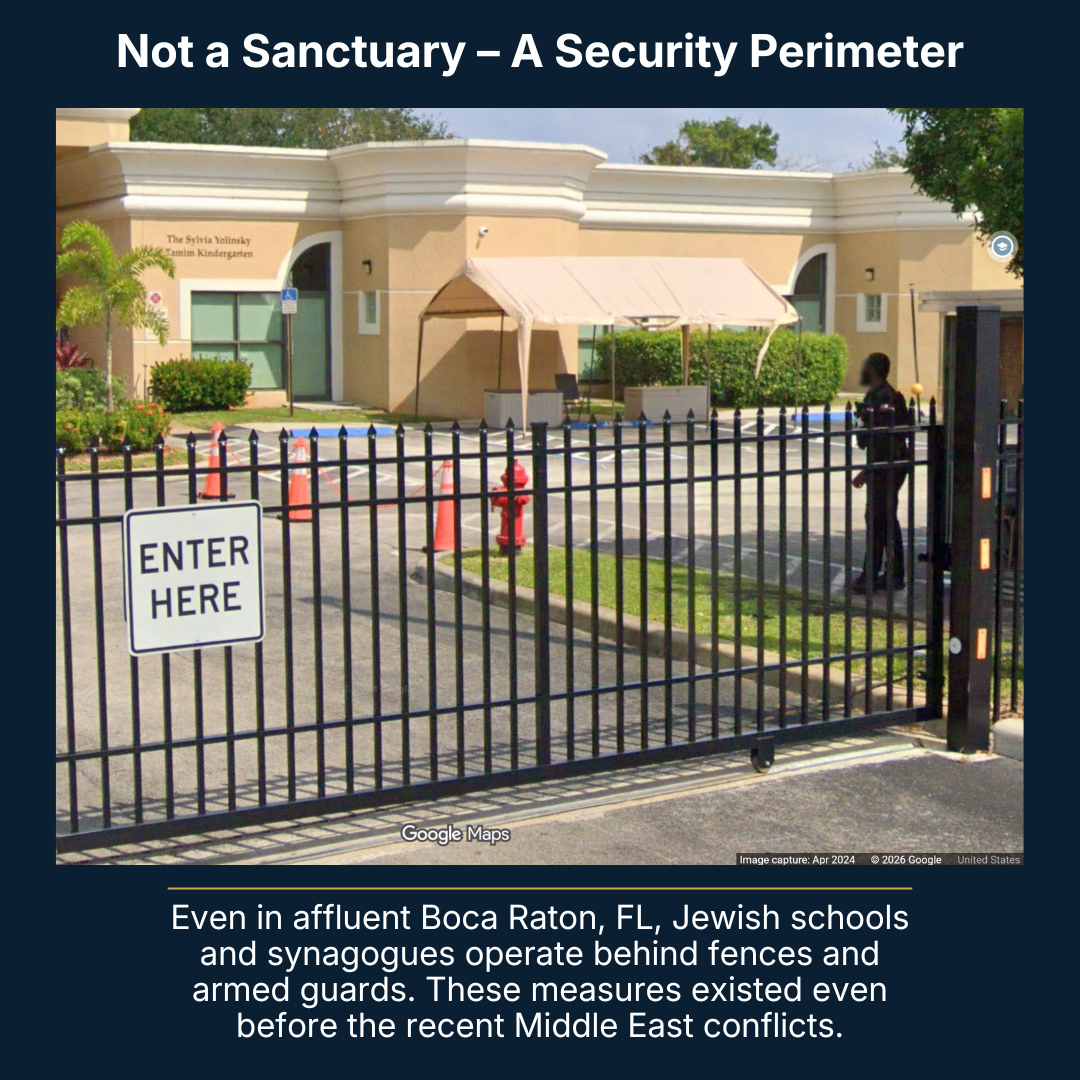
Police protection, surveillance systems, controlled access and emergency training are not temporary precautions for Jewish communities – they are ongoing measures designed to prevent the mass murder of Jews. These measures, rarely seen at most other houses of worship, reflect the persistent threat environment facing Jewish communities. Former head of Homeland Security and Intelligence for DC Donell Harvin noted the contrast:
“I’ve worked a lot with houses of worship in DC, and every time I go to a synagogue I’m taken aback by how prepared they are, with armed security that is visible, sometimes law enforcement. This community has been under siege for quite a long time. They’re not new to this.”
3. Security preparedness prevented a larger tragedy in Michigan
Security measures and emergency preparedness played a decisive role in limiting the impact of the Michigan synagogue attack. Armed guards and trained staff responded immediately when the attacker targeted Temple Israel’s early childhood center – where more than 100 young children were present. Preparedness training, security planning and rapid response procedures helped prevent the attack from escalating. The incident illustrates how planning, training and physical security measures can mean the difference between a thwarted attack and a mass casualty event.
4. Federal and state security funding helps protect targeted communities
Federal funds – such as the Nonprofit Security Grant Program – and state grants help religious institutions strengthen physical security and emergency preparedness. While these funds help, Jewish communities are still shouldering enormous security costs to maintain 24/7 protection. Jewish organizations have called for increased funding after recent attacks, stressing that the growing cost of protecting synagogues, schools and community centers places a heavy financial burden on many communities.
5. Violence against Jews is a global threat
Extremists targeting Jewish schools, synagogues and community institutions across Europe show that antisemitic violence is not confined to any single country. These incidents show that Jewish communities often face similar security concerns – reinforcing the need for funding, vigilance and security to protect Jewish communities worldwide. When anti-Jewish hatred is normalized, someone attacks a preschool.
|