League Logo.jpg

2025-2026 Legislative Bulletin

March 17, 2025🍀

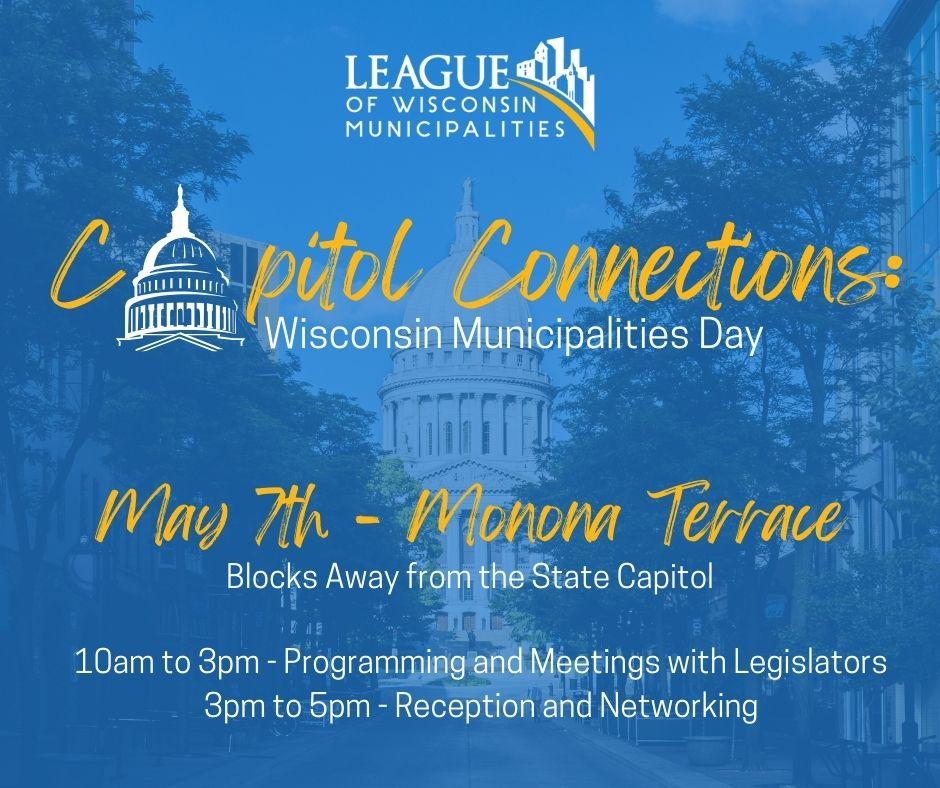
Capitol Connections Taking Place on May 7


Join us for a day of local advocacy at the League’s biennial Capitol Connections: Wisconsin Municipalities Day! We’ve packed informative programming, time to schedule meetings with legislators, delicious food, great company, and networking opportunities into this one-day event – all at NO COST to members. 

Doors to the Monona Terrace will open at 9:30am and the event begins at 10:00am with an overview of the League’s 2025-2026 Legislative Agenda and a summary of relevant legislative updates. Next, we’ll take a short walk to the State Capitol for meetings you have scheduled with legislators from 11:30am to 1:00pm, followed by a trip back to the Monona Terrace for lunch and afternoon programming from 1:30pm to 3:00pm. Finally, you’re invited to stay for a networking reception before the event concludes at 5:00pm. 


Your unique voice and individual connection with your legislators is critical to our advocacy effort. All municipal officials including elected leaders and staff are invited. Details on Capitol Connections, including registration information and frequently asked questions on scheduling meetings with legislators, are available on the League’s website. We hope to see you there!

Recently Introduced Bills of Municipal Importance


The following bills were recently introduced in the Wisconsin State Legislature and have been added to the list of those being monitored by the League. Unless otherwise indicated, no formal position has been taken on these proposals to date. 


  • SB 132: Impersonating Public Safety Officials - Sen. James (R-Thorp) and Rep. Wichgers (R-Muskego) - Under current law, a person may not impersonate a law enforcement officer, a firefighter, or an EMS practitioner with the intent to mislead others into believing that the person is actually a public safety official. Persons found to be in violation may be charged with a Class A misdemeanor. This legislation increases the penalty for impersonating a public safety official to a Class I felony.


  • Senate Bill (SB) 128: Programs and Policies to Address PFAS - Sen. Wimberger (R-Oconto) and Reps. Mursau (R-Crivitz) and Swearingen (R-Rhinelander) - Similar to a bill supported by the League last session after working with the authors on an amendment to address municipal concerns, this legislation would exempt municipalities and certain other parties from liability for PFAS remediation under certain circumstances and conditions. The legislation also establishes a Municipal PFAS Grant Program to assist with capital and operational costs related to PFAS, exempts certain emergency water utility actions to address PFAS from Public Service Commission of Wisconsin approvals, and establishes other programs and policies related to PFAS. The League has registered in-favor of this legislation. 
View the League's Full Summary of Bills Introduced in Past Two Weeks

⭐If you would like to contact your legislators on any bills mentioned in the Bulletin, you can find contact information for all legislators here. To find out which legislators represent your community, use the "Find Your Legislator" function on the right side of the page.

Upcoming Hearing to Remove Local Decision-Making


The Assembly Committee on Local Government has scheduled a public hearing this Wednesday, March 19 at 10:00am on two bills that would remove the ability for municipal leaders to make the right decisions for their communities. These two bills include: 


  • Assembly Bill (AB) 41: Prohibiting Local Regulation of Gardens - Rep. Sortwell (R-Two Rivers) and Sen. Jacque (R-New Franken) - This legislation prohibits cities, villages, towns, and counties from requiring a permit for or prohibiting the cultivation of vegetable or flower gardens on property not owned by the local government. Municipal officials would retain the power to control the spread of noxious weeds or invasive species. 


  • AB 42: Prohibiting Chicken and Quail Bans - Rep. Sortwell (R-Two Rivers) and Sen. Cabral-Guevara (R-Appleton) - This legislation prohibits cities, villages, towns, counties, and sewerage districts from prohibiting an owner or certain lessees of residential property from keeping four or fewer chickens or quail. While municipal officials could not prohibit what’s often referred to as ‘backyard chickens,’ the proposal would allow local governments to require permits, require notification of adjacent landowners, impose regulations on fowl housing, prohibit the keeping of roosters, and impose cleanliness standards. 


The League is opposed to both bills. While many municipalities have ordinances authorizing backyard chickens and gardens, those with prohibitions in place have often done so with local resident concerns in mind. In the case of chickens, those concerns have been tied to disease spread, noise, smell, and the prevention of the intrusion of predators like wolves or coyotes. 


Each municipality is different. Overriding community-first decision-making removes the ability for governing bodies to put their residents’ interests first. The League is opposed to ABs 41 and 42 and will oppose other legislative efforts looking to impose one-size-fits-all restrictions over locally driven decisions. 

Agency Anecdotes


Discontinuing CDBG Local Housing Revolving Loan Programs 


The Wisconsin Department of Administration (DOA) announced last year that all Community Development Block Grant (CDBG) Small Communities Housing Revolving Loan Funds will be discontinued to meet federal requirements. 


In the 1980s, CDBG funding was provided to local governments to establish revolving loan programs for the purpose of offering housing repair loans to low and moderate-income households. In 2012, DOA’s Division of Energy, Housing and Community Resources (DEHCR) discontinued the competitive award process and begin awarding CDBG housing funds on a regional level. As of 2024, approximately 215 local revolving loan funds were locally holding approximately $22 million in funding. DEHCR’s 2025-2029 Consolidated Plan for the CDBG calls for housing revolving loan funds to be returned to the state where they will be used to create an affordable housing program to convert underutilized or vacant buildings into affordable housing units. 


Municipalities with revolving loan funds are asked to attend one of the three upcoming meetings listed below to learn how these changes may impact your community. 


  • Tuesday, April 8 from 1pm to 2pm - DOA Building, 101 E. Wilson St., Madison 


  • Thursday, April 24 from 1pm to 2pm - Conference Center, 1000 Lake View Dr., Wausau 


  • Tuesday, April 29 from 10am to 11am - Virtual Meeting via Microsoft Teams 


Earlier this month, DOA sent letters with additional details on the program and upcoming meetings to municipalities with housing revolving loan funds. A sample of that letter is available here.


Upcoming Training on Supplemental EMS Payments


EMS transports of Medicaid recipients are now eligible for supplemental payments following the approval of a federal waiver earlier this year. The Wisconsin Department of Health Services’ (DHS) Certified Public Expenditure (CPE) Program for public EMS providers will close the gap between current Medicaid reimbursement rates and the true cost of providing emergency care and transportation. The League has been actively engaged in supporting the creation of these supplemental payments in the Legislature.


Payments may be retroactive to January 1, 2023, but EMS providers must opt in to this program as participation is not automatic nor mandatory. Three trainings held next week will assist EMS providers in learning about the CPE cost reporting requirements for these supplemental payments. These virtual webinars will be held on Monday, March 25 from 11am to 1pm, Wednesday, March 27 from 10am to 12pm, and Friday, March 29 from 10am to 12pm.


Learn more about the CPE Program on DHS’s website and view details for these trainings here. 


Free Cybersecurity Assessments for Utilities


Cybersecurity continues to be a major threat for local governments. Learning about municipality’s cyber vulnerabilities and ways to limit risk may seem like a daunting task given already strained resources. For drinking water and wastewater utilities, the U.S. Environmental Protection Agency (EPA) is looking to make these risk assessments easier.


On Wednesday, March 26, the EPA is hosting a webinar from 1:00pm to 2:00pm Central Time on their free Cybersecurity Assessment Program designed to provide local utilities with an assessment report and risk mitigation plan to understand identified cybersecurity vulnerabilities and receive guidance on enhancing cybersecurity. Utilities interested in receiving a free Cybersecurity Assessment will have an opportunity to sign up at the end on the webinar.


Additional program details and webinar registration may be found on the Wisconsin Department of Natural Resources’ (DNR) website. The link also provides details on registering for an assessment if your municipality is interested but unable to attend the webinar.  


Lead Service Line Outreach Funding Available


Due to federal Lead and Copper Rule (LCR) changes, municipal water utilities may be looking to alter their lead service line (LSL) replacement schedule. To assist in these efforts, the DNR is accepting applications through April 30 for LSL Replacement Community Outreach Grants. This program provides funding to water utilities to conduct community outreach efforts that support ongoing or upcoming LSL replacement projects. $4 million is available to provide grants up to $150,000 per project with no match required. Learn more on the DNR’s website. 


Updates to Municipal Retail Alcohol License Forms


The Wisconsin Department of Revenue’s (DOR) Spring 2025 edition of DOR On Tap: Wisconsin Alcohol Industry Update, discusses feedback they’ve received from municipal clerks leading to work on an abbreviated Retail Alcohol License Renewal Form for the 2026-2027 licensing season. The form is expected to be released later this year, but if you have thoughts on potential changes, you’re encouraged to contact DOR. Learn more in the DOR On Tap Clerk’s Corner. 

📚Reading Room


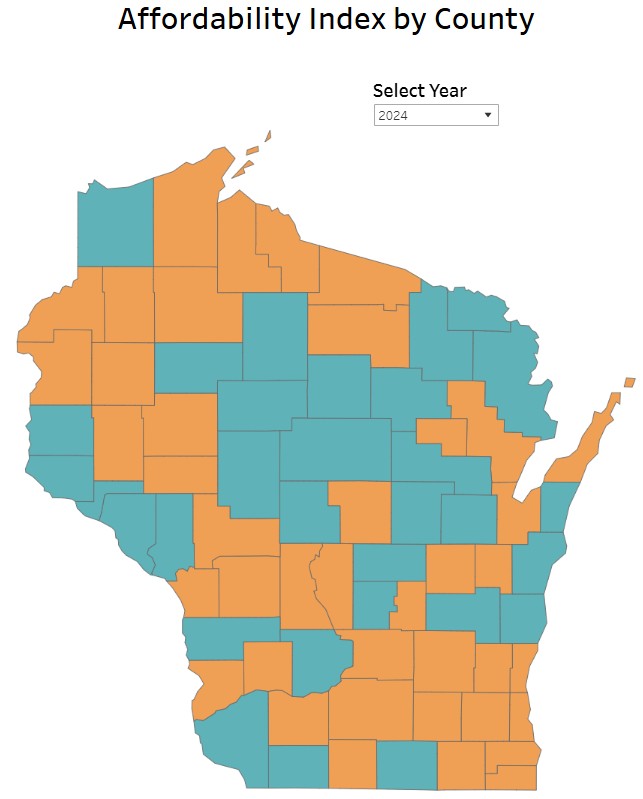
Housing affordability and the available housing stock continues to be a pressing issue in municipalities throughout the state. A new Spotlight from Forward Analytics titled Is Home Affordability Out of Reach? provides insight into the affordability crisis. Included in the report is an analysis showing that we’ve gone from 1 county being considered unaffordable in 2021 to 41 counties deemed unaffordable in 2024. Read the two-page Spotlight and check out the home affordability map on Forward Analytics’ website. 

While municipalities didn’t cause the housing affordability crisis, cities and villages of all sizes throughout the state have been searching for ways to be partners in solving this challenge. More Housing Wisconsin, a partnership between the League, Wisconsin Builders Association, and Wisconsin Realtors Association, recently completed a series of 12 briefing papers and associated videos detailing ways municipalities can help to promote residential development in their communities. More Housing Wisconsin’s work may be viewed on the League’s website.  

Email questions or comments to:

Toni Herkert, Government Affairs Director, therkert@lwm-info.org

Evan Miller, Government Affairs Specialist, emiller@lwm-info.org

Facebook  Twitter  LinkedIn  Web