Volume 3, Issue 8 - August 2025 | | |
Dear Friends,
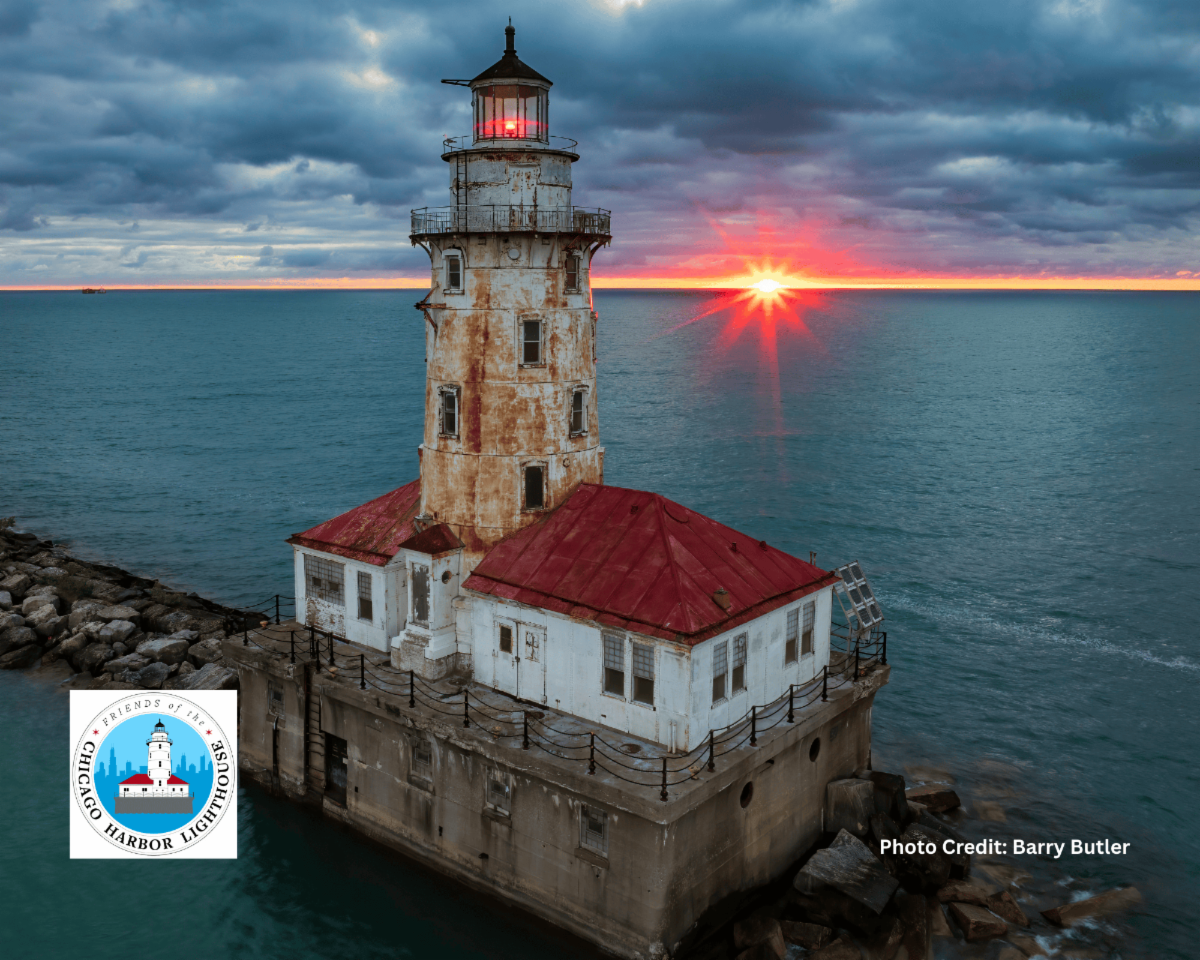
August is a time of transitions, reflections, and, for all of us at the Friends of the Chicago Harbor Lighthouse, a time of celebration.
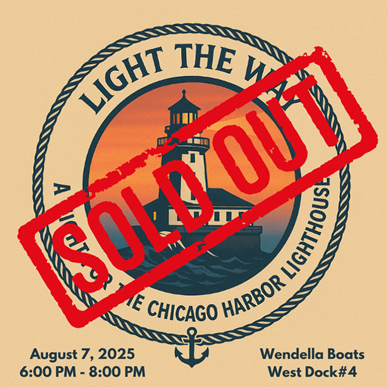
On August 7, 2025—National Lighthouse Day—we will gather for our inaugural fundraising event, Light the Way: A Night for the Chicago Harbor Lighthouse.
| | |
It’s hard to believe this dream of mine, which began back in January 2022, has grown into a full-fledged movement powered by your passion and support. The event sold out in just four weeks, and we are overwhelmed with gratitude for the response.
Whether you’re joining us on the boat, cheering us on from shore, or sharing our mission with others, thank you. Together, we are making a difference—and thanks to a generous anonymous donor, every $2 raised at the event will be matched with $1, amplifying the impact of your support.
In this month’s newsletter, I’m excited to share three stories that shine a light on different parts of our journey:
Light the Way gives you a behind-the-scenes look at the success of our sold-out fundraiser and the inspiring momentum we’re building together.
Explore the Lights of Lake Michigan takes you on a road trip around the lake with 105 lighthouse stops, thanks to our friends at the West Michigan Tourist Association.
And in Life at the Lighthouse: Food Preparation, Steve Clements explores how keepers cooked and ate at the lighthouse across generations—from coal stoves to gas ranges and even a mystery second kitchen.
Each story reflects our mission not just to restore the Chicago Harbor Lighthouse, but to rediscover and retell its rich history—one detail, one photograph, one floor plan at a time.
So as August winds down and we start thinking about fall, let’s not forget to take one last walk along the lake, take your family for a Wendella Boats boat ride to get a close view of the Chicago Harbor Lighthouse, or maybe even plan a visit to another Great Lakes lighthouse.
And while you’re at it, please consider a donation to help keep our light shining:
www.SaveTheLighthouse.org/donate
Thank you again for being part of this journey. You’ve helped turn a single dream into a community-wide movement—and together, we will Light the Way.
Be Safe and Be Well!
Regards,
Kurt Lentsch
Chief Dreamer and President
| | |
Light the Way: Sold Out, Matched Up, and Moving Forward!
By Kurt Lentsch
| | |
When we launched Light the Way: A Night for the Chicago Harbor Lighthouse, I knew we were planning something special—but even I couldn’t have imagined just how quickly this event would capture hearts and imaginations.
In just four short weeks, the event completely sold out. Every ticket claimed. Every spot spoken for.
And yes—many of my closest friends missed out!
But that overwhelming response isn’t just about a fun night on the water—it’s a reflection of the passion, excitement, and energy that surrounds this lighthouse and our shared mission to preserve, restore, and celebrate one of Chicago’s most iconic landmarks.
I’m also thrilled to share some incredible news: thanks to the generosity of an anonymous donor, every $2 raised the night of the event will be matched with an additional $1. That means your support will go even farther in helping us reach our fundraising goal and launch the first phase of restoration.
A very special thank you goes to the Borgstrom Family and Wendella Boats, Chicago’s Original Architecture Tour, for their steadfast support in making this event possible. Their partnership has been instrumental.
For those who didn’t score a ticket, don’t worry—you can still experience the magic. Grab your friends and family and take a Wendella Lakefront Tour.
Wendella is proudly celebrating its 90th year of serving Chicago, and our lighthouse has stood watch over its tours for every one of those years.
| | |
When I started this journey in January 2022, I knew I was passionate about saving this lighthouse. I had no idea how many others would step up, speak out, and shine their own light alongside me.
To see hundreds of supporters rally together—donating, subscribing to our newsletter, sharing our story, volunteering their time, and offering their encouragement—has been nothing short of inspiring.
Yes, I may have lit the first spark. But you—this incredible community—have kept the fire burning. You’ve helped this idea grow from a dream into a movement. And every step we take together gets us closer to making this beacon shine again.
Thank you—each one of you. Whether you’re attending the event, supporting from afar, or simply sharing our story—you are part of this.
Together, we will Light the Way.
Please donate today and help make an even greater impact. With the $1 for every $2 Match, your donation makes a greater impact.
Every dollar brings us closer to restoring this historic treasure.
www.SaveTheLighthouse.org/donate
| | The Meaning of National Lighthouse Day | | |
Each year on August 7, communities across the country honor the beacons that have guided mariners for generations. For those of us dedicated to preserving the Chicago Harbor Lighthouse, National Lighthouse Day is more than a celebration—it’s a call to remember our maritime past and recommit to protecting its legacy for the future.
A Beacon in History
The roots of National Lighthouse Day stretch back to the very founding of the United States.
On August 7, 1789, the newly formed Congress passed the Lighthouse Act, placing the construction and maintenance of all American lighthouses under federal control. It was one of the nation’s first public works efforts—an acknowledgment that the safety and success of our coastal and inland water commerce depended on well-maintained aids to navigation.
Two centuries later, in 1989, Congress passed a resolution to commemorate the 200th anniversary of the Lighthouse Act. President Ronald Reagan signed it into law, officially designating August 7 as National Lighthouse Day—a time to recognize the importance of lighthouses in shaping America’s development, safety, and maritime heritage.
Why We Still Celebrate
Lighthouses are more than structures—they are symbols of resilience, dedication, and the power of light in the darkest conditions. For more than two centuries, lighthouse keepers braved storms and solitude to ensure their lights stayed lit, protecting lives and livelihoods.
Although many lighthouses are now automated or retired from active service, they remain vital touchstones for our history. Today, they serve as museums, educational centers, and cultural icons—reminding us of the ingenuity and perseverance that helped build this country.
A Light on the Lake
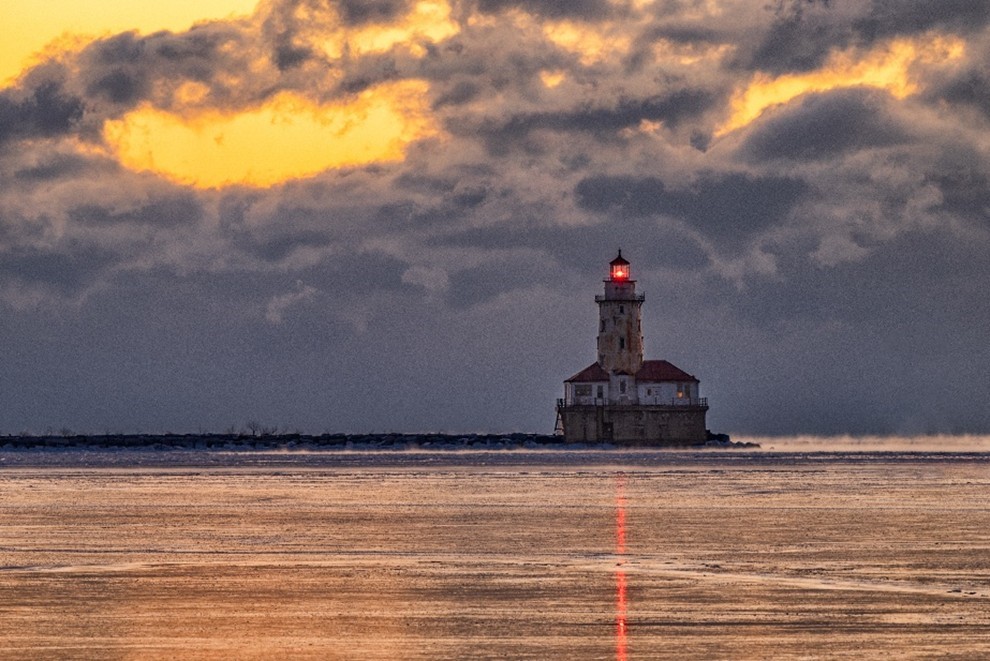
Here in Chicago, we are proud stewards of one of the Great Lakes’ most iconic lights. The Chicago Harbor Lighthouse was originally constructed for the 1893 World’s Columbian Exposition and relocated to its current position off the end of Navy Pier in 1919. It was listed on the National Register of Historic Places in 1984 and became a Chicago Landmark in 2003.
Today, the Friends of the Chicago Harbor Lighthouse are leading efforts to restore this historic beacon and open it to the public. We believe National Lighthouse Day is a powerful opportunity to raise awareness, build community, and shine a light on the work ahead.
Why It Matters in Chicago
Celebrating National Lighthouse Day in Chicago isn’t just about honoring a building—it’s about:
- Preserving History: Recognizing the lighthouse’s critical role in our maritime story.
- Building Momentum: Encouraging support for our restoration efforts.
- Educating the Public: Sharing the history and future of the lighthouse with Chicagoans and visitors alike.
- Fostering Civic Pride: Embracing the lighthouse as a unique and enduring symbol of our city’s connection to Lake Michigan and the wider world.
A Special Thank You
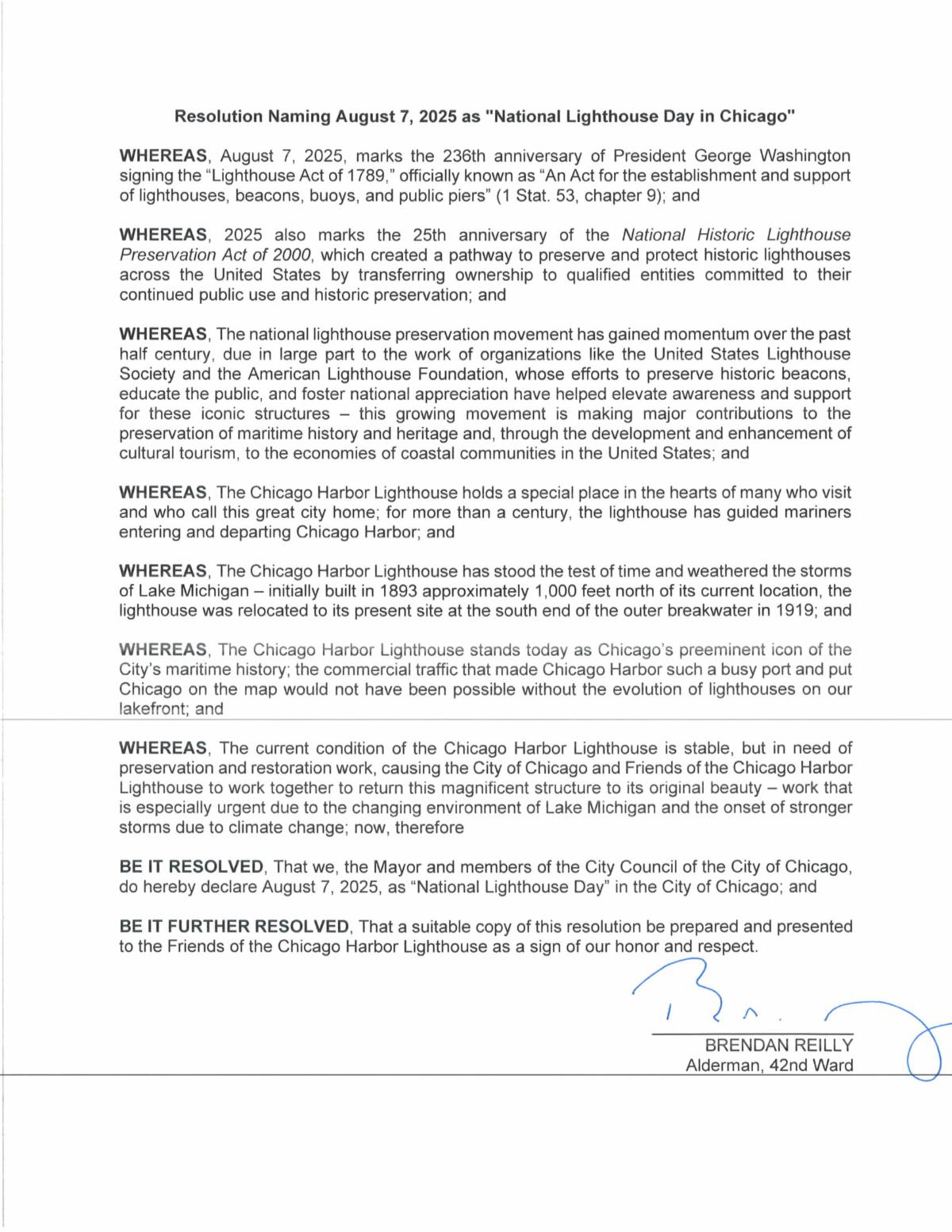
We would like to give a heartfelt thank you to Alderman Brendan Reilly and his staff for their support and leadership in sponsoring the City Council resolution officially naming August 7, 2025, as National Lighthouse Day in Chicago.
Their commitment to honoring our city’s maritime heritage ensures that the Chicago Harbor Lighthouse continues to shine—both as a historical treasure and a beacon of civic pride.
| |
Join Us in Celebration
This August 7, we invite you to reflect on the meaning of this day and take part in our efforts to preserve, restore, and celebrate the Chicago Harbor Lighthouse.
Whether you’re joining us aboard Wendella for our sold-out “Light the Way” fundraiser, following our progress online, or simply telling a friend about the lighthouse, you are helping keep the light shining for future generations.
Let’s honor the past—and light the way forward.
| | |
Life at the Lighthouse: Food Preparation
By Steve Clements
| | |
Let me preface this article by saying that while we know quite a bit about the structure and general history of the Chicago Harbor Lighthouse, there’s still a lot to learn about what daily life was like for the many Lighthouse Service and later Coast Guard personnel who lived and worked there from 1893 through 1979.
We’re hopeful that detailed records from the lighthouse’s early years: logbooks, incident reports, equipment inventories, interior photos, and notes on daily routines—were carefully preserved by the U.S. Lighthouse Service, which operated the station at the time. While some documents may have been lost or discarded during the 1917–1918 relocation, we believe much of the story still survives, waiting to be rediscovered.
Some of those records, both before and after the move, may reside in the National Archives or in maritime collections that haven’t yet been fully explored. Just as promising is the potential to learn from the families of those who served at the lighthouse. Personal letters, photographs, oral histories—even handwritten recipes passed down through generations—could shed light on the daily life and character of the keepers who called the lighthouse home. Together, these sources offer a chance to fill in the human side of the story—one that deserves to be remembered and shared.
So, let’s take a look at what we do know about food preparation at the lighthouse—and how the kitchen evolved over time. Some of what follows is confirmed through drawings and documents. Some of it we’ve pieced together based on what was typical at other offshore lighthouses of the era.
It’s a mix of fact, educated guesses, and a little imagination. Let’s dig in.
| | |
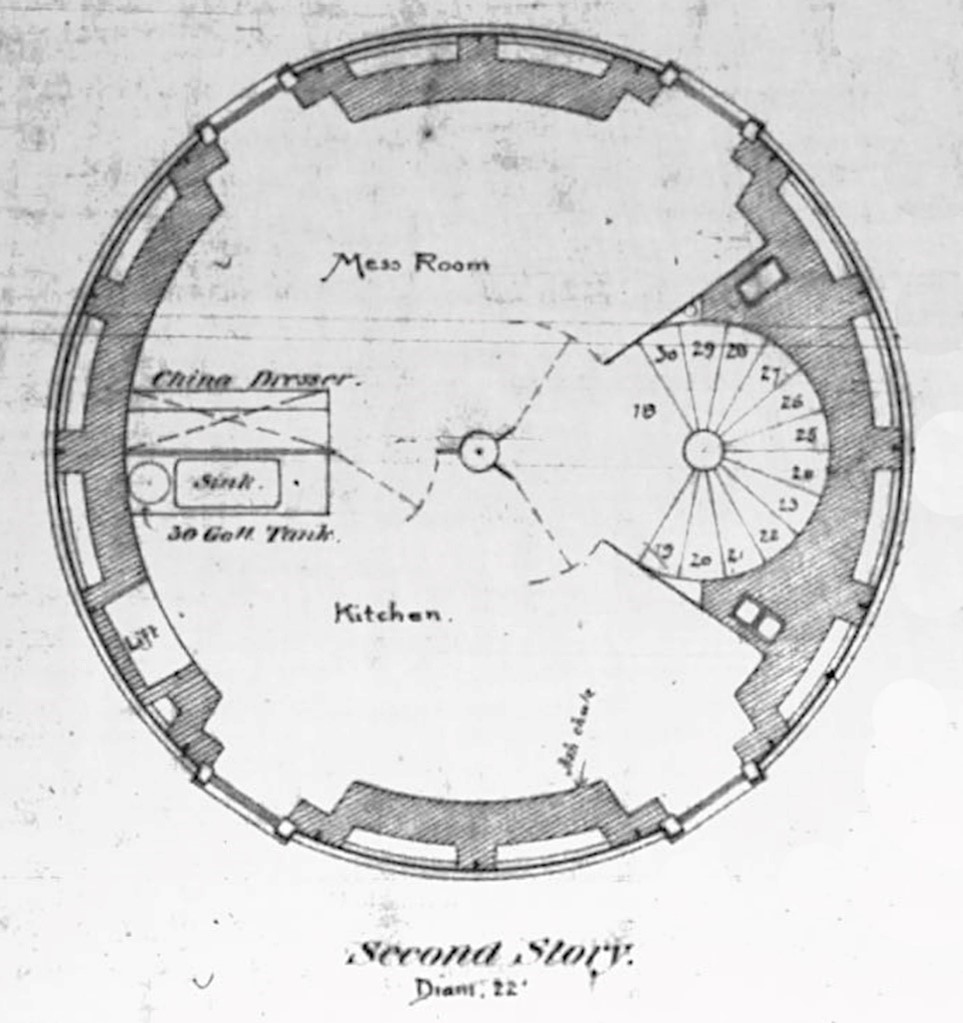
Floor plan for the second story of the 1893 Chicago Harbor Lighthouse, depicting
the Kitchen and Mess Room
| | |
The 1893 Lighthouse
We are fortunate to have access to the original 1893 building plans. From them, we can piece together what early meal preparation might have looked like for the Principal Keeper and two Assistant Keepers who lived and worked onsite.
Shown above is the plan for the second story (technically the third level, since the ground level was called the basement). The conical tower narrows as it rises, and at this level, the exterior diameter measures 22 feet. The thick inner ring of bricks (shown in gray on the plans) lined the cast-iron walls, providing structural support for the weight above.
Keepers would have climbed the spiral staircase (shown at the right on the floor plan), and at step number 30 reached the second-floor landing. A door to the right led to the Mess Room, where meals were shared and stories likely swapped. This was the social center of an offshore lighthouse—a place to decompress, eat, and maybe play cards or write letters. It was furnished simply, probably with a table and chairs. A built-in china dresser is shown on the plan, and it likely held dishes and possibly a few personal effects.
Two casement windows in both the kitchen and the mess room would have offered ample daylight and welcome ventilation during hot summer months. Heat came from a coal-fired boiler in the basement, and by 1893, cast iron radiators were probably installed in various locations.
In the kitchen itself, the plan shows a built-in sink and a 30-gallon water tank. The sink might have been made of wood or iron—we’re not yet sure. The tank was located directly above a cistern built into the foundation, and it’s almost certain that one of the Assistant Keepers was tasked with hand-pumping water from the cistern up to the tank as part of daily duties. By the early 20th century, many lighthouses had electric pumps, so ours may have followed suit as electricity reached offshore stations like this one.
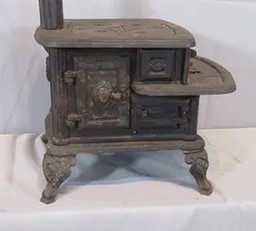
Coal stored onsite was used for heating, and probably for cooking, too. A basic coal-fired cookstove would have been typical for the time, perhaps something like the example shown here. The floor plan even notes an ash chute in the wall, which supports the idea that a coal stove once stood nearby. If so, it likely sat between the kitchen windows, adjacent to the chute. Once restoration work begins, we hope to confirm this by locating the chimney or venting that would’ve served that stove.
| | Typical late 19th century basic coal fired cook stove | |
At around the eight o’clock position on the floor plan, there’s a “Lift” shaft marked in the wall. This appears only at the basement and kitchen levels. That makes it likely this was a simple freight lift, used to haul cooking supplies up from the basement once offloaded from the supply boat, and maybe to send trash or waste back down. A great convenience when you think about lugging sacks of coal or boxes of provisions up a spiral staircase.
We don’t yet have documentation about what kinds of worktables or cabinets were in the kitchen, but it’s safe to assume there were a few for prep and storage. There’s also no information about cold storage. It’s possible that a storage room built into the granite foundation, near the cistern, served as a makeshift root cellar, taking advantage of the naturally cool lake temperature. As with many offshore lighthouses, non-perishable foods were essential. Canned goods were becoming more available, and other preservation methods—salting, pickling, smoking, and drying—remained in wide use and reliable for food safety.
After the 1917–1918 Relocation
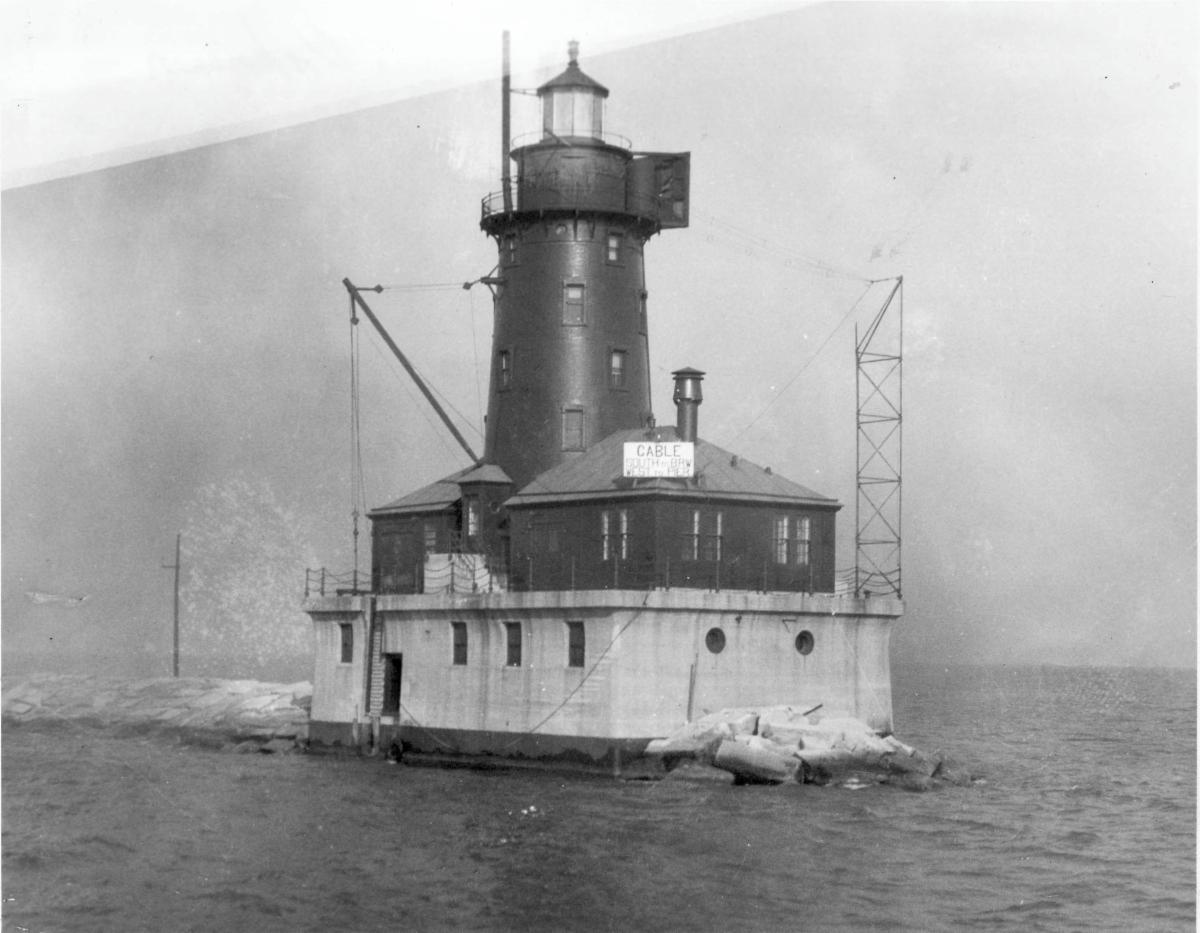
When the lighthouse was relit in 1918 after its move, the function of most rooms in the tower, including the kitchen and mess room stayed the same. The new location, though, had some upgrades. Most notably, the lighthouse now sat on a new concrete base—about 20 feet taller than its old foundation. That raised the focal height of the light (making it visible from farther away) and created a proper basement level for modernized equipment.
Our best source of post-move information about Chicago Harbor Lighthouse is a 1929 U.S. Lighthouse Service “Description” report, which includes an equipment inventory and report about conditions at the lighthouse.
That report tells us the rainwater cistern present at the old site was replaced with a 4-foot-deep cement-lined well cut through the basement floor and into the stone cribbing beneath the lighthouse. A Milwaukee Compressed Air Power Pump was installed to draw water into the station for cooking, cleaning, and general plumbing.
That change in water supply likely reflects confidence in water quality following the reversal of the Chicago River in 1900 and improvements in sewage treatment by the 1920s—though we should note that wastewater from the lighthouse still drained back into the harbor. That said, it’s worth noting that all the 1929 report said about the “Quality” of the water were two simple words: Harbor Water.
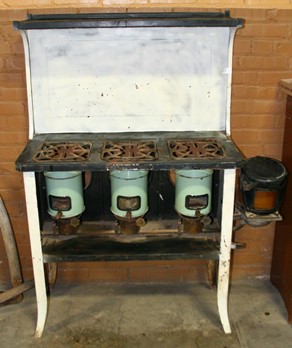
| New Perfection kerosene cook stove - Circa 1920 | |
The report also documents that by then, the cooking stove had been upgraded to a New Perfection No. 303 kerosene model, like the one pictured here. That switch made sense—kerosene was commonly used in lighthouses not just for cooking but for lighting the lamp itself. Before electrification of the Chicago Harbor Lighthouse in 1925, our lens was illuminated by vaporized kerosene under pressure, which glowed brightly against multiple fabric mantles, much like a camp lantern. Large kerosene tanks were kept in the basement for this purpose.
It’s unclear whether the original ash chute or the lift were retained after the move. We also don’t yet know whether the kitchen layout remained the same or if any of the equipment was rearranged. We’re hoping that 1917-1918 floor plans or photographs will surface someday to help answer those questions.
A Second Kitchen Location?
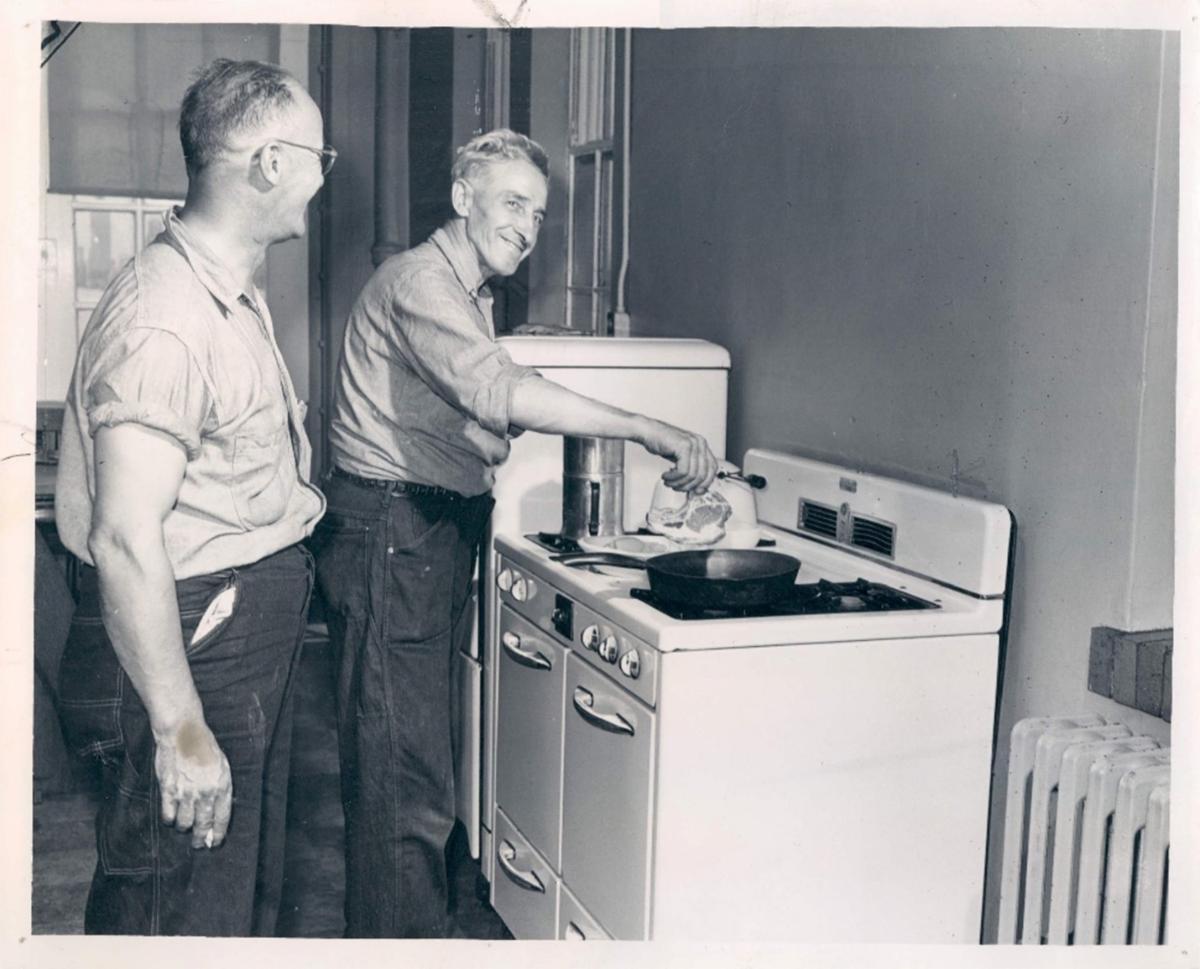
A surprising historical photo from 1947 offers a new clue and surprising fact about cooking at Chicago Harbor Lighthouse and opens a new exciting area to be researched.
| US Lighthouse Society Archive - 1947 wire photo titled "Chicago Harbor Kitchen" | |
Pictured above, preparing dinner is James Brotherson, appointed in 1943 to Principal Keeper at Chicago Harbor Lighthouse after beginning his tenure here as 1st Assistant Keeper in 1936. Brotherson is standing with another keeper whose identity is not yet known.
By the 1940s, food preparation technology had moved far beyond coal and kerosene stoves. The circa 1940s appliances pictured here, including the refrigerator next to the stove, look more modern and recognizable to us. The stove was fueled by bottled LP gas tanks, which can be seen in contemporary exterior photos. However, none of that is the surprising part of this photo.
Notice the shape of the external walls? Straight with corners, no longer a round-walled room situated on the second story of a conical tower! By the 1940s the kitchen had either been relocated or possibly an additional kitchen had been added to the lighthouse. The photo above depicts the more recent kitchen located in the structure connected to the tower on the south side. That space was originally built as the fog signal room, and contained two large steam engines (one for redundancy in case of failure) used to power the fog signal.
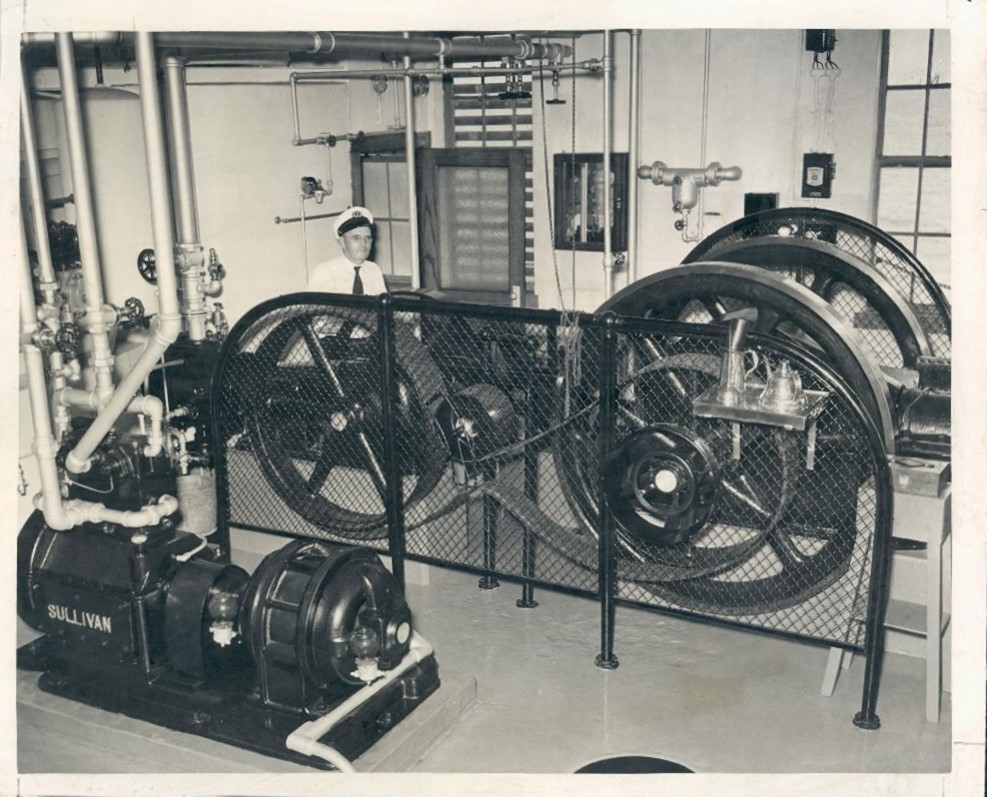
In 1925, the fog signal was converted from steam to a new “air diaphone” technology, which used compressed air at far lower pressure. This was a cheaper, safer, simpler, and more effective technology for fog signals. The large steam engines were removed, replaced by a much smaller, electric-powered air compressor. With a far smaller footprint that the steam engines, this freed up a lot of space in the fog signal room. Apparently, enough space to add kitchen facilities to that space sometime between 1925 and 1947.
| 1939 photo showing electric motor-driven air compressor to power the fog signal | |
There's no question this modification improved life at the ighthouse. Assuming the mess room was also moved to be adjacent to the new kitchen (we don’t know for sure), it was far more spacious and, during summer, offered the opportunity to enjoy a meal out on the deck with a great view of the city.
A Mystery Still Cooking
Many questions remain. What became of the original kitchen space in the tower? Was it repurposed? Did the mess room move too? If so, was it partitioned off from the fog signal equipment?
Restoring a historic lighthouse is a bit like solving a mystery novel. Each clue—a surprising photo, a floor plan, a stove model—opens the door to new discoveries and even more questions.
That’s what drives the mission of Friends of the Chicago Harbor Lighthouse. We’re committed to uncovering the full story of this remarkable structure—from architectural blueprints to a keeper’s favorite kitchen spoon. As renovations move forward and old layers are peeled back, we expect more pieces of the puzzle to emerge—and we can’t wait to share them with you.
Stay tuned and stay curious!
| | Explore the Lights of Lake Michigan: The Lighthouse Map and Circle Tour | | |
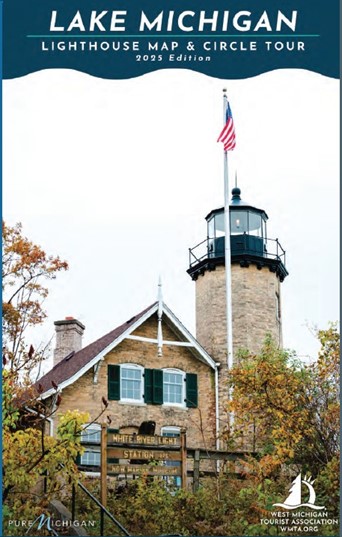
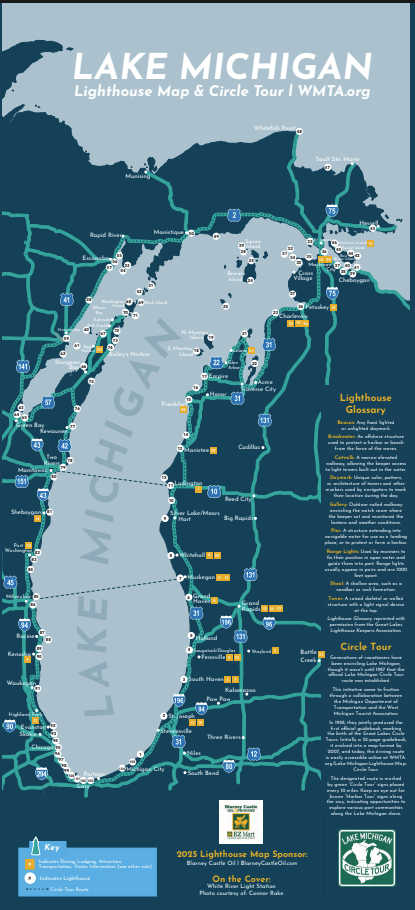
For those who dream of a road trip infused with history, adventure, and the timeless charm of lighthouses, the Lake Michigan Lighthouse Map and Circle Tour, published by our friends at the West Michigan Tourist Association (WMTA.org), is a must-have companion. This map charts out 105 lighthouses and harbor lights that encircle Lake Michigan, guiding travelers through the coastal beauty of Michigan, Wisconsin and Illinois.
What began in the 1980s as a partnership between the Michigan Department of Transportation and the West Michigan Tourist Association has become one of the most scenic and historic driving adventures in the Midwest. The Lake Michigan Circle Tour officially launched in 1988 as a 52-page guidebook and was later transformed into a user-friendly map in 2007.
Today, it’s available online and still captures the hearts of lighthouse lovers, history buffs, and road-trippers alike.
This isn’t just a road trip—it’s a pilgrimage for lighthouse enthusiasts. From towering steel beacons to humble harbor lights, this tour offers a unique opportunity to visit more than 100 lights that have stood watch over the Great Lake for generations. You’ll encounter quaint harbor towns, miles of sandy beaches, historic state parks, and even the modern marvel of the Mackinac Bridge.
Whether you’re heading to the rocky shores of Wisconsin, the golden dunes of Michigan, or the bold skyline of Chicago, this map provides a powerful reminder of just how many incredible lighthouses still dot our shared shoreline.
At the Friends of the Chicago Harbor Lighthouse, we encourage you to take the tour—or even just a section of it—and support lighthouse preservation efforts across the region. Many of these lights are maintained by dedicated nonprofit organizations, local volunteers, and maritime enthusiasts who share our mission: to preserve, restore, and celebrate these historic guardians of the lake.
| | |
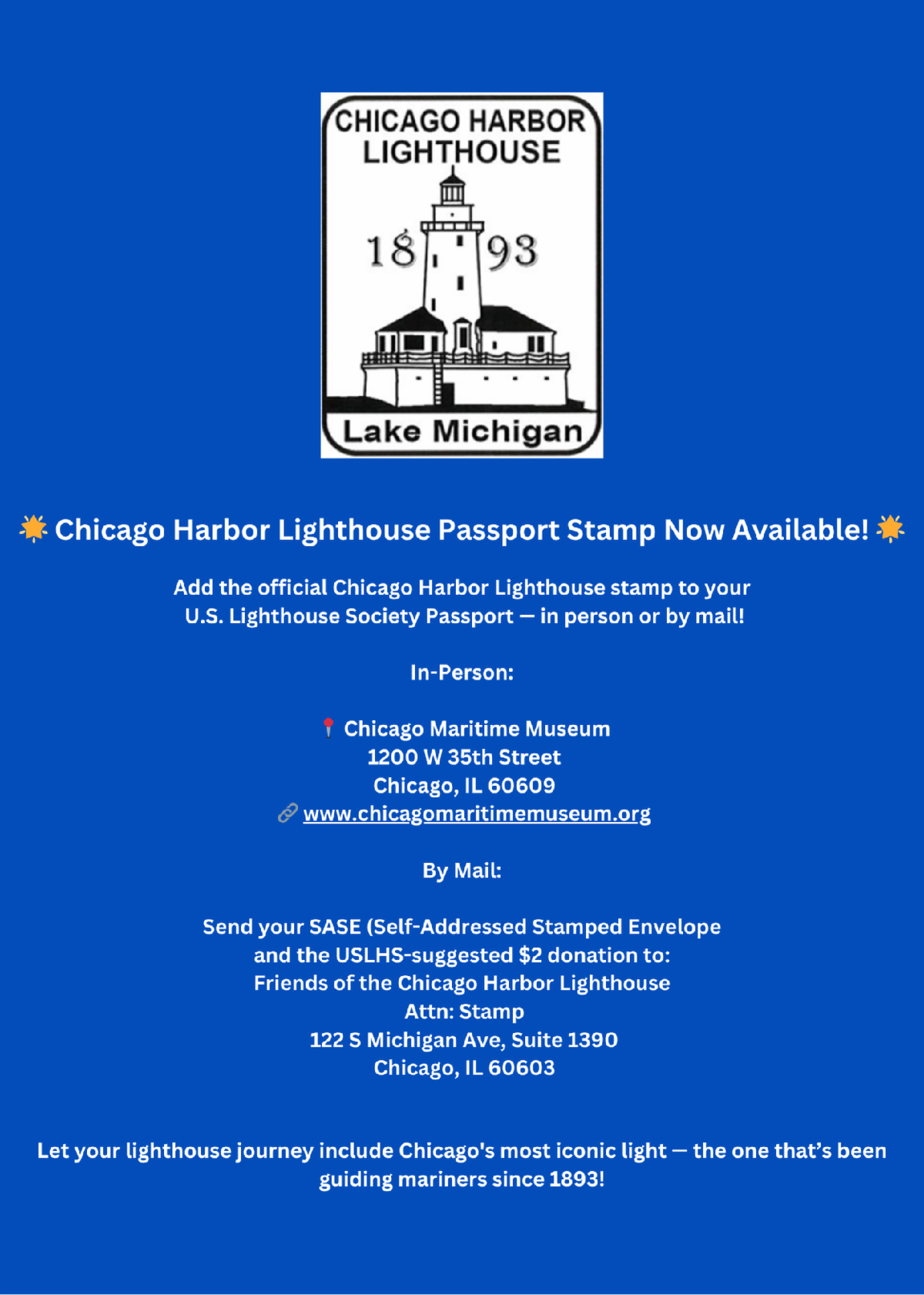
So, pack a cooler, bring your camera, grab a Lake Michigan Lighthouse Map, and hit the road. Whether you’re inspired by maritime history, seeking the perfect sunset, or collecting Lighthouse Passport Stamps along the way, this journey is sure to illuminate your love for the Great Lakes.
And of course, don’t forget to save your final stamp for us—Chicago Harbor Lighthouse—proudly guarding the mouth of the Chicago River since 1893.
We hope to welcome you soon.
Learn more and plan your route: https://www.wmta.org/lake-michigan-lighthouse-map-circle-tour/
Download the map or view the itinerary: Lake Michigan Circle Tour
Keep the light shining—everywhere around the lake.
| | |
Whether you’re looking for a one-time project or a long-term role, we’d love your help!
We’re looking for:
- Educators & Curriculum Designers
- Writers & Storytellers
- Graphic Designers & Illustrators
- Historians & Preservationists
- Social Media Coordinators & Digital Creatives
-
General Volunteers ready to lend a hand and build something meaningful
This is your chance to be part of a once-in-a-generation project—one that honors Chicago’s past while educating its future. We’ll work together to turn this historic beacon into a learning destination unlike any other.
Want to help?
Email: info@savethelighthouse.org with “VOLUNTEER” in the subject line.
Let us know your interests, background, or any ideas you’d like to contribute.
Let’s build something lasting, together—and light the way for generations to come.
| | Shop the Store That Shines a Light on Chicago’s History! | | |
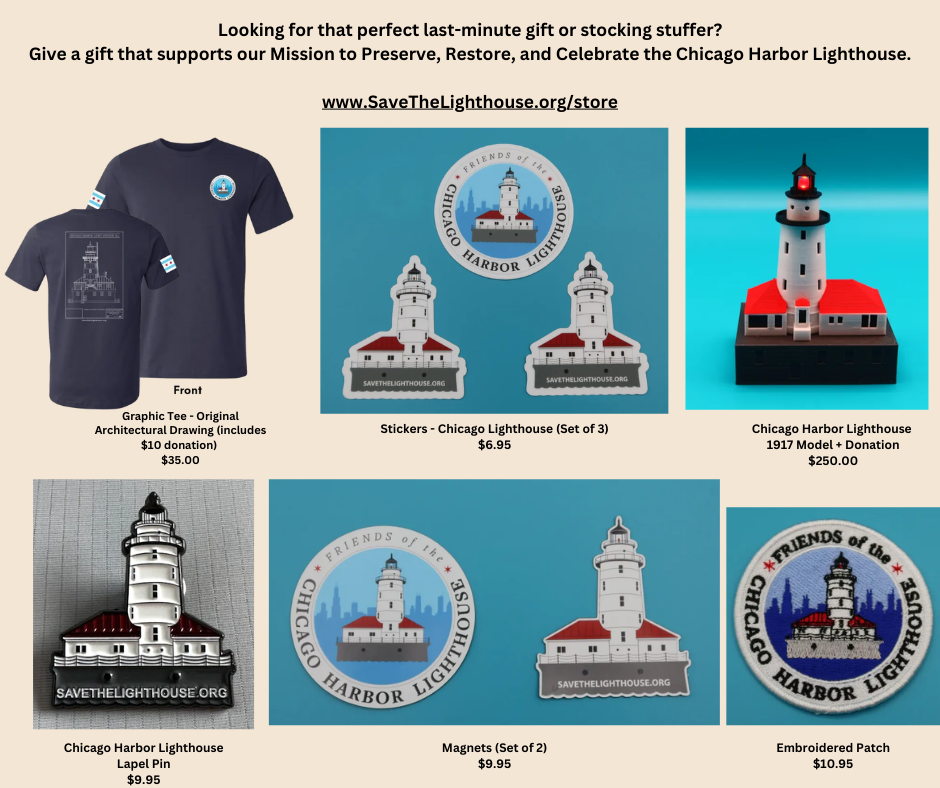
Have you visited the Friends of the Chicago Harbor Lighthouse Online Store lately? Now’s the perfect time to stock up on unique lighthouse-themed gifts that support a great cause!
-
New apparel, pins, and stickers let you wear your lighthouse pride year-round
- Our popular 3D lighthouse model makes a standout gift for history buffs and Chicagoans alike
- Every purchase directly supports our mission to Preserve, Restore, and Celebrate the Chicago Harbor Lighthouse
Whether you're shopping for yourself or picking up something special for a lighthouse lover in your life, your support keeps the light shining bright.
Visit www.SaveTheLighthouse.org/store and make your purchase count!
| | |
Bring the Lighthouse to Your Group:
Book a Save the Lighthouse Presentation
Are you part of a school, club, organization, or community group of 25 or more? Invite us to shine a light on one of Chicago’s most iconic landmarks—the Chicago Harbor Lighthouse!
| | |
Our Save the Lighthouse presentation explores:
- The lighthouse’s fascinating history and architectural legacy
- Its current condition and preservation challenges
- Our future plans to restore, protect, and open it to the public
Presenters Kurt Lentsch, President of Friends of the Chicago Harbor Lighthouse, and Edward Torrez, Historic Preservation Architect, have captivated audiences across the city with this compelling, visual journey through time, told with passion and purpose.
To inquire about booking a presentation for your group, contact:
Steve Clements — steveclements@savethelighthouse.org
Let’s work together to preserve this beacon of Chicago’s maritime past and illuminate its future!
| | Photo credit: Barry Butler | | |
Help Light the Way
Every gift makes a difference. As we approach the final stages of acquiring the Chicago Harbor Lighthouse, your support powers the future-- restoration, public access, education, and celebration of this enduring symbol of our city’s maritime history.
This summer, we’re raising critical funds to launch our first major restoration efforts and create engaging programming that brings students, families, and visitors to the lighthouse for generations to come.
- Donate today and become part of the story.
- Share our mission with friends, neighbors, and colleagues.
- Be a Lightkeeper and help us preserve this national treasure.
The Friends of the Chicago Harbor Lighthouse is a 501(c)(3) nonprofit organization.
Your donation is fully tax-deductible.
Visit www.SaveTheLighthouse.org/donate
Together, we can Save the Lighthouse. Thank you!
| | If you are part of an organization that has an interest in financially supporting our efforts to Preserve, Restore, and Celebrate the Chicago Harbor Lighthouse, please reach out to Nick Naber (nicknaber@savethelighthouse.org), our treasurer and a member of our fundraising working group. | | Copyright © 2025 Friends of the Chicago Harbor Lighthouse - All Rights Reserved. | | | | |