View as Webpage

Vol. 15, March 2026

Monday, March 30, 2026

4:00 PM - 6:00 PM

Chatham Community Center

702 Main Street, Chatham, MA

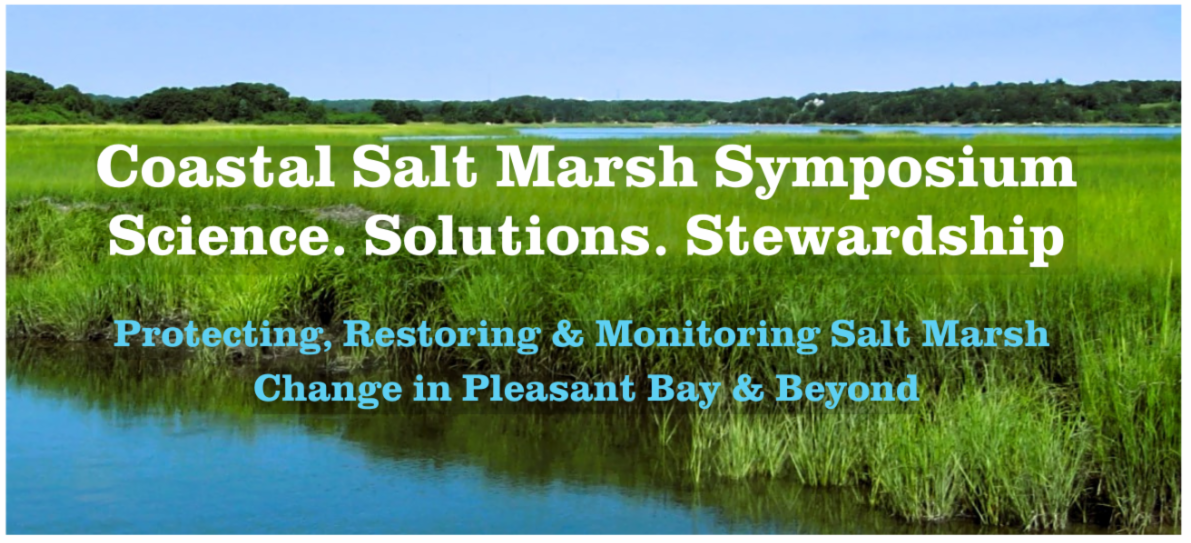
Join the conversation! Protect salt marshes in Pleasant Bay and beyond!


Salt marshes protect our water, wildlife, and shoreline — but they’re under threat from climate change, development, and environmental stress. The Friends of Pleasant Bay and Pleasant Bay Alliance are bringing together scientists, local officials, and coastal experts for the Coastal Salt Marsh Symposium at the Chatham Community Center on March 30 to discuss how science can guide action in your community.


This free, two-hour program will showcase the latest research, restoration successes, and practical tools to help communities protect and restore these vital ecosystems. Learn from experts like Sophia Fox, Ph.D. (Cape Cod National Seashore), Greg Berman and Catherine Ricks (Town of Chatham), Katie Castagno, Ph.D. (Center for Coastal Studies), Carole Ridley (Pleasant Bay Alliance), Tom Keras (Orleans Conservation Trust), and others for a lively and informative discussion.

Dollars & sense

Funding & technical assistance opportunities


Cape Cod communities continue to advance critical work in water quality protection, land conservation, and climate resilience — and several timely funding opportunities can help move priority projects forward. Below is a curated roundup of current grants and workshops especially relevant to municipalities, conservation commissions, DPWs, land trusts, watershed groups, and Tribal partners.


~~~~~~~~~~~~~~~~~~~~~~~~


Massachusetts Grant Funding Workshop

Sponsor: SNEP Network & New England Environmental Finance Center (NEEFC)

Date: March 3, 2026 | 1:00–3:00 PM (Virtual)


If your town is navigating funding for water quality improvements, stormwater upgrades, climate resilience planning, or infrastructure retrofits, this workshop is well worth two hours on your calendar. NEEFC will convene state, regional, and federal funders to provide concise overviews of active programs, followed by live breakout sessions for project-specific questions and feedback. Free technical assistance resources will also be highlighted.


Register here.

__________________________


2026 Land Acquisition Grants – Priscilla Alden Sears Memorial Fund

Sponsor: The Cape Cod Foundation

Who Can Apply: Cape Cod land trusts and Tribal entities (501(c)(3))

Deadline: March 26, 2026


This year’s grant cycle supports acquisition of priority conservation parcels on Cape Cod to ensure permanent protection of open space, wildlife habitat, and ecologically significant lands. Parcels must be dedicated entirely to conservation (with or without public access), and applicants must demonstrate a clear plan to acquire the property within 18 months of award.


This program is being offered as a pilot and reflects a strong regional commitment to strategic land protection. Questions? Contact Lauren Dreyer, Program Officer, ldreyer@capecodfoundation.org.


Click here for Guidelines & Application..

__________________________


FY2027 Coastal Resilience Grants

Sponsor: Massachusetts Office of Coastal Zone Management (CZM)

Deadline: March 20, 2026

Funding: Up to $2 million per project


CZM is seeking proposals for innovative and transferable local and regional projects that address coastal flooding, erosion, and sea level rise impacts. Funding supports vulnerability assessments, public engagement, infrastructure retrofits or relocations, shoreline restoration, and forward-looking resilience planning.


Eligible applicants include Massachusetts coastal municipalities, Tribal Governments, and certified 501(c)(3) nonprofit organizations. Projects must be submitted through the new ECO One Stop application portal via the Grants Management System (GMS).


For communities advancing multi-year resilience strategies, this represents one of the most significant state funding opportunities currently available.


Click here for more grant information and application instructions.

__________________________


FY2027 Coastal Habitat & Water Quality (CHWQ) Grants

Sponsor: Massachusetts Office of Coastal Zone Management (CZM)

Deadline: March 20, 2026


This competitive grant round funds projects that assess and treat stormwater pollution, advance green infrastructure, and restore coastal habitats. Eligible activities include stormwater nonpoint source assessment, design and implementation of structural best management practices (BMPs), capacity-building for green stormwater infrastructure, comprehensive habitat restoration planning, land acquisition planning activities, and engineering/data collection to support future crossing infrastructure improvements.

Municipalities within the Massachusetts coastal watershed, federally recognized Tribes, certified 501(c)(3) nonprofit organizations, regional planning agencies, and stormwater collaboratives (in partnership with eligible municipalities) are eligible to apply. Applications must be submitted through the ECO One Stop system via GMS.


Click here for more information and application instructions.

Coastal connections

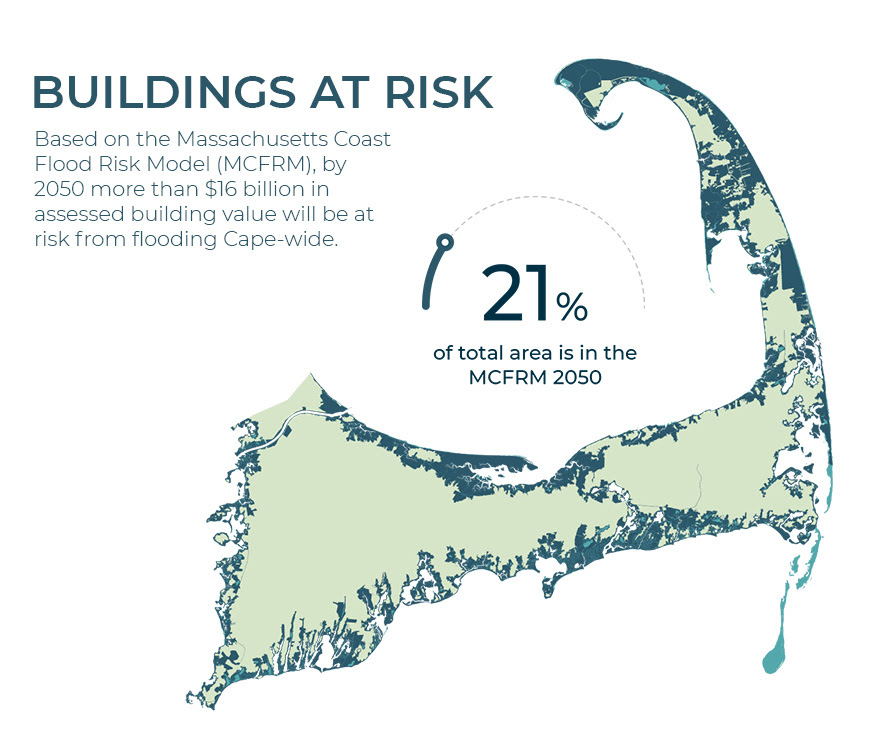
Cape Cod Commission reports on Buildings at Risk


Much of Barnstable County lies within areas that are vulnerable to flooding from storms and sea level rise, putting many structures at risk. These include FEMA Special Flood Hazard Areas within the 1% annual flood extent, which is mapped to identify vulnerable structures.


The Massachusetts Coast Flood Risk Model (MCFRM) is also used to identify structures vulnerable to flooding during future time horizons. ...The potential impacts due to loss of structures are widespread across all of Barnstable County, with particularly high levels of loss in low-elevation coastal areas, though the extent of vulnerability varies from town to town. Read more.

Center for Coastal Studies' Shoreline & Seafloor Mapping Program

Science-based mapping for coastal resilience


The Center for Coastal Studies’ (CCS) Shoreline & Seafloor Mapping Program uses cutting-edge, science-based mapping to support coastal resilience. By combining detailed surveys of both the shoreline and underwater seafloor, the program provides critical data on erosion patterns, habitat distribution, and changes in coastal landscapes. These maps help communities, scientists, and policymakers understand vulnerabilities, plan effective conservation strategies, and make informed decisions to protect Cape Cod’s dynamic coastal environment. Through this work, the Center translates complex geospatial data into actionable insights that guide sustainable management of the region’s shorelines and estuaries.


On February 4, 2026, CCS Marine Geology Department Chair and Director of the Shoreline and Seafloor Mapping Program Mark Borrelli, Ph.D., delivered a CCS Insider Update Zoom presentation, with introduction by CCS Executive Director Anne-Marie Runfola.


Watch the video here.

Was this email forwarded to you by a friend or colleague? Sign up here to receive the Pleasant Bay Current in your inbox.

Events

Cape Cod Conservation Calendar of Events for March 2026


This month's event calendar offers a full range of activities good for body, mind, and soul, and for people of all ages, interests, and abilities. Check out FoPB's Cape Cod Conservation Calendar here..

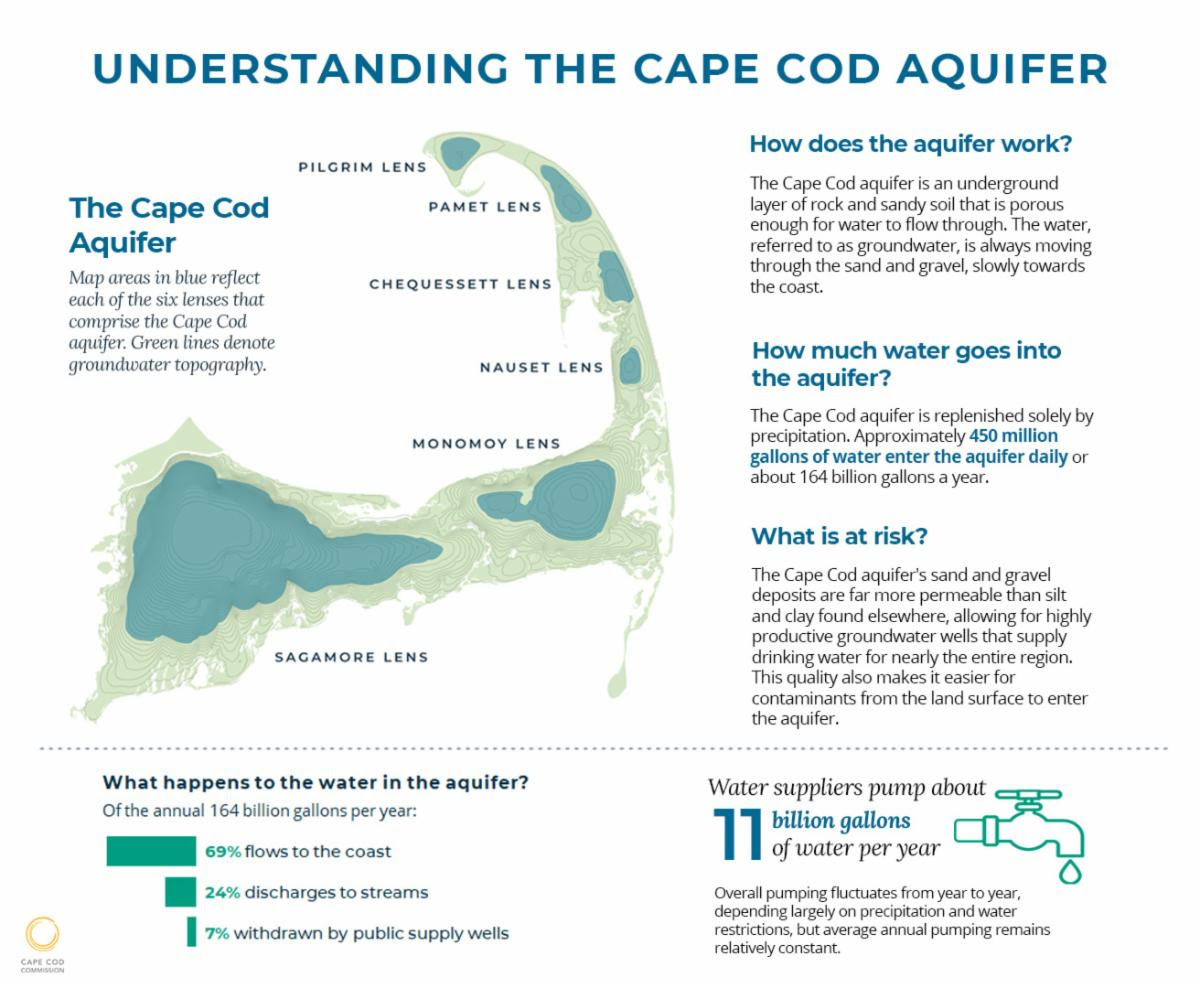
Pleasant Bay begins in the aquifer


Cape Cod sits atop a network of sandy, permeable aquifers, formed by six separate groundwater “lenses” left behind by glaciers. These underground reservoirs store freshwater that feeds drinking wells, streams, ponds, and coastal bays. Nearly 70% of this groundwater eventually flows toward the coast, including into Pleasant Bay and its tributaries.

Pleasant Bay—the largest estuary on Cape Cod and the second largest in Massachusetts—lies primarily within the Monomoy Lens, which underlies parts of Brewster, Chatham, Orleans, and Harwich. Water from this lens nourishes rivers, salt marshes, and the bay itself, sustaining fish, shellfish, and marsh habitats. Because Cape Cod’s soils are so permeable, nutrients like nitrogen can travel underground easily, making protection of the Monomoy Lens and careful wastewater management essential for the Bay’s long-term health.


The Cape Cod Commission’s aquifer map above shows the location and extent of these critical groundwater sources. On Cape Cod, the watershed is largely invisible—but entirely interconnected.

~~~~~~~~~~~~~~~~~~~~~~~~~~~~~~

LinkedIn Share This Email