|
This is fundamentally what feels so central to this collective moment: that so much of what has been built was imagined by people who could not, or would not, imagine us. They could not imagine the ones now young, and they could not imagine the worlds their longing would eventually cost. In contrast, for me, to become a better ancestor centers on labouring a different imagination, rooted in facing patterns of harm that we can refuse to hand forward and, more importantly, patterns of care that we can insist on planting now so that they might be inherited and harvested from later.
This essay is an attempt to sit with that labour, and specifically with the ones who are doing it in some of the most urgent, most bodily ways: young people.
The ground we are standing on
We are living through convergent unmakings of systems, language, processes and fundamentally a reality. What this means is that this turbulence has become and will increasingly become the ordinary conditions for young people perpetually coming of age amidst it. And yet turbulence has always been the medium through which the most vital movements have been born. Collapse costs real things (safety, years, lives, etc.) and it is also true, as every organiser who has done this work knows in their bones, that the old order rarely makes room for the new until it is forced to.
This makes the question of youth power inseparable from the conditions in which young people are coming of age. To live so intimately within the unmaking of inherited systems means youth power, then, is already present in the capacity of young people to perceive what is breaking and to participate in the making of what comes next and does not merely begin at the point of “invitation”.
What power young people already hold
Youth power becomes distorted when we understand it primarily as something that must be given to young people. Power, despite what we've been trained to see (that power is handed down through hierarchy), is also what moves through relationship, and through the simple but enormous act of naming a thing as unjust and organising your body and your time around changing it. Young people already historically hold this immense power. They hold the power of clarity as beings often least compromised by systems of injustice due to their short time within them, and they also hold the power of proximity to the future; they are, quite literally, the ones who will live longest inside the consequences of decisions being made today.
But of course power is always shaped by the systems and relationships it moves within. Paulo Freire, in his book Pedagogy of the Oppressed and more broadly across his work, insisted that liberation could not be handed from the powerful to the powerless as a gift, "the conviction of the oppressed that they must fight for their liberation is not a gift bestowed by the revolutionary leadership, but the result of their own conscientização [consciousness]" He wrote, "We are all teachers and we are all learners," which to me means dismantling the hierarchy of who gets to know and who is merely to be filled with knowing (Banking Model, Freire). Youth power is shaped by the conditions and systems within which it operates. Thus, to speak honestly about youth power, we need to face the conditions that both call it forth and constrain it.
The particular nature of youth organising
I find youth organising to be fractal in nature. Young people tend to organise through webs of accountability, weaving care deeply into the work of changing systems, and recognising that how we organise together is itself a practice of the world we want to create. I picture a murmuration of starlings creating collective shapes through their flight paths, and how this is only possible through each bird attending closely to its nearest neighbour. Youth movements often move this way, and I could spend hours naming those whose strength and capacity for resilience have grounded me deeply, but alas, I will instead list (in no particular order) a few that I would like to honour and from whom I receive this starling-murmuration spirit: Black Consciousness Movement. Rhodes Must Fall. Fridays for Future. Y'en a Marre. Sunrise Movement. Palestinian Student Solidarity Movement. March for Our Lives. The American Civil Rights Movement and so many more!
In the words of Grace Lee Boggs,"We are the leaders we've been waiting for."
What youth need to be positioned well
Positioning a generation to meet collapse has to be a matter of material and relational conditions. What young people need, to name two fundamental things, is unpoliced resources shared in trust, and the trust to be invited into our agency as beings who hold knowledge and decision-making power. We also, of course, need material support (funding, housing, healthcare, time, conditions for life, etc.), because there is little liberation in endlessly organising within a broken system when so much of our energy is already spent simply trying to stay afloat amid collapse. We need rest and grief support equipped to be responsive to the times. And, in the words of Wangari Maathai, “To the young people I say, you are a gift to your communities and indeed the world. You are our hope and our future,” we need to feel this structurally, materially, and relationally.
Weaving the generations
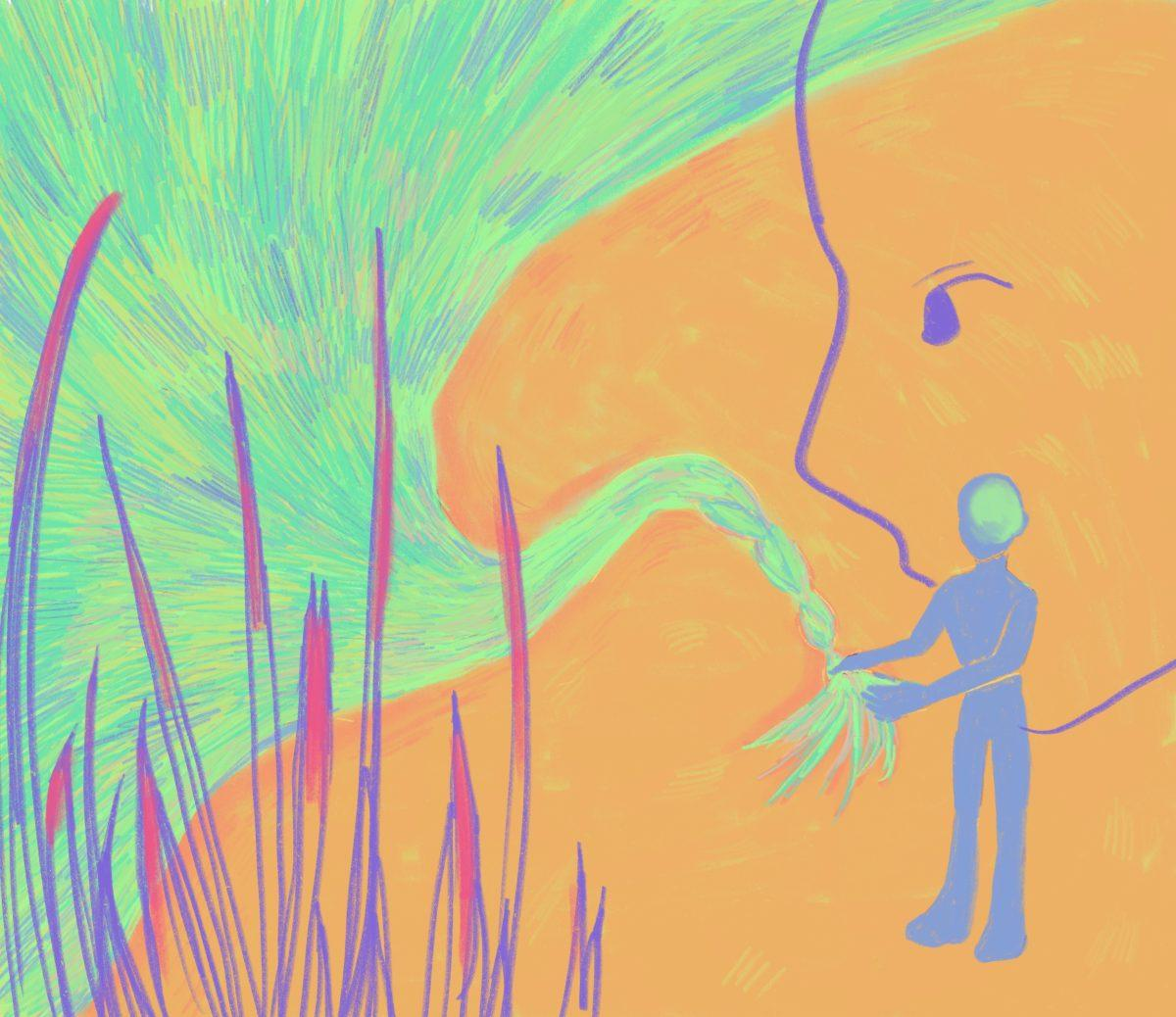
The idea of relationships across ancestors concentrically organised feels so deeply relational and reciprocal. To draw on Robin Wall Kimmerer’s analogy of braiding sweetgrass (one strand representing Western science, one strand representing indigenous knowledge, and one strand representing the wisdom of plants), I imagine three strands, woven together, creating shared strength. One strand is the knowledge of elders. Another strand is the intelligence of the young. The third strand is the ones not yet born, whose claim on the present must be inherent and inspired by the seventh-generation principle, the ones whose faces we are asked, in many Indigenous traditions, to hold in mind with every decision made today.
Weaving these strands together feels like what we need, across generations, to become better ancestors. Young people organising today do not have the luxury of waiting, as collapse does not afford us that privilege. Our task as young people, and yours (as adult allies) alongside us, is to use the power already gathering in our hands in service not only of the world future generations will inherit, but of those becoming alongside us in the present, and those who will come after, whose flourishing is already, through kinship, our responsibility.
We do not get to choose whether we become ancestors, because both beautifully and terrifyingly every generation becomes one, eventually. What we choose is what kind, and whether the imagination we leave behind includes the joy and liberation of those who will stand on the ground we leave, or not.
|