|
MidSummer Reds
by Catherine Smith
It’s a green, green midsummer. Reds stand out in all the green. Blackbirds flash red-shouldered wings among the cattails in the vernal pools when I walk near. Red flowers draw my eye in the tangle edging the paths. Looking closer at those red flowers, I glimpse the active life of plants and animals at ChicoryLane. Here I want to share the life stories of two midsummer reds, the Canada lily (Lilium canadense L.) and bergamot (Monarda didyma L.).
| | |
Images, above
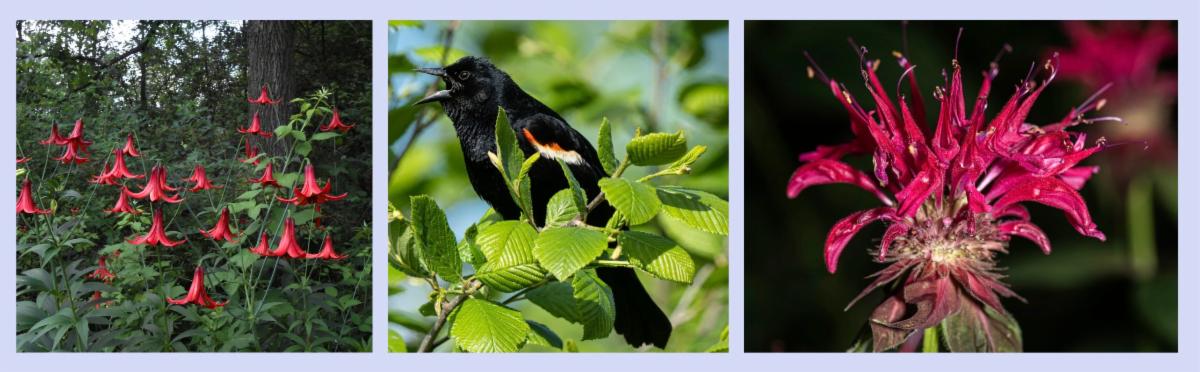
Left: A red Canada Lily cluster. Photo credit Susan Haney
Center: A red-winged blackbird (Agelaius phoeniceus). Photo credit: Bill Rathfon
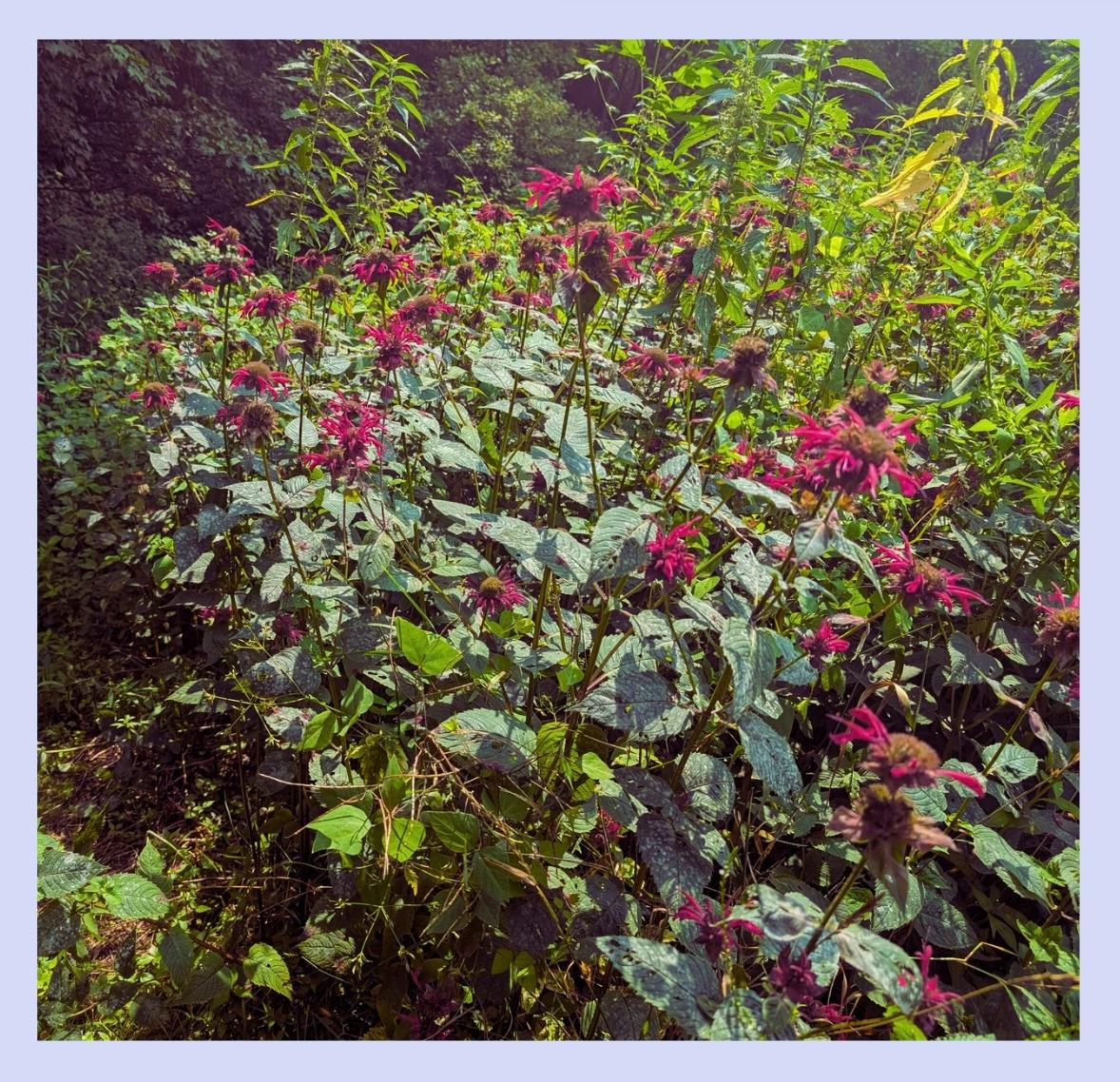
Right: A red bergamot bloom. Photo credit: Bill Rathfon
| | |
Canada Lily
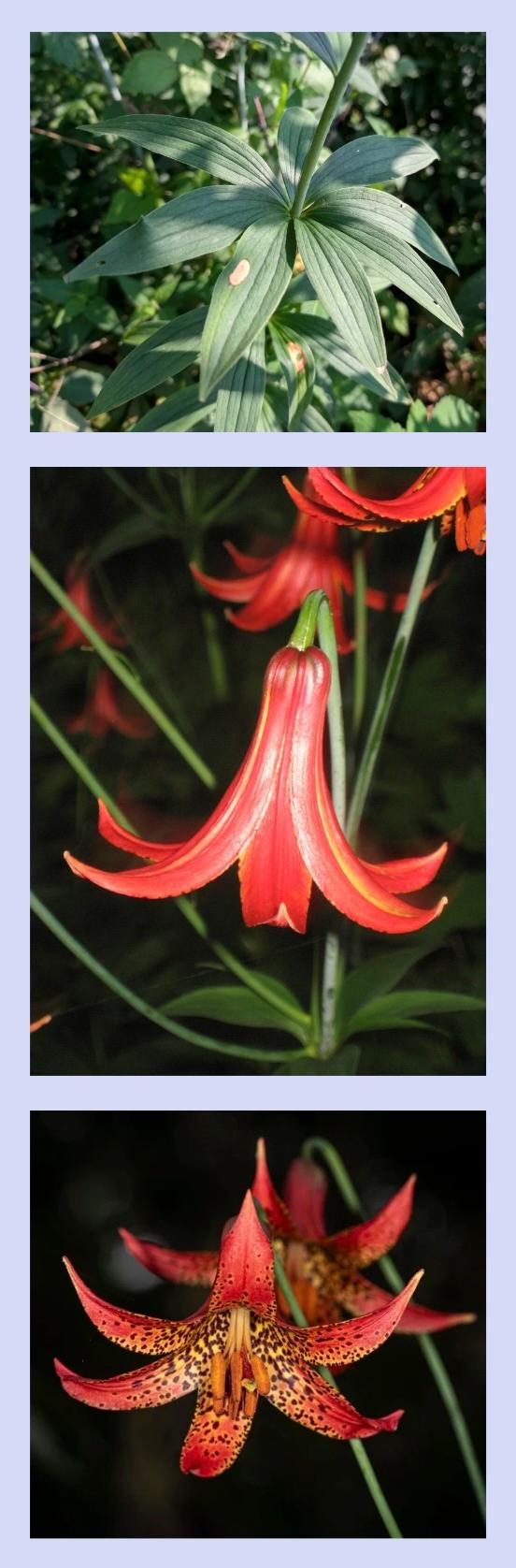
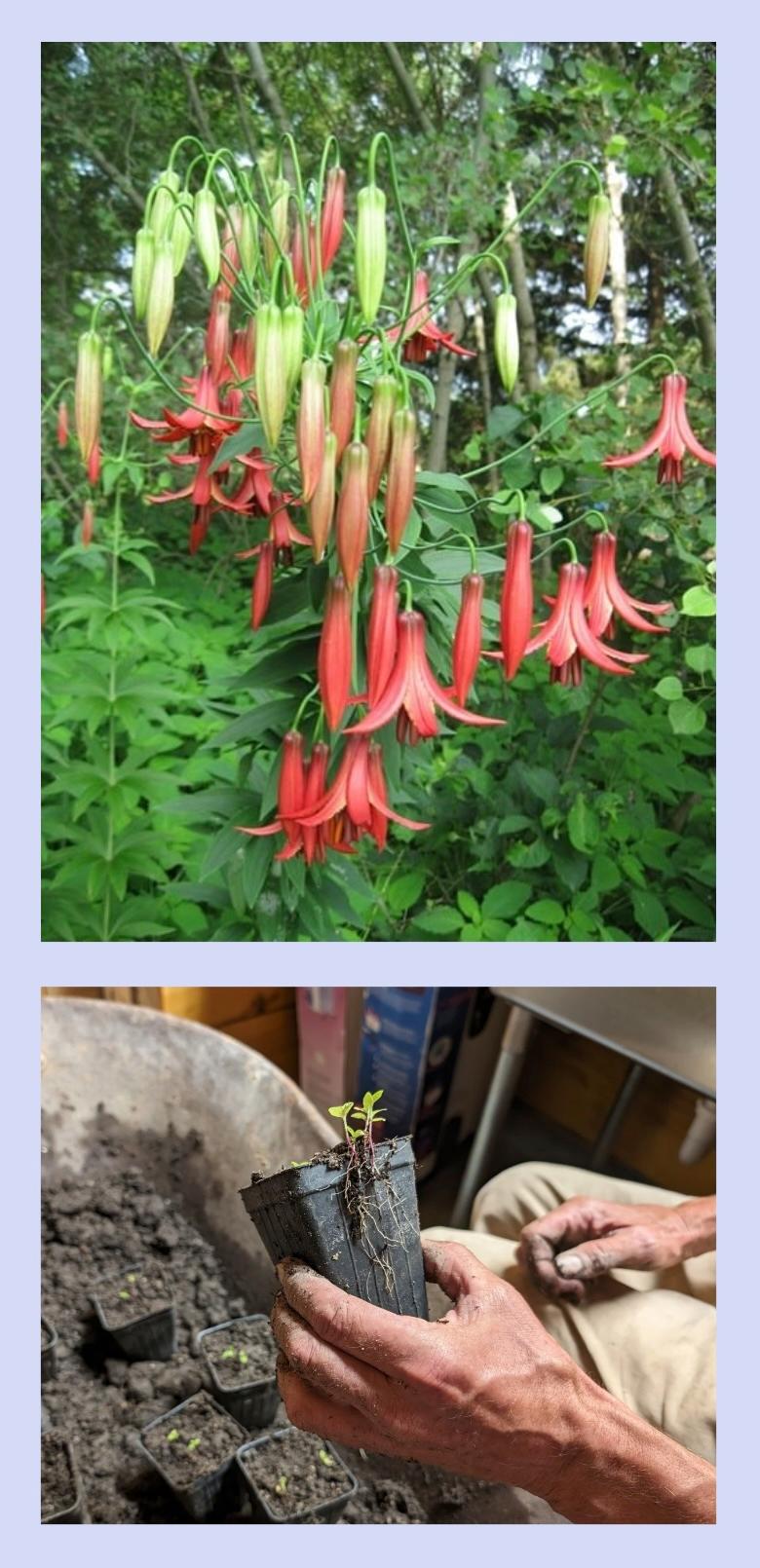
On the red lily’s round stem at regular intervals are rosettes (image, top) of three to twelve leaves. Each rosette marks a year’s growth. These umbrella-like leaves are the plant’s energy centers. They photosynthesize sunlight, moisture, and soil chemicals to grow the plant. By the second to fifth year, energy shifts to the stem’s tip where three to four wire-thin stalks stretch out to support slender, pale green buds. Over twenty-four hours or so, the bud gradually splits, and the red flower emerges to hang facing downward. Its petals curl up a little.
If I imagine watching this growth in fast-forward photography, I see something like a dancer’s choreographed moves, stretching up, bending down, reaching up again with a final small gesture. (image, center) In fact, that is happening, according to plant biologists. Molecules and hormones in its cells choreograph the red lily’s growth. The timing connects the lily with other plants and animals for mutual benefits, ecologists say. When a migrating hummingbird darts by, for instance, upturned petals ease a long beak’s access to the nectar inside the red flower.
When I notice that glowing red lily in the green tangle, I want to touch it. Sometimes, my hand turns the flower up so that the lily and I are face-to-face. The petals’ soft matte yellow inside with black freckles, brown stamens, and gold pistils delights me. Other people experience the delight, too. Once when I turned a red Canada lily flower to face an Amish friend, she smiled. “Wow,” she said. (image, bottom. Photo credit Bill Rathfon)
| |
What about predators such as deer? Red Canada lilies are food for herbivorous deer, but not because of the red flowers. Deer eyes can’t see the color red, only blues and greens. To a deer, red Canada lilies are just green groceries. Not to me. When I find a glorious tall, flower-full lily gone, browsed overnight by deer, I feel loss. But that’s life in lily space. Deer are part of the lily’s ecosystem. After decades of absence from central Pennsylvania, deer populations are now back at historic levels. Aggressively browsed woods, fields, and wildflowers are normal again. (Photo credit James Lesher)
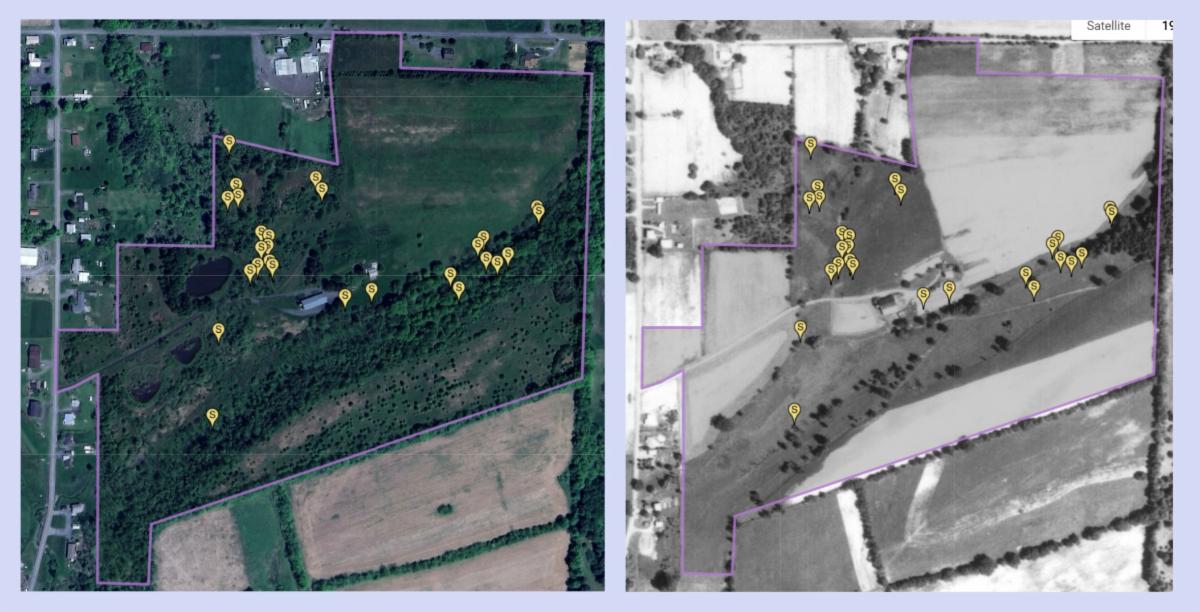
| Actually, animal foraging benefits the lilies. Lily eaters—deer and other animals—spread lilies by pooping seeds as they travel, maybe far from the eaten plant. That might explain why red Canada lilies now show up anywhere at ChicoryLane from year to year. Around 2012 we inventoried twenty-five or so lily plants (map image, left) scattered around ChicoryLane in varied locations, usually in wet spots. There's no telling how long the seeds had waited to germinate. For decades, those locations had been in dry, open, farmed fields and pastures. No lilies. Question: how long do lily seeds wait in the "seed bank" before "deciding" to grow? | |
Images, above
Left: Yellow markers indicate 2012 Canada lily locations (Photo credit: Google Earth, 2025)
Right: Yellow markers indicate 2012 Canada lily locations in 1971 farm fields (Photo credit: Penn Pilot)
| |
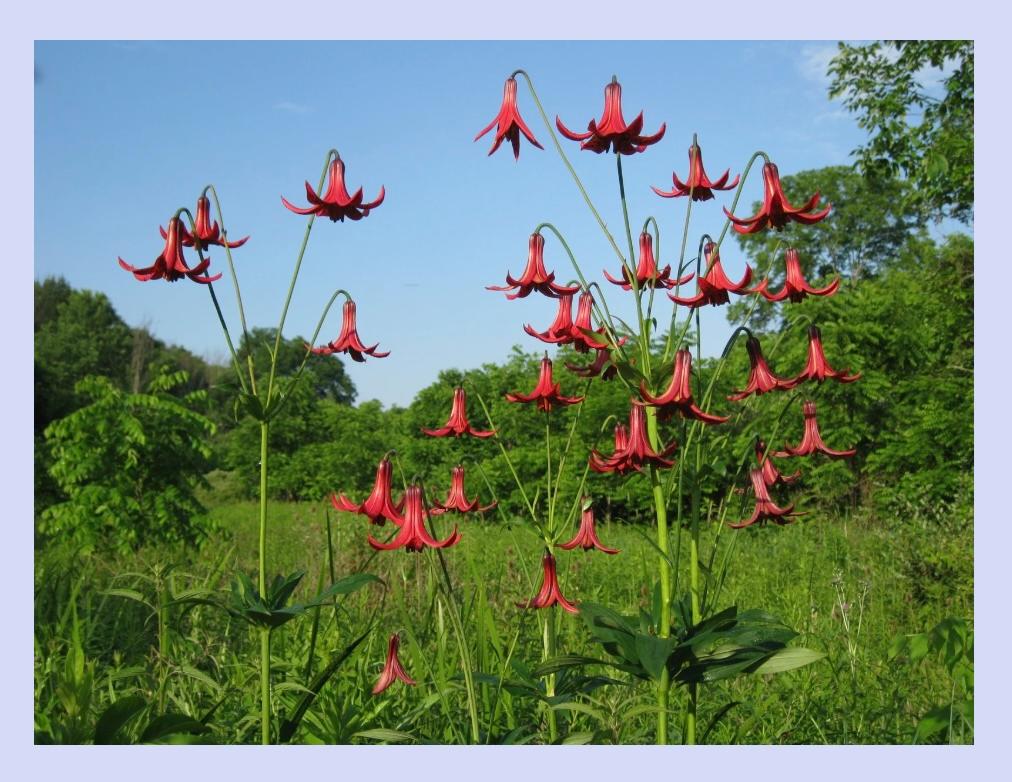
The red Canada lily is a survivor. Its seeds wait for years maybe in unfriendly conditions before metamorphosis into roots, stalks, leaves, and flowers. (image, top) On my walks around ChicoryLane, when the red lily catches my eye, it takes me into another world where other-than-human life carries on.
Lilies don’t “need” us to survive, but sometimes we try to increase their chances at ChicoryLane. Land manager James Lesher collects red Canada lily seeds, pots them (image, bottom) in animal-proof boxes, waters them for (maybe many) months until they sprout, then transfers the sprouts to the landscape. After that, we wait. Two to five years later, we might see a red lily bloom, depending on the plant’s interactions between predatory voles, rabbits, deer and the neighboring plants’ demands for air, water, and light.
More than twenty-five years ago James visited ChicoryLane for the first time. As he drove along the lane scanning the landscape, red Canada lilies in the grasses caught his eye. Like invitations. That day James agreed to work here.
| |
Red Bergamot
What about other midsummer reds? The red bergamot or bee balm (Monarda didyma L.), for example. What’s its life story?
Bergamot and Canada lily are both wild natives, but they are different characters. Bee balm's square, finely-haired stems are segmented by pairs of finely-haired leaves and topped by multi-petaled flowers. Unlike the elegant, solitary Canada lily, bee balm is expansive, pushy. It grows in a patch of multiple stems and flowers. When it establishes a colony in the landscape, it crowds its neighbors incompatibly. Not much competes with bee balm. Stinging nettles (Urtica gracilis L.) maybe.
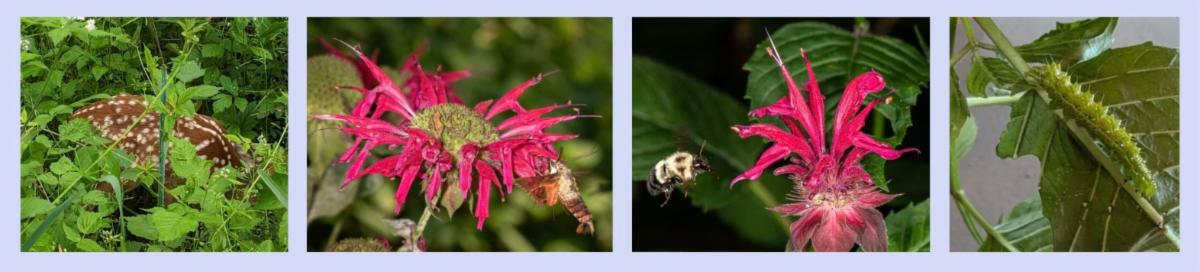
| Foraging deer generally ignore bee balm although fawns sometimes rest in its mass of stems. Hummingbirds, moths, bees, and flies feed on nectar in the flowers’ open-mouthed blooms. Caterpillars or the larval form of butterflies and moths feed on the leaves. A many-headed patch of red bee balm is a busy insect habitat. It would not surprise this midsummer red plant to learn that three quarters of the earth’s species are insects and half of all insect species are plant-eaters. | | |
Images, above
Left: Fawn resting in bergamot patch
Center: Hummingbird moth and bee feeding on bergamot flowers (Photo credits: Bill Rathfon)
Right: Caterpillar feeding on bergamot leaves
What am I saying here? ChicoryLane is one place, but it encompasses worlds. A few humans and a multitude of other species co-exist here separately and in connection. That’s all, no more and no less.
References
- “Canada Lilies,” chicorylane.com
- "Weed Walk,” chicorylane.com
-
Craig Holdredge, “The Story of an Organism [Common Milkweed]” in Thinking Like a Plant (2013)
-
David George Haskell, “May 18--Herbivory” in The Forest Unseen (2012)
- Penn Pilot Historical Aerial Photographs of Pennsylvania, PASDA Imagery Navigator, Penn State University
| | | | |
ChicoryLane is an ecological reserve near Spring Mills protected by a Conservation Easement held by Clearwater Conservancy. Its 68 acres are actively managed for conservation.
The landscape is natural and scenic. It includes wetlands and meadows, streams, remnant and successional forests, and a grassland. This diversity of habitats is especially inviting to birds and butterflies. A system of mowed trails makes most of the property accessible to walkers.
| | | | |