Janke Innovations in Sustainability Science Research Fund
In December 2015, FAU’s Center for Environmental Studies received a $1 million gift from Dr. Walter and Lalita Janke to establish the Walter and Lalita Janke Innovations in Sustainability Science Research Fund. Over the past six years, this fund has awarded $330,000 to FAU faculty research that advances knowledge and applications relevant for improving environmental sustainability.
|
|
CES Researchers share knowledge with Pine Jog’s Climate READY Ambassadors
Last fall, FAU's Pine Jog Environmental Education Center learned that they had been awarded funding from NOAA's Environmental Literacy Program to implement their new Climate READY Program - Resilience Education & Action for Dedicated Youth. One aspect of the program involved recruiting high school students to become Climate READY Ambassadors, aiming "to educate younger students, teachers, and local residents about how our communities can become more resilient to environmental challenges and work together toward equitable climate solutions."
On July 10, the 28 students, representing nine high schools within six of Palm Beach County’s most climate-vulnerable communities, gathered at Galaxy E3 Elementary School for their first day of an intensive, week-long institute. CES' Dr. Colin Polsky kicked off the Ambassador Institute by providing students with a primer on Climate Change 101. After the presentation, one student remarked, “Dr. Polsky’s presentation left a real impact on me. I learned so much new information about the climate, and he showed lots of surprising data/statistics and graphs/diagrams that let me visually see what is going on in our atmosphere.”
|
|
Then on Tuesday, July 13, the students heard from several of CES' researchers from our Coastal Resilience Research Lab. The researchers presented a few of the exciting research projects that they have been working on at CES. They also shared their experiences of being graduate students at FAU. |
|
|
The institute wrapped up on Saturday, July 17 after hearing from over 16 presenters from partners in South Florida, from local government to non-profits. Now equipped with knowledge gained in the Institute, the students will serve as mentors to younger afterschool students in the fall of 2021 and participate in community outreach events in the spring of 2022. Learn more about this innovative program by visiting: www.pinejog.fau.edu/student-programs/climate-ready.php
|
|
Understanding Algal Blooms in Florida
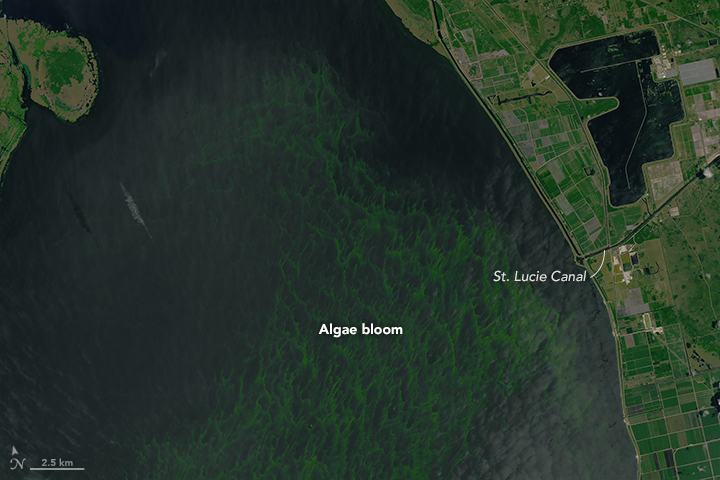
Do you have questions about the recent explosion of harmful algal blooms (HABs) in Lake Okeechobee and the St. Lucie Estuary? CES, in partnership with the United States Geological Survey’s (USGS) Greater Everglades Priority Ecosystem Sciences Program, has developed a series of online modules that can assist in understanding the science and challenges related to algal blooms and improving communication among decision makers and others.
The online series of short videos are designed to provide basic, jargon-free, scientific information on HABs: what they are; where they live and grow; and causes, impacts, and potential mitigation of blooms. Accompanying each video is a one-page fact sheet with the important takeaway concepts from each video. This free, online education series is directed toward resource managers and decision-makers, but also is a great resource for the general public who desire to have a better understanding of HABs. Learn more by visiting: www.ces.fau.edu/usgs/understanding-algae/
|
|
Satellite view of cyanobacteria (blue-green algae) blooms in Lake Okeechobee. Photo credit: NASA
|
|
CES-USGS Research Support Program
The Center for Environmental Studies (CES) recently established the CES-USGS Research Support Program for FAU graduate students interested in, or currently conducting, Everglades restoration-related research. The Program provides a stipend and tuition costs for one graduate student per year.
CES is pleased to announce John Ricca has been chosen as the 2021 CES-USGS Research Support Program (RSP) awardee for his research project titled “Interactions Between Cyanotoxins and Living Cyanobacterial Cells Studied Using Stable Isotopes.” John, who is pursuing a Ph.D. in Chemistry, will be working part-time for CES as he pursues his research, along with working collaboratively with a U.S. Geological Survey (USGS) scientist as a part of the RSP program. This program aims to build a strong linkage between the science being conducted at FAU and USGS resource managers and scientists. CES manages a research contract under the USGS’ Greater Everglades Priority Ecosystem Sciences (GEPES) Program. USGS’ GEPES Program ensures that sound science is the guiding principle for management decisions and restoration research for America’s Everglades. |
|
CES Master's Graduate Research Assistants Conduct Thesis Defenses
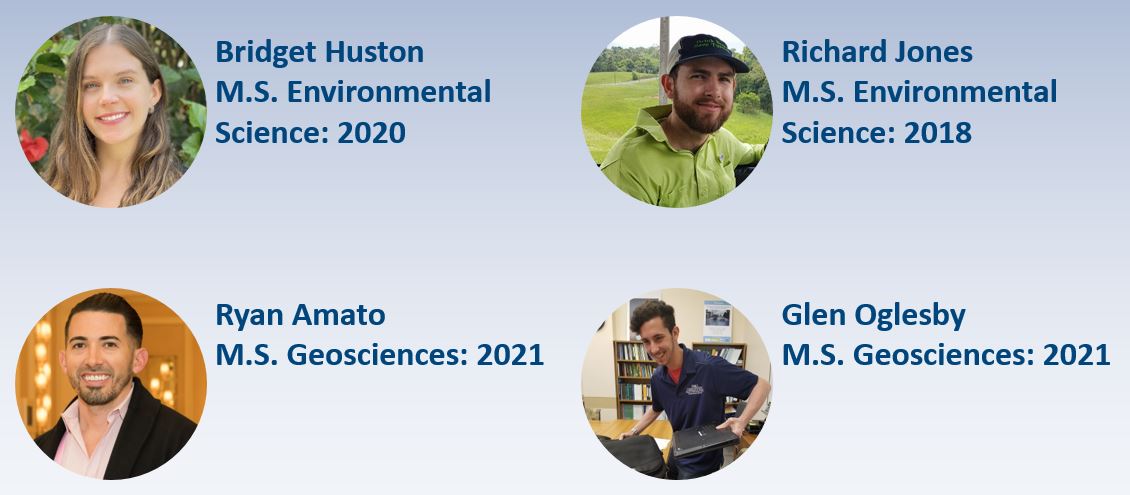
CES would like to congratulate our research students Glen Oglesby and Ryan Amato on defending their master's theses June 29th and June 30th, respectively, via remote video conferences. Glen joined the CES research lab in April 2019, and Ryan joined the lab in October 2019. They teamed up in 2020 to work on CES' "The New First Line of Defense: Building Community Resilience Through Residential Risk Disclosure" research project. Glen's thesis, "It's All Just in Your Head: How Does a Person's Cultural Identity Affect Their Flood Risk Perceptions and Mitigation Behaviors?" and Ryan's thesis, "Hiding in Floodplain Sight: How Does Flood Risk Information Affect Flood Risk Perceptions and Mitigation Behaviors?", both worked in tandem to answer questions involving how mitigation and home-buying are influenced by emotions and worldviews. Their research is going to help CES move forward on a multi-institutional research project funded by the National Academy of Sciences (NAS) Gulf Research Program to help renters and homebuyers increase their coastal resilience.
|
|
Master's Graduate Research Assistant
|
|
Master's Graduate Research Assistant
|
|
|
|
|
|
|