July 2021 | Volume 13 Issue 7 |
|
Hello!
The month of June was busy with NPAW, see the update below, including our contest winners! There's lots of virtual and in-person events in the Upcoming Events section, which is great to see! There's also quite a few articles under "Native Prairie in the News"! Make sure to check them out!
If you missed our June webinar presentation, Corey Olson from the Wildlife Conservation Society Canada, talked about bat conservation.The webinar recording is on our YouTube Channel!
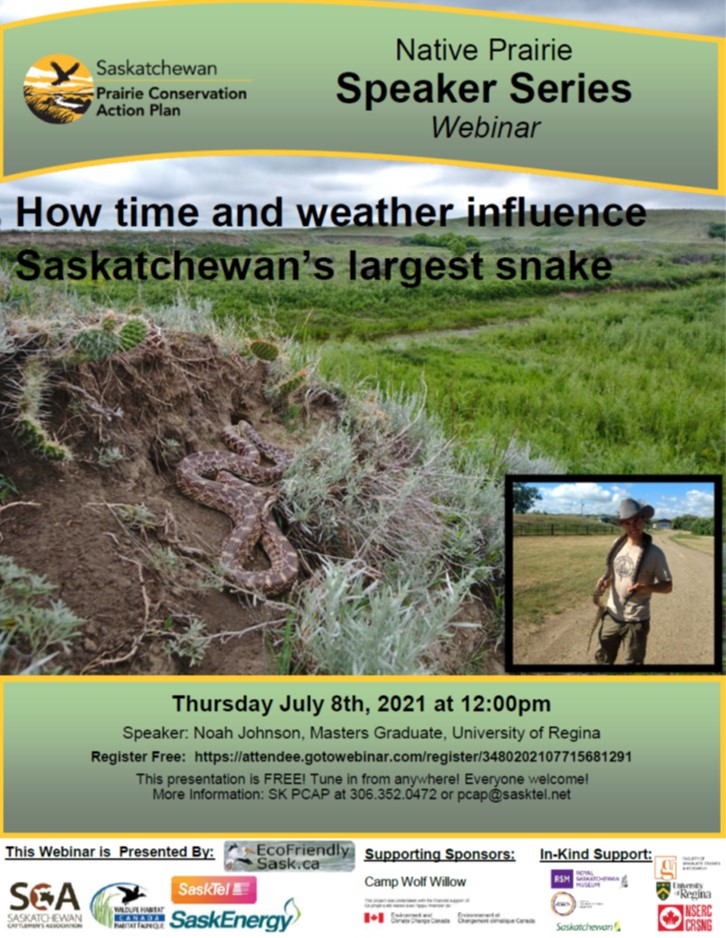
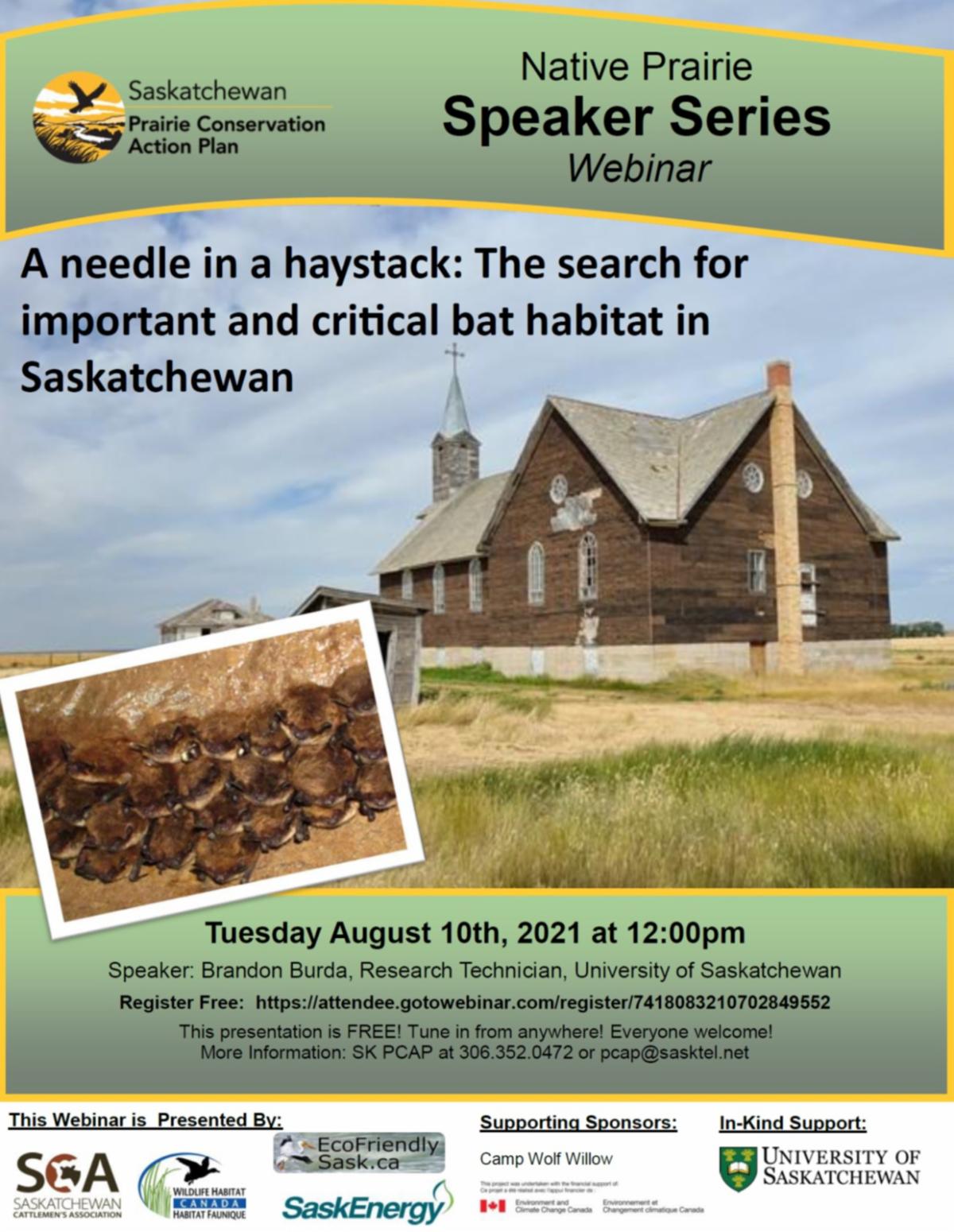
This month's NPSS presentation is by Noah Johnson, who will discuss bullsnakes! You can register here! You can also register for the August webinar which will be Brandon Burda talking about bats. Register here!
And finally, we would like to thank our sponsors for their generous support: Camp Wolf Willow, EcoFriendly Sask, K+S Potash, Pembina Pipelines, Saskatchewan Cattlemen's Association, SaskEnergy, SaskPower, SaskTel, Wildlife Habitat Canada and Environment and Climate Change Canada, as well as the continuous support of all the PCAP Partners.
Have a great summer!
Carolyn Gaudet, SK PCAP Manager
Ph. 306 352 0472
|
PCAP Recap: Native Prairie Appreciation Week, June 13-19
SK PCAP would like to extend a heartfelt thanks to all partners, followers and native prairie enthusiasts for spreading the word about native prairie and the importance of its conservation.
Here are the highlights:
- In addition to an official proclamation from the SK Ministry of Agriculture and the SK Ministry of Environment, the urban municipalities of Weyburn, Moose Jaw, Regina and Saskatoon all proclaimed Native Prairie Appreciation Week.
-
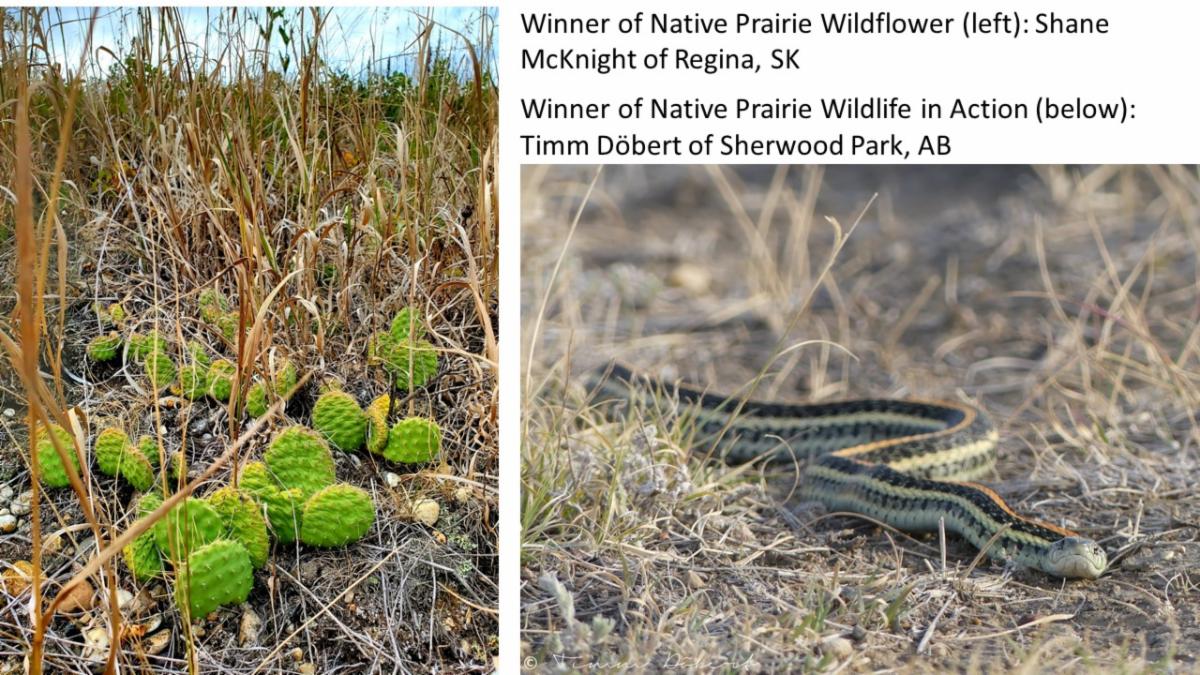
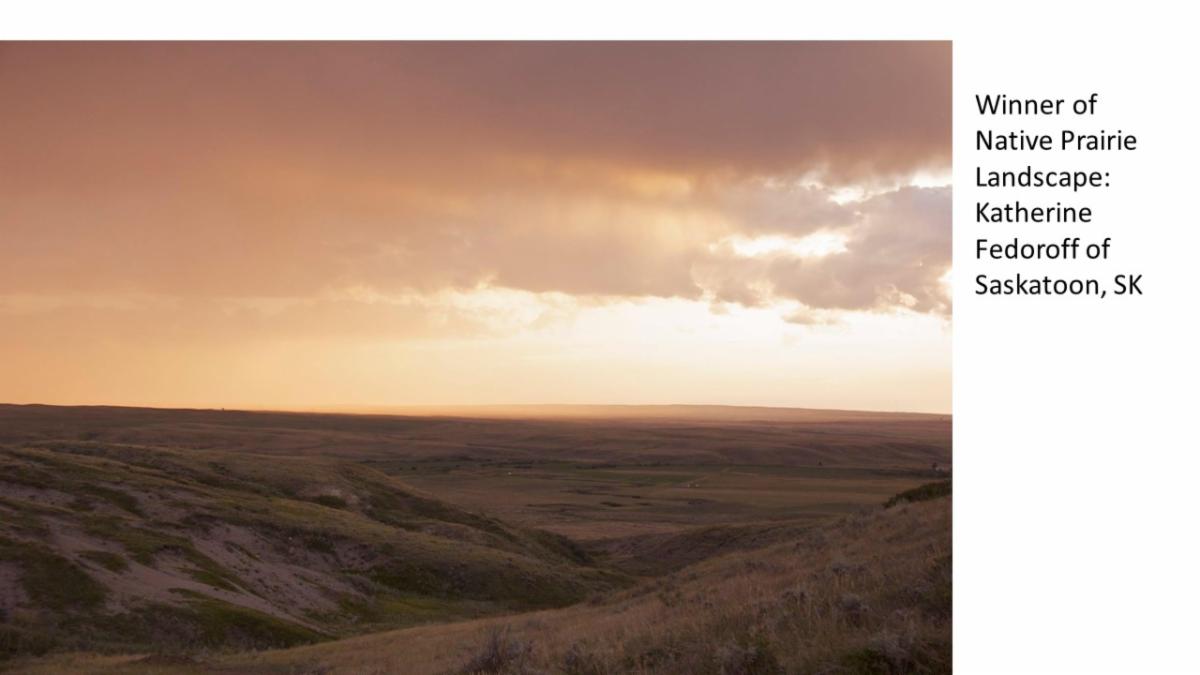
Our Native Prairie Photo contest received over 130 entries in three categories: Native Prairie Landscape, Native Prairie Wildflower, and Wildlife in Action. Thank you to everyone who submitted photos and voted for their favourites! It's a great way to share the beauty and diversity of native prairie landscapes. You can see all entries on our Facebook page HERE.
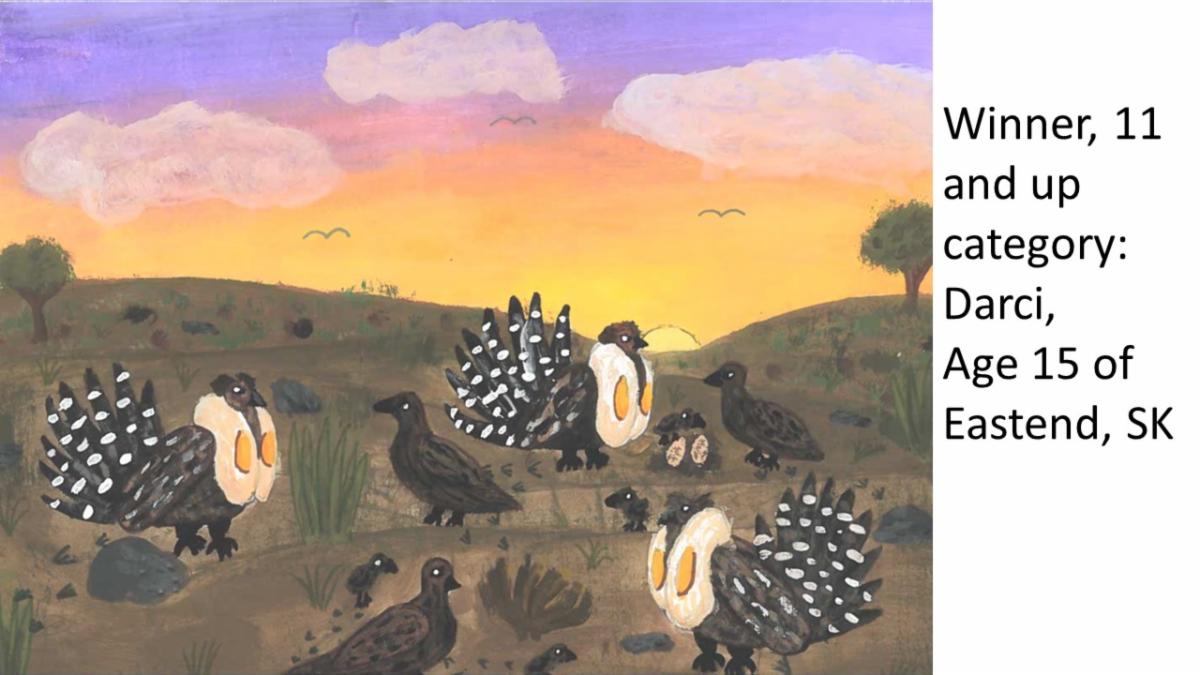
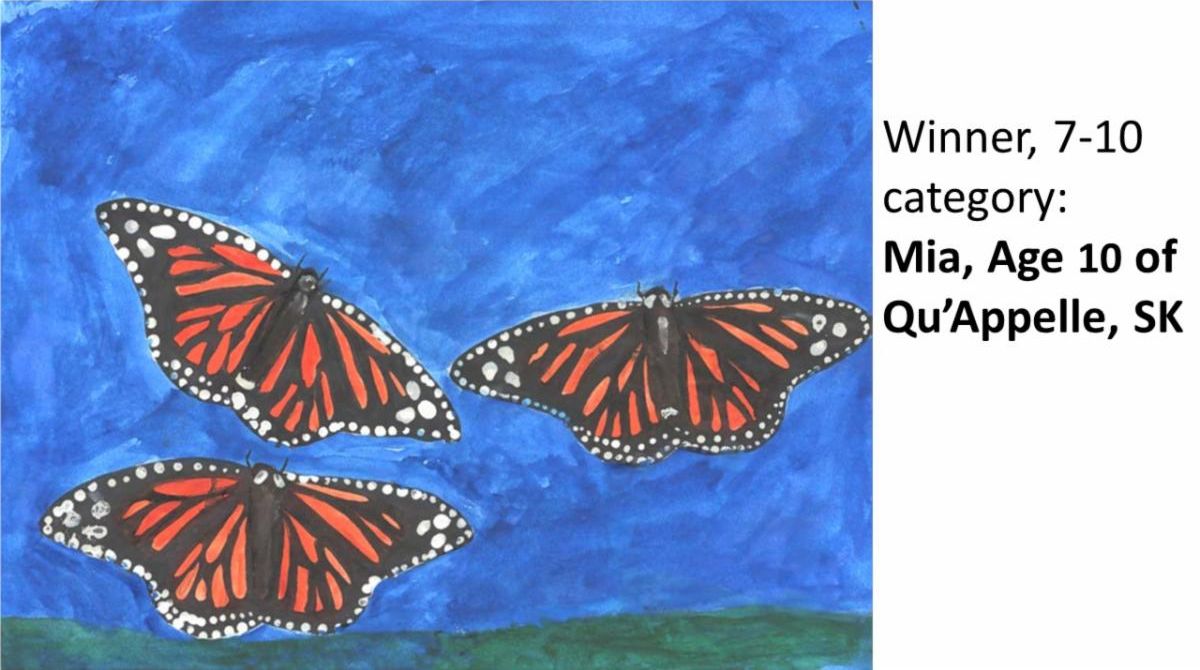
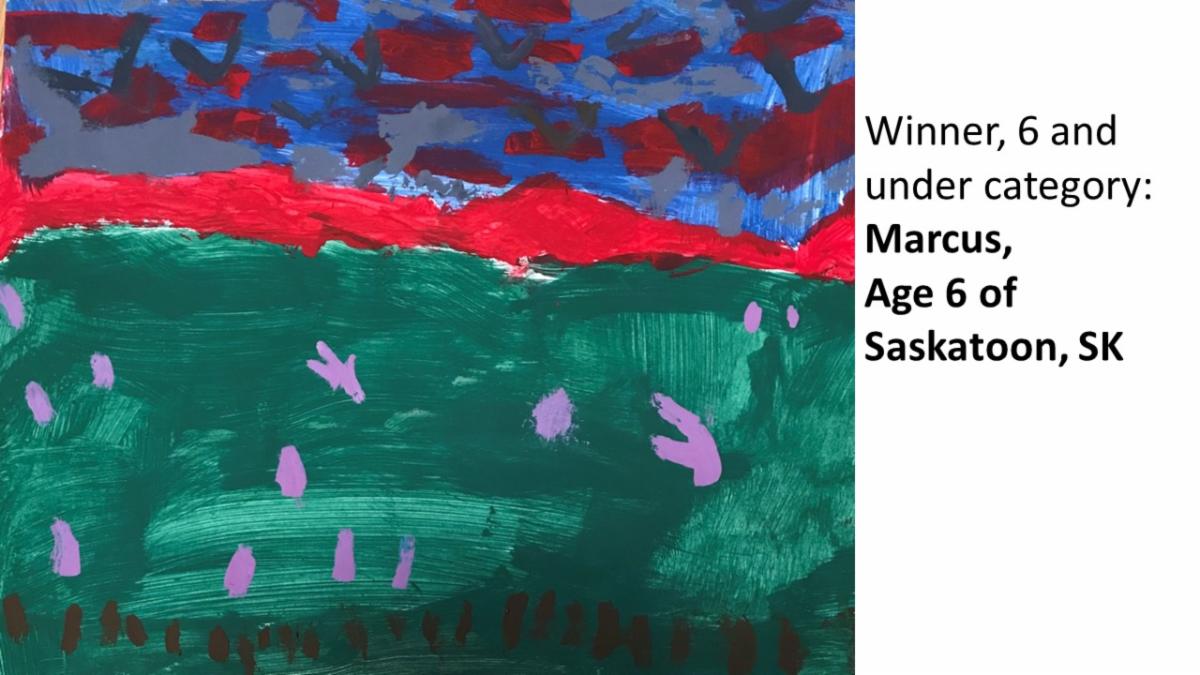
- Almost 400 posters were submitted to the Native Prairie Youth Poster Contest this year! The winners are below!
-
We also had 3 webinars during NPAW, they were well attended with over 300 individuals tuning-in for the webinars and an additional 220 views on YouTube! You can find our YouTube Channel here!
2021 NPAW Youth Poster Contest Winners
|
2021 NPAW Social Media Photo Contest Winners
|
PCAP Partner Spotlight...
Nature Conservancy of Canada
Submitted by Daphne May, NCC Communications Manager
The Nature Conservancy of Canada invites you to explore a new hiking trail at Asquith
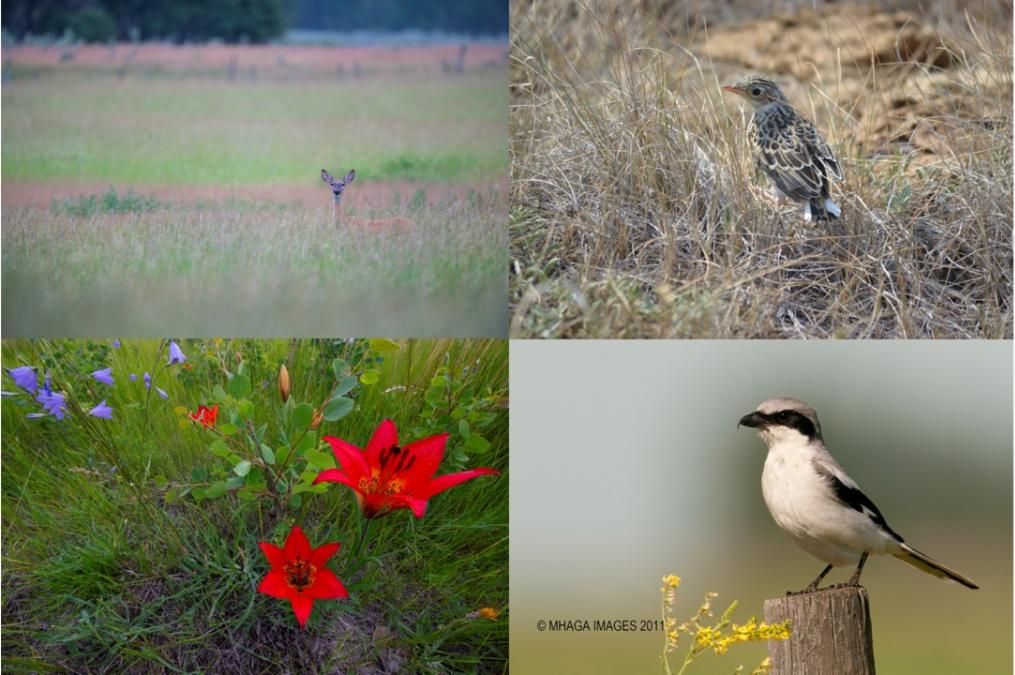
NCC’s Asquith property is located approximately 45 minutes from Saskatoon. The trail leads you through scenic landscapes — from grasslands bursting with wildflowers, to canopies of trees and rolling sand dunes.
As you lace up your shoes to start the hike, you’ll want to have your camera handy, as the trail makes for great photo opportunities. Native grasslands and wildflowers abound, and there’s a chance you could see incredible migratory birds flying above or swimming below in the wetlands.
NCC’s Asquith conservation area consists of 543 hectares (1,343 acres) of ecologically significant land and water. This area contributes to an important wildlife habitat corridor in the Saskatoon Prairie Natural Area.
Thanks to support from the Saskatoon Nature Society, the Asquith property offers a well-marked, mowed trail complete with interpretive signs. The trail is ideal for those keen on a leisurely stroll, with the chance to see the area’s striking bird life and flora up close.
Getting out in nature provides an opportunity to explore and recharge. And the Asquith property is the perfect place to do both. The trail winds through six kilometers of different traditional prairie landscapes. It’s a special area that is home to many plants and animals. At-risk species you may see include American badger, bobolink, loggerhead shrike, Sprague’s pipit and northern leopard frog.
Here’s how to get there: 1. From Saskatoon, take 22nd Street West/SK-14 West toward Asquith. 2. Turn right onto SK-376 North. 3. Turn right on Township Road 374. Drive for approximately 200 meters, until you reach a parking area and welcome sign.
|
Images supplied by NCC, copyrights belong to Jason Bantle (top-left and bottom-left), NCC (top-right) and May Haga (bottom-right). |
Healthy, sustainable landscapes support pollinators… and people too
Submitted by Ducks Unlimited Canada
There are approximately 380 bee species in Prairie Canada and these tiny creatures significantly benefit from shared conservation efforts on the landscape.
Research shows that healthy landscapes that host mixed natural areas including wetlands, grasslands, and shelterbelts – all systems supported by Ducks Unlimited Canada’s (DUC) conservation work – aid in increased biodiversity and safe spaces for pollinators. And more pollinators mean increased production of our crops and food.
“Mixed natural areas play an important role in providing resources to wild pollinators for nesting and foraging, especially when located in cropped landscapes,” says DUC research scientist, Jim Devries, who also conducts research on pollinators for the organization. “And these pollinators return the favour. They help increase crop production through increased pollination. Maintaining places for pollinators to reside also supports other beneficial insects, and biodiversity in general, including habitat for amphibians, mammals and birds.”
Bees and other pollinators have a natural partnership with agriculture, and with crops like canola and soybeans, in particular. Many studies of insect pollination in canola demonstrate increases in yield. These results make a strong case for setting aside areas that benefit pollinators to further maximize crop production. And when we include mixed natural areas on the landscape, we all benefit from resulting carbon storage, biodiversity, increased soil retention, and water filtration.
In addition to conserving natural areas, we can help support local pollinators by increasing the type and variety of flowers available throughout the growing season. A diversity of available floral resources largely determines the ability of grasslands to support pollinator species.
Providing a pollen- and nectar-rich mix of agricultural legumes is a good step, and that’s why DUC offers a Pollinator Power Pak seed blend as part of its new Marginal Areas Program on the Prairies. The vision for this aspect of the program? If every producer planting grass incorporates a floral component into their stand, we’ll end up with a moderate density of flowers over thousands of acres.
And that could mean the difference between thriving and barely surviving for some wild bee species. A little-known fact about bees is they don’t all travel the same distance for food. While the largest bee species, including some bumblebees, will travel up to 1.5 km between nest and forage, the tiniest bees only venture 75 m, meaning they need to find suitable forage in close proximity to nest sites.
“The contribution farmers and ranchers make in providing habitat for pollinators is significant and should be recognized,” says Paul Thoroughgood, DUC’s agriculture lead. “Natural areas, wetlands and flowering crops like canola and legumes all play a role in sustainable agriculture by providing for the needs of pollinators as well as the current and future health of our soil and water.”
|
PCAP Partner Events
Stargazing, northern lights chasing and nighttime photography have become popular activities and are a great way to explore your province and the beauty of the night sky that we all share. Join two local experts and learn why dark skies are important for the environment, tips and tricks for stargazing and northern lights chasing, and how to take photos of the nighttime sky. Not only will you learn skills to get started, you will also learn how to safely undertake these activities.
The Saskatchewan Pasture Tour will take place on August 10th, starting at 9 a.m., near Francis, Saskatchewan. (That's 45 minutes south east of Regina) .Come to a casual meeting out in the pasture to share and learn with your peers and specialists for new ideas to get the most out of your own pastures.
The following topics will be discussed: Water Quality and Delivery, Plant Identification and Invasive Species, Grazing Management, Fertilizing your forages, Salinity in your soils
To register, contact the Saskatchewan Forage Council at office@saskforage.ca or 306-731-7610.
|
|
SK PCAP Native Prairie Speaker Series
Plan to attend our July Native Prairie Speaker Series webinar!
|
Register for the August Native Prairie Speaker Series too!
|
July 6 @ 6:30 PM CST
July 14 @ 11 AM CT
(or 10 MT)
July 15 in Gladmar, SK
July 20-29 @ 9 AM MT
July 27 in Lethbridge, AB
July 29 in Brooks, AB
Saskatchewan Pasture Tour
August 10 in Francis, SK
August 31-September 2
|
Nature United recently published a study that is the first-ever comprehensive evaluation of the potential of nature to mitigate greenhouse gas emissions in Canada. The study estimates the annual mitigation potential for each province with greatest potential in SK, ON, QC, BC and MB.
|
Many of us car owners in SK will be receiving an unexpected SGI rebate. Consider donating it to conserving grasslands for many future generations and species through the Field of Dreams Initiative.
For every dollar donated to Field of Dreams, Heather Ryan and David Dubé will donate a dollar to Nature Conservancy of Canada to support conservation throughout the province.
|
Native Prairie in the News
|
2021/22 Speaker Series Supporting Sponsors
Camp Wolf Willow
|
2021/22 Education Programs:
Presenting Sponsors:
|
2021/22 Education Programs
Supporting Sponsors:
|
|
Carolyn Gaudet, Editor, Saskatchewan Prairie Conservation Action Plan Newsletter |
|
SK PCAP gratefully acknowledges financial support in 2021-2022 from:
Camp Wolf Willow, Ducks Unlimited Canada, EcoFriendlySask.ca, Parks Canada - Grasslands National Park of Canada, Pembina Pipelines, Saskatchewan Cattlemen's Association, Saskatchewan Ministry of Agriculture, Saskatchewan Ministry of Environment - Fish and Wildlife Development Fund, SaskEnergy, SaskPower, SaskTel, University of Regina, University of Saskatchewan - College of Agriculture and Bioresources, Water Security Agency and Wildlife Habitat Canada.
SK PCAP gratefully acknowledges in-kind support for 2021-22 from:
Agriculture and Agri-Food Canada - Science and Technology Branch, Canadian Parks and Wilderness Association, Environment Canada - Canadian Wildlife Service, Friends of the Royal Saskatchewan Museum, Friends of Wascana Marsh, Meewasin Valley Authority, Native Plant Society of Saskatchewan, Nature Conservancy Canada, Nature Saskatchewan, Parks Canada - Grasslands National Park, Prairie Wind & Silver Sage, Ranchers Stewardship Alliance Inc., Redberry Lake Biosphere Region, Saskatchewan Association of Rural Municipalities, Saskatchewan Association of Watersheds, Saskatchewan Bison Association, Saskatchewan Burrowing Owl Interpretive Centre, Saskatchewan Cattlemen's Association, Saskatchewan Environmental Society, Saskatchewan Forage Council, Saskatchewan Ministry of Agriculture, Saskatchewan Ministry of Environment, Saskatchewan Ministry of Energy and Resources, Saskatchewan Ministry of Parks, Culture and Sport, Saskatchewan Stock Growers Association, Saskatchewan Wildlife Federation, SaskEnergy, SaskOutdoors, SaskPower, Society for Range Management - Prairie Parkland Chapter, South of the Divide Conservation Action Program Inc., University of Regina, University of Saskatchewan - College of Agriculture and Bioresources.
|
|
|
|
|
|
|