July 2023

Frequently Asked Questions on California Certified Payroll Reporting


1. Who must submit certified payroll records?

All contractors and subcontractors working on public works projects (except for those listed below) must submit electronic certified payroll records to the Labor Commissioner. The Labor Commissioner has exempted the following projects from the requirement:

(a) Projects monitored by the following legacy Labor Compliance Programs:

  • California Department of Transportation (Caltrans)
  • City of Los Angeles
  • Los Angeles Unified School District
  • County of Sacramento


(b) Projects covered by a qualifying project labor agreement.

(c) Projects covered by the small project exemption. The small project exemption applies for all public works projects that do not exceed:

  • $25,000 for new construction, alteration, installation, demolition or repair 
  • $15,000 for maintenance


2. Is the electronic certified payroll reporting system the only way to submit certified payroll records to the Labor Commissioner?

Yes. All contractors must submit their certified payroll records to the Labor Commissioner using the DIR's online system. It offers two options for submitting certified payroll records: entering the information directly using the online form or uploading xml files.


3. Is every company responsible for submitting its own payroll for each project on which it is working?

Yes. Each contractor and subcontractor must submit certified payroll records directly to the Labor Commissioner using DIR's online system.


4. When/how frequently must the certified payroll records be submitted?

Certified payroll records must be submitted at least monthly (within a month after the end of the payroll period) or more frequently if more frequent submission is required by the contract with the awarding body. The best practice is to submit the records weekly or at the conclusion of each payroll period.


5. If the awarding body has not registered the project with the DIR, how can I submit my certified payroll records?

Projects must be registered with the DIR using the PWC-100 form in order for contractors and subcontractors to submit certified payroll records for those projects. You should contact the awarding body to confirm that the project was registered. If the awarding body has not registered the project, you should ask it to complete the registration as soon as possible. If you have made this request, but the awarding body still has not registered the project, please contact the DIR for further assistance at publicworks@dir.ca.gov.


6. If I am required to submit certified payroll records to a union, to the prime contractor, or to the awarding body or a Labor Compliance Program, do I still have to submit certified payroll records to the DIR?

Yes. Submitting certified payroll records to other agencies does not fulfill the requirement to submit certified payroll records to the Labor Commissioner/DIR.


READ MORE

Public Works Manual – Assistance for Contractors to Follow California Prevailing Wage Laws


The Division of Labor Standards Enforcement (aka Labor Commissioner) has had their Public Works Manual on the DIR website for several years now. True it does need some updating since it was published in 2018 but it is an extremely valuable tool for all contractors performing public works projects in California. The full document can be found here. From the Labor Commissioner “This Manual is designed to be used by the Labor Commissioner’s Office to ensure consistent, timely, and accurate enforcement of the law statewide and is also intended as an educational tool for our public works stakeholder community.”


(Editor comment - Note specifically Page 15 Section 3.1.6 Contractors' Obligation To Electronically Submit Certified Payroll Records ("eCPRs) and also maintain copies equal to that required in form A-131) 

Your Employment Law Poster is Up, but What About Your Wage Orders?


Nearly every employer knows about the requirement to post California State and Federal employment laws where their employees can read them, but often when we ask people about their IWC Wage Orders, they aren’t exactly certain what we’re talking about.   


Anyone who owns or manages a business has the responsibility to post a minimum of two things in the workplace for employees:

  1. The current State/Federal Employment Law poster(s) and
  2. Your Industrial Welfare Commission (IWC) Wage Order(s).


What are IWC Wage Orders?

The Industrial Welfare Commission (IWC) Wage Orders provide your company and your employees with information about the wage and hour laws in your particular industry. Different industries have different rules and regulations so it's important to post the correct wage order.


There are 17 different IWC wage orders, and some companies may need to post two, one for their office staff and another one for employees working out in the field.


Examples of information you can find in the IWC wage orders include requirements about breaks, lunches, split shifts, maintaining uniforms and other logo wear for your company, and more!


Construction can be found under IWO 16 https://www.dir.ca.gov/IWC/WageOrderIndustries.htm


IWC wage order are a great resource to turn to when you (or your employees) have questions like:

  • How do I handle reporting time pay when an employee is sent home from work early?
  • Can I deduct breakage, loss of equipment, or an employee's cash drawer coming up short from an employee’s wages?
  • What are the rules for requiring employees to provide their own tools for work?


Yes, you will find answers to these questions and more in your wage orders. When posting any required notices, attach them to the wall in a way that makes it readable by your employees. Wondering how to get a copy of your IWC wage orders? Get a copy online through the CA Department of Industrial Relations. 

News Alert: COVID-19 Paid Sick Leave Grant Program for Employers

By: Roger M. Mason, Esq., Caitlin E. Kaufman, Esq., and Rachael E. Brown, Esq. 


Many employers may not know that the legislation extending COVID-19 Supplemental Paid Sick Leave (SPSL) also provided for a grant program for certain businesses to offset the costs of providing SPSL.

Eligible businesses may apply for the grant via the State of California website: https://caspsl.com/


Eligibility

A “qualified small business or nonprofit” must satisfy the following criteria to be eligible to receive a grant award under the program:


1. Must meet the definition of a qualified small business or nonprofit as confirmed by the California Office of Small Business Advocate (CalOSBA) or fiscal agent through review of revenue declines, other relief funds received, credit history, tax returns, and bank account validation.

  • Must be A “C” corporation, “S” corporation, cooperative, limited liability company, partnership, or limited partnership OR a registered 501(c)(3), 501(c)(6), or 501(c)(19).
  • Began operating before June 1, 2021.
  • Is currently active and operating.
  • Had 26 to 49 employees between January 1, 2021, and December 31, 2022, and must provide payroll data and an affidavit, signed under penalty of perjury, attesting to that fact.
  • Has provided COVID-19 Supplemental Paid Sick Leave pursuant to the requirements of Sections 248.6 and 248.7 of the California Labor Code.
  • Must provide organizing documents, including a 2020 or 2021 tax return or Form 990, and a copy of official filing with the Secretary of State or with the local municipality, as applicable, including, but not limited to, Articles of Incorporation, Certificate of Organization, Fictitious Name of Registration, or government-issued business license.


2. Must have an owner – or in the case of a nonprofit, an officer – identified as the authorized signer on the application that is at least 18 years of age.


3. Must be able to provide an acceptable form of identity verification through an acceptable government-issued photo ID.


Grant Money is for Reimbursement Only

Eligible businesses may use the grant money to reimburse for SPSL provided between January 1, 2022, and December 31, 2022. Businesses will be required to provide proof of employee payroll records that verify all SPSL provided by the business was pursuant to the state requirements under Labor Code sections 248.6 and 247.7.

Please contact us with any questions about the COVID-19 Grant Program. 


For more information about any of these employment legal updates, please contact our employment team at 408-356-3000 or via email: Roger Mason at rmason@smwb.com, Caitlin Kaufman at ckaufman@smwb.com, or Rachael Brown at reb@smwb.com. 

Mid-Year Mandatory Labor Law Poster Update

KATIE CULLITON Editor, CalChamber, JUNE 27, 2023 30


California employers are required to post 18 separate state and federal employment notices in each business location and jobsite where employees can easily see and read it. Due to a rare mid-year update, employers must post two updated federal workplace notices.


For the last few years, employers have only needed to update their postings at the beginning of each year — with one exception being last October’s Equal Employment Opportunity Commission (EEOC) poster update. Due to new laws, however, two new notices were recently updated, requiring employers to make updates to their own postings.


First, in April 2023, the Federal Minimum Wage notice (applicable to all employers) was updated in response to the PUMP Act that passed at the end of December 2022. Second, the EEOC updated its “Know Your Rights” poster to address the Pregnant Workers Fairness Act, which goes into effect on June 27, 2023.


Also of note is that the U.S. Department of Labor updated the FMLA poster, which all covered employers are required to display, as it summarizes the FMLA’s major provisions and tells employees how to file a complaint. Both the English and Spanish posters were last revised in April 2023; however, the previous two poster versions (April 2016 and February 2013) still fulfill the posting requirement, meaning that employers are still in compliance if they have the older version up in their workplace.


If, however, they preorder the July 2023 edition of CalChamber’s convenient 28″ x 46″ all-in-one poster combining the 18 separate state and federal employment notices that California employers must display — in English, Spanish and Simplified Chinese — employers would get not only the mandatory updated federal notices, but also an updated version of the FMLA poster.


Remember, although a recent law allows employers to distribute these required notices via email, they are still obligated to physically display posters in the workplace, including where employees work remotely 100 percent of the time.


Notices aren’t the only thing being updated right now — the California Employment Development Department (EDD) is updating its Paid Family Leave (PFL) and State Disability Insurance (SDI) pamphlets by the end of June.


Employers can preorder these mandatory pamphlet updates! CalChamber also sells a California Required Notices Kit, which includes the updated poster and pamphlets.

Check ABC NorCal website for ALL upcoming classes, events and webinars.

Upcoming Webinars/Events


Sacramento Open House - July 19th - 3:00 p.m. - 6:00 p.m. - North Highlands


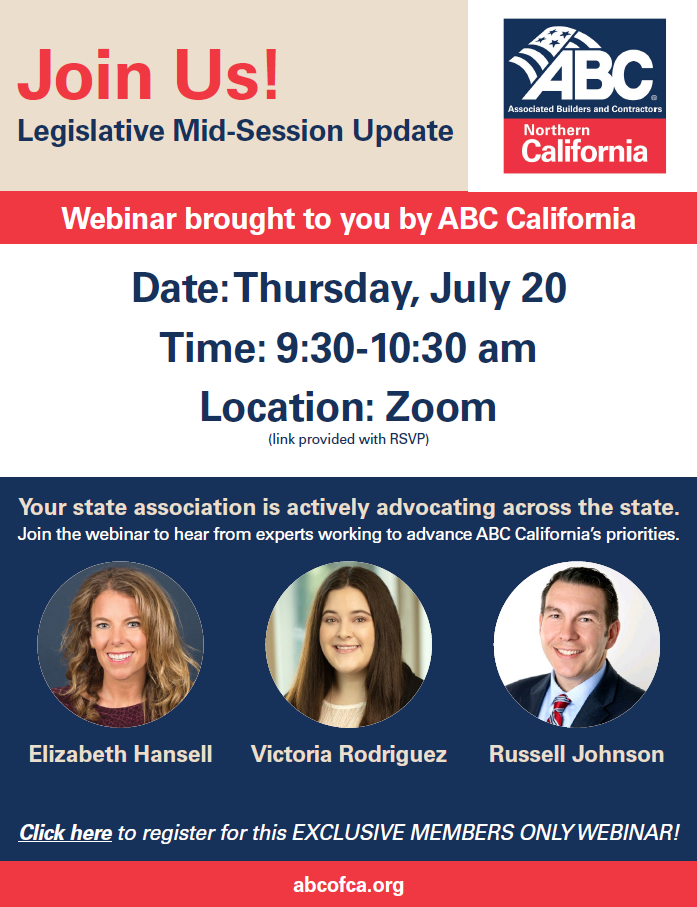
Public Works Compliance 101 - July 20th - 10:00 a.m. - 11:00 a.m. - Webinar


43rd Annual Golf Tournament - September 8th - Poppy Ridge

Subscribe to the Newsletter
 
Facebook  Instagram  Twitter  Linkedin