|
The Corresponder
The Newsletter of the Committees of Correspondence for Democracy and Socialism
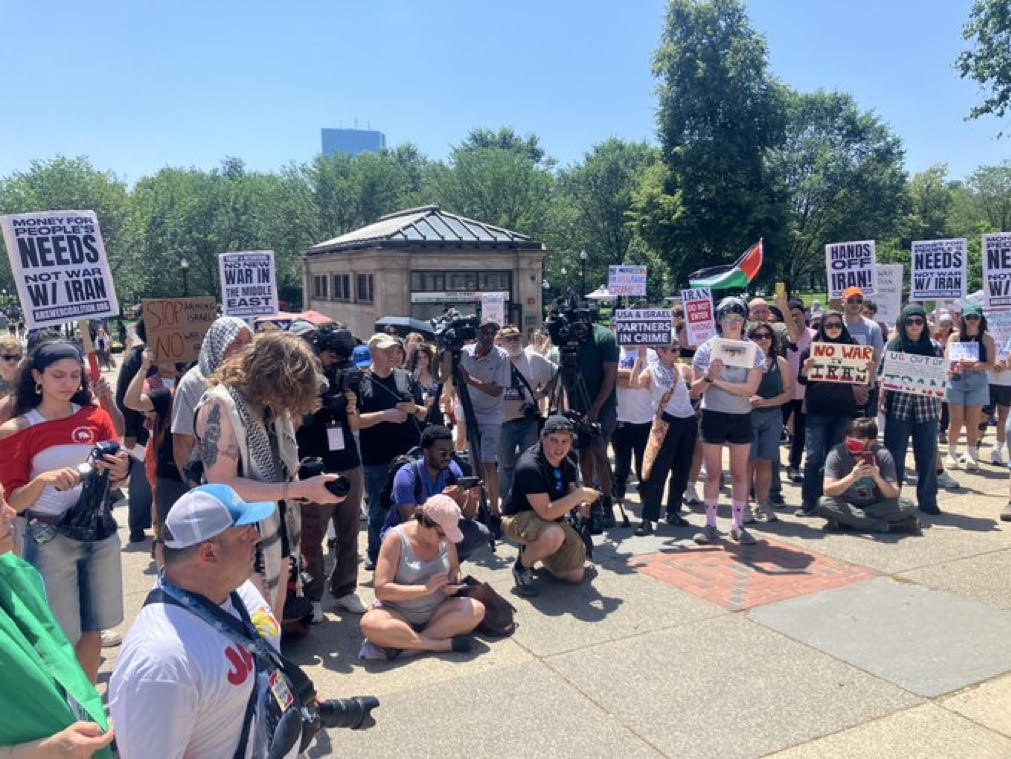
| | There will be no 4th Monday Webinar in July | | Photo: Boston Commons, submitted by Sandy Easton | |
CCDS Statement Against US War on Iran
Late Saturday June 21, 2025, US forces launched a massive unilateral aerial raid on several sites within Iran.
We do not yet know how the results of the Trump regime's so-called "Operation Midnight Hammer" will play out.
We know it has already taken a toll. The potential for catastrophic damage to the health, safety, and well-being of the Iranian people will only increase if the war continues. Others in the region have already been put in harm's way and their risk will grow so long as this war continues.
The Iranian people will not soon forget. No doubt they justifiably see this as the latest in a long string of US aggressions. While Iran does not have a military capacity that comes close to matching the US, they are nonetheless a formidable adversary.
For the US, one way or another, the consequences of June 21st will further exacerbate the widening Constitutional crisis, as Trump ignored the responsibility of Congress to launch war, not the president. "Operation Midnight Hammer" alone likely cost hundreds of millions of dollars, which are at the expense of under- and un-funded domestic needs. We do not yet know how many millions or billions of dollars may have to be spent to cover ongoing direct and indirect costs for this war or its aftermath.
We do not yet know the full extent of Iran's response to this attack which may be both extensive and long-term. The Iranian military has already responded with missiles launched at a US base in Qatar. While damage was reportedly minimal, it is unknown whether this was simply an opening salvo or if more should be anticipated. To the extent the conflict is ongoing, an Iranian response may strike domestic US interests, as well as additional interests abroad. These possibilities illustrate Trump's ill-conceived strike failed to take into account long- and short-term considerations alike.
For the sake of all involved, the US must immediately cease and desist from all aggression against Iran. Differences between the US and Iran can be peacefully resolved. The Iranian people are not our enemy.
CCDS believes the people of the two countries have more in common than what has divided them. A meaningful resolution would include reparations to the people of Iran for the loss of life, injuries, and damages they've incurred as a result of this attack. The US must commit to engage in no further acts of aggression and must immediately detach itself from using or funding Israel to wage any proxy war on Iran or others.
"Operation Midnight Hammer" must be understood as integral to the drive of US elites for global dominance and exploitation. As in the war against Iraq, it includes the desire to regain control of Iran's petroleum resources. Overall this drive is inherently destabilizing, it perpetuates patterns of unequal development, illegitimate government and regime change, among other forms of social injustice, which are often enforced through military intervention and violence. In so doing the danger of escalation to wider conflict, including world war, becomes a substantially greater danger.
CCDS calls for an immediate repudiation of this imperative and all it entails. All funding for such purposes must now and henceforth be reallocated for humanitarian and other peaceful uses. International and regional conflicts, most critically at present in the Middle East, require the meaningful involvement of the United Nations, not the self-interested intervention of the US.
No war on Iran! Solidarity with the Iranian people!
| | |
David Schwartzmann,
Presente!
It is with profound sadness and a great sense of loss that we share the passing of our own Statesman, Dr. David Schwartzman. David was a founding member of CCDS.
David transitioned in the loving arms of his life partner Joanne Fleming, today (July 1) around 2:38 pm.
David was a strong DC Statehood proponent, committed to social justice and equality for everyone. He used all of his brilliant mind to further causes he believed in with all that he had. He ran for DC Council multiple times on the DC Statehood Green ticket and was a tireless party organizer.
David was Professor Emeritus in the Department of Biology at Howard University. For a glimpse of his visionary ecological optimism, visit his Solar Utopia web site
(https://solarutopia.org), created with his son Peter Schwartzman, Mayor of Galesburg, Illinois.
The DC Statehood Green Party is forever in David's debt and will continue the fight. We extend our thoughts and condolences to Joanne and to David's family. Further details on his memorial service are forthcoming.
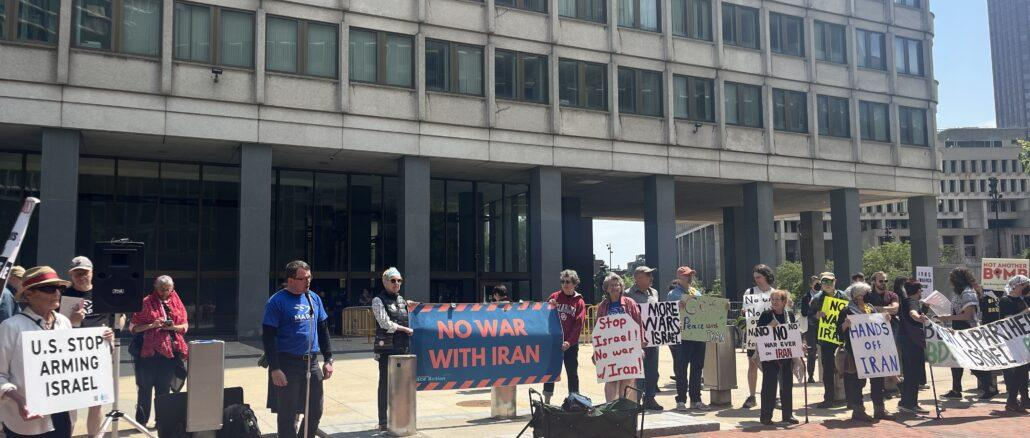
| | Massachusetts Peace Action | |
Tuesday, June 17, 2025
THE DANGER OF WAR WITH IRAN TODAY: WE MUST SAY "NO"
Harry Targ
The history of U.S./Iranian relations has been long and painful. Before the dramatic United States involvement in that country, Iran’s vital oil resource had been under control of the weakening British empire. In 1901 the Anglo-Iranian Oil Company (now British Petroleum) consolidated control of much of the production, refining, and export of Iranian oil. Local oligarchs received only 16 percent of the oil revenue from the global sale of the oil.
After World War II, with a young monarch Mohammad Reza Shah serving as the Iranian ruler and Iranian masses living in poverty, Iranian nationalists mobilized to seize control of their valuable resource. Upper class nationalist Mohammed Mossadegh became Prime Minister and asserted the power of the parliament over the monarchy. The parliament voted to nationalize the Anglo-Iranian Oil Company.
The British government enlisted the United States in 1953 to overthrow the Mossadegh regime using covert operations directed by the CIA. After Mossadegh was imprisoned and the Shah given full power to impose his will on an angry population, a new oil consortium agreement was established in 1954 which allowed five U.S. oil companies to gain a 40 percent share of Iranian oil. Anglo-Iranian would retain another 40 percent, and the rest would be given to rich Iranians.
Over the years, the Shah’s regime became the bulwark of U.S. power in the increasingly vital Persian Gulf region. In the Nixon period, Iran was defined as a key “gendarme” state, which would serve as a surrogate western police power to oversee the region. Presumably Iran would protect the flow of Gulf oil to the United States, Europe, and Japan. By the 1970s, the Shah’s military was the fifth largest in the world.
To the great surprise of left critics of the Shah’s dictatorship, the CIA, and the Carter administration, the Shah’s regime began to crumble in the summer of 1978 as large strikes were organized by oil workers against the regime. In January, 1979 secretly organized massive street protests led by the religious community doomed the regime.
As Iranian soldiers refused to fire upon street demonstrators, President Carter’s National Security Advisor, Zbigniew Brzezinski, urged the president to send troops to Iran to save the U.S. regional policeman, the Shah, from overthrow. That proposal was rejected by Carter.
After jockeying for power in the post-revolutionary period, religious leaders consolidated their power over the political system. To add embarrassment to loss of economic and geopolitical control over the vital Persian Gulf region, Iranian students took 52 U.S. diplomats and military attaches hostage and held them for 444 days.
In 1980 Carter authorized a military rescue effort that failed. The bungled military operation further damaged the image of infallibility that American foreign policy elites, and the public, held about the nation’s power and destiny.
In the 1980s, to challenge Iran’s potential for becoming the hegemonic power in the Gulf, the Reagan administration sided with Iraq in the brutal war between it and Iran. In 1988, shortly before the end of the Iraq/Iran war, U.S. planes shot down a civilian Iranian airliner killing 290 people aboard.
Subsequent to the ignoble history of U.S. support for the Shah’s dictatorship, militarization, the overthrow of Mossadegh, the embarrassment of the hostage taking, funding Iraq in the brutal Gulf war of the 1980s, the United States has maintained hostility to Iran despite occasional signals from the latter of a desire to establish better relations. During the Obama administration in 2015 a nuclear treaty was negotiated between Iran, the US, and other countries, but it was abrogated by President Trump. U.S./Iranian hostilities have increased ever since, particularly since October 7, 2023.
U.S. policy has included an economic embargo, efforts to create region-wide opposition to the regime, expressions of support for a large (and justifiable) internal movement for democracy and secularization in the country, and encouragement, more or less, for growing Israeli threats against Iran.
Given this troubled history of U.S./Iranian relations spanning at least 60 years, the current threats of war expressed by both Israel and the United States are not surprising.
| | |
Carl Davidson
Jul 6
Celebrating the Promise of Abolition Democracy
By Carl Davidson
July 4, 2025
I’ve always had mixed feelings about the Fourth of July. As a young child in the 1940s, I was terrified of the loud fireworks, despite the colorful beauty they brought to the dark skies.
But to me in those years, the holiday was mainly about extended families. We would pick a park with decent swimming pools, and the clan would gather around picnic tables under trees. I had all varieties of potato and macaroni salads, hot dogs and burgers cooking on the grill, and a dozen varieties of desserts. The kids had games, like potato sack races. At some point, the older men would organize a serious baseball game. When I got older, I could play too.
In those years, I was growing up as a blue-collar greaser. Fifteen of us had black corduroy jackets, with “Satan’s Angels” on the back, a halo surrounding a red devil’s head. Our patriotism, such as it was, fit in with the outlaws: Wille Nelson, Waylon Jennings, and Johnny Cash.
But as I entered college, I was awakened by things that were new to me. I was a jazz fan, and read Jack Kerouac’s On the Road as a celebration of America from its underside, warts and all. My high school never offered us anything like Steinbeck or Hemingway. I devoured their works on my own, especially The Grapes of Wrath. James Baldwin's Another Country left me with many questions about who I was, and who all of us were, as times changed in a dramatic way. Along with all my friends, I was deeply alienated from our country. At the same time, we surged in efforts to reform or even overthrow its government.
In 1966, after the civil rights leader James Meredith was shot in Mississippi, I walked 250 miles through that state on the Freedom March with the Student Nonviolent Coordinating Committee (SNCC). I was thoroughly radicalized after returning from Mississippi. But our SNCC comrades made an important point. We were more needed as “white mother country radicals,” finding ways to win over “white America.” I took it seriously. I made a small rule for myself. If I could not explain what I was doing and why, to my friends and family in Beaver County, then I had to study more, and learn better ways to teach. I didn’t think I could win over all of my family and friends—too idealistic. But I could win over a large militant minority.
I had an important insight about change. Mao Zedong put it bluntly: “one divides into two.” I could see it everywhere, and it helped me think more about the Fourth of July: America divides into two. On the one hand, we have the America of slavery, war, and empire. On the other hand, we had the America of Native resistance, slave rebellions, and workers of all sorts trying to become a liberating force. I could easily celebrate the second America while fighting against the first.
Using “one divides into two” to study US history, I concluded that we have only rarely had a proletariat that is an active protagonist in a nationwide way. Class struggle in the US has rarely taken any pure form of “class against class.” We can draw diagrams and use statistics to define our multinational, multiracial, and multigender working class today. It would be helpful, but it would also be an abstraction. Abstractions are fine, as any reading of Marx will show you. But our analysis reveals that class struggle in the US tends to take the form of “historic bloc vs. historic bloc.”
What are these “blocs” in US history? America from below has always waged struggle. I call these battles the struggle of the four ‘E’s: the expropriated (slaves), the exterminated (native peoples), the exploited (indentured servants), and the enclosed (Puerto Rico, Guam). They rarely joined together to make their fight for freedom more effective. Their greatest advance was the Reconstruction governments from 1865 to 1876. Here a core of Black freedmen and their “Scalawag” poor white allies established a nascent “abolition democracy,” as W.E.B. Dubois envisioned—not just ending chattel slavery, but creating new institutions and social relations to afford freed Black persons the economic, political, and social capital to live as equal members in a better society for all. But the Reconstruction governments were overthrown by a bloody white supremacist counter-revolution.
The “other America” promised during the First Reconstruction is one we can readily support. We saw abolition democracy again in the Second Reconstruction, led by Martin Luther King, Jr., and now again in a Third Reconstruction being called for by Rev. William Barbour II and others.
The Fourth of July, then, can be celebrated as our aspiration for abolition democracy. In a funny way, you can find it on the back of a $1 bill. On the right, you see the armed eagle ready to wage war, or if need be, to make a few concessions. This belongs to the America of war and empire. But what’s with the other side (a question that has plagued conspiracy theorists for years)? We can view the all-seeing Eye as a sign for being Wide Awake. The unfinished pyramid means our national project has yet to be finished. We have a Latin phrase about a “New Order” to win. And then the motto that would make Trump and Miller cringe: E Pluribus Unum. Out of Many, One!
We are not national nihilists. In my travels around the world, every left group I met has found a way to tip their hat to their national forebears. But in our case, we draw a line against the superpower chauvinism of our upper crust. Dig deep into Woody Guthrie, Willie Nelson, Leadbelly, and Rosanne Cash. You’ll find an America to celebrate on the Fourth.
|
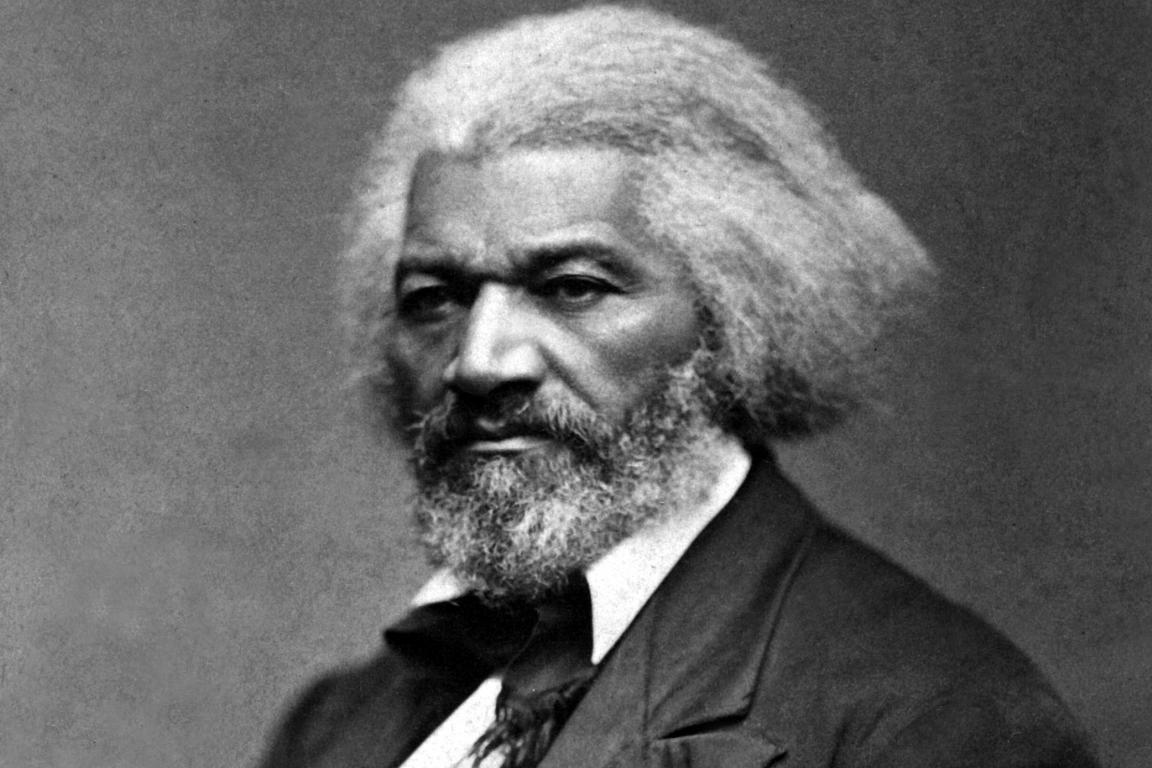
(1852) Frederick Douglass, “What, To The Slave,
Is The Fourth Of July”
May 25, 2025
Contributed By: BlackPast
Frederick Douglass
“What, to the Slave, is the Fourth of July” – Historical Context
On July 5, 1852, Frederick Douglass was invited to address the citizens of his hometown, Rochester, New York. Whatever the expectations of his audience on that 76th anniversary of the signing of the Declaration of Independence, Douglass used the occasion not to celebrate the nation’s triumphs but to remind all of its continuing enslavement of millions of people. Douglass’s speech appears below.
“What, to the Slave, is the Fourth of July” – Full Text
Mr. President, Friends and Fellow Citizens: He who could address this audience without a quailing sensation, has stronger nerves than I have. I do not remember ever to have appeared as a speaker before any assembly more shrinkingly, nor with greater distrust of my ability, than I do this day. A feeling has crept over me, quite unfavorable to the exercise of my limited powers of speech. The task before me is one which requires much previous thought and study for its proper performance. I know that apologies of this sort are generally considered flat and unmeaning. I trust, however, that mine will not be so considered. Should I seem at ease, my appearance would much misrepresent me. The little experience I have had in addressing public meetings, in country schoolhouses, avails me nothing on the present occasion.
The papers and placards say, that I am to deliver a 4th [of] July oration. This certainly sounds large, and out of the common way, for it is true that I have often had the privilege to speak in this beautiful Hall, and to address many who now honor me with their presence. But neither their familiar faces, nor the perfect gage I think I have of Corinthian Hall, seems to free me from embarrassment.
The fact is, ladies and gentlemen, the distance between this platform and the slave plantation, from which I escaped, is considerable—and the difficulties to be overcome in getting from the latter to the former, are by no means slight. That I am here today is, to me, a matter of astonishment as well as of gratitude. You will not, therefore, be surprised, if in what I have to say, I evince no elaborate preparation, nor grace my speech with any high sounding exordium. With little experience and with less learning, I have been able to throw my thoughts hastily and imperfectly together; and trusting to your patient and generous indulgence, I will proceed to lay them before you.
This, for the purpose of this celebration, is the 4th of July. It is the birthday of your National Independence, and of your political freedom. This, to you, is what the Passover was to the emancipated people of God. It carries your minds back to the day, and to the act of your great deliverance; and to the signs, and to the wonders, associated with that act, and that day. This celebration also marks the beginning of another year of your national life; and reminds you that the Republic of America is now 76 years old. I am glad, fellow-citizens, that your nation is so young. Seventy-six years, though a good old age for a man, is but a mere speck in the life of a nation. Three score years and ten is the allotted time for individual men; but nations number their years by thousands. According to this fact, you are, even now, only in the beginning of your national career, still lingering in the period of childhood. I repeat, I am glad this is so. There is hope in the thought, and hope is much needed, under the dark clouds which lower above the horizon. The eye of the reformer is met with angry flashes, portending disastrous times; but his heart may well beat lighter at the thought that America is young, and that she is still in the impressible stage of her existence. May he not hope that high lessons of wisdom, of justice and of truth, will yet give direction to her destiny? Were the nation older, the patriot’s heart might be sadder, and the reformer’s brow heavier. Its future might be shrouded in gloom, and the hope of its prophets go out in sorrow. There is consolation in the thought that America is young. Great streams are not easily turned from channels, worn deep in the course of ages. They may sometimes rise in quiet and stately majesty, and inundate the land, refreshing and fertilizing the earth with their mysterious properties. They may also rise in wrath and fury, and bear away, on their angry waves, the accumulated wealth of years of toil and hardship. They, however, gradually flow back to the same old channel, and flow on as serenely as ever. But, while the river may not be turned aside, it may dry up, and leave nothing behind but the withered branch, and the unsightly rock, to howl in the abyss-sweeping wind, the sad tale of departed glory. As with rivers so with nations.
Fellow-citizens, I shall not presume to dwell at length on the associations that cluster about this day. The simple story of it is that, 76 years ago, the people of this country were British subjects. The style and title of your “sovereign people” (in which you now glory) was not then born. You were under the British Crown . Your fathers esteemed the English Government as the home government; and England as the fatherland. This home government, you know, although a considerable distance from your home, did, in the exercise of its parental prerogatives, impose upon its colonial children, such restraints, burdens and limitations, as, in its mature judgment, it deemed wise, right and proper.
But, your fathers, who had not adopted the fashionable idea of this day, of the infallibility of government, and the absolute character of its acts, presumed to differ from the home government in respect to the wisdom and the justice of some of those burdens and restraints. They went so far in their excitement as to pronounce the measures of government unjust, unreasonable, and oppressive, and altogether such as ought not to be quietly submitted to. I scarcely need say, fellow citizens, that my opinion of those measures fully accords with that of your fathers. Such a declaration of agreement on my part would not be worth much to anybody. It would, certainly, prove nothing, as to what part I might have taken, had I lived during the great controversy of 1776. To say now that America was right, and England wrong, is exceedingly easy. Everybody can say it; the dastard, not less than the noble brave, can flippantly discant on the tyranny of England towards the American Colonies. It is fashionable to do so; but there was a time when to pronounce against England, and in favor of the cause of the colonies, tried men’s souls. They who did so were accounted in their day, plotters of mischief, agitators and rebels, dangerous men. To side with the right, against the wrong, with the weak against the strong, and with the oppressed against the oppressor! here lies the merit, and the one which, of all others, seems unfashionable in our day. The cause of liberty may be stabbed by the men who glory in the deeds of your fathers. But, to proceed. read more
| |
By Carl Davidson
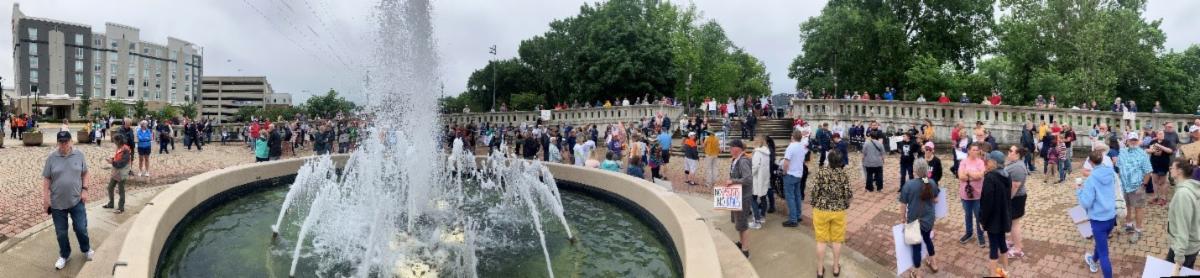
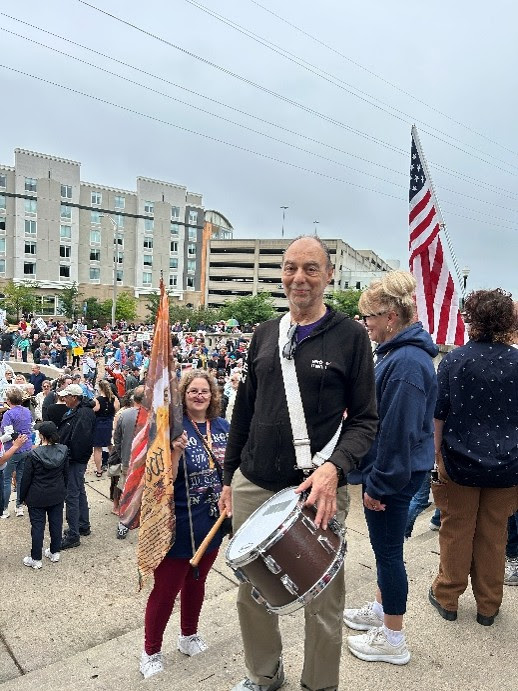
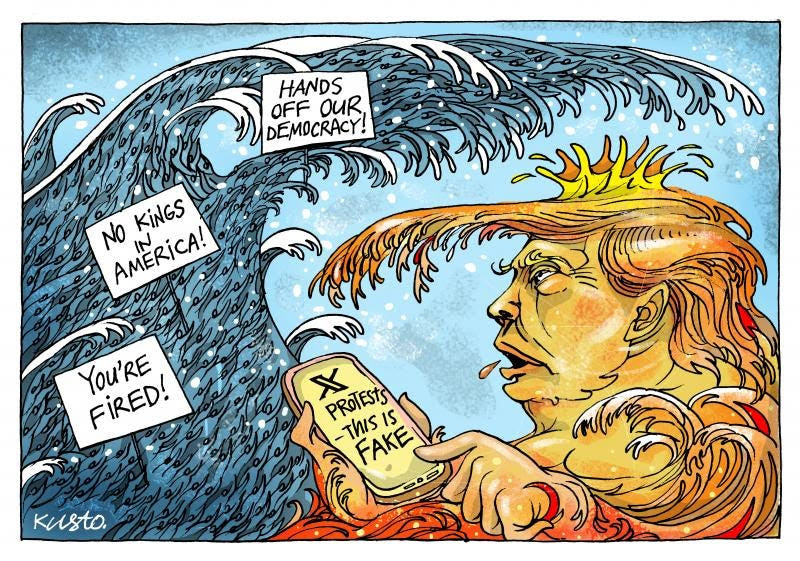
We will need more than a week to absorb the full impact and meaning of the June 'No Kings' elemental rising on June 14, 2025. Suffice it to say, we've never been here before.
Somewhere between 5 and 10 million Americans took to the streets on that day with a sharp message: 'We're sick of facing the dangers of fascism and war, so stop Trump and all of his enablers now! No Kings! We're a democracy, not an autocracy!'
Examining their scope, the June 14 events took place in over 2,200 cities, towns, county seats, and small villages. They were present in every state, regardless of whether the political terrain was viewed as blue, red, or purple. Every color of the rainbow and every nationality, every sex and gender, young, middle-aged, and senior citizens were proudly waving homemade signs and banners. Many unions were present, alongside a large number of non-union workers who would love to be part of one. But people from all walks of life, including from the middle strata and upper classes, found ways to join in and speak out. And while militant and rowdy at times, it was entirely nonviolent on a scale not seen before.
Reviewing recent history, some compared it to the huge rising against white supremacy and police brutality in 2020, when millions, angered by the police killing of George Floyd, demonstrated nationwide. African Americans took the lead, but they were quickly joined by young people of all nationalities. These insurgencies, which spread over two weeks, occurred in more than 100 cities. Protestors engaged in many battles with police, and in Minneapolis, the police station where it all started was burned to the ground. In the end, some 14,000 people were arrested; however, over 92 percent of the protests remained nonviolent.
Some also looked back to the massive rise of women in January 2017, marked by all the pink hats, following Trump's Inauguration. It was huge, with a turnout of 500,000 in DC, 400,000 in NYC, 250,000 in Chicago, and thousands more in every major city. The events were entirely peaceful and unprecedented, and with a clear message: No retreat on women's rights!
These were all impressive, but in the end, their numbers and scope didn't come near No Kings Day. The only mass protest going beyond it scope was the Black Revolt in the wake of the assassination of Rev. Martin Luther King, Jr., on April 4, 1965
Starting on that dreadful date, somewhere between 15 and 20 million people, mainly African Americans, took to the streets in over 150 cities. There was no organization leading it all. Everyone took part. Intense battles quickly broke out with the police, with buildings set afire and businesses looted. Forty-three people were killed, another 3000 were seriously injured, and more than 20,000 were arrested. Only when President Lyndon Johnson nationalized the National Guard and called out the U.S Armed Forces to occupy the country's 'inner cities' did the revolt subside.
In the wake of the Black Revolt, U.S. politics shifted rapidly. LBJ gathered all his allies and secured the quick passage of the Voting Rights and Civil Rights Acts. He also knew the cost of replacing the older ways of ruling. Blacks with voting rights in the South meant pro-segregation Democrats would desert en masse into the Republican Party, and the GOP would dominate the South and much of the West for decades to come.
We can draw a direct line from the 'New Right' that arose from the 1970s backlash to the gains of the Civil Rights campaigns to the right-wing populist, neo-Confederate bloc assembled by Trump following the election of Barack Obama. The current GOP, with its traditional conservatives having been expelled or otherwise silenced, has now brought us to the cusp of fascism and war. At home, Trump's white nationalists have targeted immigrants with brown skin as their means of gutting the U.S. Constitution. Other targets are soon following: LGBTQ people, veterans, women, and insurgent workers. Abroad, Trump's 'Christian Reconstructionists' are using Israel's genocidal expansionism and the fear of Iran to put the wider and deadly wars of the 'Second Coming' Apocalypse on the horizon.
Only a few years ago, very few of us envisioned this reactionary conjuncture, or the vast left and progressive movement arising within it. The phrase "No Kings" encapsulates a rejection of absolute authority and unchecked power, whether wielded by oligarchs or autocratic leaders. In the context of mass demonstrations, it reflects a collective yearning for new systems that serve all citizens and residents, rather than elevating a select few against the many. It is not merely a cry against monarchy but a broader call for equity, transparency, popular participation, and justice in governance. While No Kings protestors defended old norms, most of them look forward to a new and more engaging democracy, to a 'Third Reconstruction,' as the Rev. William Barber and others frame it.
The No Kings events, at their best, awaken us to the innate power of solidarity. They are a testament to human resilience and the collective capacity to demand a better future. When people chant "No Kings," they are not only rejecting systems of excessive power but affirming their belief in self-governance, equality, and the fundamental rights of all citizens.
Our effectiveness, going forward, is shaped by three key factors:
" Clarity of Purpose: The goals of the ongoing 50501 demonstrations must be specific and achievable, whether seeking legislative change, raising awareness, or demanding accountability.
" Nonviolent Resistance: History has shown that peaceful demonstrations, while challenging to maintain in the face of oppression, call out greater public sympathy and international support.
" Persistence: A single day of protest may ignite conversation, but sustained effort is necessary to see tangible change.
Learning from Dr. King, our message is clear: history bends toward justice, but only when pushed by the efforts of a militant minority working to awaken a progressive and anti-fascist majority. Let us continue to rally, chant, and march together in this ongoing journey.
| |
Tina Shannon’s Remarks at No Kings Day
Jun 20, 2025 | Featured Homepage Post, PDA Blog
Tina Shannon, Chairperson of the PA 17th Congressional District Chapter of Progressive Democrats of America
I’ve been asked to talk to you about healthcare today. In the past months, we’ve all had plenty of information and facts on healthcare, as Medicaid has been threatened. So I’d like to take a different approach today. I’d like to talk to you about the politics of the situation.
You see, all this time I’ve been working with good people, and a lot of them, maybe most of them, have had faith that if we chip away incrementally at our problems, things will eventually turn out okay. And who am to say they were wrong?\
I don’t know what’s gonna happen. So I got myself to believe that, to believe maybe they were right, and keep doing the work, and keep hoping that things would turn out okay. But I now find myself unable to do that. For one thing, my tax dollars are being sucked out of my community to destroy Gaza’s healthcare system, to bomb hospitals and kill doctors and nurses.
James Madison, the third President of our country said, “No country could preserve its freedom in the midst of continual war.” And, also in political terms regarding healthcare, all over the country, and right here in Beaver County where you live, people fought for Medicare for All. Because of that struggle, we offered the Affordable Care Act during Obama’s presidency. And even then, we had to fight to get it passed. And we did. We won that. And that was good.
I know someone who’s alive because of the ACA. She had no insurance and a wide variety of symptoms that often landed her in the emergency room. After the ACA passed, she could afford insurance and found out she had a tumor on her adrenal gland that likely would’ve killed her if she hadn’t gotten healthcare coverage to get it diagnosed.
So that’s good. But also me, under the ACA, when I was younger, in my 50s, my deductible was $15,000, and I was paying around $500 a month in premiums. So I was paying that much monthly for insurance that paid for almost nothing.
The insurance companies took over the ACA as a vehicle for their profits. And now they’re taking over Medicare too. So here we are, with less influence than ever over our government because it’s controlled by the richest 1%, from the health insurance companies to the arms manufacturers. And the general public doesn’t trust the government anymore because they can feel this, even if those feelings have been exploited and manipulated to get them to turn against each other.
As long as money extraction is the goal of our economic system and political system, we will not be able to attend to our domestic needs, and thus we will not be able to change this situation. I should know. I’ve been trying to get policy and legislation and candidates that will attend to our domestic needs my entire adult life, and trying to figure out why we’re failing.
We can’t maintain our democracy within this paradigm. I can no longer get myself to believe that everything’s gonna be okay if we just keep doing things the way we’ve been doing them.
Again, James Madison, “No country could preserve its freedom in the midst of continual war.” It’s time to do some different things. It’s time to have some different discussions. If you want to be part of that discussion, get with me or my friend Amber over there to get on my sign-up sheet.
If Gaza and the unending wars are your main issue, get with my friends from our local peace group over there holding up the War Is Making You Poor banner. And the biggest rock stars here today are the Young Dems. They put this event together.
Some of them are walking around with the orange marshal’s vests on. Talk to them or look them up online. If you’re old like me, you can look up Beaver County Dems online also. Find your place. Find your political home and get involved. It’s gonna take more than protests to change things.
——
Tina Shannon grew up in Beaver County, Pennsylvania and has lived there most of her life. She comes from a family of Beaver County mill workers, river men, and dairy farmers. She attended both Pitt and Antioch Colleges before settling down in New Brighton to operate a family daycare business.
She first became involved in politics at Pitt, through the Campus NOW chapter. She has been involved with community improvement projects, worked on peace issues, and served on the New Brighton School Board. She works to support local and national progressive candidates for office. She serves on the board of Beaver County Peace Links and serves as Chairperson of the PA 17th Congressional District Chapter of Progressive Democrats of America.
|
Welcome to the Age of Disappearance
America's new era of secret police.
Hamilton Nolan
Jul 02, 2025
It can happen to you. (Photo: Getty)
In the HBO drama “The Leftovers,” two percent of the world’s population suddenly disappears. This is cast as a fantastical and mysterious occurrence, setting the stage for a surreal tale of science fiction. You should never underestimate American ingenuity, though. We are on the verge of our own age of mass disappearance. It will be all too real. And it will not be fun.
Trump’s big budget bill passed the Senate yesterday. It will now go back the House, and there is more haggling to be done to appease various factions of the Republican Party, but it is a safe bet that it will pass with its biggest priorities intact. That means that an avalanche of new funding for the Department of Homeland Security, ICE, and anti-immigration measures is, in fact, coming. This is going to spill well past the bounds of what any sane person would consider to be “immigration enforcement.” It is going to create a lavishly funded, unaccountable, quasi-secret police force that will transform our nation for the worse. Very soon.
A couple of weeks ago, I wrote about the terrifying scale of this new funding. This bill contains enough money to build a new system of immigration detention centers far bigger than the entire federal prison system. The American Immigration Council says that it will be enough to facilitate the “daily detention of at least 116,000 non-citizens.” It will let ICE hire more field agents than the FBI. Its $170 billion in funding for Stephen Miller’s rabid campaign to purge America of brown people is comparable to the total annual funding for the United States Army.
Donald Trump envisions himself as an all-powerful leader whose will is equal to law. He is bent on revenge against his political enemies. He has installed extreme loyalists in the Justice Department, the FBI, the Defense Department, the Department of Homeland Security, and all other security departments. The courts have declined to meaningfully restrain his abuses of these departments. This budget will give him the final piece of the puzzle that he needs to achieve his fever dream: a nationwide army of masked, unaccountable armed agents empowered to snatch anyone they like off the streets, and the physical infrastructure to imprison or deport those people at will. Thousands of men with guns, unrestrained by judges or local police, who do not answer to Congress, who point guns at the press, who arrest whoever they want, for reasons they do not share, and do whatever they wish with those people. The implications of this are going to make America a much darker place.
One year ago, if a Congressman on the lunatic fringe of the Republican Party had called for the forcible deportation of the man who just won the New York City Democratic mayoral primary, it could have been dismissed as posturing and delusion. Today, after what has happened over the past six months, you would be delusional not to consider this a serious threat. ICE has already arrested a number of Democratic elected officials, including mayors and members of Congress and a judge. In this environment, it is a trivial matter for Trump and his loyalists to concoct reasons to arrest almost anyone. People can be arrested if they are immigrants, if they look like they might be immigrants, if they illegally harbored or assisted immigrants, or if they somehow impeded ICE’s quest to arrest immigrants. The mission can and will be scaled up from “deport immigrants” to “punish those who want to stand in the way of our mission.” This is already happening, and soon will happen much more, in more places, to a greater degree. We must recognize that we are dealing with people for whom the intellectual justifications are unimportant secondary concerns, made up hastily to pave the way for them to do what they want to do.
This week, the White House told the Justice Department to “prioritize and maximally pursue denaturalization proceedings in all cases permitted by law and supported by evidence.” Thus we will begin to see some of the 25 million naturalized US citizens who the White House considers to be its enemies have their citizenship revoked. They will be exiled. What sort of criteria might be used to choose these targets? According to the memo, among those prioritized for denaturalization will be “Cases against individuals who pose a potential danger to national security, including those with a nexus to terrorism.” Because “national security” and “terrorism” both mean nothing and everything, this category alone is large enough to cover just about anyone that the administration wants to get rid of. Been to a protest? Written a left-wing op-ed? Shared a meme of JD Vance? You can and will be ejected from America.
Yesterday, JD Vance wrote that everything in Trump’s budget bill “is immaterial compared to the ICE money and immigration enforcement provisions.” This statement is false, particularly for the millions of people who will soon be losing their health insurance, but it does illustrate the extent to which Republicans are willing to whip up hatred of immigrants and use it as a smokescreen for their grand class war. It also reminds me that it is impossible for me to put into words my contempt for JD Vance. Men like Stephen Miller are, at least, genuine Nazis to the core, driven by a deep reservoir of hate. Vance, on the other hand, is a lotion-drenched, amoral careerist, a professional ass kisser of monsters, sitting in air conditioned rooms with his fellow Yale graduates dreaming up justifications for racist policies as a way to amuse himself, as a beloved PTA mom who has spent 47 years in America is snatched out of her Louisiana home and separated from her family. If Trump and Miller are the arsonists of American democracy, Vance is the accomplice pointing the firefighters in the wrong direction, to ensure that things burn as completely as his boss wishes.
Yesterday, Trump proudly attended the opening of a concentration camp. There will be many more to come.
It is astonishing how many times we are forced to relearn the Martin Niemoller poem. But here we are! Every few generations, those who lived through the last round of this stuff die off, and a new generation must repeat the same atrocities, and suffer the same indignities, before at least redrawing the same conclusions. America is about to fund and build a huge secret police force that will, I promise you, be used to attack and imprison and exile the president’s enemies, of all sorts. Better to look this fact square in the face than to continue to kid ourselves as long as possible as we march down the road to the gulags.
This state of affairs is the fault of those who are now carrying it out—the White House, the Trump loyalists, the Republican cowards in Congress, the political supporters of fascism. But, if we want to be completely honest, there is a certain level of responsibility that a much broader slice of America must bear. The things that most Americans long countenanced for others are now being turned on us. The surveillance systems, the heavily armed police, the “anti-terrorism” measures, the vast intelligence apparatus—all these things, we imagined, would be used only for “criminals” of the sort that were not us. Now we are surprised to find that we have been defined as the criminals. Turns out we should not have built the systems of injustice in the first place. This is one of morality’s oldest lessons. We relearn, and relearn, and relearn, the hard way.
Getting through the period of American history that is now descending upon us will require all of us to practice radical empathy. A strange quality of even the worst totalitarian fascist states is that very bad things might happen to the person next to you, and your life can still continue as normal. More and more Americans are going to find that their neighbor or their friend or their employee or their colleague was just snatched up by armed men and taken somewhere. And meanwhile, all of us who were not snatched up can still go to McDonald’s and go to the beach and watch TV. The urge to retreat into the comforting security of the idea “it’s not me” will be strong. Yet navigating our way out of this means having a collective heart. You do not know whether they will come for you, or your neighbor, or your friend, or your colleague, and if they come for any one of us, they come for all of us. We must nurture the outrage that fuels the resistance to what is going to happen. We must hit the streets for our neighbors in the same way that our neighbors would hit the streets for us. It is an illusion to think that you are exempt from the gaze of the secret police. That’s not how it works. Believe that they can come for any one of us, and it will give you the conviction that this cannot be allowed to persist. Some bad things are coming. Luckily, we have something that Trump and Vance and Miller and all of the ICE agents never will. All the money and guns and masks and prisons in the world can’t make up for a coward’s weak heart.
| | |
Photo: Trump during his tour of the so-called Alligator Alcatraz immigrant detention center in Ochopee, Florida ANDREW CABALLERO-REYNOLDS/AFP/Getty Images
| |
Trump’s ‘Alligator Alcatraz’ Reveals the Ongoing
Cruelty Towards Migrants in US
President’s supporters are gleeful but Everglades jail could prove to be a humanitarian and environmental tragedy
July 7, 2025 Richard Luscombe The Guardian
President Donald Trump, Gov. Ron DeSantis, R-Fla., Homeland Security Secretary Kristi Noem and others, tour “Alligator Alcatraz,” a new migrant detention facility at Dade-Collier Training and Transition facility, Tuesday, July 1, 2025, in Ochopee, Fla., (AP Photo/Evan Vucci)
After the cruelty, the mockery. As the first detainees were being hauled into Donald Trump’s controversial migrant jail in the inhospitable, steamy wetlands of the Florida Everglades last week, his supporters were indulging in some parallel retail therapy.
“Surrounded by swamps & pythons, it’s a one-way ticket to regret,” the Florida Republican party’s official X account crowed, hawking its new range of Alligator Alcatraz-themed shirts and hats. “Grab our merch to support tough-on-crime borders! Limited supply – get yours before the gators do!”
The blatant and brutish grift on the back of the plight of America’s undocumented is neither new nor surprising to those who have watched Florida’s full-on assault on migrants and immigration rights in recent years, led by its hard-right Republican governor, Ron DeSantis.
Share this article on
They remember how he used Florida taxpayers’ money for a stunt baiting dozens of Venezuelans to board a flight in Texas with false promises of accommodation and jobs, then dumped them in Massachusetts, promptly followed by the launch of a line of sardonic “DeSantis Airlines – bringing the border to you” apparel, drinks glasses and coffee mugs.
“Again, it proves that cruelty was always the point,” Maxwell Frost, a Democratic Florida congressman, told the Guardian after the president and governor visited the swamp on Tuesday to boast about how awful the camp will be for those held there.
“Selling hats and merchandise for a place that is about to become a hell on earth for thousands of people who are going to be subjected to some of the worst conditions and human rights abuses you could think of is disgusting.
“These are human beings being held in a tent in the middle of the Everglades, where temperatures are 90F to 100F daily, and hurricane season is an ever-present threat. We saw a run-of-the-mill Florida rainstorm cause flooding on the day that Trump and DeSantis touted the facility. We saw water pouring in and tents shaking because of some slight rain.
“The hats, the facility, the press conferences and media interviews – this is all one fun, cruel, disgusting game to them. To treat people like animals, like they’re less than, because they were not born in this country. And the truth is that they don’t care about the human lives they will harm and potentially kill because of their actions.”
To other observers, Trump’s high-visibility visit – his tour of the site flanked by DeSantis and homeland security secretary Kristi Noem, and his scornful advice to any escaping detainee that they would need to learn to zigzag instead of run in a straight line from any pursuing alligator – was the ultimate example of performance over policy.
“This is Donald Trump 101. Come up with a catchy phrase, and market the heck out of the merch,” said Michael Binder, professor of political science and public administration at the University of North Florida.
“I certainly think that is much more about the show than the actual usage of a detention center. Will they hold a bunch of people there? Probably. Will it ever get entirely packed? Maybe. And it’s also true that more detention centers are probably going to be needed if they’re going to keep rounding people up.
“So theoretically it makes sense. The show provides immediate political benefit. The risk they’re taking is down the road.”
Binder cited the example of Hurricane Katrina in 2005, and the botched federal response by the George W Bush administration to a disaster that killed more than a thousand mostly Black and low-income residents in New Orleans.
“What happens if something goes wrong at one of these camps? They’re built presumably with aluminum pipes and some tarps. This is Florida, right? We get hurricanes. If you have a hurricane run through there, I think it’s gone,” he said.
“The air conditioning is going to be limited at best. It’s hot in the summer. What happens if people start dying? These are things that can really turn poorly. If you think about Katrina, and the black eye that put on the Bush administration, if it happened in 2003 instead of 2005 it’s probable they wouldn’t have been re-elected.
“These things can have real consequences if the national narrative turns exceptionally negative.”
Any such consequences are unlikely to concern Trump or DeSantis, both of whom have extolled the harshest possible conditions for immigrant detainees, while being termed out at the conclusion of their respective current terms in office.
In DeSantis’s case, however, some see his full-throated backing for Trump’s immigration agenda, Alligator Alcatraz and the warp-speed effort that turned it from a simple idea to operational facility inside 10 days as evidence of his determination to be in the mix for the 2028 presidential election despite his dismal 2024 effort.
“While his time in Florida is on the clock, he certainly has eyes on going back to Iowa in a couple of years, and staying relevant in the national spotlight is vitally important to him,” Binder said.
“Keeping his name in the press, in the media, around an issue that his base thinks is important, is certainly useful to that end.”
An alliance of immigration advocates, environmental groups, and the Miccosukee and Seminole Native American tribes that oppose Alligator Alcatraz says that DeSantis’s race to build the camp – which state officials have said could hold up to 5,000 detainees and 1,000 staff at capacity – threatens not only area residents, but also the fragile wetlands he has claimed to champion.
“Development of this scale at this location requires massive changes to an ecologically delicate landscape, including running huge generators, trucking in massive amounts of food and water, and trucking out waste,” Melissa Abdo, Sun Coast regional director of the National Parks Conservation Association, said.
“Communities in the area, as well as the people detained and working at this facility, could all be at serious risk if the need arose to quickly evacuate from a hurricane, using only a single two-lane highway that’s currently under construction.”
Representative Frost said he shares critics’ fears, and highlighted the choice of the camp’s remote location, which is popular with hunters and outdoorsmen.
“For people like Trump, DeSantis and Noem, this is a sick game of hunting, kidnapping, harming and discarding human beings,” he said.
“It was never about helping Americans or putting our country first. What we’re seeing is pure hatred and disdain for human beings because of the color of their skin and where they were born.”
Richard Luscombe is a reporter for Guardian US based in Miami, Florida
| | |
From Activist to Organizer
By Tina Shannon at the webinar on Women and Political Struggle on March 24th
I'm Tina Shannon. I'm here in western Pennsylvania, in the Rust Belt, and I'm from the Appalachia side of my county. So the the eastern side of my county is former steel mill country, and I'm from the people that came here before that to violate the Treaty of the Alleghenies and steal land and kill and ethnically cleanse. So just to be upfront about that.
And so when I was thinking about what to say. It was hard, because I know that you all are a bunch of activists, so you've done a lot of things that I've done, you've organized groups, you've organized rallies, you know, you've protested, you've worked with unions. And so I just really didn't know exactly what to say to you, so I started to think about what was important about what has happened to me over my political life and my political career. and I realized that the most important thing that happened to me was my transformation from being an activist to being an organizer.
I thought I would start by telling you a little story about that. So back in the 90s, I had been going on busses to DC, and, going to rallies and protests and things, but just as an individual, and then I married Randy, and I had a baby. When she went to elementary school, lo and behold, a right wing Christian coalition group took over our school board. The contract for the teachers ran out and the school board wouldn't settle. The teachers struck, went back to work, the school board wouldn't settle.
So some people asked me if I would run on slate with them to be on the school board. So I said yes. The teachers caved in to every single item, every single point in the negotiations. They were hold out for one thing, they did not want to add an hour to their work day. That was the only thing. They caved in on the price of health care, they caved in on everything except for that one demand The school board voted, instead of settling the contract, they voted to hire replacement teachers! Our community exploded!
I was running for school board. So in a day and a half after that vote, a spontaneous meeting. I mean, I know you hear about spontaneous meetings, but it really did happen. It was like a few people, and then next thing you know, there's like 100 people at a meeting. We had to move across the street to the church.. So Randy told me, stand up. Stand up. So I stood up and said, I'm running against it. Took name.So, lo and behold, I got elected to school board. There was a slate of five. Two of us got elected. The other guy immediately caved in.
We're on school board. I was elected to fight those people. I'm like, Yeah, I know how to do that. So for two years, I fought those people. I had press conferences. I got interviewed by reporters. One thing they like to do was to go in executive session and handle their business, and then come out and then just vote on it. So I would come out of the executive session and I would stand up and tell the audience what they had talked about in Executive Session. They got really mad. They started keeping the microphone from me. School board meetings got huge. It was like standing room only at the school board meetings.
So they decided to hire a cop there so that if they called me out of order, he could remove me. So I came out of Executive Session one night, started telling people about what they did, and they told the police to remove me. Somebody in the audience stood up and said, Tina, take it outside. Well listen to you outside. I stood up, left the room, and the whole audience followed me
I was running for school board. So in a day and a half after that vote, a spontaneous meeting. I mean, I know you hear about spontaneous meetings, but it really did happen. It was like a few people, and then next thing you know, there's like 100 people at a meeting. We had to move across the street to the church. So Randy told me, stand up. Stand up. So I stood up and said, I'm running against it. They took my name. So, lo and behold, I got elected to school board. There was a slate of five. Two of us got elected. The other guy immediately caved.
This was two whole years of this. We were in the news every month. They were banning books. They were changing curriculum. They were harassing teachers. They tried to fire the school board and the teachers union president. All of this for two years, tooth and nail.
After two years of staggered terms, we got a normal school board elected, but not like me.They didn't want to fight. So I was so excited I could finally go to some school board conferences. I went down to New Orleans at the school board conference, went to every workshop that looked like it would suit our school, came back with ideas. I told The New people we could do this. We could do that. We could have big community meetings and heal this breach that we have. We could have these different community activities. We could have these programs for kids and parents. They were like, that sounds really nice, but let's just get things back to normal. So for two years they didn't really listen to me. All I thought was that I had to come to them with these good ideas and things would get better, and they would just pat me on the head and say, That's really nice. Thank you, Tina, let's just go back to normal. So lo and behold, two years I come up for re election, and I lose. And so I had to really think about, like, what the hell happened?
In the meantime, I had read a book about Leonard Peltier. It was a popular biography about him, and the name of the book was In the Spirit of Crazy Horse. Didn't really read it to learn about politics. I just read like a good book. The thing that stood out to me the whole book was everything he did, what he was thinking about, what to do for his people. He was so embedded in doing for his people. It really had an effect on me. Left me thinking about who are my people? My people are here in Beaver Count? Like, my gosh, look at my people.
Then what really, then somebody gave me a book about Ella Baker by Barbara Ransby's book. It's called Ella Baker and the Black Freedom Movement.That book changed my life because Ella Baker the book. Ella Baker not only saw her people, and she not only like wanted to do for her people, but she figured out how. She figured out. I read the book and I was like, You, I realized that you can do things in an effective way that you like, you can like, look at your people, you can look at the forces all around you, and you can figure out what to do. One example is when she was organizing SNCC, the Student Nonviolent Coordinating Committee. So she had students, she had black, Black young people from the South and Black young people from the north, and had them together in a conference. She realized that the northern young people were running over the southern young people, because they were they had more words and had more confidence, but the young black people from the South had some experiences that really were crucial. So she separated them into groups, and then she brought them back together, and it was perfect. And so I just, you know, like, so the combination of thinking about who are my people, and then seeing this whole book of an example of how to actually do it! It just really changed my life. and that so, I'm doing stuff, and I'm looking at my people, I'm trying to figure out, like, how to be effective, how not just to be about all the good ideas in my head.
That's when Progressive Democrats of America was founded. It was just at the right time for me. A lot of the people I was working with and organizing, the very first thing they'd want to do is go toward electoral politics. They wanted to go see their representatives and ask them, why the hell aren't you doing what we want you to do? What about this policy? They wanted to work for campaigns. Some of them wanted to run for office. So Progressive Democrats of America was not the Democratic Party. It was separate. PDA has an inside, outside policy, and it allowed me to interface with all the people I needed to interface with without being completely beholden to the Democratic Party. It was really good, and also allowed me to pivot to different issues as they became active.
That totally got me ready to discover Gramsci. When I discovered Gramsci and the whole concept of the organic intellectual, I felt like somebody had finally seen me because that's what I had been doing for all those years I had been standing beside people and trying to describe what was happening around us. I was trying to articulate what we were going through and what was happening to us. So I think that that was my entire trajectory of how I went from being a activist centered on myself and my own ideas to being able to have this huge kind of web of interaction and relationship that I think is, like, crucial.
| | Tina Shannon Her main political activity has been chairing a Progressive Democrats of America Chapter to help form the progressive coalition in my county. She’s been involved in a wide range of issues, from serving on her local school board to advocating for single payer healthcare, rallying local community to support union actions and bringing progressive/radical speakers and classes to the public, also participating in her local peace group and helping other groups whenever possible | |
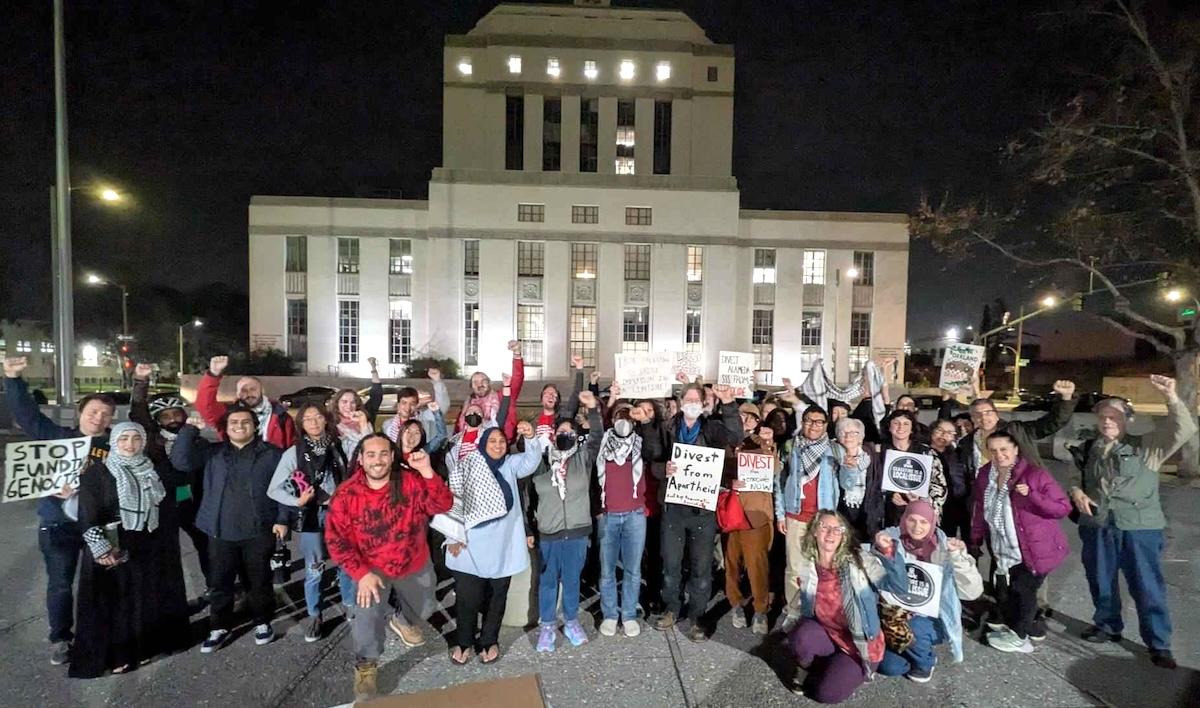
How East Bay DSA, Community Members, and Workers Won Alameda County Divestment from Israeli Apartheid
Andrew Basta, Vish Soroushian and Zach Weinstein
from Democratic Left
in December of last year, the treasurer of Alameda County announced he was going to divest the $32 million in bonds issued by Caterpillar, a construction equipment manufacturer responsible for the violent displacement of Palestinians. The county Board of Supervisors also voted to task him to prepare an ethical investment policy that could lead to a prohibition on investing public funds in companies that profit from serious human rights violations, including Israel’s crimes against the Palestinian people and land. East Bay DSA organizers played a major role in pushing for this transformation, one of the largest wins for the BDS Movement and the Palestine solidarity movement in the United States to date. East Bay DSA’s work with union members was of particular importance to this campaign’s victory.
Andrew Basta, a member of DSA’s International Committee’s steering committee interviews two East Bay DSA organizers, Zach Weinstein, one of the co-chairs of East Bay DSA, and Vish Soroushian, a campaign co-lead for East Bay DSA’s Divest from Apartheid campaign. This interview discusses how the chapter identified this target, the political terrain the chapter battled on, how they built a strong campaign, and what’s next for East Bay DSA. We hope that this interview can serve as a resource to chapters and activists interested in replicating municipal and county divestment across the country. East Bay DSA’s “Divest From Apartheid” campaign organizers can be reached at divest@eastbaydsa.org.
The interview has been edited for clarity and length.
Andrew: How did the campaign to pressure Alameda County to divest begin in both the Bay Area and within East Bay DSA? Was it connected to previous successful divestment efforts in the cities of Hayward and Richmond?
Zach: Alameda County has long been a hotbed of pro-Palestine organizing. For example, there are local Arab-led organizations like AROC (Arab Resource and Organizing Center) that have spent many years building relationships with the Longshoremen’s Union, ILWU (International Longshore and Warehouse Union), at the port of Oakland, and that has effectively meant that Israeli ships have been unable to dock in Oakland for many years. Famous left organizations that have emerged out of the Bay Area have also had a strong internationalist bent to them, like the Black Panthers. The Bay Area also has a large Palestinian American population. With all these factors in mind, when organizing around Palestine took on a new urgency after Oct. 7, it was inevitable that there would be a strong and renewed demand locally around divesting from Israel. The question for us was how can the chapter contribute to that.
For those who don’t know, Alameda County includes Oakland, which is its largest city, as well as several other large cities such as Berkeley, Fremont, and Hayward. East Bay DSA’s chapter jurisdiction includes all of Alameda County and also all of Contra Costa County, which is next door, and includes a lot of working-class cities like Richmond. Richmond has a socialist majority on their City Council, and they were the second city to divest in the country [after Hayward]. That effort was largely led by elected officials from the Richmond Progressive Alliance, most of whom are also members of East Bay DSA. In Richmond and Hayward [which had already divested], we had members who were highly involved including some electeds, but organizationally we hadn’t quite put the infrastructure in place where we, as a chapter, could drive major turnout or organize public support. We, of course, took a lot of inspiration from [both Hayward and Richmond’s] success.
By the time Richmond had voted to divest in May 2024, conversations had started in the chapter about making a local municipal divestment from Israel our chapter’s top priority campaign for the upcoming year. My recollection is that Vish came to me maybe in March or April of 2024, and asked what I thought about East Bay DSA starting a formal divestment campaign. I was really excited about it and encouraged him to talk to other chapter leaders. By our chapter convention in June of last year, we launched our Divest from Apartheid campaign and named it our top priority campaign for the next 12 months.
Vish: The city of Alameda (within Alameda County) also adopted a divestment resolution which divested them from weapons manufacturers and other things. Also, just to add to the richness and the history of the Bay Area in terms of supporting social justice and whatnot, back in the 70’s and the 80’s, there was a robust divestment movement in opposition to apartheid in South Africa, and there was also support throughout the Bay Area from divestment for Burma in the nineties. This is part of the local relevance Zach described.
I also want to give a big shout out to East Bay DSA’s Anti-imperialism Committee. We have a great committee here that has been focused on supporting the cause of Palestinian liberation locally since before Oct. 7, and the campaign plan was really born out of that committee.
Andrew: How did you land on Alameda County specifically?
Vish: Back in March on the 21st anniversary of the murder of Rachel Corrie by Caterpillar bulldozers while she was in Gaza, we had several SEIU members in our chapter who were honoring her legacy and commemorating her death. It was around that time when, with Alameda County’s investment portfolio available online for public view, I noticed that we had $32 million invested in Caterpillar bonds, amongst other problematic investments. That was really the catalyst for doing this work.
There were a couple of other factors that were on our radar: there was a [county] supervisor who was retiring. We figured that with his impending retirement he wouldn’t have the political pressures laying down on him that somebody seeking further office would. This individual was involved with divestment from South Africa and Burma as well, so they seemed like a natural ally. We also worked closely with a council member in Hayward, who made divestment happen over there. This council member had a relationship with Treasurer Henry Levy, so that gave the local divestment movement access to him. Those are all factors that we took into account and helped us shape the plan for East Bay’s Divest from Apartheid campaign.
Andrew: The campaign targeted both the county treasurer, Henry Levy, and the five members of the Board of Supervisors. Targeting the treasurer is a new model for the BDS Movement. How did you land on these targets, and what were your demands?
Vish: What we learned through our research is that the Board of Supervisors ultimately delegates its investment authority to the county treasurer. This means that it’s not really up to the Board of Supervisors to dump Caterpillar; it’s up to the treasurer. [We could, however,] target the Board of Supervisors with the goal of passing and adopting an ethical investment policy with a human rights screen, which essentially would mean that the county’s investment policy would include a prohibition on investing in companies that profit off of human rights violations such as apartheid and fossil fuel companies. So we targeted both the Board of Supervisors and the county treasurer. With the Board of Supervisors, we said, “We don’t want any of our public funds going towards this thing.” But, in the moment, we are invested in Caterpillar, we need to do something about that, and the county treasurer has the ability to make that decision.
Now, there were some challenges with [targeting the treasurer]. We were a little bit surprised that we got him to divest, and it’s really a testament to the amount of organizing that we did as East Bay DSA with our labor partners as well as other organizations and individuals’ work that came to convince him to take this action.
Zach: There are two things I would add that informed the campaign targeting and the structure. First, the county treasurer is elected. That meant he was more susceptible to the same sorts of pressures that any other elected official might be.
The other reason for the focus on the ethical investment angle, rather than specifically talking about BDS and Israel, is that there’s a soft anti-BDS law on the books in California that makes it so that you can’t target specific countries effectively. Doing something with a wider scope decreases the risk of a BDS action being overturned.
Vish: For Hayward, the divestment that they pursued was just dropping investments in certain companies. In Richmond, they passed an ethical investment policy. What we accomplished [in Alameda County] was the combination of the two, which is really the ideal.
Andrew: A large coalition of community faith, labor, and activist organizations came together to support this effort. How did you build this coalition and end up collaborating together?
Zach: In some ways, the coalition was already coming together because there are so many different organizations that have a history of working on this issue, and there are also a lot of Arab and Palestinian-led organizations in the Bay Area. Another group called Bay Area Divest! (BAD!) also formed not long before we launched the Divest from Apartheid campaign.
Part of what Vish and other leaders on the divestment campaign did in the early phases was meetings with different community groups to get them on board, as well as other groups that were already working on this in order to coordinate and collaborate. One of the mechanisms for getting folks on our side was a big letter that grew to over 80 organizations signing on. It was one of the main mechanisms for building the coalition.
Vish: I wrote that letter in conjunction with our labor allies at SEIU 1021 [pronounced “ten-two-one”], and we chose to highlight the intersecting harms that these companies produce and create broad-based support for divestment. We also tried to meet with environmental justice organizations, immigration justice organizations, and anti-police terror organizations because everybody understands that a company that is responsible for creating displacement and death in Palestine also causes harm in all these different areas as well.
Andrew: Inside the coalition, how did you work through different points of view from different organizations? Were there any strategies that were successful in building unity across these different groups?
Zach: One thing that we tried to do was respect that people were coming to this from a lot of different political backgrounds and organizational approaches.
Most of the organizations involved in this campaign weren’t socialist organizations. Very few of them have the kind of internal, robust member democracy that DSA has. Inherently, as a volunteer run organization, [DSA is] going to be less experienced and less focused on the internal game including staying on top of lobbying visits and setting the lobbying strategy. Vish and other leaders on the campaign did a really good job on that front, but there are other organizations that literally have people who do [inside work] for their full-time jobs.
When there were differences of opinion on tactics and strategy, we tried to model some flexibility: if you’re gonna try it that way, you can go ahead and try that. We’re gonna try this thing. When there were groups that were more focused on the inside strategy, we would try to do the outside strategy in a way that wouldn’t undermine or counter their work.
Andrew: In the treasurer’s long op-ed in Jewish News of North California, he cites some work of JVP (Jewish Voice for Peace) in convincing him to divest. Do you want to speak to the Jewish angle in organizing for divestment? Read more
|
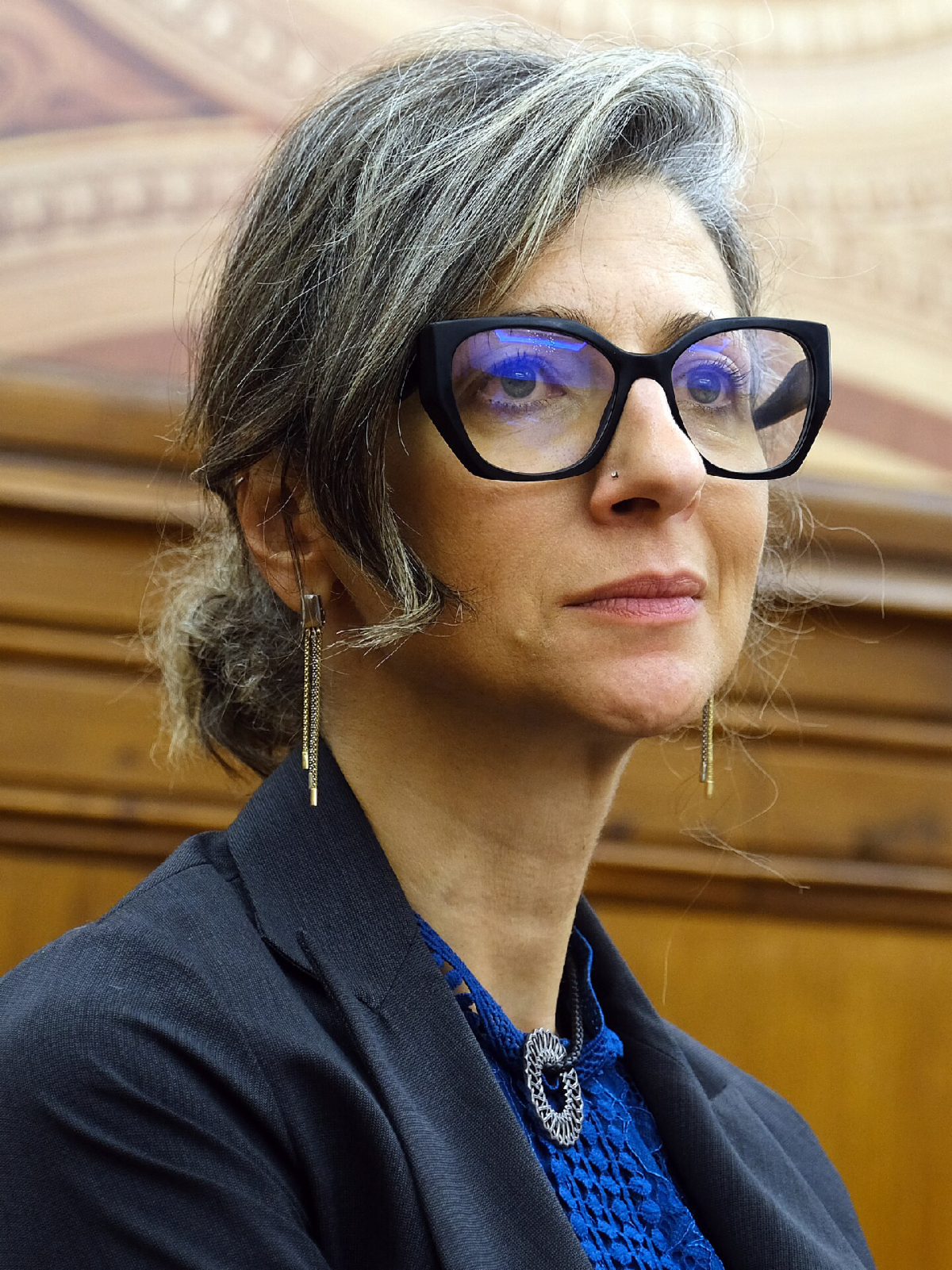
EXCLUSIVE: Top Economists Back Francesca Albanese's Report on the 'Economy of Genocide' in Gaza
Former Greek Finance Minister Yanis Varoufakis, French economist Thomas Piketty, and others join open letter supporting Albanese amid US calls to remove her as the UN special rapporteur on Palestine.
Team Zeteo
Jul 07, 2025
Last week, UN Special Rapporteur Francesca Albanese made headlines across the world for exposing the dozens of companies that she says have profited from Israel’s genocide in Gaza. Albanese’s UN report, ‘From Economy of Occupation to Economy of Genocide,’ goes beyond just the typical weapons-manufacturing culprits, and calls out financial institutions, educational institutions, and Big Tech companies, including Alphabet Inc. (Google), Amazon, IBM, Palantir, as well as many, many others.
In response, the US Mission to the UN renewed its calls for the UN secretary-general to condemn Albanese and remove her as special rapporteur for human rights in the Occupied Palestinian Territory.
Now, world-leading economists, including former Greek Finance Minister Yanis Varoufakis, French economist Thomas Piketty, and Lebanese-American statistician and essayist Nassim Nicholas Taleb, are praising Albanese for her report.
Zeteo has obtained an exclusive English copy of the economists’ open letter on Albanese’s report, in which they accuse corporations of “maintaining the Apartheid regime and enabling the subsequent genocide.” Read the full letter below.
ECONOMISTS IN PRAISE OF SPECIAL RAPPORTEUR FRANCESCA ALBANESE’S REPORT TO THE UNITED NATIONS: ‘FROM ECONOMY OF OCCUPATION TO ECONOMY OF GENOCIDE’
History teaches us that economic interests have been key drivers and enablers of colonial enterprises and often of the genocides they perpetrated. The corporate sector has been intrinsic to colonialism since its inception, with corporations historically contributing to the violence against, the exploitation, and ultimately the dispossession, of Indigenous people and lands, a mode of domination known as racial colonial capitalism. Israel’s colonization of the occupied Palestinian territories is no exception.
The recent report by Francesca Albanese, the UN Special Rapporteur on the situation of human rights in the Palestinian territories occupied since 1967, constitutes a major contribution to understanding the political economy of Israel’s Apartheid state, the ethnic cleansing of Palestinians and, now, their genocide. As such, we believe, it must be studied and debated widely and freely.
In view of the virulently hostile and indeed intimidating letter from the US government to the UN Secretary General demanding the dismissal of Ms Albanese and the quashing of her excellent report, we felt the need to express our strong support for Ms Albanese and to encourage the UN to dismiss the shrill demands of the US and Israeli governments.
Following a well-trodden path of genocide denial and of bullying anyone who challenges the right of the colonial power to dispossess Indigenous peoples, the US and Israeli governments, with most European governments too timid to take a stance, demand that the international community turn a blind eye to the ongoing genocide and, in particular, to the key role that multinational and national corporations are playing in maintaining the Apartheid regime and enabling the subsequent genocide.
As economists we feel the duty to highlight three key findings that Ms Albanese’s report unveils with clarity and precision.
First, occupation and genocide are highly lucrative for conglomerates. These include not only the usual arms and ‘defence’ big businesses (e.g., Lockheed-Martin, the primary maker of the F35s, ELBIT, Israel’s own arms manufacturer, and Palantir, the software company whose algorithms have most likely been crucial in the selection of ‘targets’ across Gaza) but also household brand names (e.g., Caterpillar, BNP Paribas, Barclays, Allianz, Chevron, BP, Petrobas, A.P. Moller-Maersk A/S). As Israel’s defence budget doubled, with the active support of the US government, it crowded in large ‘investments’ into Israel’s killing machine across this international network of complicit conglomerates in which thousands of Israeli companies are intertwined with US, European, Korean and even a Brazilian mega-corporation. This explains why Israeli equities rose by 161% at a time of falling demand, production and consumer confidence.
The second finding in Ms Albanese’s report that deserves extensive study is that the Palestinian territories Israel occupies have functioned as Big Tech’s ideal laboratory and testing ground – a function that the transition from occupation to genocide has only heightened. No country, for instance, has given as much access to a population’s biometric data as Israel has given to IBM. Since 7th October 2023, Microsoft, Amazon, Alphabet and Palantir have been expanding their cloud capital services at a breathtaking pace. Face recognition software, target selection algorithms and automated execution systems are being tested in real time, at will, and with fewer ethical constraints than in the case of experiments on laboratory rats. Big Tech could not be happier!
The third key finding is that top US and European universities are financially dependent on remaining wedded to Israel’s Apartheid and permanent occupation/conflict political economy. Many top US and EU institutions will face serious financial difficulties if they were to stop backing Israel’s genocide. Ms Albanese’s report must be commended for drawing this sordid dependency of stellar Western universities and research institutions (including the Technical University of Munich, MIT Labs, the University of Edinburgh among others). The peoples of Europe and America have a right to know that some of their most cherished academic institutions are financially reliant on helping Israel reproduce its political economy of occupation and genocide.
In a few years, almost everyone will claim they opposed this genocide. But it is now that people of good conscience need to take a stand. As economists we stand, today, with Francesca Albanese, the UN Special Rapporteur under attack by the US and Israeli governments because her recent report throws indescribably important light on the political economy of Israel’s occupation and genocide.
Yanis Varoufakis, former Greek finance minister
Thomas Piketty, author of ‘Capital in the Twenty-First Century’
Nassim Nicholas Taleb, author of ‘The Black Swan’
Michael Hudson, president of the Institute for the Study of Long-Term Economic Trends (ISLET)
Guy Standing, professorial research associate, SOAS University of London
Jayati Ghosh, professor of economics at the University of Massachusetts Amherst
Giuseppe Mastruzzo, director of the International University College of Turin (IUC)
Jomo Kwame Sundaram, research advisor at Khazanah Research Institute
Robert H. Wade, professor of Political Economy and Development at London School of Economics and Political Science
Christopher Cramer, professor of the Political Economy of Development at SOAS University of London
Nidhi Srinivas, associate professor of management at Milano School of Policy, Management, and Environment
| | "It's one thing for a fascist clique to take office in DC and begin to wreak havoc. But we're a big country of 50 states, hundreds of large cities and 3000 counties. They will have to go through all of them to consolidate their fascist hegemony, the long march through the civil society institutions 'in reverse,' so to speak. But we can fight them every step of the way, from our localities, then networking outward and upward. Win on our local ground first. We rarely win at the top what we haven't already secured at the base." Carl Davidson | | The grass is dry in Cleveland. Be sure to click the play button. | | | |  | |
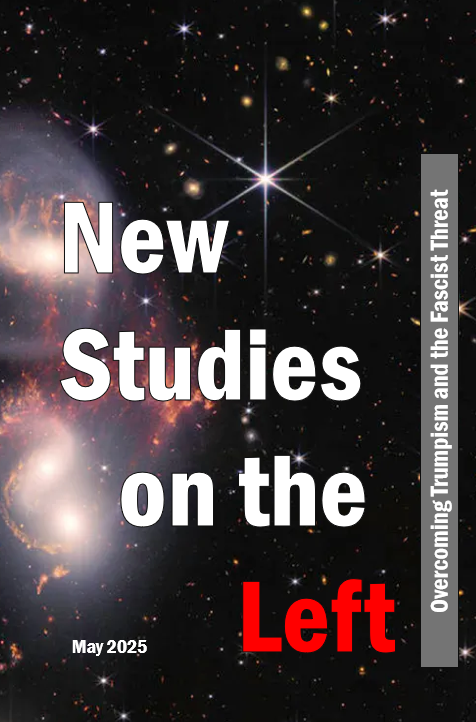
New Studies on the Left, May 2025
Paperback $14.95
...is a journal of socialist theory and practice. It is the successor to ‘Dialogue and Initiative, published as an annual journal of the Committees of Correspondence for Democracy and Socialism in book form from 2012 to 2022. It will continue the CCDS policy of left unity, including articles with a variety of left perspectives, including debates.
This issue contains a dozen articles grouped under the headings of Analysis and Global Reach, Electoral campaigns, and Book Reviews. Some are reprinted from other sources, but many appear here for the first time.
Among the authors are C.J. Atkins, Carl Davidson, Steve Early, Bill Fletcher, Jr., Suzanne Gordon, Jerry Harris, Jay Jurie, Paul Krehbiel, Matthew Scott, Rod Such, Harry Targ, and Janet Tucker and Steve Willett.
Table of Contents
Click HERE to purchase
| | | |
With the winning of the Trump/Vance ticket along with the far right in leadership of all 3 branches of government we need to bury our differences and build the left and the Progressive Majority, a majority that we know exists on most issues of public policy.
We need to build our organizations to defend democracy, in our communities and at the state and national levels including progressive gains won over several decades.
IN GENERAL WE NEED TO REBUILD OUR LEFT: PEACE ACTIVISTS, FEMINISTS, WORKERS, ENVIRONMENTALISTS, AND ALL HUMANISTS WHO UNDERSTAND THAT. (HOWEVER WEAK) US DEMOCRATIC INSTITUTIONS ARE UNDER ATTACK AND THE VERY PEACE AND ENVIRONMENTAL CONDITION OF THE WORLD ARE UNDER ATTACK
Harry Targ
| | "Organization is the central task; revolutionary education is the key link." Carl Davidson | | |
Carl Davidson
Mar 10
New Video Courses
How the U.S. Civil War Made Canada
New Text Courses
Alexander Dugin, the Imperialist Philosopher Who Demanded the Ukraine War
New Blog Post
Marxism is the ‘True Scripture’ of Us Communists, By Tang Aijun, Study Times, China
New in the Archives
Historical Roots of American Fascism and Antifascism: Bibliography-in-Progress, for the Marxist Education Project 2025
New in Cultural Studies
The Communist Folk singer Who Shaped Bob Dylan
To visit the OUL, go here: http://ouleft.org
| | Organization is the central task; revolutionary education is the key link. | | |
Our Amazing Resource for Radical Education
CURRENT FEATURE: In the 'Study Guides' Section
A 4-PART STUDY OF THE SHAPING OF THE
RUST BELT WORKING CLASS.
From the settlers to the present, and how its consciousness is conflicted. Prepared by Carl Davidson and Rebecca Tarlau,
with some help from the DSA Rust Belt group.
There are hundreds of video courses here, along with study guides, downloadable books and links to hundreds of other resources for study groups or individuals.
Nearly 10,000 people have signed on to the OUL for daily updates, and more than 150,000 have visited us at least once.
Karl Marx's ideas are a common touchstone for many people working for change. His historical materialism, his many contributions to political economy and class analysis, all continue to serve his core values--the self-emancipation of the working class and a vision of a classless society. There are naturally many trends in Marxism that have developed over the years, and new ones are on the rise today. All of them and others who want to see this project succeed are welcome here.
NEW UPDATES...
On our Blog Page:
How to Create a Future of Cheap Energy for All
The WIRED & Octopus Energy Tech Summit in Berlin was bursting with innovative ideas for reaching net zero and on working together at an ever-greater scale.
How to Build an Underground Resistance Force in 16 Steps
Lessons from Blue Virginia, a community-based organization of women
Our Latino/a Studies Dept:
Forced Amnesia: The Hidden History Of America’s Far West
An emotional and historical journey through the American West on the tracks of the pre-1848 border, to meet families that lived there since long before the US takeover.
Our History Dept:
Marcus Rediker on the Quaker Abolitionist and Seaman Benjamin Lay – History from Below after the Transnational Turn.
This seminar subtitled “The Case of a Forgotten 18th-century Revolutionary,” was given by Marcus Rediker as part of the Development Studies Seminar Series on 24 October 2017 at SOAS University of London
To get regular updates, be sure to ‘Like’ us at http://facebook.com/ouleft.org Be sure to also, under ‘Like’, pick ‘Get Notifications.’ You can also ‘subscribe’ to our FB page and send in articles for our blog at the OUL main site, http://ouleft.org
Read more
http://ouleft.org
| | | | | |
Digging Deeper into the Meaning
of Palestine
By Rod Such
Author's note: My initial decision to begin reviewing books on Palestine and the Palestinian liberation struggle was to write for political activists, rather than academics or the general public. This book, which collects dozens of reviews over a decade, might also be regarded then as a kind of wide-ranging primer or introduction to Palestine that will lead hopefully to an ongoing learning experience.
316 pages, $19.00 (discounts available for quantity), order at:
Changemaker Publications
https://www.lulu.com/spotlight/changemaker
| | | POWER TOOLS FOR UNION BUILDING | |
Timothy Sheard | 415 Argyle Rd. 6A | Brooklyn, NY 11218 US
| | With grave new challenges from the current administration, Hard Ball Press is raising our game, with new books & new Staff. | | Click go to Hard Ball Press for fresh information about organizing the workplace and building union power. | | |
Hard Ball Press is thrilled to welcome Cynthia Selene Hernandez to our staff. Cynthia will take charge of new book development, design and marketing, beginning with a children's book about Women In Construction.
Cynthia began her organizing career during the Free Trade Area of the Americas protests in Miami in the early 2000s. As a student organizer in 2006, she took part in the Justice for Janitors campaign at Florida International University, which successfully advocated for improved wages and working conditions for janitorial staff.
With the support of a Pell Grant, Cynthia joined Florida International University's Labor Center (FIU), advancing from research intern to senior research associate and instructor. Her focus on wage theft led to the enactment of seven anti-wage theft county ordinances in Florida. After nearly a decade at FIU, she became the Executive Director of the South Florida AFL-CIO. She led labor and community coalitions to enhance wages and benefits for low-income families in Miami-Dade County.
In 2018, Cynthia joined Resilience Force as Florida Director, advocating for labor protections for resilience workers. As Hurricane Ian made landfall in Florida in 2022, she returned as Resilience Force National Training and Education Director.
| | | | Be sure to check out the latest organizing tools from Labor's Book Store and the latest labor news from Work-BItes. | |
CHANGEMAKER PUBLICATIONS: Recent works on new paths to socialism and the solidarity economy
Remember Us for Gift Giving and Study Groups
We are a small publisher of books with big ideas. We specialize in works that show us how a better world is possible and needed. Click Gramsci below for our list.
| |
522 Valencia St.
San Francisco, CA 94110
415 863-6637
| | | | | |