|
“Our science team is small, with just three teachers, so collectively, we work with all of the students in our buildings,” said Anne Friederich who teaches science for grades 7-8 at Postville. “Having all three of us involved in this professional development experience is an important message that tells stakeholders and our students that we are committed to keeping our teaching skills dynamic and strong.”
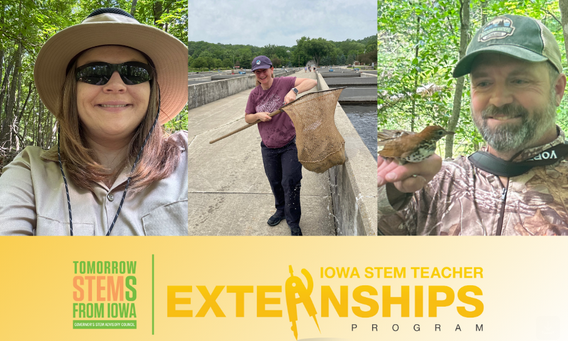
Friederich was an extern at Effigy Mounds National Monument. She worked with the Biological Technician team to assist field tasks such as removing invasive plants and identifying native prairie plants in addition to implementing a Junior Scientist Day.
Emily Neal teaches high school science, including physical science and chemistry, at Postville. This was Neal’s second summer externing with the Iowa Department of Natural Resources at the Decorah Fish Hatchery.
“There are a lot of different data gathering techniques used at the Hatchery, including sample sizing,” Neal said. “This year in my classroom, I referenced this experience quite a bit, and I worked with students on the importance of gathering averages to make data more accurate.”
This year, Neal is expanding upon the programming she created last summer by using a web-based scavenger hunt platform to create a series of outdoor interactive scavenger hunts with hopes of increasing visitor engagement with the Hatchery and surrounding natural areas.
Sean Singewald teaches biology, physics, anatomy and physiology at Postville. He worked with the Iowa DNR Wildlife Team at Sweet Marsh Wildlife Management Area for his summer Externship. He is participating in habitat improvement projects, creation of winter thermal cover, songbird capture and tracking, as well as goose banding and endangered species studies.
“Teaching and learning are two different processes. Being the learner again helps me be more conscious of the struggles students face when they are learning something new,” said Singewald. “It's a huge advantage to be able to give students concrete examples of how science is used and how they are benefiting from people who are using science in the real world. This helps with student engagement and buy-in.”
|