Trouble viewing this email? View as Webpage


Senate Checkup Newsletter // July 8, 2026


Newsletter Topics


Message from the Chair: 
Shared Governance in Complex Times


Faculty Time Use Study Final Report

Senate examines strategies to address

faculty burnout and workload


Research Data & Metadata Survey

Final Report

Building the Future of Research Data at UCSF


Message from the Chair:
Shared Governance in 
Complex Times

 
Errol Lobo Headshot

As I conclude my first year as Chair of the UCSF Academic Senate, I want to focus on what shared governance continues to mean in this rapidly changing academic and healthcare environment. At the core of the Academic Senate is a commitment to open dialogue and freedom of expression. Faculty partner with campus leaders willing to hear concerns and work with said faculty towards developing productive solutions on complex issues. In recent years, the Senate has increasingly been called upon not simply to opine but to translate the new complicated institutional reality into actionable guidance.


The Senate’s work brings together diverse expertise across the pillars of education, research, clinical care, and campus infrastructure. These efforts are time-intensive for faculty but are essential to ensure that initiatives and recommendations remain informed by lived experience and aligned with UCSF’s mission and values. With increased career expectations -- be it research funding, education efforts, or clinician workload -- it is imperative that faculty discuss issues openly as well as encourage such frankness with students and postdoctoral fellows and clinical learners.


Along those lines, I want to highlight two Academic Senate task force final reports, both just released. One addresses long-standing faculty issues of burnout and workload, while the second examines a research issue UCSF is facing perhaps more so than other UC campuses, and on which UCSF can pioneer solutions.


Neither are simple topics and required deliberate ideation sessions, coupled with systematic literature reviews, stakeholder interviews, and faculty focus groups. Faculty and campus leaders brough the same analytical rigor to these discussions as they bring to the academic and clinical missions, resulting in specific and pilot program-ready recommendations.


The Academic Senate’s Faculty Time Use Study Task Force researched strategies to address faculty burnout associated with invisible work – mentoring, service, teaching, and administrative responsibilities – which are often unrecognized or uncompensated. The final report now being circulated to the Deans reflects months of collaborative analysis and demonstrates the critical role shared governance plays in surfacing new opportunities.


The report’s primary recommendation was the creation of Department-level incentive programs. In support of this, it further recommended development of a centralized dashboard to track faculty effort across teaching, service, mentoring, research, and clinical efforts. Faculty from all schools and efforts responded to the initial 2023 study conducted by the Senate’s Committee on Faculty Welfare. The Task Force was also rooted in a Gender Equity Round Table discussion with UC Regent Emerita Sherry Lansing and UC Davis Provost and Executive Vice Chancellor Mary Croughan at the 2022 UCSF Academic Senate Spring Division meeting.


Separately, the Task Force on Research Data and Metadata Standardization (RDMS) spent more than a year assessing how UCSF can modernize the stewardship, discoverability, and interoperability of biomedical research data across the institution. It was organized in response to mounting national expectations around reproducibility, FAIR data principles, and NIH data management and sharing requirements. The task force partnered with Library experts and IT leaders at UCSF along with research stakeholders to examine the current campus research data ecosystem, its infrastructure, and faculty practices.


The resulting report demonstrates the level of interdisciplinary coordination necessary to position UCSF competitively in an increasingly data-driven scientific environment. The task force recognized that successful implementation will depend not only on infrastructure investments, but also on incentive alignment and governance reform. Further the task force hoped that data stewardship will be recognized as a meaningful scholarly contribution.


Across these efforts, a consistent theme has emerged: the freedom of expression must be guaranteed for shared governance to work. It must also be afforded to students whose training and scientific inquiries require freedom of thought, for academic instruction, and quality patient care too. The need for analysis grounded in the shared experiences of faculty, coupled with strong collaboration between Academic Senate and campus leaders can bring forth new ideas. The Senate’s work reflects the increasingly consultative role shared governance must play in advocating for faculty while seeking solutions that protect the integrity and accessibility of academic science and open dialogue. 


I remain grateful to the faculty leaders and campus administrative partners who have contributed substantial time and thoughtfulness to these efforts. Their work reflects the best of shared governance: collaborative and evidence-based leadership in service of the institution and its future. Finally, I also want to encourage more faculty participation in the endeavors of the Academic Senate. We have a small cadre of faculty who remain continuously active in the Senate; however, we need new blood, new ideas and greater participation especially from younger faculty. Your voice is needed!


Faculty Time Use Study 
Final Report


The Academic Senate created the Faculty Time Use Study Task Force in September 2024, in response to a time use study conducted by the Senate Committee on Faculty Welfare. This study found that UCSF faculty perform invisible work, defined as work that is necessary for institutional functioning but is not tracked, compensated, or tied to other reward structures (e.g., promotion). Furthermore, this work is disproportionately borne by women and underrepresented faculty, leading to burnout. The Faculty Time Use Study Task Force was charged with identifying recommendations for UCSF to make invisible work visible and reduce faculty burnout.


The task force conducted a systematic literature review, interviews with campus leaders and external experts at peer institutions, and a focus group discussion with faculty. Based on its analyses, the task force coalesced around one overarching recommendation for UCSF:


UCSF must create an incentive program that measures faculty efforts and recognizes contributions across the University’s pillars. In support of this incentive program, the University should develop a standardized dashboard to track faculty’s time and efforts across all areas of review.


Additionally, the task force recommends:

  • The ideal incentive program provides financial compensation for exceptional efforts in fields previously considered invisible
  • UCSF should dedicate centralized resources to ensure the incentive program's success
  • A risk assessment should be conducted to ensure the acceptability of any risks or liabilities associated with tracking faculty’s time use


As an immediate next step, the task force recommends that 2-5 Departments pilot the task force’s proposed recommendations. Task force representatives plan to meet with Department Chairs and ORU Directors over the coming months to identify units that are interested in participating in pilot programs. We encourage you to review the full report, which includes more detailed insights from the task force’s analyses. Please contact Senate analyst Liz Greenwood (liz.greenwood@ucsf.edu) if you have any questions or are interested in piloting the task force recommendations.


Click here to view the task force report.


Research Data & Metadata 
Task Force Final Report

Building the Future of Research Data at UCSF


The UCSF Academic Senate's Executive Council recently endorsed a faculty-led initiative to improve research data discovery, reproducibility, and AI-enabled science, while launching a pilot project supported by a $50,000 Chancellor's Fund award.


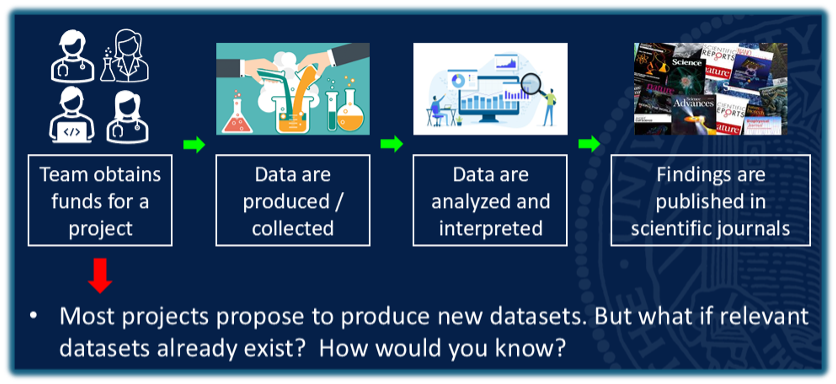
Every year, UCSF investigators generate thousands of research datasets representing substantial investments of public funding, scientific expertise, advanced technologies, and access to patients and biological samples. However, without consistent metadata standards, much of that information remains difficult to discover, integrate, reuse, and sustain—an increasingly urgent challenge as FAIR principles and NIH data-sharing policies reshape expectations for research data stewardship. While these problems may seem local, collectively they impose a substantial tax on scientific progress by slowing discovery, limiting collaboration, and reducing the long-term value of publicly funded research.

These challenges are not simply information technology problems—they are scholarly communication problems. As the Senate committee charged with advising on scholarly communication, open scholarship, and the accessibility and dissemination of research, the Committee on Library and Scholarly Communication (COLASC) recognized that modern scholarship increasingly extends beyond journal articles to include datasets, software, workflows, and digital repositories. To address the need for resources to remain discoverable, interoperable, reusable, and sustainable over time, COLASC established the Research Data and Metadata Standardization (RDMS) Task Force in late 2024.


The Task Force's review identified four major institutional challenges at UCSF:


  • Research datasets are often difficult to discover because metadata standards are inconsistent and there is no effective way to search across the many independent repositories, databases, and data lakes that exist throughout UCSF and beyond.
  • Information describing how data were generated, processed, and analyzed is documented differently across research groups, making datasets difficult to interpret, compare, and integrate.
  • UCSF lacks shared infrastructure to enable efficient collaboration and consensus-building around data analysis.
  • The separation of publications, datasets, and analytical code contributes to broader concerns regarding research reproducibility.


To better understand current practices and institutional needs, the RDMS Task Force conducted a survey between April and June 2025, which generated 181 responses across all UCSF schools, 35 departments, and 34 institutes, centers, and organized research units. The results revealed that metadata standardization remains uncommon across the institution: 67% do not use standardized nomenclature to describe their data, 70% do not use metadata standardization tools, and 84% are unaware of organizations that develop metadata standards. 65% indicated that they believe a reproducibility crisis exists in biomedical research, and only 17% believed UCSF is adequately addressing the issue institutionally. Nearly 80% supported greater institutional investment in open science, with many calling for centralized support, improved infrastructure, stronger data stewardship practices, and additional data science expertise.


Click here to read the rest of the article...


Want More Senate News?

For more on how your Senate committee members and leaders are advancing the academic mission and supporting faculty life at UCSF and systemwide, check out the Senate Check Up Newsletter.