In this issue:
- Housestaff Recognitions
- Quality Improvement
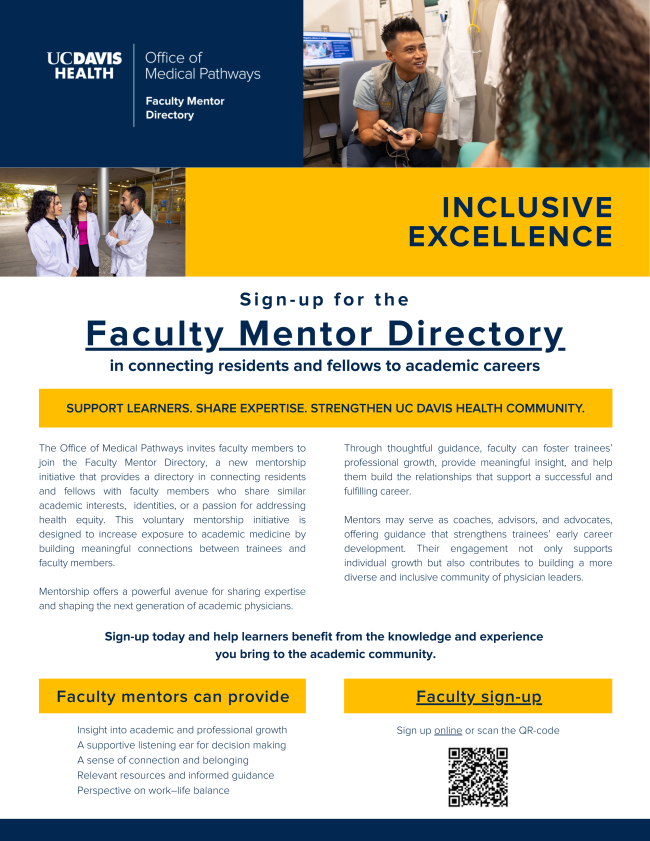
- Inclusive Excellence
- Resident and Fellow Development
- Wellness
- Coordinator Hub
- GME Calendar
- CME Resources
| | | Spotlights, Appreciation & Awards | | |
Housestaff Recognition
Over the past month, the following residents and fellows were recognized by colleagues from across the health system or from their patients:
Housestaff Name and Program
- Dr. Hallie Whalen / Neuroradiology
- Dr. Paul Mangasarian / Emergency Medicine
- Dr. Sam Rouleau / Pulmonary and Critical Care Medicine
- Dr. Kelsi Camacho / Family and Community Medicine
- Dr. Jean Kalima / Surgery
- Dr. Jon Oules / Emergency Medicine
- Dr. Nehikhare Ekhator / Internal Medicine
BEST Rewards is an on-line system that can be used to recognize and reward UC Davis Health System employees who provide exceptional service. Log in to the site to thank or acknowledge your colleagues, see who is being thanked, and send them a congratulations note or a “cheers”!
| | | |
|
Healthcare Impact Lab: 2026 Training Program in Clinical Practice Improvement
Build real solutions for real healthcare challenges in 30 days
October 14, 21, 28 and November 4, 2026
(Four consecutive Wednesdays, 9 AM–12 PM PDT)
Location: Online
This 30-day program is geared toward healthcare professionals and staff who want to learn about how to design and implement a clinical quality improvement (QI) project or initiative. Prior to the program, you should identify a health care quality or patient safety issue that you want to improve. This project-based learning program utilizes active learning to help you solve real-world problems and build skills in quality improvement methods, collaboration, and critical thinking. During the program, you will actively apply the methods and tools taught and design an actionable and feasible quality improvement project under the guidance of course faculty. Following your submission of a project plan for review and feedback by course faculty, you will receive a certificate of workshop completion.
Registration Instructions:
Please register early. Registration is limited to 50 participants.
Tuition (due with registration):
- $350 for UC Davis Health employees
- $700 for all other participants
Course Director:
Ulfat Shaikh, M.D., M.P.H.
Professor of Pediatrics, and Director, Healthcare Quality, UC Davis School of Medicine
| | | |
Resident/Fellow Support and Resources
As part of our commitment to fostering a supportive environment, we want to provide you with a list of UC Davis resources available to support you throughout your time here. Whether you’re seeking guidance, support, or simply want to connect with a community, we encourage you to explore and utilize these valuable resources.
This is an evolving list. If there are additional UC Davis resources, you'd like us to share please contact Erynne Faucett, MD, Sean Muñoz, MD, Eva Lee, MS, Maggie Rea, PhD, Susan Guralnick, MD or Ryan Traynham, MBA.
| | | | Resident and Fellow Development | | |
Career Coaching
The start of a new academic year is a good time to assess current organization and time management systems. Do you have inbox messages piling up, a QI or research project that needs attention, or want to upgrade your daily workflow? These are common topics discussed in productivity coaching. Residents and fellows are invited to utilize individual coaching to strategize about: best practices for physician time management, productivity tools, project management, strategies for managing procrastination, etc.
What is coaching? A coach acts as a sounding board to help you organize your thoughts and plan, and holds space for self-accountability. Coaching sessions are 1-1 and confidential between you and your coach. Schedule a coaching session.
Cloe Le Gall-Scoville, Ph.D., ACC
Director of Resident and Fellow Development
clegalls@health.ucdavis.edu
| |
|
At the start of the new academic year is an important time to ensure that everyone is aware of the many resources available to support the mental health and well-being of our GME community. The Office of Wellness, and the Director, Maggie Rea, Ph.D. (mrea@health.ucdavis.edu), is always a great place to access support and/or to identify resources. Dr. Rea is available to offer support to individuals, but also as a resource for group support such as process spaces, debriefings, or sessions on various wellness topics.
The Academic and Staff Assistance Program is available to offer no fee, confidential counseling for trainees, faculty and staff and their partners/spouses with dedicated counselors for our GME trainees. Please call (916) 734-2727 or email ASAPhealth@ucdavis.edu to make an appointment. In addition to our onsite/virtual UC Davis resources, trainees can access counseling and psychiatry services through Anthem or HeadspaceCare which is a behavioral health platform offered to residents/fellows and their partners and includes 15 counseling and/or psychiatric services sessions as well as wellness coaching and psychoeducational resources.
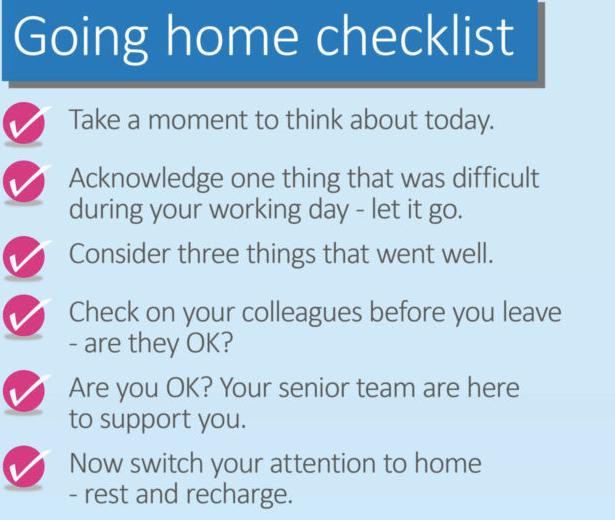
The start of the new academic year is also a good time to be reminded of the power of quick and accessible strategies to help navigate stress. One fun and helpful practice is the One Moment Meditation seen in this video which offers a helpful guide on how to de-stress in just a minute. Consider getting your team together, take a break and play the video and notice the calm that ensues and the increase in your focus. Perhaps try this short one minute breath meditation from Headspace to relieve stress, shrapen focus or cultivate more compassion. Or incorporate this going home checklist for yourself and your teams:
| |
Take time for self-reflection and check in on your well-being by completing this anonymous Wellness Survey
Please do not hesitate to reach out to any of the many resources.
For urgent crisis needs:
- Suicide Prevention Hotline 988
- Text HELLO to 741741
- Sutter Center for Psychiatry 24/7 at (916) 386-3000
- Mental Health Urgent Care Clinic 24/7 at (916) 520-2460
| | | |
|
Chief Resident/Fellow Leadership Day 2026
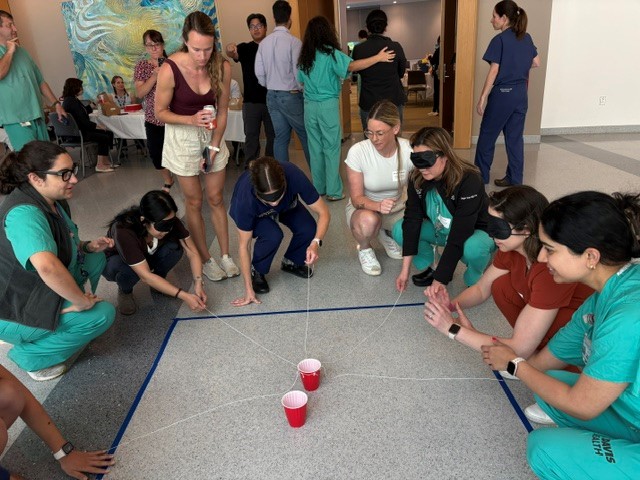
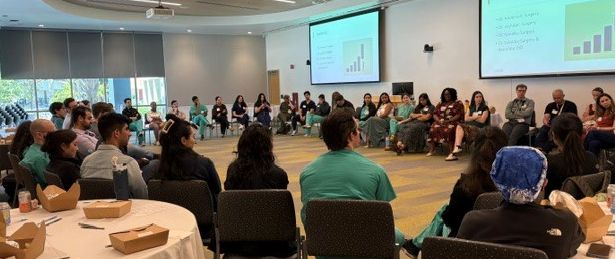
On June 3, rising chief residents and fellows from across UC Davis Health gathered for Chief Resident Leadership Day, an opportunity to build connections and foster community across residency programs. The day featured an interactive leadership experience facilitated by our trauma surgery faculty, Drs. Salcedo, Anderson, Leshikar, and Symalla, who guided participants through practical leadership development activities. Rising chiefs had the opportunity to strengthen key skills in coaching, conflict negotiation, and time management, while engaging with colleagues from diverse specialties. The event provided a valuable foundation for the upcoming year, equipping and empowering chiefs with tools and relationships to support their success as leaders.
| |
Chief residents participate in a team-building leadership exercise indoors. Several residents, some wearing blindfolds, kneel around a taped square on the floor and use strings attached to cups to work together toward a shared goal. Other participants observe and provide support, highlighting collaboration, communication, trust, and problem-solving skills in a group learning environment.
| Chief residents gather in a conference room for a facilitated leadership discussion led by members of the trauma surgery team following their leadership exercise. The residents are sitting in a circle, engaging in reflective conversation and sharing perspectives on leadership, teamwork, and professional development. | | | |
For Program Administrators and Coordinators
Leadership • Organization • Growth
| | | |
Inspirational Quote of the Month
"The secret of getting ahead is getting started." — Mark Twain
July is often one of the busiest operational months in Graduate Medical Education—not because of preparation, but because everything is now in motion. New trainees are learning workflows, faculty are adapting to new team structures, and programs begin collecting the first real data of the academic year. This month is an opportunity to shift from onboarding mode into monitoring, supporting, and optimizing program operations.
|
Professional Development Spotlight
“The Lazy Genius Podcast – How to Declutter Your Week” by Kendra Adachi
This episode focuses on simplifying busy seasons, prioritizing what matters most, and reducing overwhelm by looking at one week at a time—very relevant for Program Coordinators managing onboarding, scheduling, and early academic-year tasks.
Visit the podcast website or scan the QR code to listen.
Approx. 43 minutes — practical, relatable, and easy to implement!
Why this is relevant for Program Coordinators:
- Managing multiple competing priorities during the start of the academic year
- Reducing administrative overwhelm through intentional planning
- Creating manageable systems for high-demand seasons
- Staying focused on immediate priorities rather than future stressors
Perfect for:
- Organizing your week more effectively
- Navigating busy onboarding and scheduling seasons
- Preventing burnout through simplified planning
|
GME Operations & Accreditation Focus
Recruitment Season Preparation Begins
Although interview season may feel far away, July is an ideal time to begin preparing for the upcoming recruitment cycle
Consider reviewing:
- ERAS application review workflows
- Interview dates and scheduling logistics
- Faculty interview availability
- Recruitment materials and program presentations
- Website accuracy and updates
Starting early can reduce stress when applications are released
Rotation Schedule Audits
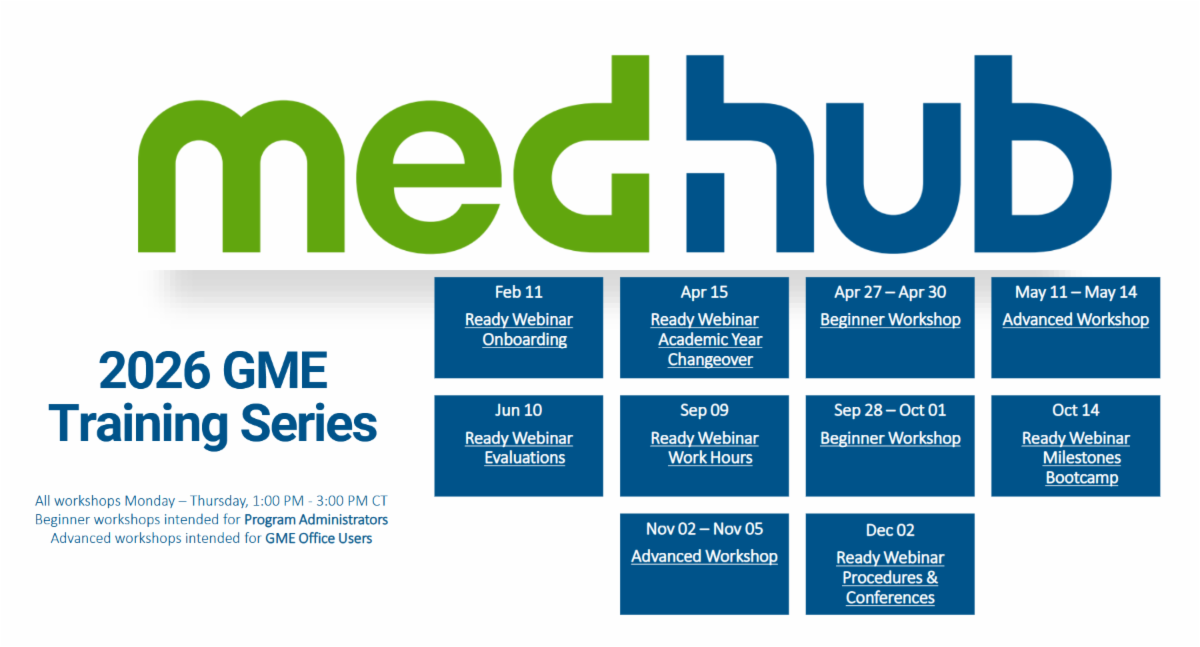
With the academic year underway, now is the time to perform an internal review of rotation schedules. You can do this by running the "Resident Scheduling Errors" report in MedHub
Check for:
- Coverage gaps
- Overlapping assignments
- Compliance with educational requirements
- Vacation accuracy
- Holiday coverage planning
Early audits can prevent scheduling conflicts later in the year
Faculty Engagement and Annual Expectations
July is a strong time to reconnect with faculty regarding educational responsibilities. Have your Program Director schedule time with the faculty to discuss the following topics.
Review:
- Evaluation completion expectations
- Conference attendance requirements
- Supervision responsibilities
- Faculty development opportunities
- Scholarly activity goals
Clear expectations at the start of the year improve engagement and accountability.
Resident/Fellow Wellness Planning
Rather than reacting to burnout later, July is a great time to proactively build wellness into the academic year.
Consider:
- Scheduling wellness check-ins quarterly
- Planning social events or team-building activities
- Reviewing fatigue mitigation resources
- Creating peer-support opportunities
- Identifying high-stress rotations in advance
Intentional planning supports retention and trainee satisfaction.
Data Tracking Systems Review
Ask yourself:
- Are evaluations being completed on time?
- Is duty hour compliance being monitored?
- Are conference attendance records accurate?
- Are procedure logs being reviewed regularly?
- Are remediation processes clearly documented?
Strong data systems support smoother accreditation reviews and internal program improvement.
Mid-Year Planning Starts Now
While it may seem early, July is the best time to begin looking ahead to winter deadlines.
Begin mapping:
- Semiannual evaluation timelines
- Holiday staffing coverage
- Recruitment interview season
- In-training exam preparation
- Budget planning for conferences and education funds
Forward planning now creates flexibility later.
Coordinator Success Tip
July is the month to observe, assess, and strengthen your systems
A simple reminder:
- What feels disorganized now will likely become a bigger challenge later
- What works well now should be documented and repeated
- What trainees need now may shape their success all year
Small improvements in July can have a lasting impact.
A Special Thank You
July often brings the reality of the work into full view. New questions arise, schedules shift, and systems are tested.
Thank you for:
- Keeping operations moving smoothly
- Anticipating challenges before they escalate
- Supporting trainees as they find their footing
- Helping faculty stay connected and informed
- Strengthening your program’s foundation every day
Your work is not just administrative—it is strategic, impactful, and essential.
Your leadership shapes the trainee experience more than you may realize.
Wishing you a focused, productive, and successful July!
| | | | All Residents and Fellows are welcome to attend the monthly meetings (meeting details will be emailed prior to the meeting dates). Sign up to be your program's representative by contacting your program coordinator today. | |
Meetings
Graduate Medical Education Committee (GMEC) (in-person)
- Tuesday, July 7, 2026
- Tuesday, August 4, 2026
First Tuesday of each month, at 11:30am-1:00pm. Agenda and Locations announced via email. Lunch provided.
Program Administrators/Program Coordinator Meeting (virtual)
- Thursday, July 16, 2026 at 9:30-11am
Monthly meeting, attendance is required. Join Zoom meeting. Meeting ID: 993 0618 8232 / Passcode: 581258
PD Connect (virtual)
- Thursday, July 23 at 12:00-1:00pm
Join Drs. Guralnick and Rea on Zoom for the monthly Program Director Connect, an informal gathering where you can have a chance to connect with others in the same role, share experiences and get input and support. Join Zoom meeting.
PC Connect (virtual)
- Wednesday, July 28 at 12-1pm
This monthly informal call is an open space for Program Coordinators to connect, ask questions, share challenges, and exchange best practices. Whether you're looking for advice, new ideas, or just want to hear how others are approaching their work, this is a chance to learn from and support one another in a relaxed, peer-driven environment. No formal agenda—just real talk with fellow coordinators. Join Zoom meeting.
Courses and Workshops
GME Workshop: ACGME ADS Annual Update (virtual)
- Monday, July 13 at 12:00pm
Program directors and administrators can attend this workshop, provided by the GME Office, in preparation for the program's ADS Annual Update. Join Zoom meeting.
ACGME Self-Empowerment Workshop for Coordinators (virtual)
This seven-day interactive workshop is meant for both the new and experienced coordinators who wish to gain insights into leadership, networking, professionalism, and self-promotion as it pertains to the profession. This free workshop is repeated monthly. Visit the ACGME workshop website.
ACGME LINC [Listening, Information, News, Collaboration] (virtual)
-
Date and Time: July 20, 5:00-6:00 p.m. Central
-
Topic: The Basics of Accreditation for Program Coordinators
-
Who: Newer program coordinators or those seeking a refresher; all members of the GME community are invited to attend
ACGME LINC provides an opportunity for the GME community to interact with and hear from ACGME representatives, and to receive updates and information on ACGME activities. Miss a previous session? View the recordings at Learn at ACGME. (Note: A free Learn at ACGME account is required to access the recordings.) Register for the session.
Due Dates
ACGME ADS Annual Update 2026-2027AY
The Annual Update will be collected between July and September 2026. The 2026-2027 ADS Annual Update Overview, FAQs, Schedule, and other resources are available in the ACGME Cloud Annual Update.
- Programs without case log data: July 6 – August 21, 2026
- Programs with case log data: July 20 – September 18, 2026
Thalamus Sign-up and Ordering 2027AY
-
ERAS programs automatically have complimentary access to Thalamus Core, Itinerary Wizard, Cerebellum, and Cortex; option to purchase Thalamus Video is available.
-
Non-ERAS programs have options to purchase Thalamus Core, Itinerary Wizard and Thalamus Video.
See email sent on 6/22/2026 for details. Send requests to Cirby Hatano, chatano@health.ucdavis.edu by July 3, 2026.
Reminder: Annual Program Evaluation (APE) 2025-2026 AY
Templates and instructions were emailed to program directors and program administrators on April 2, 2026. Please complete the APE and submit to the GME Office by July 15, 2026 by emailing Cirby Hatano, chatano@health.ucdavis.edu.
| | | | GME Programming Menu for Trainees and Faculty | | |
|
Program leadership are encouraged to review GME's programming menu of workshops and didactics available for their trainees and faculty.
Many of the topics meet ACGME requirements for Wellness, Interpersonal Communication, Professionalism, and Faculty Development.
Reach out to Dr. Maggie Rea at mrea@health.ucdavis.edu or Dr. Cloe Le Gall-Scoville at clegalls@health.ucdavis.edu as you plan your educational curriculum.
| | | | Faculty and Professional Development | | |
|
UC Davis Health Faculty and Professional Development Program is committed to delivering high quality training and resources for UC Davis Faculty. Our offerings derive from our core missions: Education, Research, Clinical Care and Service.
Our faculty trainers are subject matter experts that aim to provide timely and relevant programs, courses and individual sessions through multiple modalities to ensure access for faculty. We collaborate with other Institutional and National entities that align with the mission of UC Davis Health to ensure continuous quality improvement of our programming. We partner closely with the office of Health Equity by Design for Inclusive Excellence, the office of Medical Pathways in the School of Medicine, and the Betty Irene Moore School of Nursing to provide and promote inclusive excellence training for all of our faculty.
| | | | | | For questions regarding the GME monthly newsletter please write Ahmet Demirer at aademirer@health.ucdavis.edu. Thank you. | | | You can view the GME newsletter on the Web {here.} | | | | |