|
|
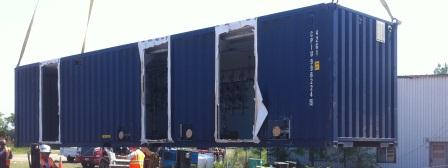
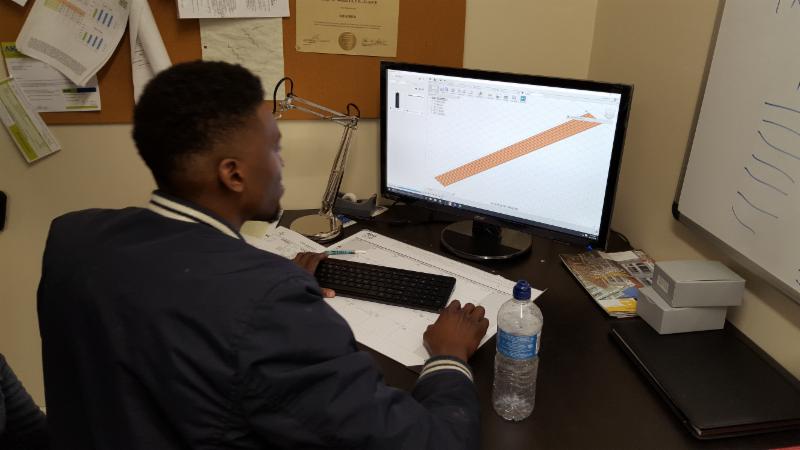
AJ is building a model of a shipping container.
|
When we hired AJ Blyden, he t
old us he knew how to use Autodesk Revit, and I re
ally didn't pay much attention. Revit is a 3 dimensional design program that has a lot of power. It is used in BIM (Building Information Management), which is a system of designing in 3d among all disciplines, and constantly sharing the design over the Internet with all the parties in a construction project. It is extremely valuable with very large projects because all the systems ca
n be modeled in 3d, keeping conflicts in design to a minimum, and design changes can be made quickly and share immediately.
We aren't doing projects that involve BIM at this point, but at some point in the future we will. So, we knew we had to get over to Revit soon. The learning curve is not something you want to experience in a large project. However, I didn't think using Revit would make much of a difference.
I was wrong. We're using Revit in our shipping container building design, and we can generate a building fast. Also, we can see easily where we will have problems, and we can more accurately develop our design details.
One thing I like, which seems like a minor item is stairways. Stairs are a pain to draw, working through the geometry is a nightmare. It's not just the risers and the treads. It's the headroom, and the landings. You have to comply with the Code for the pitch, yet make everything work out. Revit allows you to generate stairs quickly, and it is easy to see if everything is working out.
In addition to Revit, we've started using Autodesk Inventor. Inventor lets us build structures and structurally analyze them. The big advantage with Inventor is some of our clients develop prototypes with it or Softworks, and we can take the prototypes and do the structural analysis without having to redo the models in our own software. This cuts our turnaround time and saves on man-hours.
The problem with 3d design is that there are a lot of programs out there, and they are not compatible. I have clients that use ArchiCAD, Vectorworks, Vertex, Revit, and Softplan. All of those programs are extremely expensive, and they aren't really compatible.
We're basically where we were in the 1980s with CAD. A lot of firms back then put out a lot of money for systems that didn't work well, were insanely expensive, and never caught on. The example that comes to mind was Intergraph. It was moving up as a standard, a lot highway departments were using it, and the Army Corps of Engineers used it. I was told by one firm that they spent about a half million dollars on their workstation. They ran it 24 hours a day, seven days a week to try to recoup their investment. It didn't work well at all.
Ultimately, Autodesk AutoCAD pushed aside Intergraph, because you could run it on a PC. A complete work station with the PC, software, and plotter cost about $10,000. That's a lot in today's dollars, but it was a lot less than $500,000. Since you could technically share the plotter, each additional work station would only cost you $5,000, so you could outfit an office with a large number of workstations.
So, today you can spend an insane amount of money for a 3d design system and have it kill you in overhead, and find you have a difficult to use system that gets pushed out by a competitor. Your other alternative is to not do anything, and find yourself left way behind as others move forward. When CAD came about, many firms resisted it. Some companies refused to go over to CAD. Those companies either don't exist anymore, or are down to one guy working in his basement. I don't want to be that guy, and if you are an architect or engineer, neither should you..
We're taking a bit of a gamble that Revit and Inventor are going to come out on top. The first reason is most firms and agencies I've talked to are going with Revit. The second is it has the power of Autodesk behind it. Finally, we're able to get the software with a subscription, which makes it affordable. Using the Principle of Mediocrity, that we are pretty much like everyone else, others will probably reason the same as we have and the Autodesk products will win out.