|
Dear Closing the Health Gap Community:
This past week served as a jarring and powerful reminder of both the progress we’ve made and the challenges that remain. On Thursday, we celebrated Juneteenth, a day honoring the end of slavery in the United States – yet just days before, a federal judge ruled that the Trump administration’s cancellation of hundreds of DEI and health equity grants was not only unlawful but likely rooted in racial and LGBTQ+ discrimination.
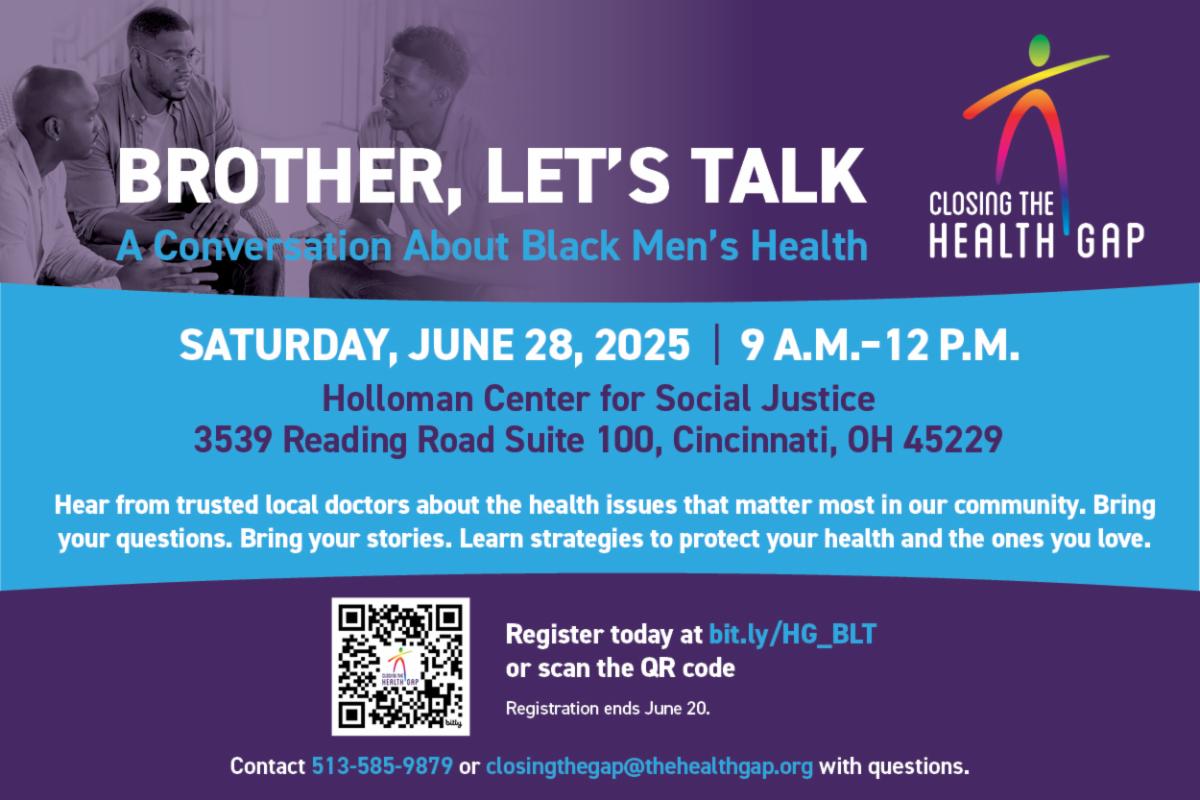
These two moments, occurring within days of each other, highlight the ongoing struggle for justice, equity and inclusion in health care and beyond. At the Center for Closing the Health Gap, we remain committed to defending efforts that advance equity and understanding the systems that continue to marginalize our neighbors. Join the Center for Closing The Health Gap in experiences for the family to talk about the change we can be. That includes our June 28 "Brother, Let's Talk" event and registrations are open until Thursday, June 26.
We must not be deterred. We Must Save Us. Blessings for a safe and healthy week ahead.
Renee Mahaffey Harris
President & CEO
| |
MSNBC: The NIH says health disparity research is discriminatory. That’s beyond ignorant.
by Dr. Esther Choo, MSNBC Columnist
Brittany Charlton, an associate professor at Harvard Medical School and renowned expert in LGBTQ health, has described the goal of her research as “trying to improve health care for a segment of the population that had been largely ignored despite a greater-than-average rate of poor outcomes.”
That’s a succinct description of health disparities research. Addressing disparities entails figuring out why there’s a failure in health or health care somewhere and how to fix it. Such failures can depend on how old you are, how wealthy, if you have a disability, how much access you have to a healthy diet, and so on. And some occur among particular racial or ethnic groups and among those who are sexual and gender minorities. But the National Institutes of Health terminated research related to those latter groups, including Charlton’s, stating that President Donald Trump’s NIH director, Jay Bhattacharya, found such work “not scientifically valuable.”
| | |
Calling All Closing the Health Gap Volunteers!
Be a part of something bigger. Our Volunteer Kickoff and Orientation for Closing the Health Gap is your chance to contribute to the health and wellness of our communities. Every volunteer, past, present, and future, plays a crucial role. Let's be the change together.
Monday, June 23 at 6:00pm
UC Health Business Center
Questions? Call 513-585-9879.
| |
Cardiovascular Disease and Diabetes Are Driving the Increase in US Excess Mortality—and Adults Without College Degrees Are Bearing Most of the Burden
Cardiometabolic diseases such as cardiovascular disease and type 2 diabetes have emerged as some of the key drivers of worsening mortality rates in the United States over the last 15 years. People with limited education are feeling the brunt of this crisis, according to a new study by the School of Public Health, the University of Helsinki, and the University of Minnesota.
For both men and women without a bachelor’s degree (BA), mortality between 2011-2023 was markedly higher than would have been expected had death rates from 2006-2010 continued. Among 564,855 excess deaths in 2023 alone, 481,211 occurred among people without a BA—a 26 percent increase in mortality among this population, compared to pre-2010 trends. In contrast, mortality only increased by eight percent among people who received a BA. The study was published in JAMA Health Forum.
| |
Uniting for Health Equity on Juneteenth: Why Closing the Breast Cancer Gap Must Be a Global Priority
by Dana Brown, President & CEO, iCAD, Inc.
On Juneteenth, we reflect on freedom and the responsibility that comes with it. As we commemorate the emancipation of enslaved people in the United States, we must also recognize the systemic inequities that persist, particularly in healthcare. Breast cancer demonstrates how these disparities manifest. According to recent data from the American Cancer Society, Black women in the U.S. are 40% more likely to die from breast cancer than white women. They are often diagnosed at later stages and are at greater risk for aggressive subtypes like triple-negative breast cancer. These outcomes are not indiscriminate. Instead, they reflect long-standing gaps in access, awareness, and care.
The Reality: Disparities in Breast Cancer Care
Breast cancer is the most commonly diagnosed cancer worldwide. In 2020, there were more than 2.3 million new cases and 685,000 deaths. By 2040, that burden is expected to grow to over 3 million new cases and 1 million deaths annually. While most diagnoses occur in transitioned countries, transitioning and underserved regions experience a disproportionate share of breast cancer deaths. Globally and locally, factors such as limited access to high-quality screening, fewer trained specialists, and delays in care contribute to this inequality. For example, in North America, the breast cancer incidence rate is 84.8 per 100,000 women, but mortality is relatively low at 12.6 per 100,000, thanks in part to early detection and access to treatment. In contrast, Western Africa has a much lower incidence rate of 37.3, yet a significantly higher mortality rate of 17.8—highlighting how late-stage diagnosis and limited access to care can dramatically worsen outcomes.
Even within the United States, Black women are less likely to receive advanced screening technologies like 3D mammography.7-8 When they do, they often face additional hurdles, such as limited access to subspecialists, cultural barriers, and implicit bias in care delivery.
| |
Tumor collagen structure may help explain racial disparities in cancer outcomes
In cancer care, accurate tools for predicting whether a tumor will spread (metastasize) can help patients receive the most appropriate treatments. But existing prediction methods don't always work equally well for everyone. In particular, Black patients with breast or colon cancer often experience worse outcomes than White patients, despite receiving similar care. A new study from researchers at the University of Rochester, published in Biophotonics Discovery, suggests that differences in the structure of collagen-the main protein in connective tissue-may help explain part of this disparity.
|
Root Causes of Health Disparities
In recent decades, epidemiologists have identified the unequal distribution of wealth, income, and resources in a society as a root cause for health disparity in that society, independent of individual risk factors.
At the most basic level, socioeconomic differences affect access to health care and health outcomes. Epidemiologic analyses of chronic disease development in populations characterized by economic disparity show individuals of lower socioeconomic status suffer higher rates of chronic disease and experience lower life expectancy when compared to those of higher socioeconomic status, in lock-step fashion. It’s not surprising. Economic disparities create a complex web that ultimately affects individuals’ healthy lifespan. When resources are limited, access to necessary health care, nutritious food, and safe living conditions diminish. Consequently, individuals from lower socioeconomic backgrounds experience a higher burden of chronic diseases, which can truncate lifespan.
| | | | |