June 2026 || Newsletter Edition 189 | |
In this issue:
CSU Food Systems Spotlight
Mark Your Calendar
Funding Opportunities
News, Resources, and Reading
From Our Communities
About Us
Stay Connected
| | CSU Food Systems Spotlight | | |
Amber Obermaier
Graduate Student, Department of Sociology
Amber is a Ph.D. candidate in the Department of Sociology at Colorado State University. Her research broadly focuses on food insecurity, environmental justice, and health. Previously, she earned her Bachelor’s in Anthropology and Nutrition from Missouri State University and her Master’s in Sociology from the University of Arkansas. She is currently completing her dissertation on how different populations perceive and address college student food insecurity, conducting interview and content analysis at universities and colleges across Colorado. She also is a graduate teaching instructor for the Department of Sociology.
Amber brings her experience in the food access world into her scholarship and teaching, including helping run the student pantry at the University of Arkansas, serving as an Extension summer intern for the Larimer County Farmers Market, and reviewing USDA grants. She currently also serves as a qualitative analysis research assistant in a project that examines community-engaged approaches from extension professionals surrounding food insecurity and resilience. Above all, she believes in promoting equitable food access for all.
| | |
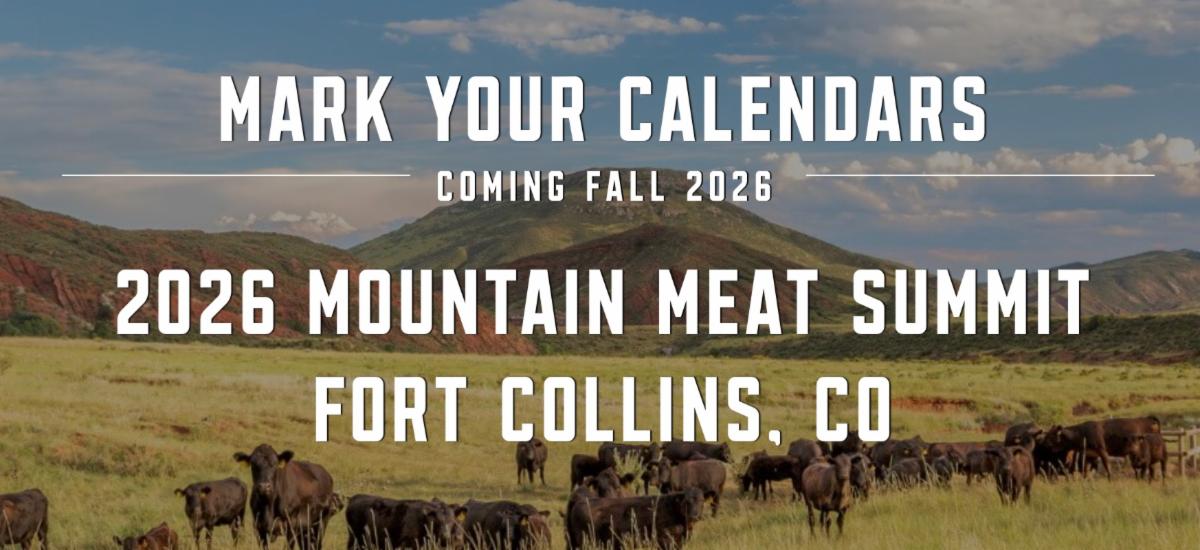
Mountain Meat Summit Webinar
Although the Mountain Meat Summit has been postponed until this fall to allow for stronger participation and more meaningful engagement across our regional meat community, we are bringing you a webinar on timely industry topics in preparation for our Fall 2026 event. Join us HERE for a Mountain Meat Webinar on Friday, June 12, from 12:30–1:30 PM to hear updates and help shape future programming.
Topics include: American Association of Meat Processors updates, USDA Meat and Poultry Processors Expansion Program grants, workforce development, small- to mid-scale rendering and feedback on future Mountain Meat Summit topics. Learn more here.
| |
Field-Based Education in the High Plains Region
Mark your calendars and check out these educational opportunities coming soon across the High Plains region!
| | |
Free Market Channel Assessments
Growers, are you thinking about which market channels are the best use of your labor? CO Fruit & Vegetable Growers Association and CSU Extension have 4 farm stipends to carry out farm-specific market channel assessments this season!
CSU Extension will help you by looking at sales volume, labor costs, and an array of market-based factors during one peak week of the market season. They provide a stipend for your time to collect that information (which you often already have) and you receive a report and discuss recommendations for enhancing profitability.
If you are interested, please complete this form https://col.st/GgmSF or email Nicole.Didero@colostate.edu.
| | |
Advancing Regional Organic Markets: A Farmer's Toolkit
Calling all farmers and stakeholders who live in the Plains region! Join Rodale Institute on August 19, 2026 from 11:00 a.m.-12:00 p.m. for an in-depth discussion of an updated “Advancing Regional Organic Markets: A Farmer’s Toolkit”, a resource designed to strengthen regional organic economies. This toolkit provides farmers and stakeholders with data, insights, and opportunity analysis to help expand regional production of high-demand organic crops, reduce reliance on imports, and increase economic opportunities for U.S. farmers.
During this Advisor Call, we’ll discuss the Toolkit’s improvements since it was first launched in December 2025 and explore how to use the toolkit to identify key market opportunities in the Plains region, support resilient supply chains rooted in local identity, and foster stronger connections between producers, processors, and buyers.
If you’re looking to grow your organic markets, plan for the future, or better understand where new opportunities are emerging, this virtual advisor call is for you. Register here: https://rodaleinstitute.org/events/advisor-call-advancing-regional-organic-markets-a-farmers-toolkit-plains/
| | |
Annie's Project Facilitator Trainings
Annie's Project is hosting facilitator training sessions. Registration is limited to the first 20 participants. All sessions are virtual and there is no charge for the training.
Virtual National Annie’s Project Facilitator Training (8 hours)
All 8 hours must be completed to be certified as an Annie’s Project facilitator. If you are interested in hosting Annie's Project in your county, the first step is to become a trained facilitator by taking this course.
-
September 15-16 (9am – 11am and 1pm – 3pm MST). Times repeated on both days.
-
November 9-10 (9am – 11am and 1pm – 3pm MST). Times repeated on both days.
Contact Jenny Beiermann (jenny.beiermann@colostate.edu) or Karisha Devlin (karisha@anniesproject.org) with questions or for more information.
| | |
Training Programs at the Food Finance Institute
The University of Wisconsin's Food Finance Institute (FFI) is offering these upcoming programs:
-
Funding Your Farm's Future (begins June 3rd) - For people looking to to grow their farm and those who want expert guidance to strengthen their applications and deals.
-
Financial Foundations for Food Brands (begins June 8th) - Define your customer and your unique value, understand costs to ensure profitability, and master key financial documents for growth.
-
Consultant Training (begins October 1st) - Learn market trends and business models; master financials, performance, and funding strategies.
Learn more and sign up here.
| | |
Online Course for Aspiring Farmers, Ranchers, and Food System Workers: Exploring Your Farm Dream
Exploring Your Farm Dream is an online course offered by CSU and the Colorado Building Farmers and Ranchers Program for people looking to equip themselves with the knowledge, skills, and business strategies for a future in agricultural production. This self-paced course is designed for learners who have limited experience in agriculture. Visit the course website here for more information.
Participants can expect to:
- Learn from CSU Extension faculty instructors with expertise in agricultural business management
- Get access to strategic personal and business planning insights, tools, and resources
- Assess preparedness for starting a farm-based business aligned with your resources, skills, and goals
- Explore a variety of different pathways and business models in ranching, agriculture, and food systems
The course consists of 10 modules, which learners will have access to for a full year. Registration costs $150. Register for the course here.
| | |
Food Safety Training for Colorado Cottage Foods Producers
Learn how to safely produce food from home as a cottage food business. This course covers a variety of topics, including: basic food safety, foods that are permissible under the updated Colorado Cottage Foods Act, ingredient labeling, special considerations for food preparation at high altitudes, and safe food sampling best practices. Registration is $55.
For dates of online and in-person classes and to learn more, check the website here.
| | |
Farm Resilience Online Course
Learn practical strategies and tools to boost your farm’s resilience amidst the challenges of climate change. This self-paced, online course is designed specifically for farmers and ranchers in the West, focusing on real-world solutions and hands-on techniques.
Join a community of like-minded individuals and gain the knowledge you need to secure your farm's future. CSU was fortunate to partner with this program to develop some of the content and decision tools.
Enroll today and deepen your journey towards climate resilience and sustainability.
| | |
USDA Announces Local Agriculture Market Program Funding Opportunities
The U.S. Department of Agriculture (USDA) has opened applications for its Local Agriculture Market Program (LAMP) grants to support the development, coordination, and expansion of direct producer-to-consumer marketing; local and regional food markets and enterprises; and value-added agricultural products. These include the Farmers Market Promotion Program (FMPP), Local Food Promotion Program (LFPP), and the Regional Food System Partnerships (RFSP).
AMS hosted a webinar for applicants to each of these grant programs, and the recordings are posted on the AMS Grant Webinars page.
USDA is accepting applications for these grant programs until June 5, 2026.
LAMP and its accompanying grant programs are administered by USDA’s Agricultural Marketing Service (AMS) and are funded through the 2018 Farm Bill. For more information, visit the AMS LAMP webpage.
| |
USDA Protection and Recovery Resources
USDA provides a suite of disaster assistance programs to help offset losses as well as crop insurance and other coverage options to help manage risk and provide a safety net. USDA’s Farm Service Agency, Natural Resources Conservation Service, and Risk Management Agency offers a number of options.
Learn more about USDA's disaster assistance programs here, and the Noninsured Crop Disaster Assistance Program here. The Risk Management Agency of USDA has crop insurance resources here.
| | News, Resources & Reading | | |
Food Hub Operator's Toolkit
USDA AMS, in partnership with the University of Vermont and Michigan State University, investigated the main roles of food hub operators and the progression of their work from start up, to expansion, to innovation.
Many Hats – A Food Hub Operator’s Toolkit is a central depot of resources that will support food hub operators in the roles they may play at each phase of a food hub’s lifespan. It provides peer-generated knowledge, industry context, and direct links to existing and relevant resources across organizational, value chain, operations, and partnership development. This project is accompanied by a four-episode podcast series available through The Food Hub Podcast.
| | |
Characteristics of Regional Food Policy Councils
Interest in regional approaches to food system planning, development, and governance has grown dramatically in the last decade, including that of food policy councils (FPCs). Due to limited information on regional FPCs, AMS and researchers and practitioners from Ohio State University, Colorado State University, and Johns Hopkins Center for a Livable Future partnered with 11 regional FPCs through an 18-month community of practice. They explored the unique opportunities, challenges, and needs of regional FPCs and developed resources to inform and support regional work.
These resources offer insight from the community of practice to support FPCs and other groups taking a regional approach. Visit the project website to view the resources and to learn more about the project background and takeaways.
| | |
Cultivation Station: A Colorado Proud Podcast
Cultivation Station is a business development podcast from the CO Department of Agriculture's Colorado Proud program. The podcast dives into the rich and diverse world of food and agricultural businesses. Whether you are just beginning to think about starting a food or ag business in Colorado, or your operation is up and running, there are many expert insights and insider tips to help you be successful.
Find the full list of podcast episodes here.
| | |
Poudre Valley Community Farms Land Access Bulletin
Poudre Valley Community Farms has launched a bulletin designed to connect producers with land and water access opportunities across the Front Range. Each issue will feature current listings and announcements that support long-term access and stewardship, intended for producers seeking land and landowners looking to connect with growers.
Sign up for the bulletin here.
| |
List Your Business in USDA AMS Local Foods Directories
The USDA Local Foods Directories allow you to market your local food business to a wider nationwide audience. AMS directories include:
To create a new listing, answer quick and easy questions about the status of your business so consumers can learn more about you.
Click here to sign up for the directory.
| | |
Complete the 2026 Food Business Survey
Are you a food business operating out of a shared kitchen? The Food Corridor wants to hear from you. Their 2026 Food Business Survey takes about 10–15 minutes, and your responses are completely anonymous. Participants are entered to win one of three $100 Amazon gift cards.
Take the survey: https://colostate.az1.qualtrics.com/jfe/form/SV_e8P6MoBnf0w1BUW
Results will be presented at the Shared Kitchen Summit, October 12–14, 2026, in Providence, Rhode Island.
| | |
Colorado Ag Labor Survey for Employers
Each year the Colorado Department of Labor and Employment (CDLE) is required to document the prevailing wage and practices for a particular segment of the Colorado agriculture sector and report these back to the US Department of Labor.
For the 2026 survey, CDLE is collaborating again with Colorado State University Extension (CSUE) to develop and deliver the online survey and then analyze and report to CDLE on survey findings. In this year’s survey, CDLE is focusing on livestock producers in Colorado and their 2025 entry level job wages and practices related to herding, shearing, feeding, watering, animal birth, animal health, animal harvest, etc.
-
Survey Part I: General characteristics of all respondents
-
Survey Part II: CDLE Prevailing Wage and Practices questions for livestock producers only (required)
-
Survey Part III: CSUE Labor Factors questions for all farmers and ranchers (a continuance of this annual survey to document how labor challenges are affecting Colorado farms and ranches)
Did you know there is no research group that gathers wage data paid to non-H-2A farm workers in Colorado? Your responses will help answer this question for Colorado policy makers plus provide important information about the services you provide to workers. Survey data will also provide crucial information from the entire Colorado ag sector to inform public policy not collected anywhere else.
The maximum duration of the survey is 10 minutes. If you are not a livestock producer your survey time is roughly 5 minutes. You can start, stop, and come back to complete the survey before it closes June 30th.
All responses are voluntary and anonymous and there are no risks or benefits to taking or not taking the survey.
Questions? Kerri Owen, kerri.owen@state.co.us and Adrian Card, adrian.card@colostate.edu.
Take the survey here: https://colostate.az1.qualtrics.com/jfe/form/SV_0fbK1rwHDbdgkp8
| | |
USDA Local Food Survey
USDA’s National Agricultural Statistics Service (NASS) is conducting the Local Food Marketing Practices Survey to gather data on the production and local marketing of foods. Information includes the value of food sales by marketing channel, value of crop and livestock sales, marketing practices, expenses, federal farm program participation, and more. As consumer interest has grown and programs and policies for local foods have developed, the Local Food Marketing Practices Survey is critical to showing where the sector is today and helping to identify future needs.
The survey was mailed out January 6, 2026 to almost 64,500 producers nationwide. Producers who receive the survey are strongly encouraged to respond online at agcounts.usda.gov. Learn more about the local food survey by visiting nass.usda.gov/go/local-food.
| |
ABOUT FOOD SYSTEMS
at Colorado State University
| | Food systems are the connections between natural resources, the agricultural and food industries, and the buyers, consumers, and communities to which they contribute. Research, extension and education identify and inform opportunities to bridge how production, supply chains, and eaters respond to changing markets, policy, and the environment. At CSU, we focus on these key areas to train, influence, and communicate ways to connect food-related roles and foster healthy communities, economies, and individuals. | | | Find us on social media, get farm or food systems related questions answered via email, forward to a friend, or submit your contributions to our newsletter! | | | | |