|
We acknowledge that the land on which this diocese is built is the traditional territory of the Paiute, Kawaiisu, Tubatulabal, Yokuts, Chumash, Miwok, Chukchansi, Western Mono, and Me-Wuk people.
Let’s take a moment to honor these ancestral grounds that we are collectively gathered upon and support the resilience and strength that all Indigenous people have shown worldwide.
~~~~~~~~~~~~~~~~~~~~~
Reconocemos que la tierra sobre la que está construida esta Diócesis es el territorio tradicional de los pueblos Piaute, Kawaiisu, Tubatulabal, Yokuts, Chumash, Miwok, Chukchansi, Western Mono y Me-Wuk.
Tomemos un momento para honrar estos terrenos ancestrales en los que estamos reunidos colectivamente y apoyar la resiliencia y la fuerza que todos los pueblos indígenas han demostrado en todo el mundo.
| |
Friday Reflection
Our theme for the Friday Reflections this year is “Looking Back & Moving Forward." Music came first to mind for me, which should be no surprise to those who know me well. There is a plethora of songs about the past – songs which can evoke memories of good times, bad times, lost loves, new loves, and of anything imaginable. Songs notwithstanding, we all carry memories of our journey to where we are today. They can be triggered by any number of things – a scent, a sound, something we see, and the list goes on.
I have had the privilege of being part of the nominating committee in our search for a new bishop, which has shaped my recollections. One of the first things we had to do, once the whole committee was selected, was to develop a Diocesan Profile. This was necessary to show potential candidates not only who and where we are, but also where we have been and how we arrived where we are now. This process most definitely triggered memories – mine and those of others.
For me, my memories of the diocese start in 1974, when I moved to Modesto and started attending at St. Paul’s. The Rt. Rev. Victor Rivera was bishop at the time. I joined the Navy in 1976, drifted away, and when I returned, John David Schofield was the bishop. It wasn’t a particularly happy time. I saw a diocese isolated from the rest of the Episcopal Church, leadership was in the hands of white, heterosexual men, and women were not being ordained to the priesthood, even though the rest of the Episcopal Church had taken that step.
Bishop Schofield seemed to have a tight grip on the diocese - a stranglehold in actuality. There was a time for me when that would have been fine – but life happened, and the armor of my ultraconservative upbringing was rapidly rusting away. I rebelled – I got a subscription to Episcopal Life. That I am transgender is not a secret and hasn’t been for years. I was still sorting out who I was back then, but I knew I no longer fit Bishop Schofield’s favored demographic. The situation became intolerable for me, and I ultimately left the Episcopal Church for the ELCA (Evangelical Lutheran Church in America) and missed the most significant event in the life of the diocese – the schism.
I have listened to many stories about the schism and the prelude thereto. I heard about the courageous souls in Remain Episcopal. I’ve encountered people who decided to go with the flow. Some believed, at the time, that we would never recover. Many were angry – and some are still angry. A few were so profoundly affected that the schism resulted in PTSD. As for me, while honoring the journey, and the pain, of those who lived through it, I believe that from an overall diocesan perspective, it was the best thing that could have happened. “Why?” you might ask.
I heard about the special convention to be convened in March 2008 and attended to see if it was safe to come home – it was. I listened to our then Presiding Bishop, The Most Rev. Katharine Jefferts Schori, and heard a message of inclusion and an expression of a desire to move forward. The schism gave us the opportunity to decide who we were and to move forward or perish. We chose to move forward. It was difficult at first. I started going to St. Mary in the Mountains, in Sonora, which was one of the nine “church in a box” congregations. Being a lawyer, I followed the litigation over who got to keep the buildings and contents. I was a member of the Commission on Equality. Under Bishop Schofield I would never have been ordained. Opportunities previously denied to many of us were now open. It wasn’t easy for a great number of us, but we persevered and have moved forward in significant ways.
We have become a viable, thriving diocese, fully involved in The Episcopal Church. We have grown to be inclusive, diverse, and affirming in our membership – laity and clergy alike. We are reaching out into the communities in which we live. The demographics of many of our communities are heavily Hispanic, with significant populations of other ethnic groups. Padre Nelson Serrano was brought on board as our Latino Missioner and is working diligently, and successfully, to reach out to these communities.
I mentioned in the beginning that our bishop search guided my perspective for this reflection. We’ve all worked hard to get where we are now, but God has given us the leadership we needed at each stage of our growth. In our Diocesan Profile our post-schism bishops are mentioned. Here is an excerpt.
“THE RIGHT LEADER AT THE RIGHT TIME"
Bishop Jerry Lamb was instrumental in pulling together the fragmented parts of this newly reconstituted diocese. His efforts left behind a framework of unity and acceptance which was built upon by his successor, Bishop Chet Talton.
Bishop Chet Talton worked to further unite the people of the diocese into a cohesive body ready to grow into ministry which included both clergy and laity in spreading the Gospel.
Bishop David Rice came to the diocese from New Zealand in 2014 as our third Bishop Provisional and, in 2017, was elected our 5th Bishop Diocesan.
It has been quipped that Bishop Lamb told us how to build our diocesan boat, Bishop Talton guided the construction, and Bishop Rice came and took the helm and invited others into diocesan leadership. Bishop David’s emphasis has been to get us out of our silos and to respond to the needs of the world, particularly those who are marginalized or endangered in society. He has emphasized the role of the vocational Diaconate, and the importance of the laity in our work. Some of his efforts include the various journeys for justice, the creation of three diocesan commissions, the diocesan solar energy project, and establishment of a Latino Ministry effort.”
Where do we go from here? We can clearly see our journey to this point, but what does the future look like? That is up to us. Very soon a slate of candidates to be our next bishop will be announced. You will have opportunities to learn about them, to hear them preach, to watch their introductory statements, and most importantly, an opportunity to meet them in person. Ask them about their visions for the future. Prayerfully consider what you learn about them and their visions and talk to your delegates about your conclusions. Our continued growth requires not only our commitment to our mission, but also the commitment of our leaders. May we, with God’s help, choose wisely.
Deacon Carolyn Woodall serves at St James Sonora
| | |
The Rev. Martha Korienek called to serve St Francis Turlock as Interim
Beginning August 10, The Rev. Martha Korienek will begin serving as quarter time Interim Priest-in-Charge at St Francis Turlock.
The Rev. Martha Korienek is originally from the Chicago suburbs, but has lived the majority of her adult life in the beautiful state of California. She was ordained a priest in the Diocese of Los Angeles in 2007, has since also served in the Diocese of California and the Diocese of El Camino Real. She has been grateful for the warm welcome she has been receiving in the Diocese of San Joaquin! In her free time she enjoys yoga, swimming, working towards her PhD in Pastoral Theology at the Claremont School of Theology, and spending time with her cat, June Bug.
| | |
Congregational Management Reviews (Church Audits) are due
June 30th!
Questions? Contact Canon Anna (canonanna@diosanjoquin.org)
| | |
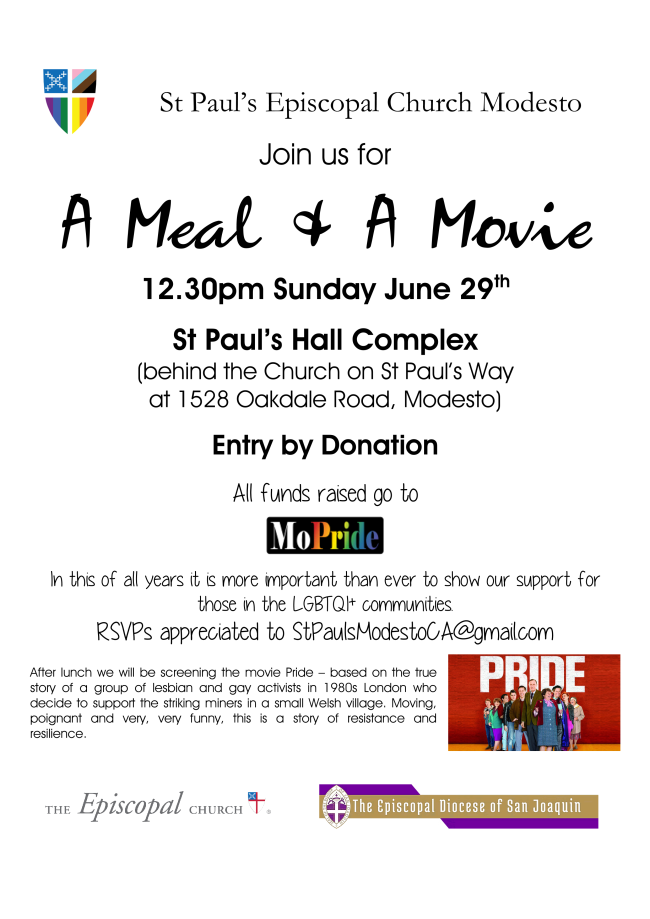
June 29
Canon Visitation @ St John's Lodi
Looking ahead to July...
July 1
Commission on Ministry, 7pm, ZOOM
July 4
Diocesan Office Closed
July 6
Bishop & Padre Nelson Visitation @ St Francis Turlock
July 9
SJRAISE book study, 6:30pm, ZOOM
July 12
Clergy Conversation, 12:30pm, ZOOM
| | | | |
EPPN Action Alert: Tell the Senate to Oppose Drastic Cuts to Vital Programs
This week, the Senate is looking to vote on its version of H.R.1, also known as the “One Big Beautiful Bill Act.” This bill would:
Please contact your senators to oppose these harmful cuts to vital programs. You can easily do this by going to https://www.episcopalchurch.org/ministries/office-government-relations/action-alerts/
EPPN in now offering weekly prayers that you can add to your personal and church prayer lists!
To subscribe go to: https://www.episcopalchurch.org/ministries/office-government-relations/eppn-sign-up/
For Trans Youth Seeking Healing and Wholeness
Gracious God, you created all people in your image, diverse and united in dignity, reflecting your boundless creativity and unwavering love. In light of the recent Supreme Court decision that allows states to prohibit gender-affirming care for minors, we pray for the youth who feel afraid and will no longer be able to access the care they need. We pray for the parents and family members who must now seek new ways to care for and protect their children. Grant us wisdom and courage so that we may offer support rooted in truth and compassion. May we, like Jesus, who welcomed the marginalized and restored the vulnerable, bear witness to your mercy and grace; through the same Jesus Christ our Lord. Amen.
For Those Affected by Gun Violence
God of peace, you invite your people to beat their swords into plowshares. As we observe Gun Violence Awareness Month, we mourn with those whose loved ones have died from gun violence. Your Spirit, O God, joins us to be a people of peace. Your Son has revealed to us a path towards peace, a world where you will wipe every tear from our eyes. Help us live into this promise now on Earth. Amen.
For Solidarity with Refugees
Holy God, you have revealed your Good News through your Son, Jesus Christ, who was an outcast and a refugee. We echo the call of the United Nations on World Refugee Day to “shine a light on the rights, needs, and dreams of those forced to flee.” Strengthen us, as we live out our baptismal calling, to actively seek solidarity with the oppressed. Reveal the plight of all refugees to the world and remind all refugees that they are not alone. We ask this in the name of your Son, Jesus Christ. Amen.
For Yemen
God of mercy and peace, we lift before you the people of Yemen. In this land torn by war and hunger, bring healing where there is pain, hope where there is despair, and peace where there is conflict. Strengthen those delivering aid, protect the vulnerable, and comfort the bereaved. Grant wisdom to leaders and diplomats, soften hearts, and open ears to cries for justice. Stir your church and nations to act, remembering that all are made in your image. Let your peace reign and your justice prevail. Through Christ our Lord. Amen
For Peace Between Israel and Iran
Merciful God, we lament the conflict escalation between the nations of Israel and Iran. In a world torn by hatred and war, help us sow seeds of peace. Grant leaders wisdom, courage, and compassion. Protect the innocent, heal the wounded, and comfort the grieving. Break the chains of violence and lead both nations to reconciliation. Jesus, transform fear into hope. May justice and mercy flow like a river through the Middle East. In Jesus' holy name, the Prince of Peace, we pray. Amen.
| |
United Thank Offering: Over $1M awarded for projects focused on water access, sanitation, education
Congratulations St Matthew's San Andreas!
The Episcopal Church Executive Council recently approved more than $1 million in United Thank Offering grants supporting 27 innovative mission and ministry projects focused on water-related issues around the world.
Projects range from a reverse osmosis filtration system to combat lead-contaminated drinking water in Western Louisiana to indoor plumbing in a South Dakota to congregate water-saving agricultural projects in Tanzania and California's Central Valley.
The funds come from the United Thank Offering's yearly Ingathering, which includes monies collected in “blue boxes” at Episcopal churches, designated as thank offerings.
This is the final round of a three-year United Thank Offering grant focus on areas of ministry based on Matthew 25:31-46. This year's grants fund projects that address sanitation; access to water; and water education or climate change mitigation.
The 2023 and 2024 United Thank Offering grants supported 42 projects related to the worldwide incarceration crisis and welcoming “the stranger.”
“The grant awards emphasize both the physical and spiritual importance of water in our lives,” said Karin Elsen, president of the United Thank Offering board. "These funds will be used for the construction of many practical things, such as showers and wells, while also fostering service, hospitality, and renewal through the projects. Many lives will be positively impacted."
The UTO Board received about $2 million in requests from 43 applications. It was able to fund 27 projects within The Episcopal Church and Anglican Communion, including three historical grants.
Grant recipients are listed below by focus category.
Projects addressing sanitation ($363,022.61 total)
- Episcopal Church in Colorado: Laundry Outreach, Ascension and Holy Trinity Church, Pueblo – $8,000
- Episcopal Diocese of Maine: New Shower and Laundry Project, Trinity Jubilee Center, Lewiston – $55,000
- Episcopal Diocese of Massachusetts: Updated Bathrooms for the Unhoused, Emmanuel Church, Boston – $46,230
- Episcopal Diocese of Pennsylvania: Showers and Laundry for Our Community, Corinth 13 Out of School Center, Philadelphia –$27,046.61
- Episcopal Diocese of South Dakota: Indoor Plumbing and Water, Church of the Mediator, Pine Ridge Reservation – $69,050
- Province of Brazil Southwestern Diocese: Bathrooms and Showers for the Unhoused, Cathedral of the Mediator, Santa Maria – $45,000
- Province of Zambia and Angola, Diocese of Zambezia: Access to Sanitation Options for Internally Displaced People – $34,960
- Province of Ceylon, Diocese of Colombo: Addressing Water Scarcity for the Marginalized – $26,136
- Province of Aotearao, Diocese of Polynesia: Water, Sanitation, and Hygiene in Informal Settlements, Yavala and Nadrala in Sigatoka, Fiji –$50,600
Projects addressing access to water ($453,101.41 total)
- Episcopal Diocese of Colombia: Improve the Access to Clean Water – $41,848
- Episcopal Diocese of Ecuador Litoral: Rainwater Collection and Purification, Ann Stevens Elementary School – $55,000
- Episcopal Church in Western Louisiana: Community Water Filling Station, Church of the Epiphany, Opelousas – $82,000
- Province of Philippines, Diocese of Northern Luzon: Provide solar-powered water solutions to vulnerable communities – $49,722.98
- Diocese of Liberia: Access to Safe Drinking Water, Good Samaritan Church and St. Thomas Chapel – $52,760
- Province of Burundi, Diocese of Gitega: Protecting Spring Water Sources for Drinking and Improving Hygiene – $45,227
- Province of Kenya, Diocese of Mumias: Access to Clean Water, Ucheka Community – $48,385
- Province of Southern Africa, Diocese of Lesotho: Addressing Water Scarcity, Thakabanna Primary School – $23,193.50
- Province of West Africa, Diocese of Gambia: Solar-Powered Boreholes – $54,964.93
Projects addressing water education or climate change mitigation ($173,624.35 total)
- Episcopal Church in Idaho: Ripples of Opportunity, Paradise Point Camp, McCall – $11,230.35
- Episcopal Diocese of New York: Equipping Chaplains to Support the Spiritual Needs of Mariners, Seamen's Church Institute – $45,000
- Episcopal Diocese of San Joaquin: Rainwater Harvesting Project, St. Matthew's Church, San Andreas – $16,290
- Episcopal Diocese of West Texas: Pollinator Garden and Water Awareness, St. George Church and School, San Antonio – $10,983
- Province of Tanzania, Diocese of Mpwapwa: Drip Irrigation Project, St. Philip's Church, Milanga – $49,893
- Province of Brazil, Diocese of Rio de Janeiro: Creating a Community Center with Access to Clean Water and Water Education – $40,228
Historical grants ($91,000 total)
- Emery Trust Award: The Archives of The Episcopal Church, Records of the Women of the Church: Preservation and Digitization Project – $35,000
- Emery Trust Award: Episcopal Service Corps/Young Adult Service Corps: Resiliency, Education, and Visioning – $51,000
- Episcopal Migration Ministries: Sustaining the Rainbow Initiative – $5,000
Since its founding in 1889, United Thank Offering has awarded 5,475 grants worth more than $148 million. Learn more about this ministry of The Episcopal Church.
https://www.episcopalchurch.org/publicaffairs/united-thank-offering-over-1m-awarded-for-projects-focused-on-water-access-sanitation-education/
| | |
In the first book of Samuel, the young prophet is serving Eli and has a strange experience: Samuel thinks he is being called by Eli, and so goes to him. Eli says he did not call, Samuel leaves, and then the process repeats, and Eli realizes that Samuel is being spoken to by God. Samuel then opens himself to God and hears the Lord speak, and thus begins the career of a prophet (1 Samuel 3).
In this diocese we often talk about our motto, “Called to Be…” and ask people, especially in these missives from the Commission on Ministry, to think about call. What I want to ask you to do is to think about where God might be calling you that you do not realize. Our world is noisy; between the political strife and worldwide conflict that populate the news and the hectic busyness of our day-to-day lives, it can be hard to hear God or discern how he speaks to us. Luckily for us, we have our neighbors, and our fellow Christians, who also are in our lives to help us hear the call of the Lord. Sometimes, this call might seem like it is coming from a different voice or context or situation, but we have to be open to the possibility that God speaks to us through our communities, and your call to be might be echoing around you, and you might not hear the voice.
Discernment is difficult; even the great prophets and saints of God have struggled with it. Oftentimes we doubt our own interior feeling of call or deny that we are worthy or qualified or prepared to follow a call. This might come from regret or humility or worry, but we become very adept at tuning out God’s call to do more. In those times, God speaks to us through those around us, and we have to be ready to hear him there as well. Just as Eli redirects Samuel our community may be redirecting you.
The call to serve God in lay or ordained ministry takes many shapes, and can look very different in your own context. I want to ask you to look around you, and see where your gifts are already active, where your work is already being fruitful, and consider if in that service to others God may already be calling you, asking you to deepen or expand your good work into a large ministry. If you listen to where God might speak in other voices, you may find yourself called to be something new and fantastic.
The Rev. Luke Martinez serves at the Episcopal Church of the Saviour in Hanford and is a member of the Commission on Ministry
|
The emotional toll of climate change is broad-ranging, especially for young people
Anxiety, grief, anger, fear, helplessness. The emotional toll of climate change is broad-ranging, especially for young people.
Many worry about what the future holds, and a daily grind of climate anxiety and distress can lead to sleeplessness, an inability to focus and worse. Some young people wonder whether it’s moral to bring children into the world. Many people grieve for the natural world.
Activists, climate psychologists and others in the fight against climate change have a range of ways to build resilience and help manage emotions. Some ideas:
- Get active in your community
- Make a positivity sandwich
- Model behaviors for your kids
- Remember: we're all connected
- Find the words to express your feelings
- You're not one, you're many
To read the full article and details on the steps to building resiliency and manage emotions, click here.
| |
A prayer for the season of Pentecost
Holy and Great father, you. Created all things and love all that you created.
Your children are divided and have turned against one another. Many live their lives in fear. As you sent our spirit to teach and comfort the first disciples 0n that first Pentecost we ask today for your spirit. May your spirit touch our leaders filling them with knowledge and compassion. May your spirit touch those in fear filling them with comfort and strength and may it give strength courage to your church to be able to walk in solidarity with those in need. We ask all of this through your son our brother Jesus Christ. Amen.
| |
I happened to catch up with a long-time friend of mine recently. We broached the subject on the impact of the current political climate on our hearts and minds. We agreed that people now tolerate discomfort, anger, frustration and hopelessness with the widespread injustices and violations on humanity. We know that some people are in whole hearted agreement with what’s going on, how are they ok with this? Some of us are exposed (directly and indirectly) to the stories of those who are suffering at the hand of these dramatic political changes. In the health care and mental health field, the concept of vicarious trauma and secondary trauma is frequently addressed and debriefed among first responders, medical staff, care givers and service providers. There is a multitude of information and research on burn out, compassion fatigue and recommendations on caring for ourselves in this context.
In this reflection piece, I ask…. what did Jesus do, how did he manage such emotional burdens? What I have gathered, from a lay person’s point of view, is that he was honest with his feelings, he certainly let us see his vulnerability, he stayed focused and true to his mission, he meditated in solitude and trusted in his Father’s plan. He also prayed, rested and nourished himself. We are blessed with such a role model and leader. So here we have it…
As for myself, I was initially glued to the news and social media, as I wanted to be up to date. It rendered me angry, frustrated, aghast, outraged, fearful and anxious. I used to get into aggravating arguments with so-called friends, neighbors and coworkers. I held grudges and became distrustful of “those people”. My neighbors hoisted the American flag outside their houses (they are still up). They made statements like “at least you came here legally”. I can still hear coworkers whisper their agreement with all the “shake up”. And so, I agree with my friend about us carrying this emotional burden, seemingly with no end. I’ve looked to God in prayer for his guidance and wisdom. I endeavor to follow his example.
As of today, I have scaled back on and set some boundaries on what and where I get my news. I process my outrage and fears with select brothers and sisters in Christ. I also have a strong support network, connected with friends and family who have similar concerns and views. I don’t disclose the advocacy and work that I engage in, except with select friends and family. In my work I provide support and advocacy, seek out dwindling community resources and provide social work services.
Hold my ground I will…
Grace Dah is a member of SJRAISE and worships at St John's Stockton.
| KNOW YOUR RIGHTS RED CARDS! | |
Sanctuary People Resource List
Below are resources to support the immigrant community. This resource list will be updated as more resources are created and needs changes.
https://bit.ly/SanctuaryPeopleResources
Family Preparedness: helping immigrant and mixed status families make a plan in case of family separation due to ICE arrest
Rapid Response:
Know Your Rights for possible encounters with immigration authorities.
Sanctuary Resources:
| |
“Promote the welfare of the city where I have sent you into exile. Pray to the Lord for it, because your future depends on its welfare.” –Jeremiah 29:7 (Common English Bible).
“A demonstration of the Spirit is given to each person for the common good.”
–1 Corinthians 12:7 (CEB).
In May, the Anti-Racism Commission of EDSJ put on a discussion of the book The Sum of Us: What Racism Costs Everyone and How We Can Prosper Together by Heather McGhee. I had the honor of co-leading the discussion alongside Canon Anna Carmichael.
The Anti-Racism Commission had studied the Sum of Us previously, so I had already read the book. But as I reread the book to help lead the conversation, I found it even more incisive in its argument that racism negatively affects everyone in the United States today. In the last forty to fifty years, there has been a concerted effort to use racial resentment to undermine the dominant culture’s confidence in the institutions of government and labor unions, which McGhee sees as two of the strongest tools for collective action (p.47).
For Christians, this must be deeply concerning. Human beings are not only individuals but are always and everywhere social creatures, born into families and other corporate groups. As Christians, we come to belong to the corporate body of the church through Holy Baptism, and we renew our participation in that body through Holy Communion.
The Holy Scriptures are clear that God created all people in God’s image, and the church has been given the mission to bring all people into unity with God and one another in Christ. Both racism and racial resentment stand condemned before God. Until God does usher in the fullness of God’s Reign, we are called to promote the good of the welfare of the societies we share with our neighbors. The mission of the church impels us as Christians to work for the common good. How the church and its members pursue the common good is going to vary by context, but this is not an optional part of our calling. We are still called to promote the welfare of the city.
Padre Toni is the Priest-in-Charge at St Francis Turlock, and a member of the Anti-Racism Commission
| | |
|
4147 East Dakota Avenue
Fresno, California 93726
209-576-0104
| |
| | | |