-
Dive into the data that shows how immigrant populations contribute to our region's labor market in a new report
-
Your guide to the November 2026 Election—key races, ballot issues, registration and more on the online Voter Election Guide
-
How House Bill 756 aims to make Ohio more competitive, incentivize research and development activity for companies
| | How Immigrant Populations Impact Regional Growth | An event recap featuring insights from Congressional, National Leaders | |
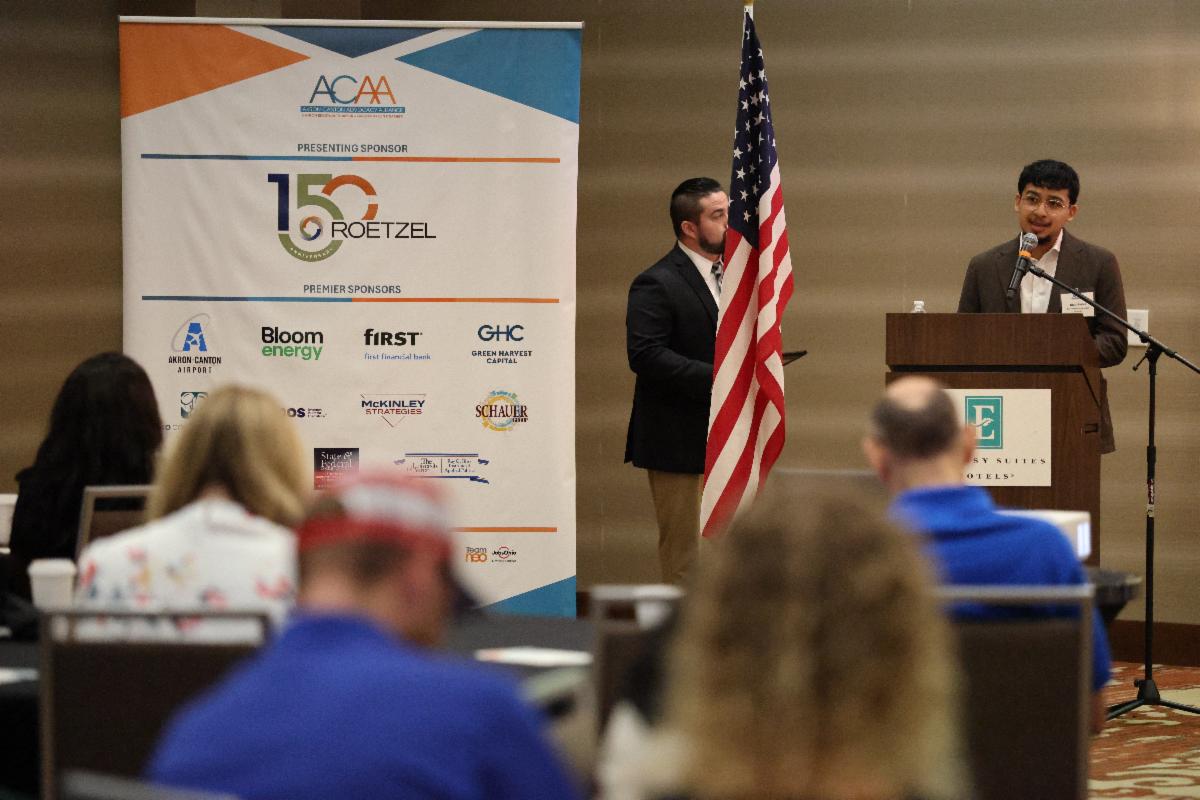
In response to persistent workforce gaps and the need for sustainable talent pipelines, the ACAA convened regional and national leaders on June 18 to examine how immigration is impacting the Akron-Canton economy and its future growth. The event was designed to move the conversation beyond national rhetoric and focus on local realities: how immigrant residents, workers, families, and entrepreneurs contribute to the region’s workforce, tax base, population stability, and overall economic competitiveness.
As part of the discussion, the ACAA, in partnership with the American Immigration Council, released a new report detailing the impact immigrants have on key indicators for regional growth and success, including population trends, talent pipelines, consumer spending, entrepreneurship, and tax contributions. The report provided a data-driven foundation for a broader conversation featuring insights from U.S. Congressman Michael Rulli (OH-6), U.S. Congresswoman Emilia Sykes (OH-13), Patrick Shen of the U.S. Chamber of Commerce, and representatives from the American Immigration Council and Ohio Business for Immigration Solutions.
Together, the discussion reinforced that immigration is not an abstract national issue, but a local economic reality. Speakers explored how businesses can better support immigrant employees, how immigrant populations are helping address workforce and demographic challenges, and why sensible immigration reform, modernized verification tools, border security, and greater public understanding are important to the region’s ability to grow.
Key takeaways from the report (based on 2023 data) include:
-
Immigrant households earned $2.5 billion in income, with $446 million going to federal taxes and $227.5 billion going to state and local taxes, leaving them with $1.8 billion in spending power that can be reinvested back into local communities
-
Immigrants were 21.6% more likely to be of working age than their U.S.-born counterparts, and made up 8.7% of workers in STEM fields
-
Immigrant workers accounted for 6% of the manufacturing industry and 5.9 percent of the transportation and warehousing industries. As such, these residents helped to create or preserve around 2,700 manufacturing jobs that would have been eliminated or moved
-
Immigrants were 35.9% more likely to be an entrepreneur than their U.S.-born counterparts in the Akron-Canton region. In 2023, 3,800 immigrant entrepreneurs generated $166.9 million in business income.
-
Between 2018 and 2023, while the region’s overall population remained flat, the immigrant population grew by 11.4%, increasing from 52,500 to 58,400 residents.
| | |
House Bill 756: R&D Tax Credit Modernization
Over the last year, the ACAA has been actively working with state legislators to advance House Bill 756, which aims to modernize Ohio’s Research & Development (R&D) tax credit by allowing businesses to leverage the credit against their aggregate tax liability instead of the Commercial Activity Tax (CAT).
Ohio’s R&D tax credit has existed for decades and is meant to incentivize businesses to invest in research and innovation within the state by reducing their CAT liability based on their qualifying research expenses over a period of time. In the last State Operating Budget, the legislature increased the CAT threshold to $6 million, resulting in a vast majority of Ohio businesses no longer having a CAT liability. This created a unique issue for Ohio’s R&D tax credit; it is no longer a feasible option for most businesses in Ohio, rendering it an ineffective tool for incentivizing R&D across the state.
From a policy perspective, House Bill 756 is the solution. By allowing taxpayers to claim Ohio’s R&D tax credit against their aggregate tax liability (for things such as taxes owed on business income), you could:
- Increase the utility of the credit for a large majority of Ohio businesses
- Achieve greater alignment/parity with similar programs found in other states and the federal government, and
- Make Ohio more attractive to site selectors and businesses considering where to conduct R&D
According to recent data, Ohio lags behind competing states in private sector spending on R&D. Ranked 11th nationwide, this doesn’t account for the recent changes to the CAT and subsequent impact on Ohio’s R&D tax credit. House Bill 756 aims to improve this situation. The simple, yet impactful, policy change proposed by this bill will enable Ohio’s R&D tax credit to incentivize R&D spending and activity more effectively, which will spur economic growth in key industries such as manufacturing, healthcare, and technology.
What's the Status?
House Bill 756 is currently in the House Ways and Means Committee and received sponsor testimony in April. A second hearing was held on June 9, where members of the ACAA provided proponent testimony expressing their support for the legislation.
As the legislation advances, the ACAA will continue providing updates and engagement opportunities.
| | |
Advocacy in Action Podcast:
A Look into House Bill 756 with Ohio Representative Jack Daniels
As both an entrepreneur and HB 756 champion, Rep. Daniels shares how the bill could boost competitiveness, incentivize investment, and keep jobs local—far beyond the tech industry.
| | The Akron-Canton Advocacy Alliance is a collaboration of the Greater Akron Chamber and the Canton Regional Chamber of Commerce to represent the needs of our 4,500 members and engage with elected officials and policymakers for the benefit of the Akron-Canton region. | | Thank You to Our Sponsors! | | | | |