|
Greetings!
Thank you for giving your attention to our newest newsletter about Capilla Azul, an intimate, community-based exhibition space in a rural sector of the Gran Isla de Chiloé, a few miles off the Patagonian coast of Chile. I’m grateful to be able welcome both our regular readers and first-time visitors to this newsletter, where our goal is to keep you informed and inspired about the extraordinary creative work being done by the artists we have invited to collaborate with us, in the Chiloé Archipelago and beyond.
For this issue, I’ve contributed some thoughts about the meaning of “community” at this moment in time, and how it helps us understand our mission. That text is joined by a critical introduction to the work of Maria-Inés Galecio and Karina Aguilera Skvirsky, currently on view through early May in the exhibition Metamorphosis, written by Ramon Castillo and me. And as always, we close with an invitation to become one of our more than two hundred supporters by donating through GoFundMe.
| | |
“Community” is one of those charged words whose precise meaning seems to evade us the closer we get to it. At one end of the spectrum lies the ideal of the perfect community, in which everyone’s individuality is acknowledged and celebrated, and where the communal values that bind all of those individuals to shared purposes are clear and indisputable. In the ideal community, one’s innate talents are allowed to prosper, as is the conviction that one is making a positive contribution to the collective whole. At the other extreme, a sure sign of cultural malaise is the feeling of not being certain or secure about one’s place within the social fabric that envelops us all. In fact, it seems almost self-evident that someone who is not sure of the value of their words and actions to others runs a greater risk of feeling stymied or thwarted on their path toward self-realization.
Beginning with the first signs of the public health emergency that became the Covid-19 pandemic six years ago, the notion of community has never been far from our conversations with each other. We learned that during a time of crisis, when our instincts turn to survival, it becomes apparent that in order to overcome some force that threatens our collective well-being, we must first have a clear idea of the community we belong to, so that we know what it is we’re protecting. Are we part of an infinitely varied cross-section of persons of all shapes, sizes, capacities and colors, or is the community to which we rightly belong more circumscribed? Is community defined principally in geographic terms, or by ethnicity, politics, culture, professional ties, and/or religious beliefs? In weighing these questions, it begins to seem plausible that the very concept of community has been stretched and pulled in so many different directions that today it is just another subject about which we can no longer agree on a basic terminology.
One way to approach the topic of community might be to start with the ideal example and try to reverse engineer its present-day reality to see what about that community is the most emblematic of its achievements. That community would need to be a place where each individual is made to feel that it belongs to them in a personal way. It should be as self-sustaining a community as possible, one where neighbors help neighbors, and where each person’s talents are provided ample opportunity to manifest themselves. Within a community, people share what they have with others, including their skills, knowledge, raw materials and labor. A community is also a place whose members know how to share the burden of loss, just as its habitants understand implicitly when to join in a collective celebration of life itself.
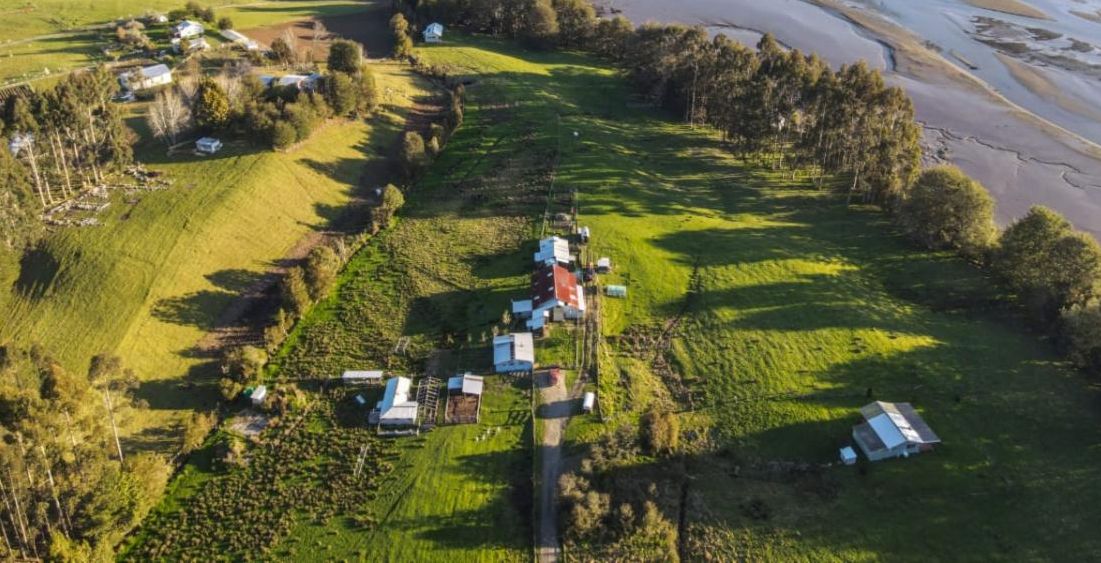
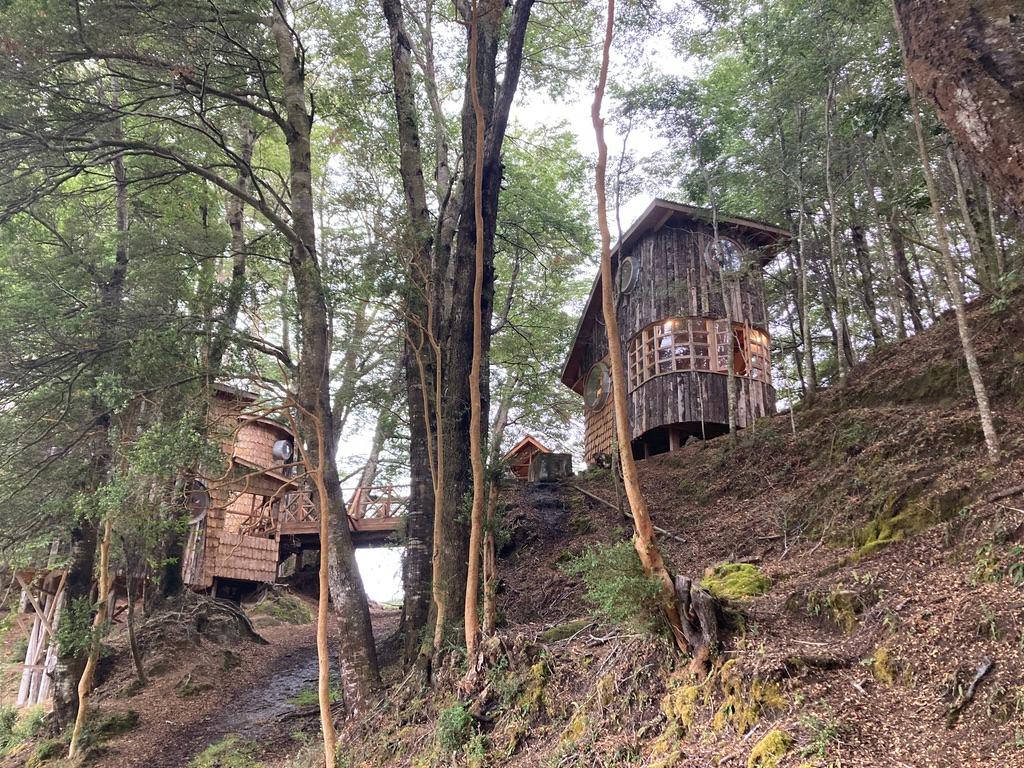
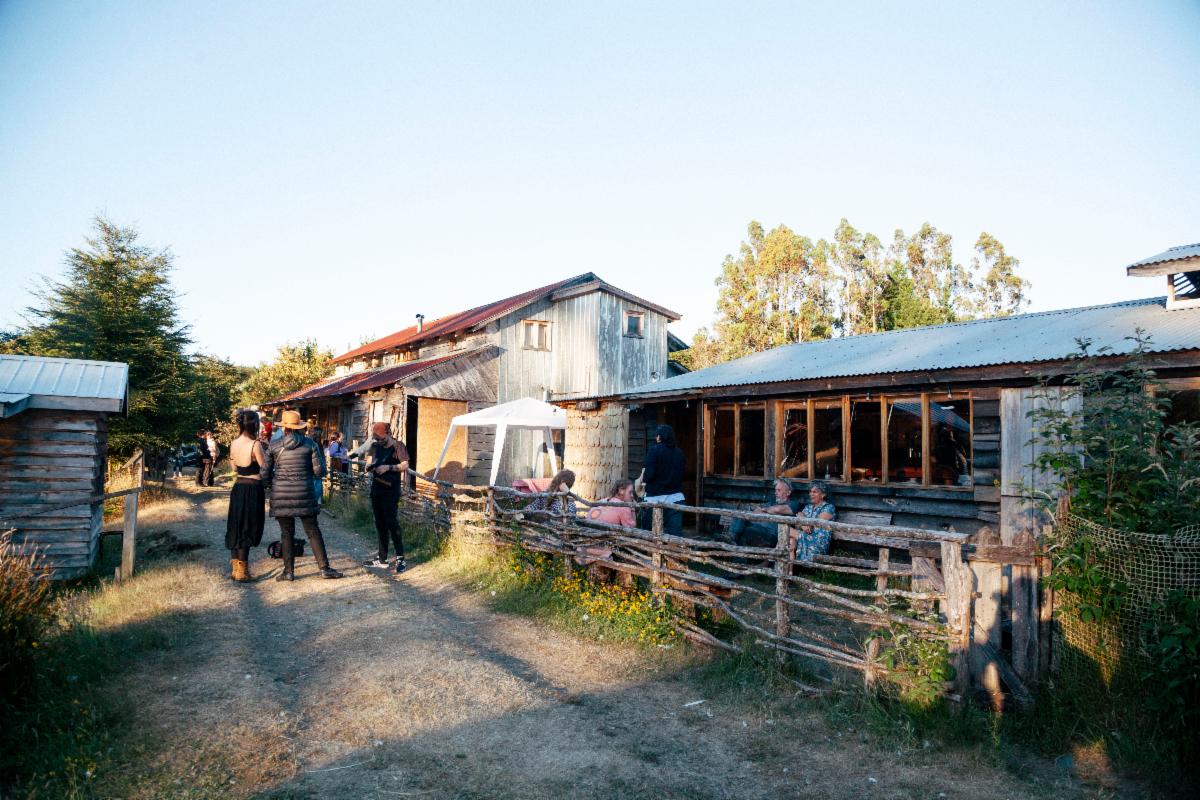
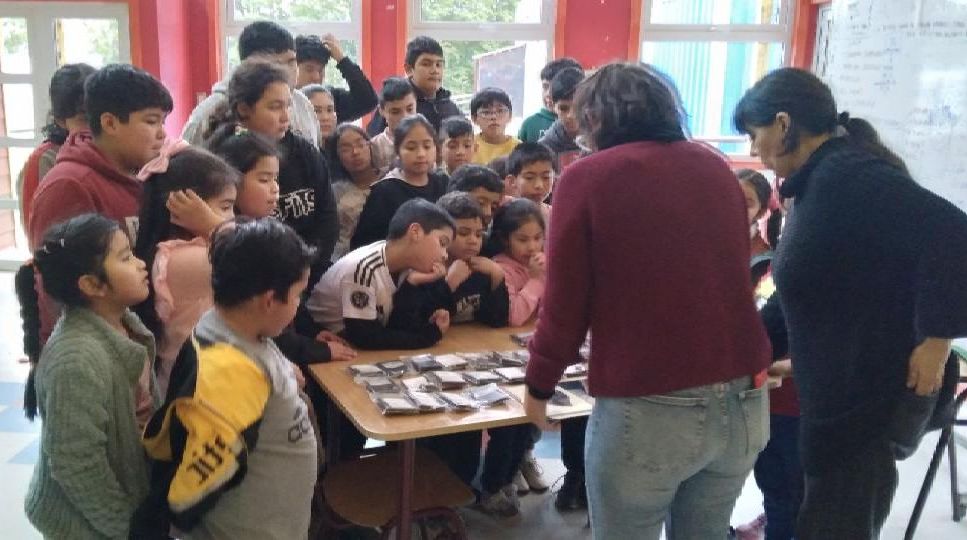
| | Aeriel view of Comarca Contuy | | Contuy, where Capilla Azul is located, is less a village than a hamlet. The houses and land belonging to its three hundred families are enough to warrant a main street, plus a school, a couple of churches, a meeting hall and a number of small businesses, but Contuy is first and foremost an agricultural community. When the Carvacho-Contreras family moved from the cosmopolitan heart of Santiago twelve years ago to Contuy, more than thirty kilometers from the nearest town of any size, the adjustment required that they fully immerse themselves in the lives and livelihoods of their neighbors, and vice versa. As a source of revenue, they soon opened Comarca Contuy, a rustic lodge with four palafito cabins overlooking the alluvial Rio Paildad, to test out the possibilities of rural tourism, only to discover that the people who were most drawn to the idyllic experience on offer were fellow-artists, and with that revelation its present-day identity as a space for cultural celebration and exchange was soon clarified. | | A natural outcome of this gradual process of assimilating into the world of their neighbors is that Comarca Contuy and its proprietors gently expanded the prevailing boundaries of Contuy’s pre-existing sense of community just enough to be able to fit comfortably within its existing field of belonging. To begin with, they adapted to their new home with humility and open minds, ready to shed old habits and develop new ones. They were also happy to take on new challenges that made use of their existing skills, particularly with respect to primary education. Although most of their own parenting responsibilities were behind them, Pablo and Marcela began to take special interest in the three closest rural schools, and within a few years their participation took the form of residencies and workshops facilitated by specialists in art and education, with the parents and children of Contuy, Agoní and Paildad becoming the immediate beneficiaries of this growing investment into the community’s future. | | | |
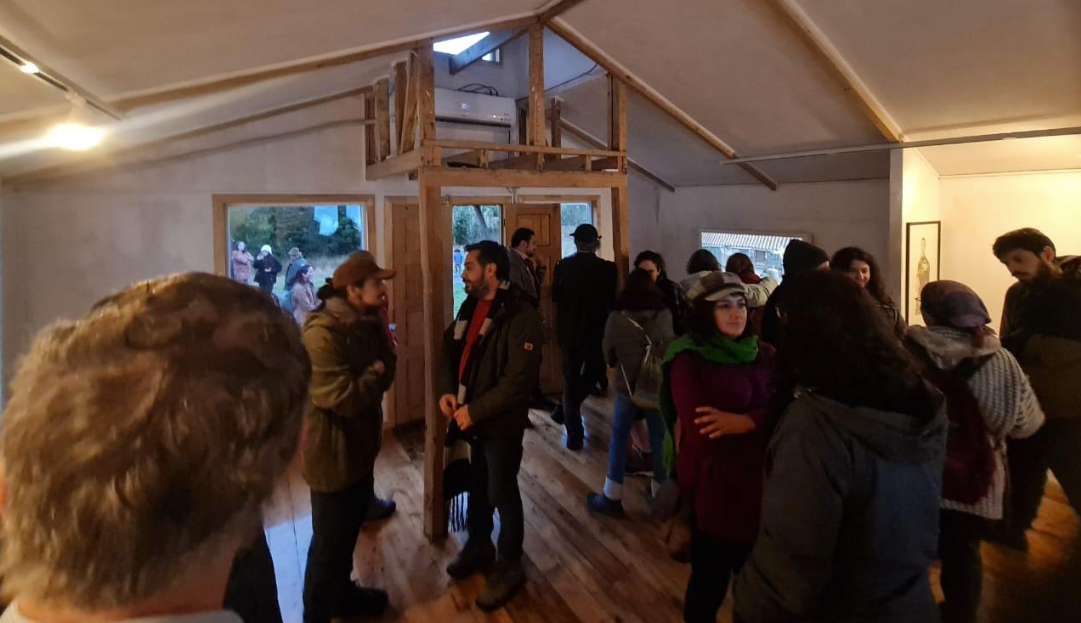
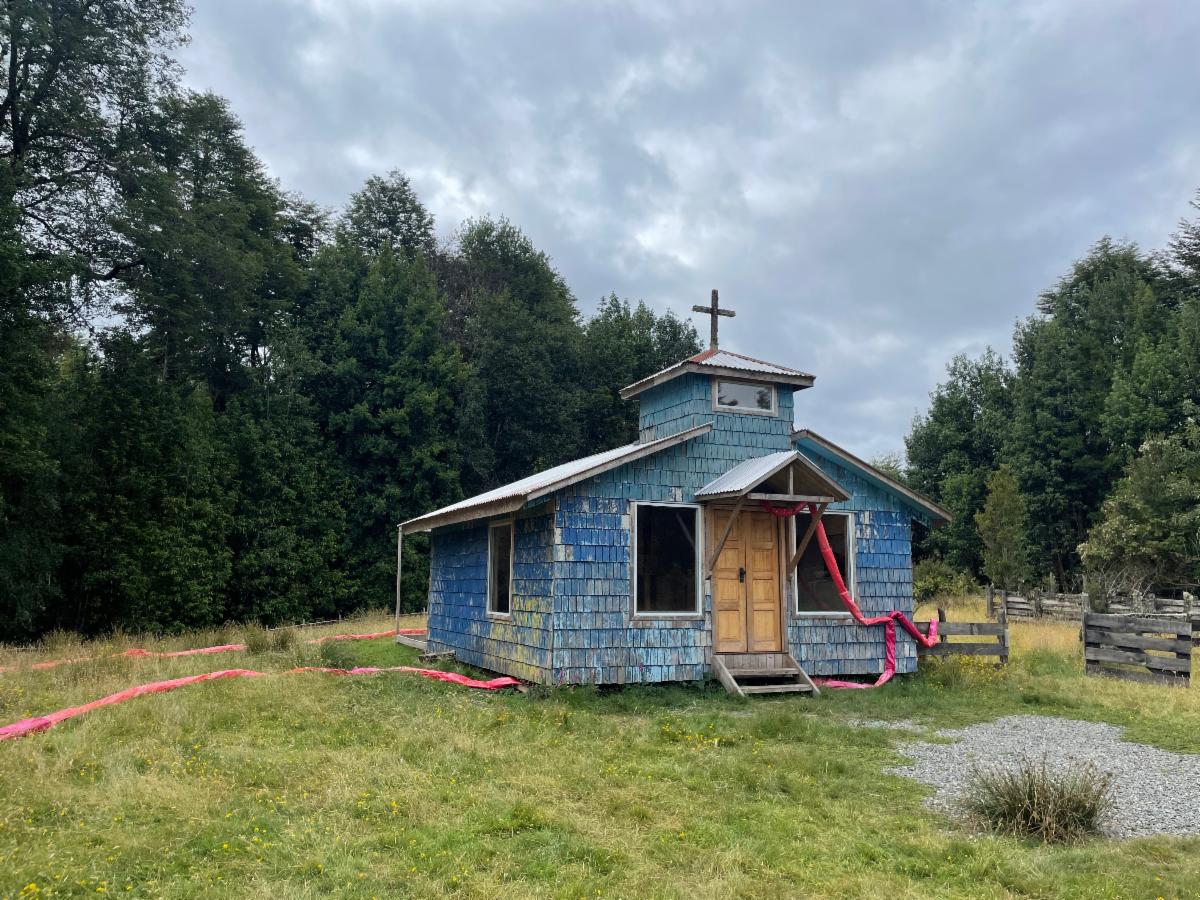
Their deepening sense of belonging to the community of Contuy is unquestionably what inspired the family to purchase the deconsecrated former Catholic house of worship, despite its having lost a part of its volume after deteriorated wood planks were discarded. As a significant part of the material history of the community, the church’s eventual renovation and restoration became a sign of Comarca Contuy’s commitment to expanding their roles to add preservation and cultural transformation to their growing list of contributions. When we learned of its availability to serve as an exhibition space for Chilote artists and artisans, the enthusiasm that greeted our plan to transform it into a fully restored jewel box of a building, complete with temperature and humidity controls and lighting to complement the new floor, insulated walls, and repaired roof, was immediately understood as a gesture rooted in the same sense of belonging. Unsurprisingly, in the nearly three years since we opened our space to the public, Capilla Azul has assumed its own active role in expanding the local idea of community, with visitors from throughout Chile and other countries embracing the values of Contuy as their own, and becoming active participants in the shared pride and achievement with which our neighbors have come to view our exhibition and educational programs.
I’ve tried to emphasize in my writing about Capilla Azul that some of the most valuable life lessons we’ve absorbed during this multi-year process weren’t part of our original objectives, but an auspicious discovery along the way. To cite the obvious, our curatorial commitment to develop a platform for the unique artistic creativity manifested by Chiloé’s habitants, both native and transplant, was not originally envisioned to also propagate paeans to the values of rural life, the intimacy of family meals shared among friends, or a broadened definition of community. We set out to fulfill a mission that was defined by art, but the inescapable and beautiful truth is that along the way we discovered that our newly strengthened belief in the sustaining values of an active community are something you might not know you’re searching for until you actually have the good fortune to find it. As Capilla Azul’s own community has continued to expand outwards, we are also finding ourselves more committed than ever to sustaining a platform for the artistic gifts of Chiloé and its people.
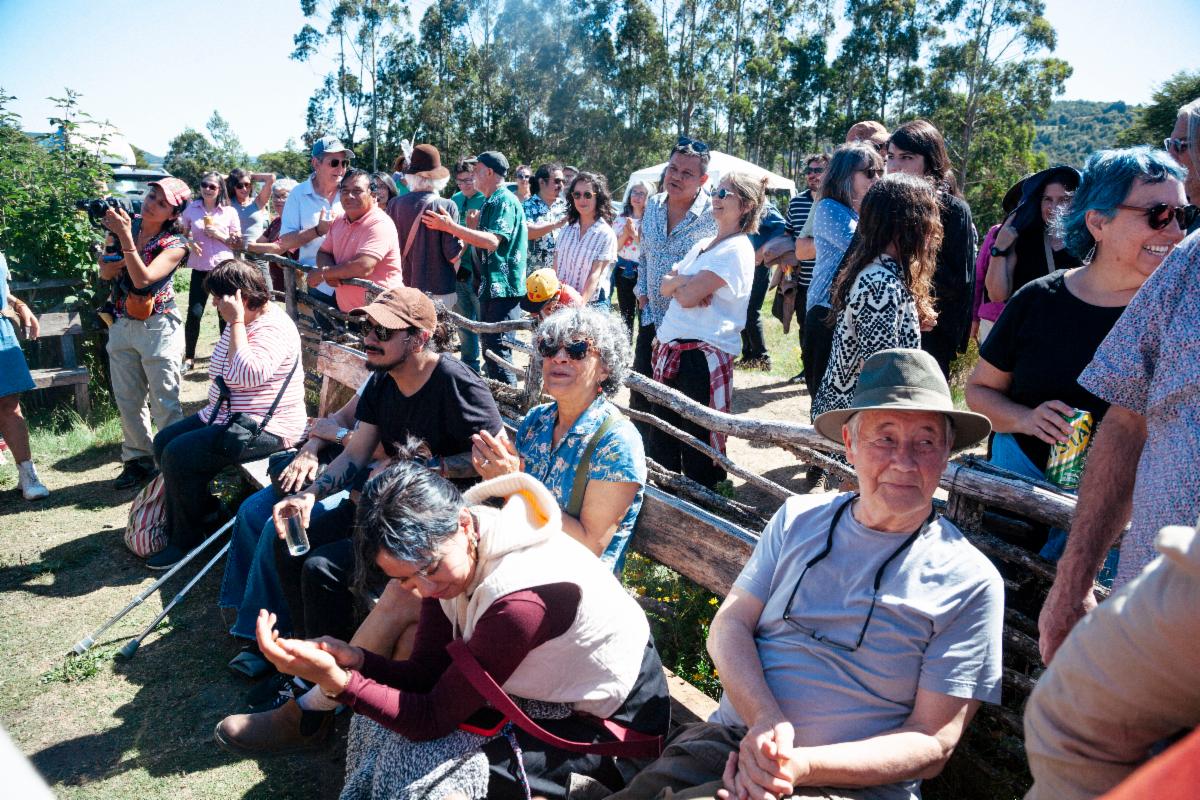
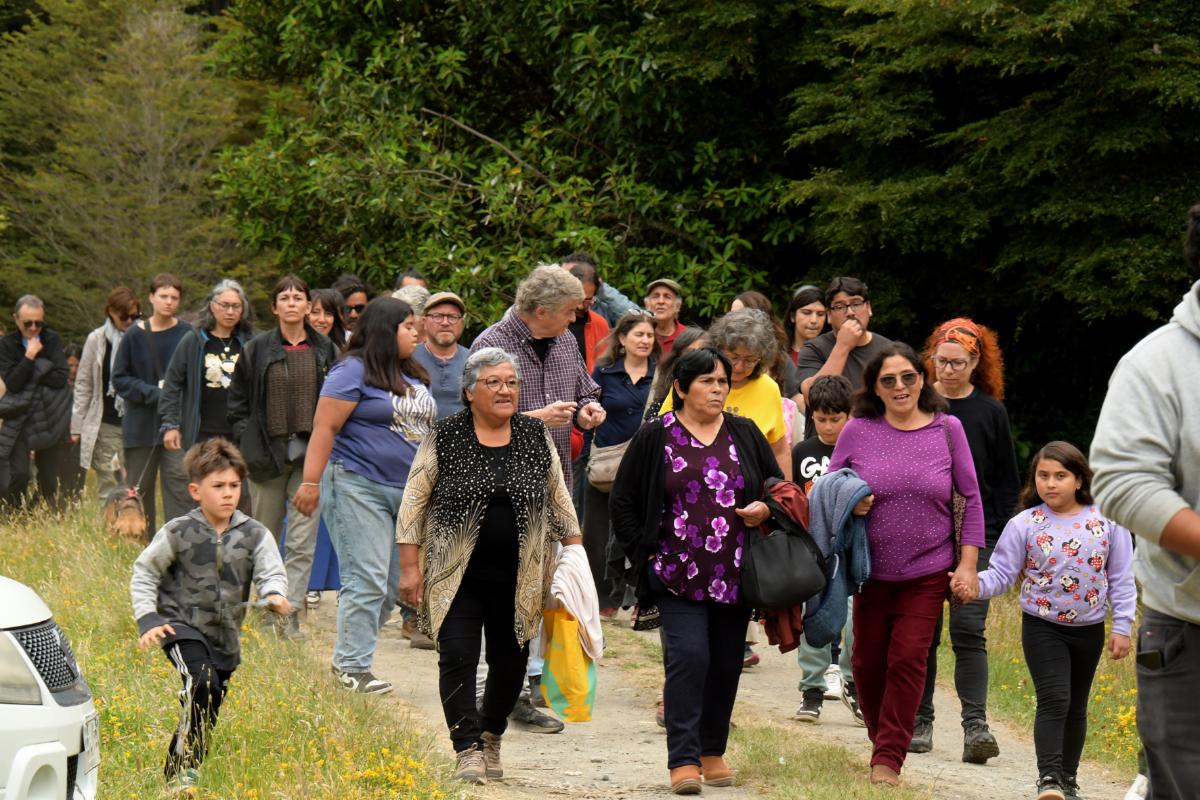
| | Waiting for the raffle to begin | | Comarca Contuy art course in 2025 | Procession to Capilla Azul | | |
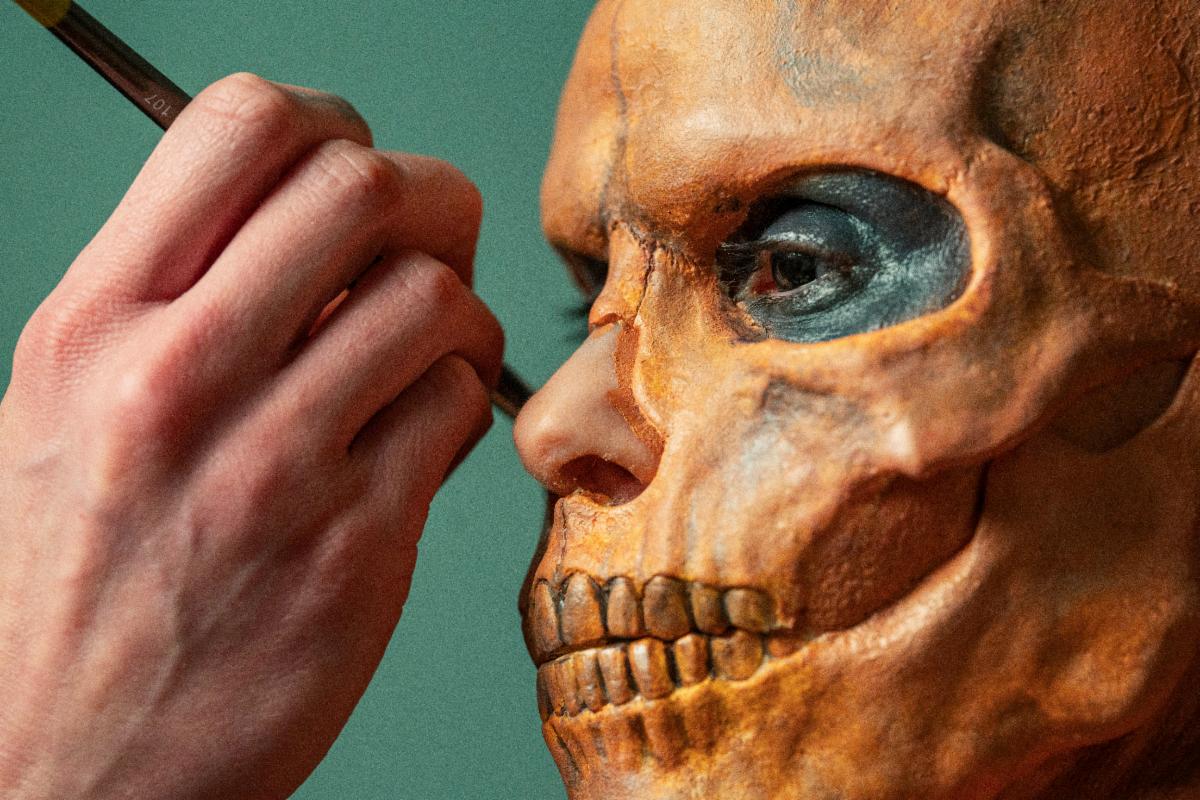
On January 24, we opened the exhibition Metamorphosis, a collaborative exhibition bringing together the work of Karina Aguilera Skvirsky and Maria-Inés Galecio. The haunting narrative that Aguilera unspools in her video traces the lingering effects of colonialism, first by transforming herself to closely resemble each of the four figures in the original four-part series made by the Ecuadoran artist Manuel Chile (aka Caspicara), which underwent their own odyssey before ending up in the collection of Archer Milton Huntington, who in 1904 founded the Hispanic Society in NYC, where the artist lives. Made over as the four embodiments of the human soul, the transformed Aguilera anxiously roams the empty rooms of the former Huntington mansion, in a prolonged state of anguish over a gallery of genteel society portraits made by Spanish painters.
We premiered this work six weeks ago, where The Afterlife signals a compelling new chapter for Capilla Azul, being the first time we've co-produced a work in digital media. Additionally, the partial glimpse her video gives her viewer into Aguilera's own Ecuadoran ancestry brings with it a layer of family genealogy as a counterweight to her alter-ego’s confrontations with symbols of colonial history.
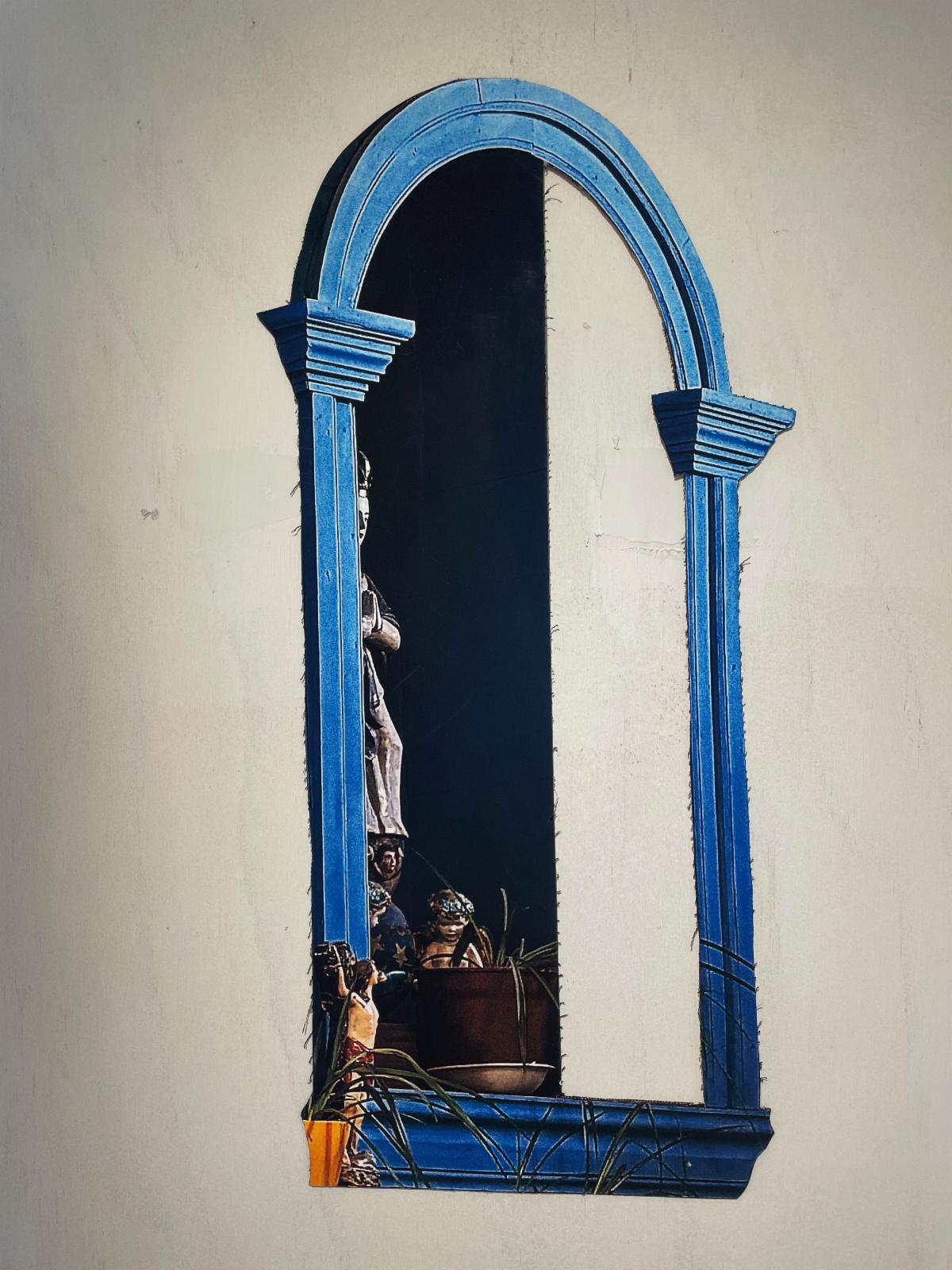
| | Karina Aguilera Skvirsky, untitled cut photograph mounted on wall, 2026, Capilla Azul | Karina Aguilera Skvirsky, Caspicara production still, "Death" | | |
La Capilla installation of Matemorphosis (above) and
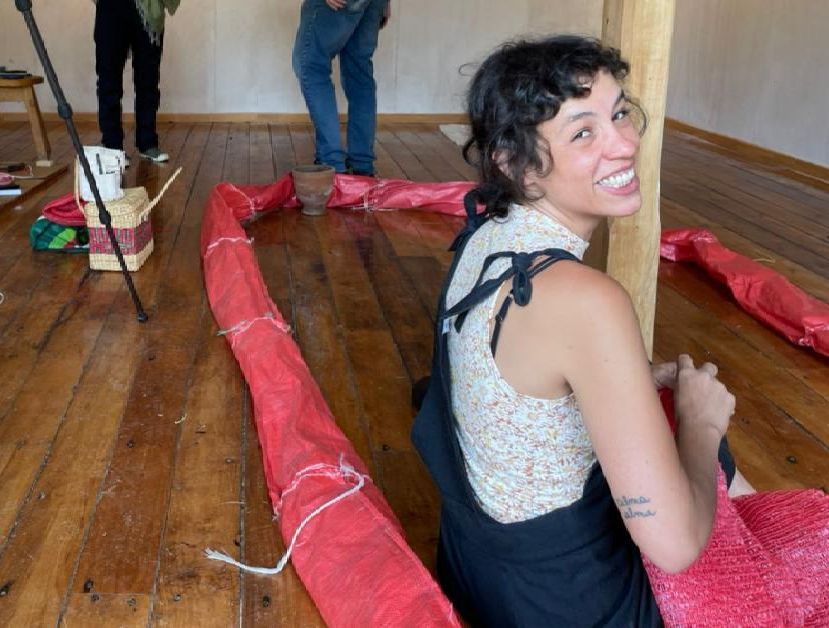
Maria-Inés Galecio installing Palpito (below)
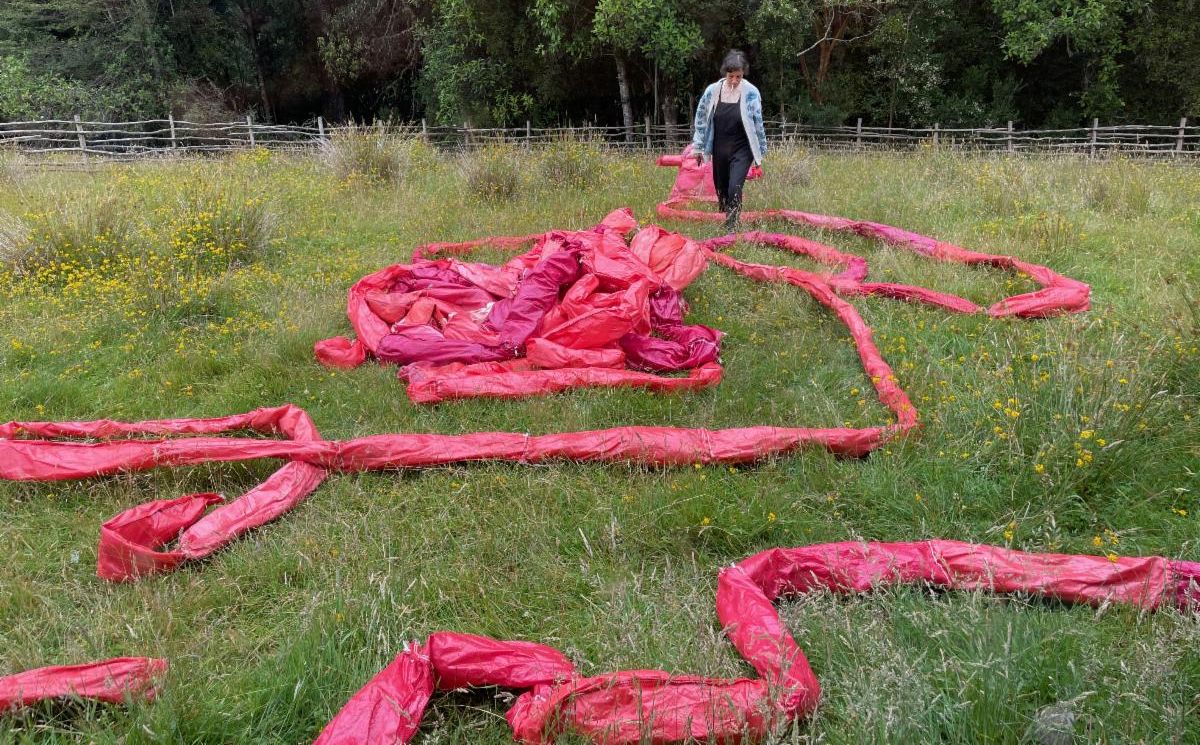
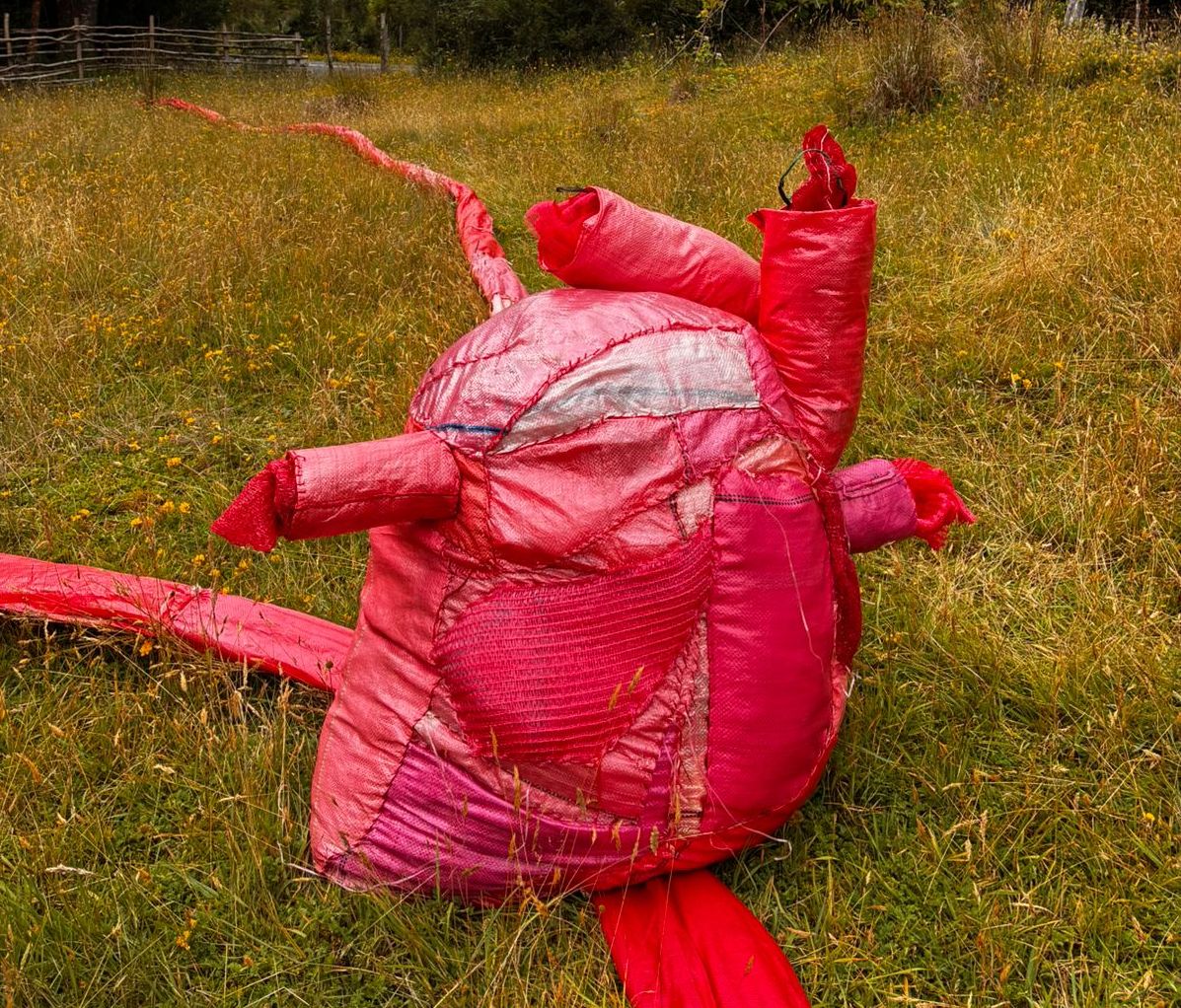
| | Displayed outside Capilla Azul in the landscape, the arteries and veins of a very different heart traverse the grassland. During the months leading up to the opening, María Inés Galecio wove and sewed 123 meters of plastic sheeting used for potato sacks in her studio in Castro. The pink and red path created by these forms leads to the chapel door, enters, and spreads itself across the floor, underneath an amud — a traditional bushel measure — that has been transformed into an exhibition plinth, and now contains a living heart-shaped potato that the artist discovered early during her creative process. On the wall, a sequence of three photographs shows different moments in the heart's journey, and at the back of the chapel hangs an electrocardiogram rendered in wool on a piece of raw fabric. Upon leaving, next to the window, single words — potato, pulse, heartbeat — are stitched in red wool on the plastic mesh. | | María Inés Galecio's on-site installation at Capilla Azul | | In a sense, Metamorphosis was an ideal two-artist collaboration: both artists communicated openly and freely with each other, and although they kept in close contact about the connect of the exhibition, neither felt any need to alter their work in response to the other. It was also the first time that both artists at Capilla Azul incorporated Catholic imagery in their work, with the understanding that even viewers who aren’t knowledgeable with the liturgical and narrative traditions of the Catholic faith will likely recognize references to the symbolism of the heart and the states of the soul that lend both artists’ works a narrative richness that might otherwise be overlooked. | |
COMING MAY 23: ANDRÉS ÁVILA
and ROGELIO LOPEZ CUENCA
| | | For our third anniversary in May, Capilla Azul will present its tenth exhibition, a collaborative project linking the talents of Quellón-based multimedia artist Andrés Ávila and the Spanish artist Rogelio Lopez Cuenca, who lives in the town of Nerja, outside Málaga. Although the exhibition doesn’t yet have a title, the artists met in person in Contuy in January, when Rogelio visited Chiloé a part of our invitation to him to produce a new project for Capilla Azul. Together we visited Andrés’ home and studio, which gave us an opportunity to see his recent experiments in robotics and acoustics, much of it rooted in imagery derived from the local salmon-farming industry. | | Metamorphosis exterior view of María Inés Galecio's Palpito in 2026 | | |
To have gotten this far on our own, with our small exhibition space at the far end of what many people consider to be the known world, would have been completely impossible without the help of friends like you, many of whom have faithfully contributed to some version of the same GoFundMe campaign that we launched in March 2022. Back then, we couldn’t have envisioned what making it to our third anniversary would feel like, much less that we would have received our 501(c)(3) classification from the U.S. Treasury as a public charity, or that a recent international guidebook would name Capilla Azul one of the ninety-nine most influential exhibition spaces in the world.
Even so, as I write this from my home in New York City, it’s become apparent in recent months that looming clouds of global uncertainty have made some donors hesitate this year about supporting non-essential cultural causes, and we have felt the change, in part because our annual budget hasn’t yet exceeded $25,000, and every missing contribution is keenly felt. That’s why it’s so important for you, dear reader, to take just a moment to think about how much you can personally spare to help an experimental art project in Latin America keep its doors open. The physical community that Capilla Azul is part of may be remote and tiny, but our outreach has grown exponentially in recent months, and it’s vital to keep building that momentum.
Click on the tab below to make a donation to La Capilla Azul, Inc.
Thank you again for reading.
| | | | Capilla Azul is part of Comarca Contuy, Queilen, Chiloé, Region Los Lagos, Chile | | | | |