| | |
Greetings!
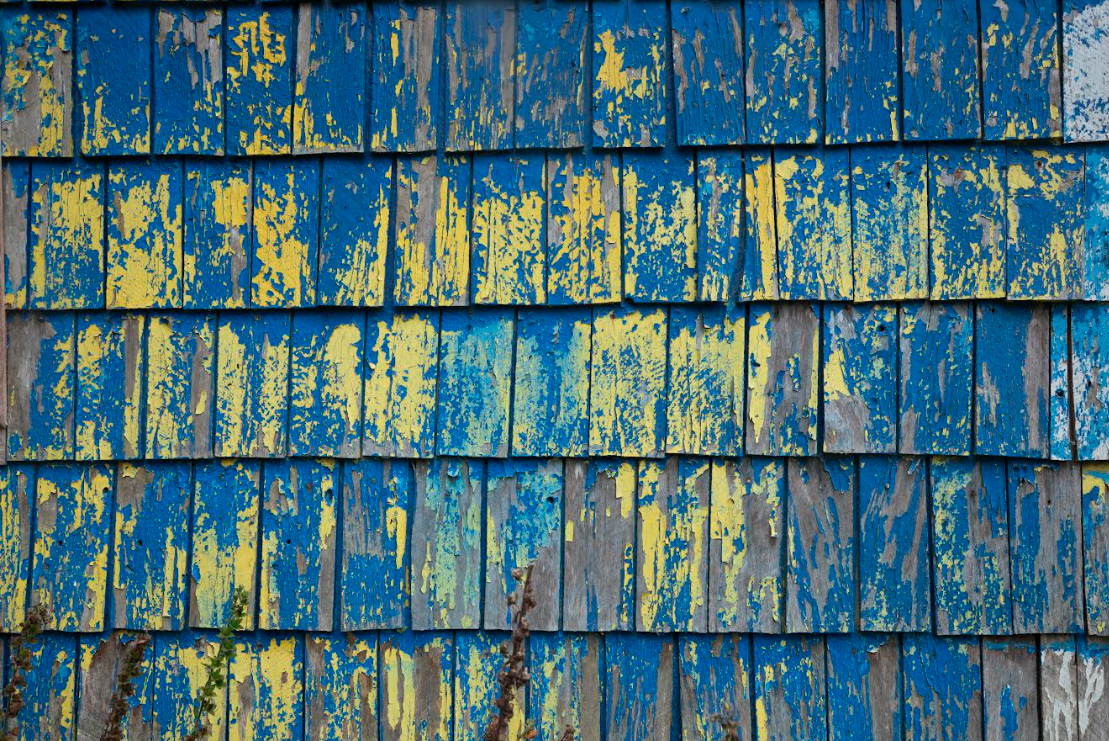
Welcome to the first Capilla Azul newsletter of 2026! Before anything else, on behalf of our Board, staff and community, I want to wish all of you a very healthy and happy New Year. We ended 2025 with the unexpected and wonderful honor of having our modest, community-based exhibition space on Gran Isla de Chiloé named one of the 99 most influential exhibition spaces in the world, which was an extraordinary affirmation of the work we’ve been doing since we opened our doors to the public in May 2023.
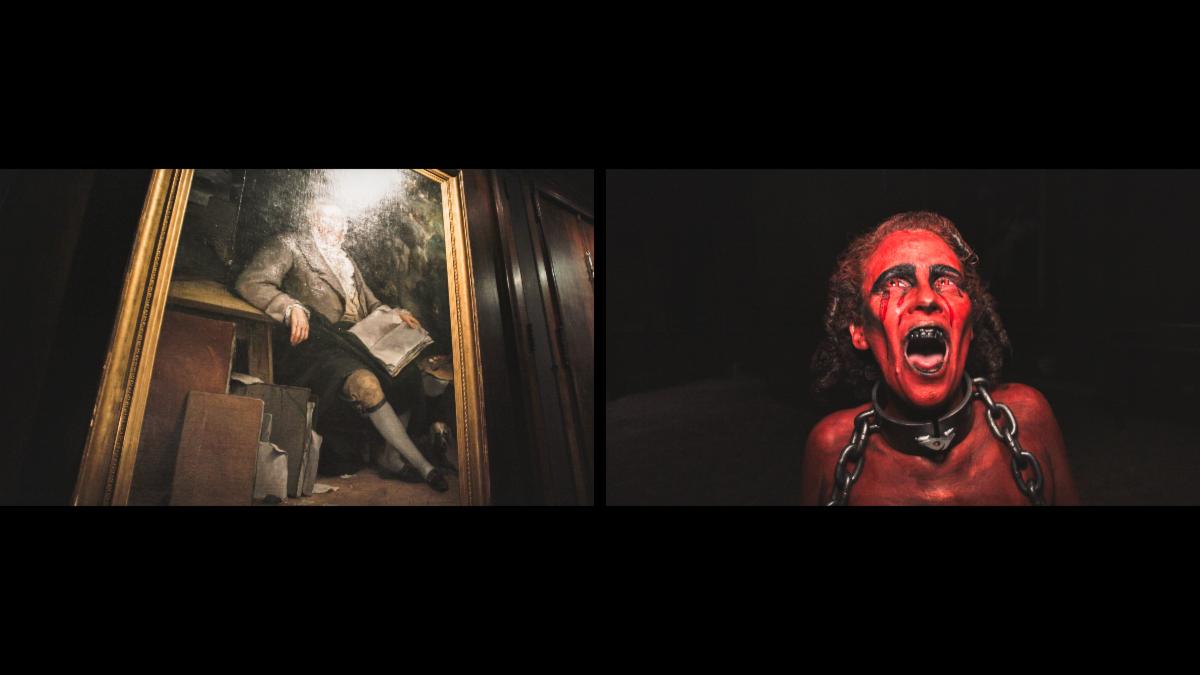
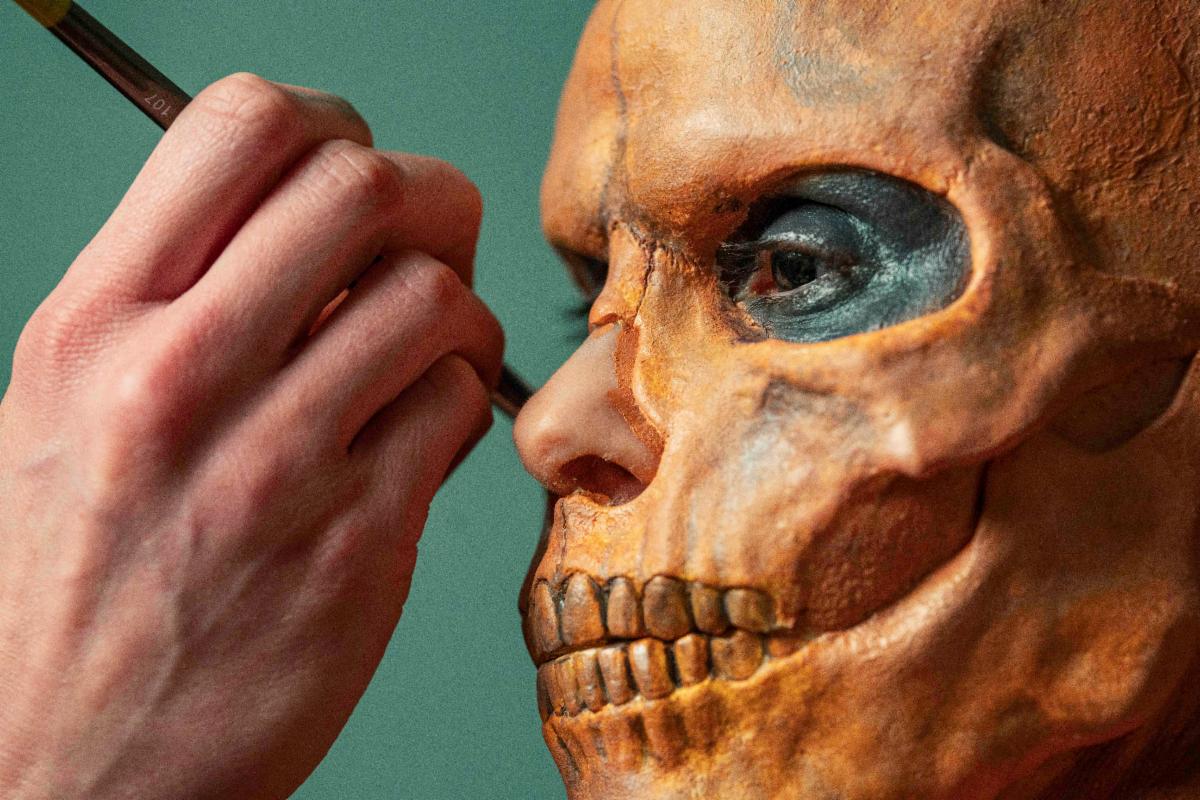
| | You will likely be reading this just before the opening on January 24 of our two-artist exhibition, Metamorphosis, featuring new works created by NYC-based Karina Aguilera Skvirsky and Castro-based Maria-Inés Galecio. I’m delighted to share the first published images of these works here, along with the curatorial text that Ramón Castillo and I wrote for the exhibition brochure. This is the first time that we’re incorporating the curatorial text in the newsletter, which seems like the ideal means of sharing the work directly with all of our readers, both near and far. | | Top: Maria-Inés Galecio, Palpito in progress // bottom: Karina Aguilera Skvirsky, The Afterlife production still | | |
Before sharing those notes, however, I want to give you a sense of how I've worked out a way to function in a fully engaged way with an exhibition space on the opposite side of the planet from New York City, where I live. Some people assume that I’ve moved full-time to Chile, while others suspect I do everything from a remote distance, neither of which is quite true. What is true is that my commitment to Capilla Azul requires me to be both nearby and faraway at the same time, in the sense that our funding support comes almost exclusively from individuals and organizations in the U.S., but all of it gets spent in Chile. In addition, since the original inspiration for Capilla Azul came from my intrepid partner Ramón Castillo and I having intense direct exchanges with artists based in Chiloé, developing our programs requires we maintain an ongoing dialogue with our friends, colleagues and partners on the ground. Here’s how it works, at least for me:
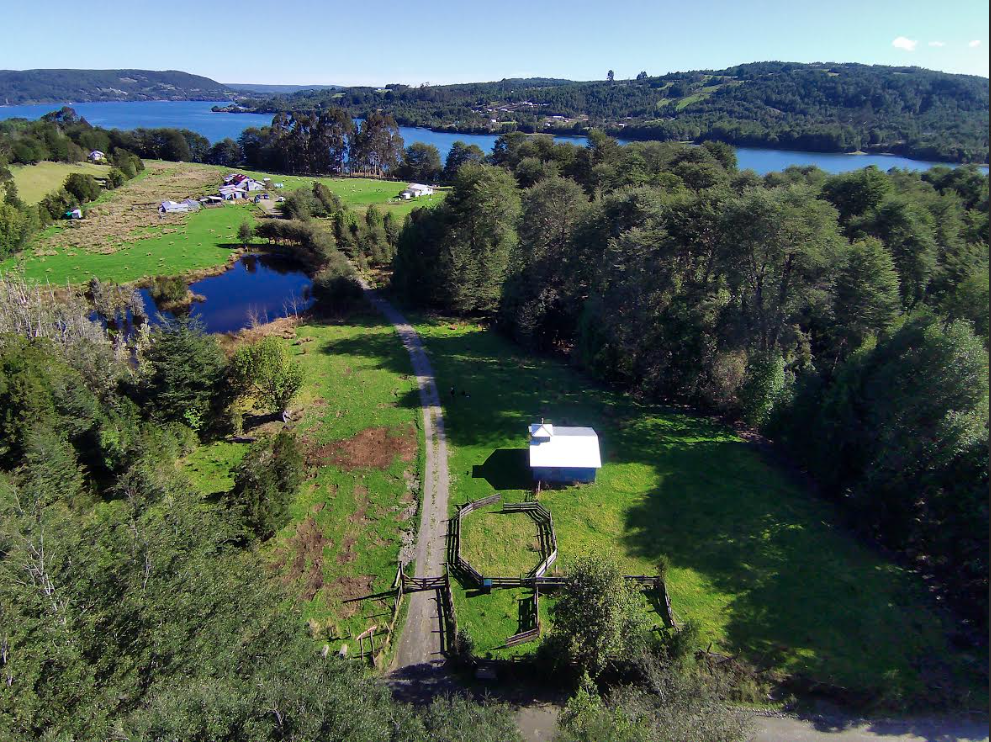
At least three times a year I undertake the same travel ritual, which begins with leaving my Lower East Side apartment for JFK, where I board the daily Delta/LATAM nonstop flight to Santiago, which departs in the early evening. It’s a minimum ten-hour flight, so the trick is to make myself as comfortable as possible in the economy section (aisle seats are a must), and if I’m lucky, those hours will be spent asleep. Once in Chile, I either linger in Santiago for a day or two to get my bearings, meet with friends, and/or look at art, or else I return to the airport the next day (sometimes sooner) to fly a thousand kilometers further south to Puerto Montt, the capital of Los Lagos (The Lakes) province, where we sometimes stay overnight in the beautiful resort town of Puerto Varas. In either case, a rented car eventually takes me and Ramón to the ferry in about ninety minutes, then crosses the Straits of Chacao, arriving in a half hour at a speck on the map called Pargua, and from there it’s onto the Panamerican Highway (Rte. 5) as it winds its way towards 0 km, its point of origin, the Pacific port city of Quellón. To give a sense of the Highway's distance, Prudhoe Bay, Alaska, some 30,000 kilometers north, marks the opposite end.
| | |
But we’re not headed to Quellón, or not usually. If the hour is right, there’s usually a requisite stop in Dalcahue, a bustling port town two hours south, with a great craft fair, impeccable ceviche and a beautiful artisans’ cooperative/cafe/library called DecoCailen, owned by our friends Andrea and Daniel. Following an after-lunch cortado, it’s time to undertake the last leg of the trip, which might entail a quick stop in Castro, the capital, but just as often means bypassing it until we reach the smaller city of Chonchi, where we make an obligatory stop at the supermarket Belén to stock up on essentials. At Chonchi, Rte. 5 continues due south to Quellon, but our route, towards the much smaller city of Queilen, hugs the coast. After some thirty kilometers, an easy-to-miss sign indicates the turnoff for Contuy, and from there it’s only six or seven kilometers to Comarca Contuy, where Capilla Azul is located, and where our friends will be waiting for us. (Note: you can also take a direct flight from Santiago to Castro, but we've come to prefer arriving by water, despite the fact that it adds an extra half-day to the trip.
Nearly three years on, we still haven’t gotten around to putting up a sign to let people know they’ve arrived at Capilla Azul, and the Comarca’s sign is inconspicuous enough that it’s easy to imagine someone driving past without seeing us, but so far that hasn’t happened. That’s probably because for the first five years of its second life, as a kind of sentry on the Comarca’s property line, the chapel’s main function (besides storing freshly sheared wool) was to let guests know they’d arrived at the lodge. Also, the logic of getting from one place to another functions a little differently in the country: first-time visitors are more likely to check and re-check their directions, while for us returnees the anticipation of turning that final curve in the road to get a first glimpse of the chapel is nearly always accompanied by a small jolt: how can something so modest and unassuming have taken on such a prepossessing role in all our lives?
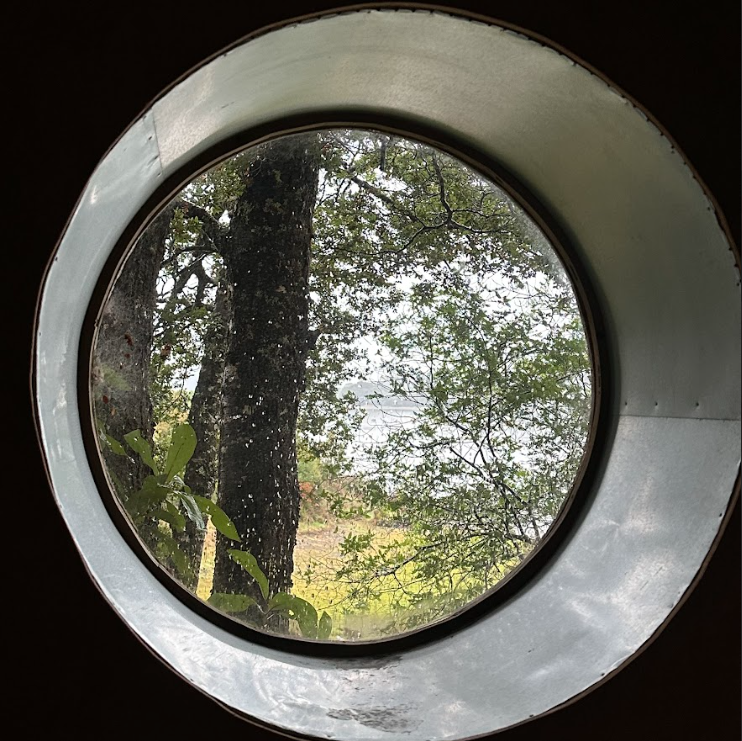
| | View from Cabaña 3, Comarca Contuy | | Many warm hugs later, cabins are assigned, luggage is wrestled with, and the moment arrives to pinch myself and remember that this is real. By now, the conversations have already begun to flow in every direction at once, and soon enough, as if on signal, we all troop from the house to the chapel, and the process of installing the next exhibition has begun. In the next newsletter, Pablo Carvacho, who isn’t just our host and President of the Board but also Capilla’s Azul installation manager, will share more detail about how this process unfolds, from the first visit by the exhibiting artist down to buying materials and tools the week before we install. | | For now, however, it’s enough to emphasize that each of our nine exhibitions so far has generated an entirely different set of challenges, and solving these over time leads to gradual improvements to the space itself, as well as to our methods of working together. At the moment, because we are preparing to open a new exhibition on January 24, let’s turn our attention to these two artists and their work. | | METAMORPHOSIS: MARIA INES GALECIO / KARINA AGUILERA SKVIRSKY | | | |
Many processes occur in nature that we don't notice, so they seem to happen unexpectedly, even suddenly. What was once a larva is now a butterfly, just as what was once a seed is now a large tepú or canela tree. Sometimes, the transition between one form and another connects the same body at different stages of its life, and we tend to use the word metamorphosis to refer to any transformation or change, sometimes radical, that happens to something or someone: from adolescent to adult, from pupa to butterfly.
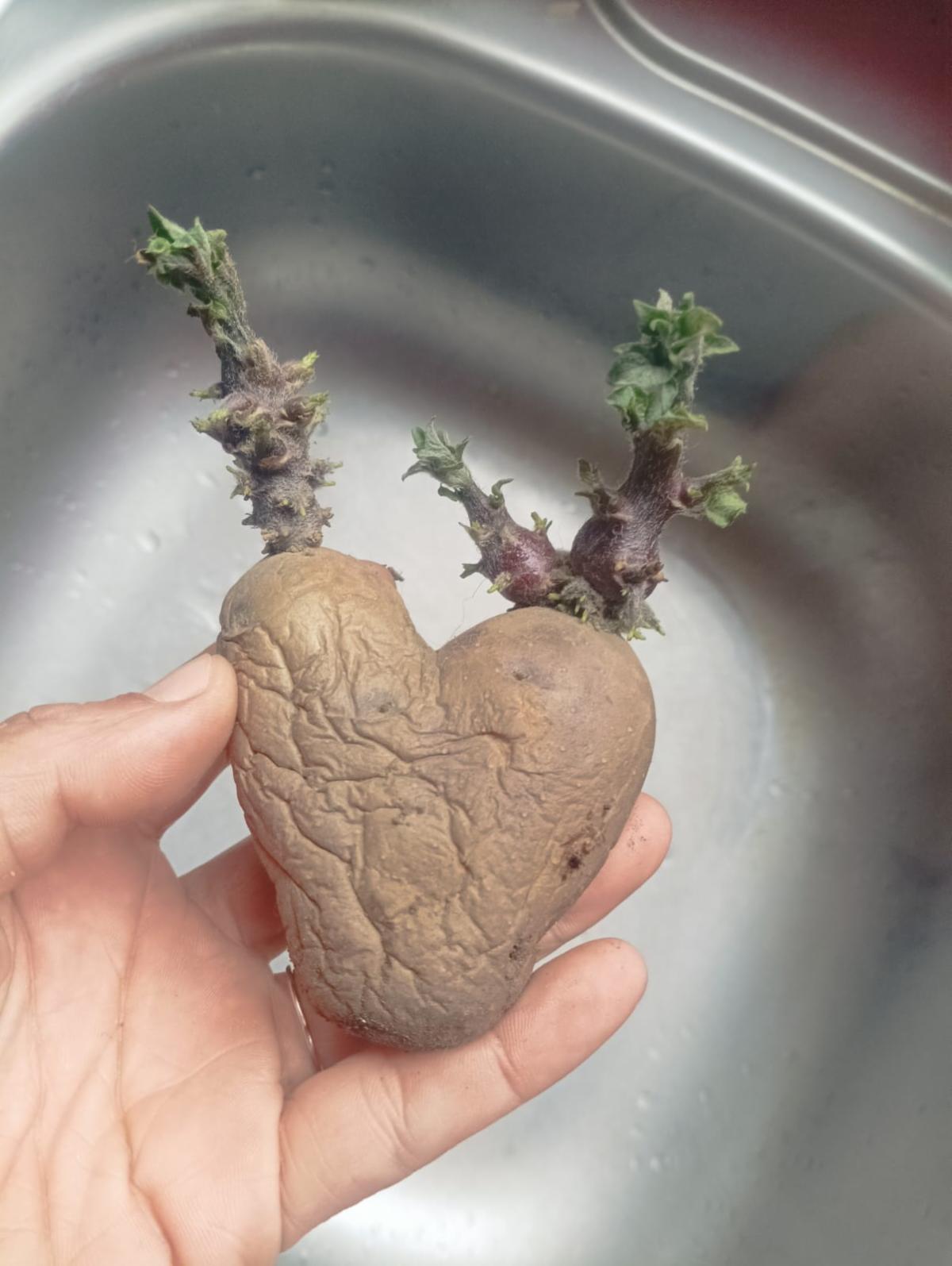
But what if one day you or I woke up transformed into a cockroach, as in Kafka's novel? What if one day the New York-based visual artist Karina Aguilera Skvirsky becomes a "restless soul" wandering inconsolably through a museum filled with colonial Spanish artworks and artifacts? And what happens if the artist María Inés Galecio, who lives in Castro, discovers one day that she has incubated the soul and heart of a potato? Following less dramatic but fully perceptible transformations, the works in this exhibition contribute to the slow metamorphosis of the Blue Chapel into an art gallery.
| | Maria-Inés Galecio, Palpito (above) and various details (below) | | |
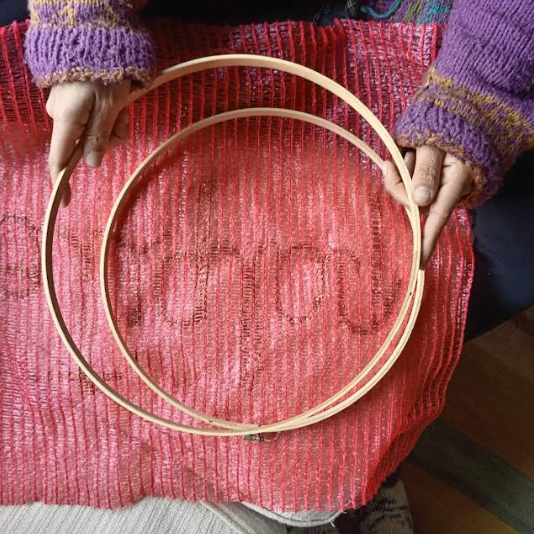
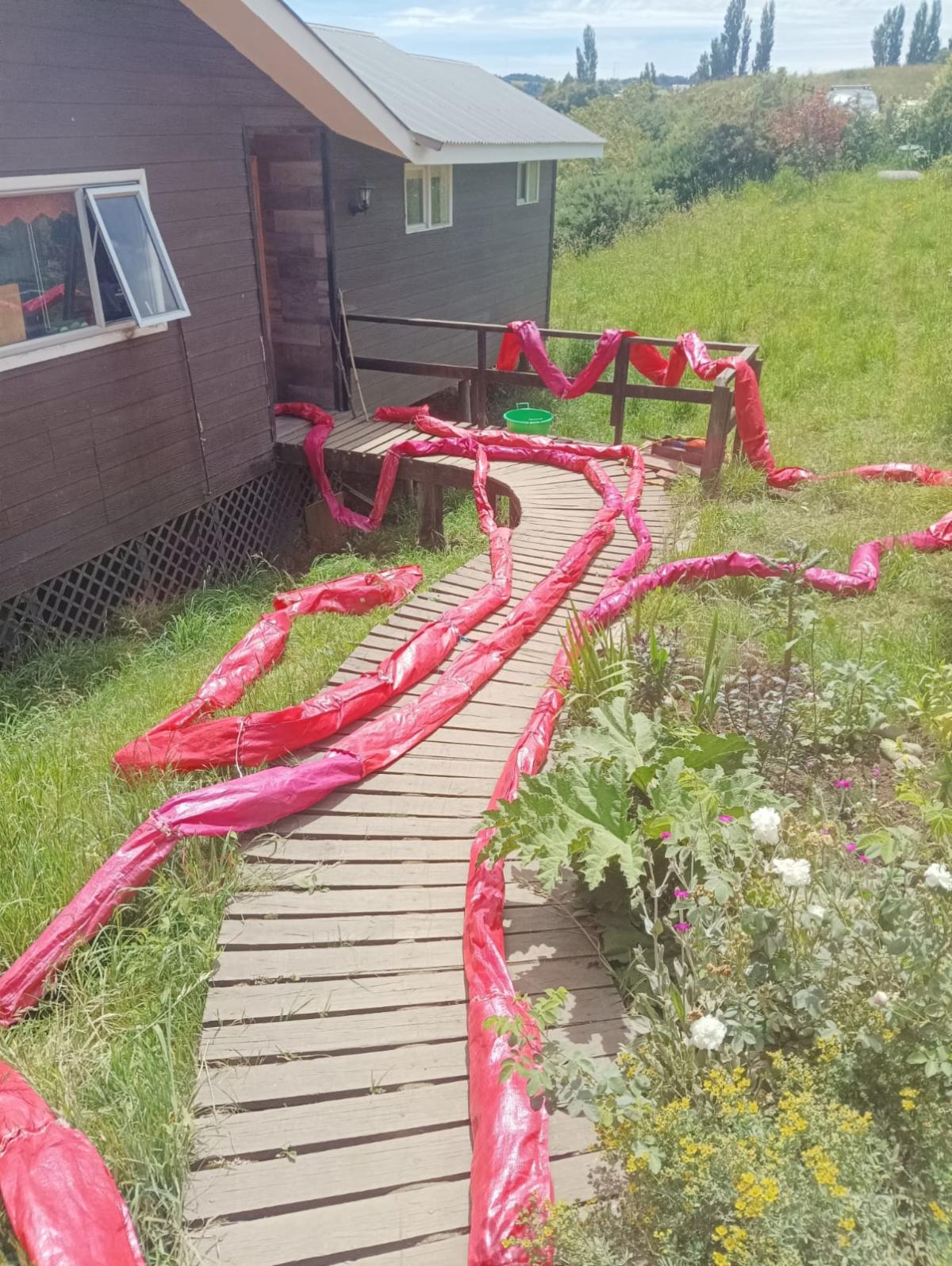
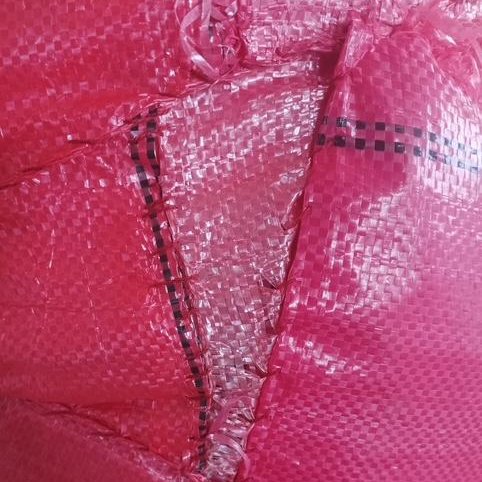
The beating of the human heart throughout life is both material and immaterial: an experience that can be recorded physically and electrochemically, but which nevertheless falls far short of explaining the life that resides within us. For María Inés Galecio, the starting point of her intervention was the discovery of a heart-shaped potato. From there, she attempted to understand the relationships between the tuber and our heart; the vital activity that manifests itself internally as the flow of blood and sap, through arteries, veins, branches, and capillaries. The resulting project, Palpita, presents different material forms of the heart: a sequence of photographs, a potato on a bushel measure, and illustrations of the omnipresent heartbeat that resonates inside the chapel, eventually synchronizing with our own. In the grass outside, alongside the forest, the artist has installed a monumental heart made of woven and interconnected plastic bags, whose intense red color transmits its vital force, across several meters of veins and arteries, into the chapel, as if it were part of a new collective body that now inhabits Contuy.
Inside the chapel, with the image of the sacred heart conspicuously absent from where the altar once stood, the heart still continues to evoke theological passion and pain, with the religious reference all but inevitable. Here, the potato-heart enjoys a continuous vitality that, as the days and weeks pass, is expected to flourish, with branches emerging from its body like veins, arteries, or arms, extending towards other entities. For the potato to thrive, it must abandon its current body to be re-born as a distinct potato in another spot where it is welcome. Scientists discovered long ago that this vital force flowing through a potato generates electricity, along with the potassium and electrolytes it absorbs as it expands outward through photosynthesis. The artist's inclusion of an electrocardiogram, in this context, becomes a graphic confirmation of her own existence: the fluctuations of the needle, its peaks and valleys, draw an irregular geography, a profile of the secret mountain range we carry in our hearts.
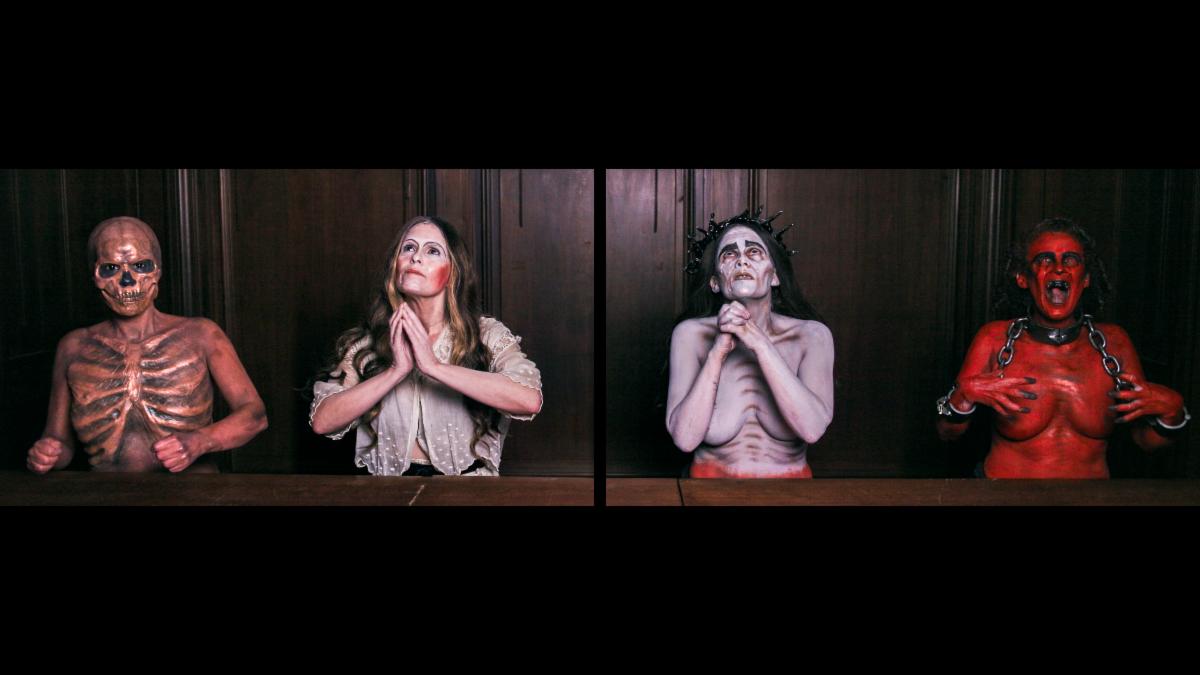
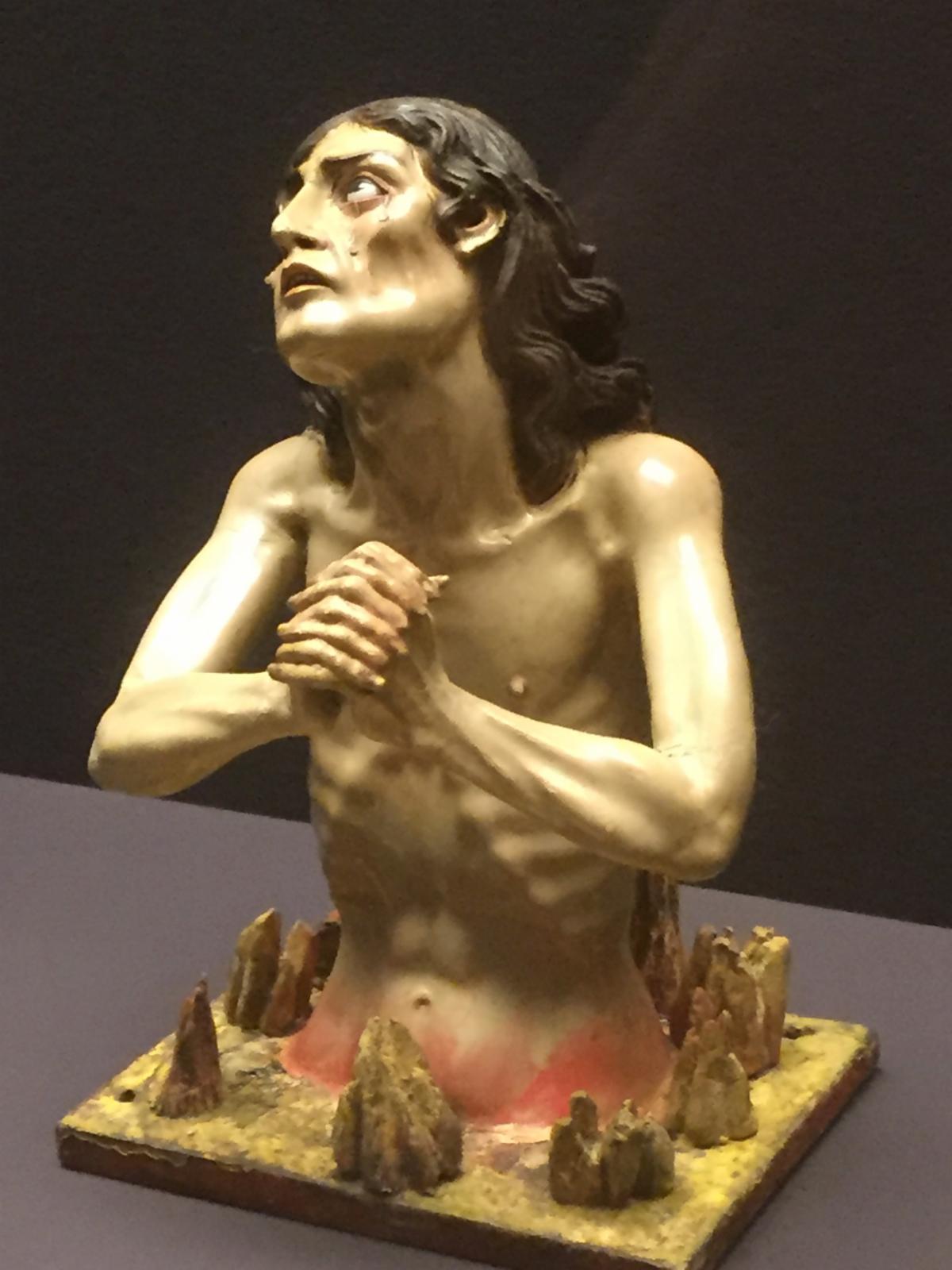
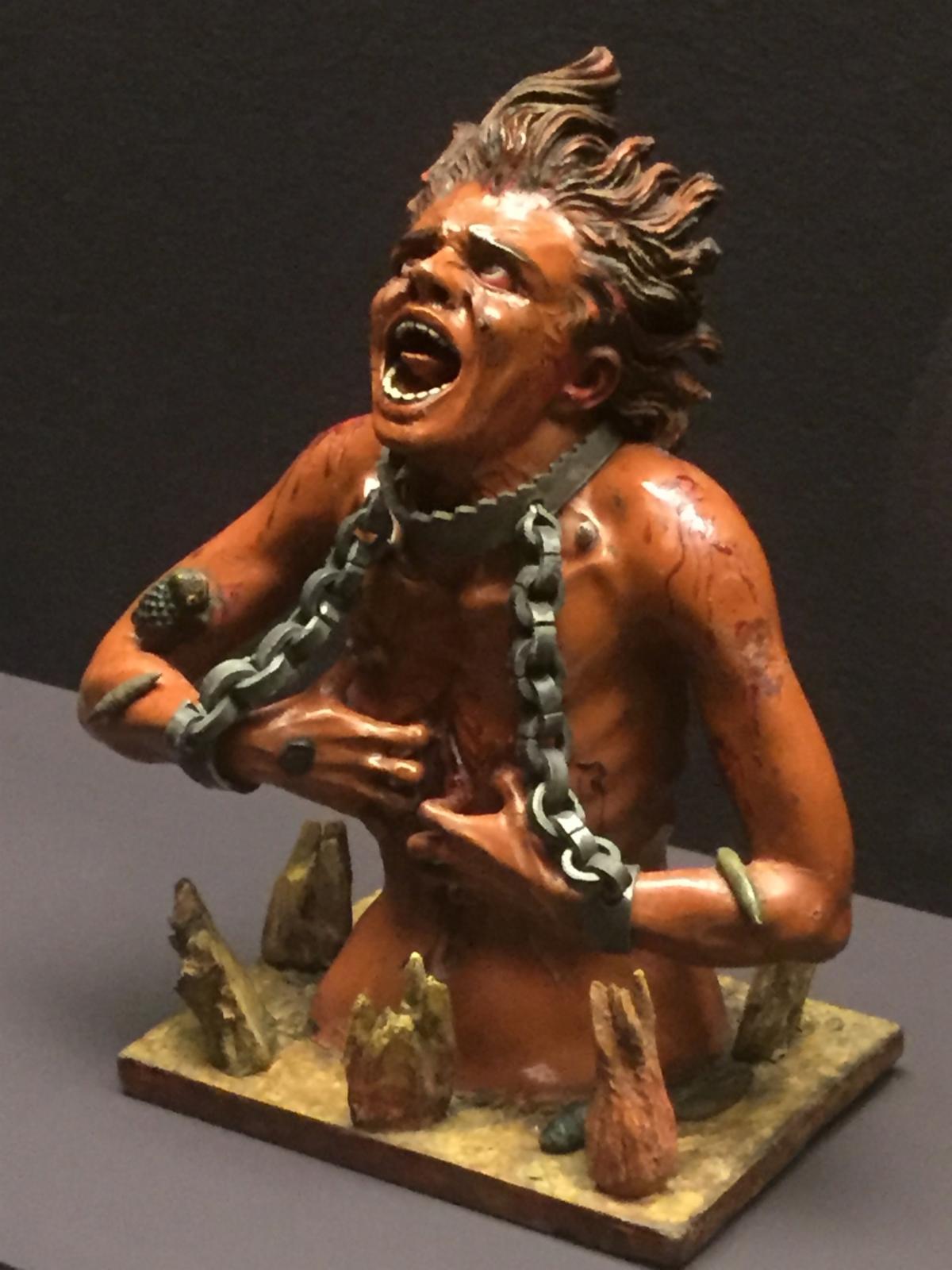
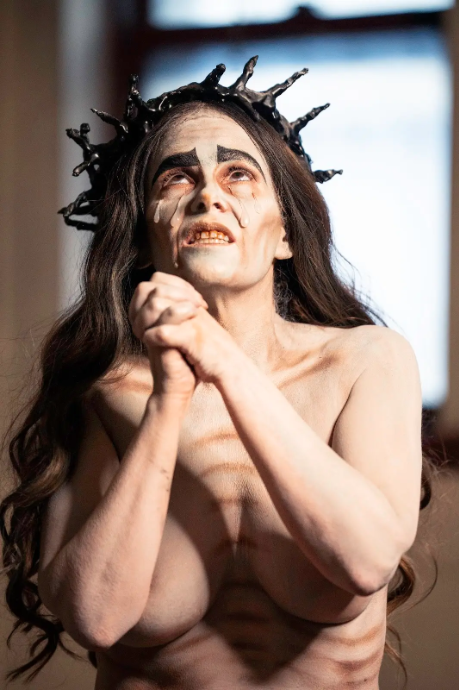
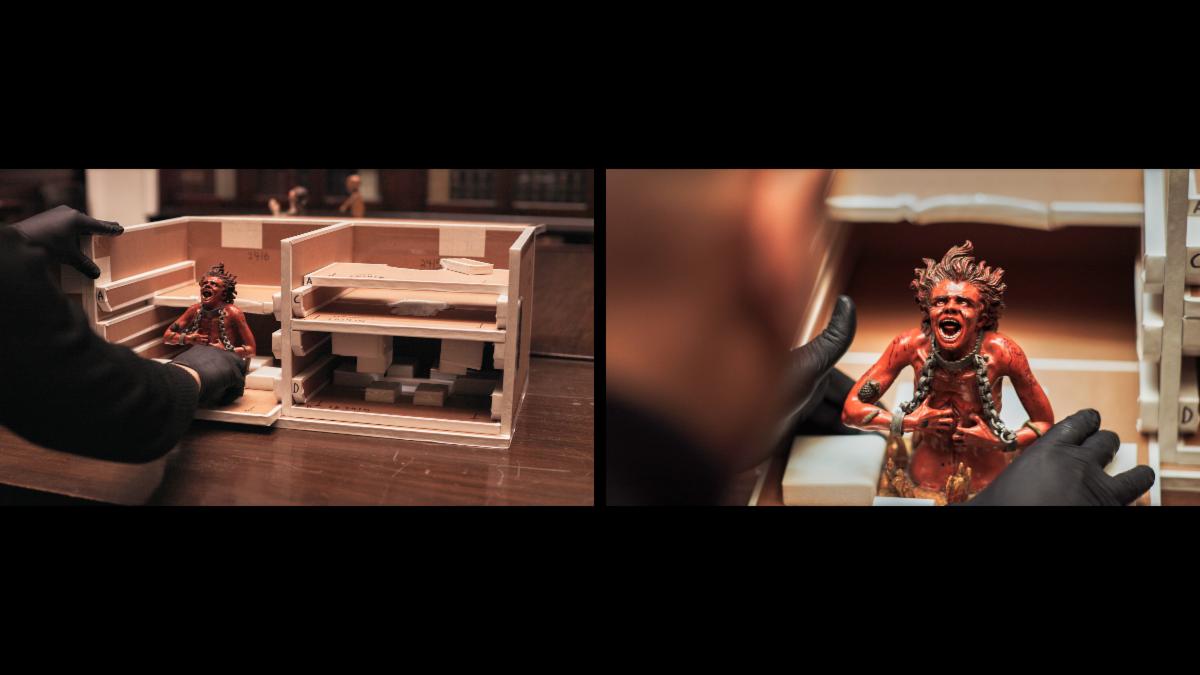
| | The extreme states of the human soul, of the very force that animates life, are the symbolic territory that Karina Aguilera Skvirsky has explored and transformed into art for this exhibition. Her work The Afterlife is a creative response to a series of wooden sculptures attributed to the master (or workshop of) Manuel Chili (1723-1796), a sculptor and carver from Quito, better known as Caspicara, who trained in the colonial workshops of the Quito School in the 18th century. At that time, the evangelizing mission of the Church during the colonial period in America was carried out through the production of iconography (sculptures, paintings, churches, textiles, and engravings, among others) for ecclesiastical spaces and civic life in general. | | Manuel Chili, The Fate of Man (Purgatory), c. 1775 | | Manuel Chili, The Fate of Man (Hell), c. 1775 | | In what are possibly the most reproduced works of art from Ecuador, Caspicara (a nickname that in Quechua means "wooden face" or "stick face") created around 1775 four small sculptures representing four states of the soul after death: death, glory, purgatory, and hell. These polychrome figures traveled or were dispersed throughout Ecuador, Chile, and Argentina, passing through different owners until they became part of the Hispanic Society Collection in New York. Following the publicity generated by the series' inclusion in an international museum tour of the Hispanic Society Collection, the artist decided to transform them into contemporary, realistic-looking figures, recreated using her own face and torso. This revived the striking realism of the figures carved and painted centuries earlier by Caspicara. | | Karina Aguilera Skvirsky, Caspicara production still | | | | |
Reality unfolds in Aguilera Skvirsky's four interpretations through a documented metamorphosis in which her body is sculpted, painted, decorated, and made up, as if it were a piece of wax or wood. Each element added to her torso, face, eyes, cheeks, and mouth references the aesthetics of Caspicara's sculptures, and in this way, Afterlife becomes an edited compilation of various behind-the-scenes sessions, where we witness the gradual metamorphosis of Aguilera Skvirsky's body and face, before and during the post-production of the filming.
As she describes the subsequent scenes, ”In the video, I transform into the sculptures and walk through the museum's halls, observing and imitating the Spanish paintings that surround me. The gestures and gazes I direct towards the paintings could be interpreted as confrontations with the colonial era." The filming concludes with a glimpse into her own family diaspora, by way of her mother's ties to her native Ecuador. Today, living and working in New York, Aguilera Skvirsky returns a piece of historical Ecuador to South America and, through a series of unique transformations, brings Caspicara's work back to its birthplace in Quito, only this time from Chiloé.
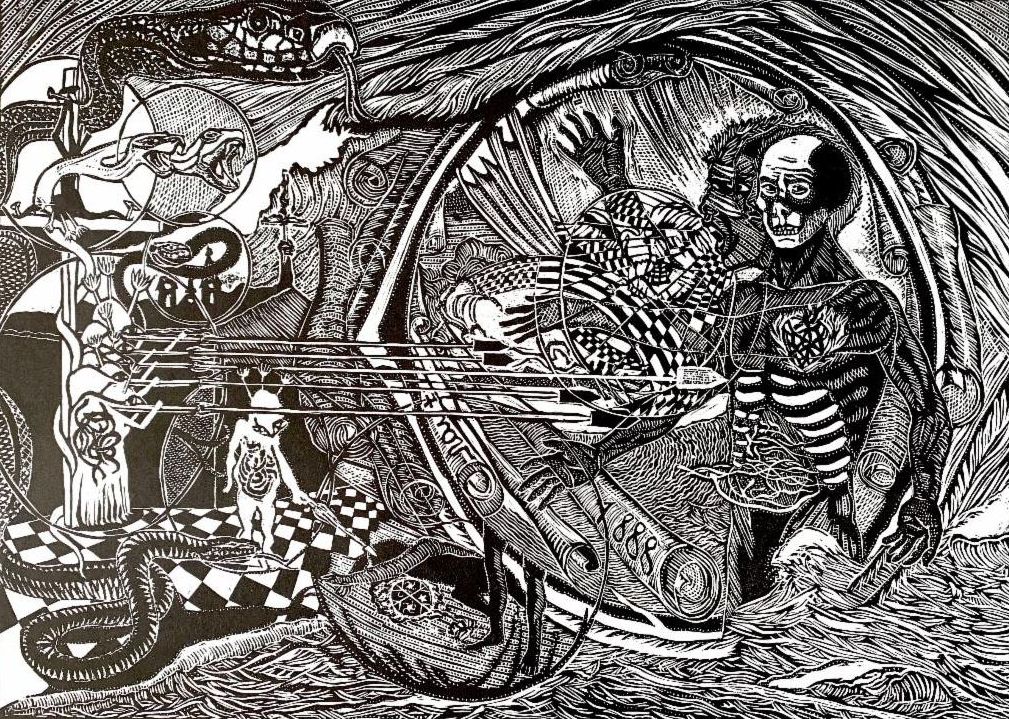
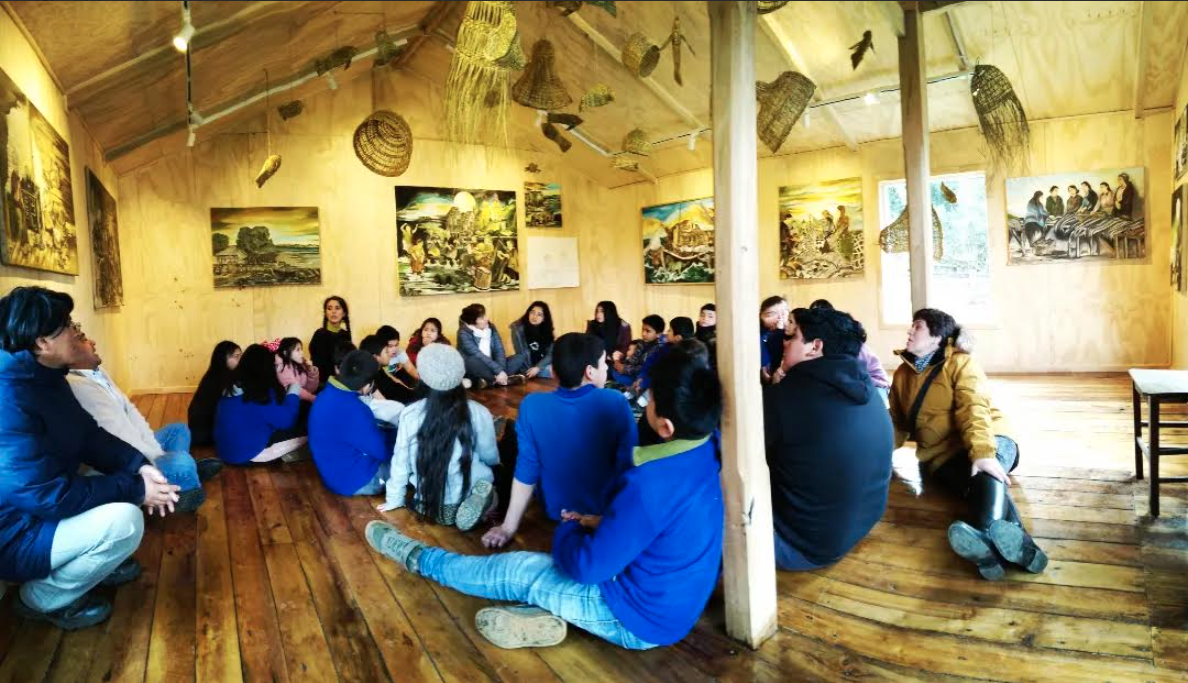
| | Karina Aguilera Skvirsky, Caspicara production stills | | RAFAEL LARA IN PUERTO VARAS | | | Also opening on January 24 is Espíritu Libre, the career survey of the graphic work of Rafael Lara (1969-2024), which we presented in September. After closing at Capilla Azul in early December, it will now be open to the public at Centro Cultural Bosque Nativo in Puerto Varas through the end of February. Additional tour venues for Espíritu Libre will be announced in the near future. | | Rafael Lara, Weichafe, Nancupel, Chilwe, Memoria, 2019, lithograph | | HELP SUPPORT CAPILLA AZUL! | | | School group at Capilla Azul | | Like so many other cultural spaces, La Capilla Azul operates on a shoestring, but even small budgets need to be raised, and for us, the more than two hundred contributors who have donated as little as twenty dollars and as much as a hundred times that, are the lifeblood that keeps us going. If you have donated in the past, thank you so much, and I hope you feel like your money was well spent. For those who haven’t contributed yet to our GoFundMe campaign, please note that as a 501c3 public charity registered in NY State, donations to Capilla Azul are always tax-deductible, within the guidelines of current tax laws. Click on the link below to learn more, and thank you for letting us stay in touch! | | | | Capilla Azul is part of Comarca Contuy, Queilen, Chiloé, Region Los Lagos, Chile | | | | |