|
Dear Friends,
So many important questions and perspectives came up during the recent Berkshire International Film Festival screening of Fork in the Road, an award-winning documentary about food systems change co-produced by Lisa Holmes (a BAV supporter!). The film does a beautiful job telling the stories of farmers and organizations nationwide working to heal the land and improve our food system. These efforts give us a way forward — and give us hope.
A key theme that emerged for me was how nonprofits fit into the work of rebuilding local food systems. During a conversation BAV hosted prior to the screening, Lisa Holmes shared what was a crucial realization for her in making the film. “One of the things that has been an ‘aha’ experience,” she said, “is the critical role that nonprofits play for small farmers. Every single farmer in our film somehow is surviving because of a nonprofit they’re related to.”
Mary Berry, who is featured in the film and joined us for a lively conversation, seconded that perspective. The daughter of Wendell Berry, she is the Executive Director of The Berry Center, a nonprofit she founded in 2011 to put her father’s ideas into practice to support farmers and rural communities. No one else was going to do it, she said with a wry laugh during our conversation. (Read more from Mary below!)
One of the exciting initiatives launched by The Berry Center is Our Home Place Meat, a Kentucky-based regional cooperative for beef farmers that is not only ensuring a fair price for quality grass-fed beef, but is bringing farmers together in new ways. I found clear, meaningful ties between this program and BAV’s work supporting livestock farmers by strengthening local meat value chains and infrastructure in our region.
There is so much common ground among BAV, The Berry Center, and this important film. As proof of that, when Mary Berry’s husband wanted to start a CSA years ago (Kentucky’s first), he reached out to none other than Robyn Van En, the pioneering co-founder of the first CSA farm in the country — Indian Line Farm in Great Barrington. It’s vitally important that we continue sharing stories and raising awareness about all we are at risk of losing — and all that is being done around the country to protect and reinvigorate local agriculture.
I came away from the film and conversation feeling energized and hopeful that relationships within and across regions hold the solutions we need. Simply put, the way forward is together!
Warmly,
| |
Rebecca Busansky, Executive Director
| |
Banner photo: Greens harvest at Full Well Farm, photo by Stephanie Zollshan | | SPOTLIGHT: A CONVERSATION WITH MARY BERRY | | |
As noted above, BAV was thrilled to welcome Mary Berry, Executive Director of The Berry Center, to join us for an intimate conversation last month alongside her public appearances during the Berkshire International Film Festival.
As one of the changemakers featured in the acclaimed documentary Fork in the Road, Mary Berry has deep experience as a farmer, nonprofit leader, and agrarian thinker in the spirit of her father, Wendell Berry. We were grateful to have had the opportunity to gather with Mary, Fork in the Road co-producer Lisa Holmes, and a circle of local farmers and partners to ask questions and share perspectives about how to support farmers and restore the culture of agriculture.
We are pleased to offer a few highlights here. We also invite you to access an edited and condensed version of the whole conversation on our website. Our thanks to all who joined us!
Can you share some reflections on your upbringing?
Mary Berry: I’m very lucky to have been born to the parents I was born to. I don’t remember ever wanting to live anywhere other than Henry County, Kentucky. I was raised with an agrarian vision and all I had to do was accept it. Part of what we need to talk about is vision. In Kentucky, there are an awful lot of people trying to do good things, but if you don’t have a vision based on something, you’ll fall for anything. Maybe that’s part of the reason there hasn’t been cultural change.
How can we truly help farmers?
Mary Berry: I finally realized one day that the cavalry ain’t coming. We’re going to have to do this ourselves. Our Home Place Meat [The Berry Center’s cooperative for small-to-midsize livestock farmers] is our first effort to put something between the farmer and the marketplace to take care of pricing, marketing, and distribution.
In this country, we have large and industrial farming and we have small and entrepreneurial farming, and we have almost nothing in the middle. I think those of us who care so much have got to begin to look for examples and try to put something in place that allows farmers to farm — if we value them.
I think we’ve got to see that the local food movement has stalled out and it’s stalled at entrepreneurial farming. It’s good and should be supported, but it’s not enough. It’s not keeping up with rural decline and it’s not changing the culture of agriculture.
I’ve learned this from my father, along with several other things: You start good work with an inventory of what you have to work with. This is another weakness of the local food movement — it’s been top down and though good and well-intentioned, it’s not coming down far enough. We need to put infrastructure in place.
What do we lose when we lose smaller-scale farmers?
Mary Berry: I don’t think people — people who care — understand what we’ve lost. How many farmers have been lost, and how losing the farmers has meant we’ve lost the culture of agriculture. Which my father says in The Unsettling of America: Culture and Agriculture turns out to be indispensable. The culture of agriculture makes sure the correct work is done, the knowledge is handed down. We have to acknowledge the truth about where we are — and go to work.
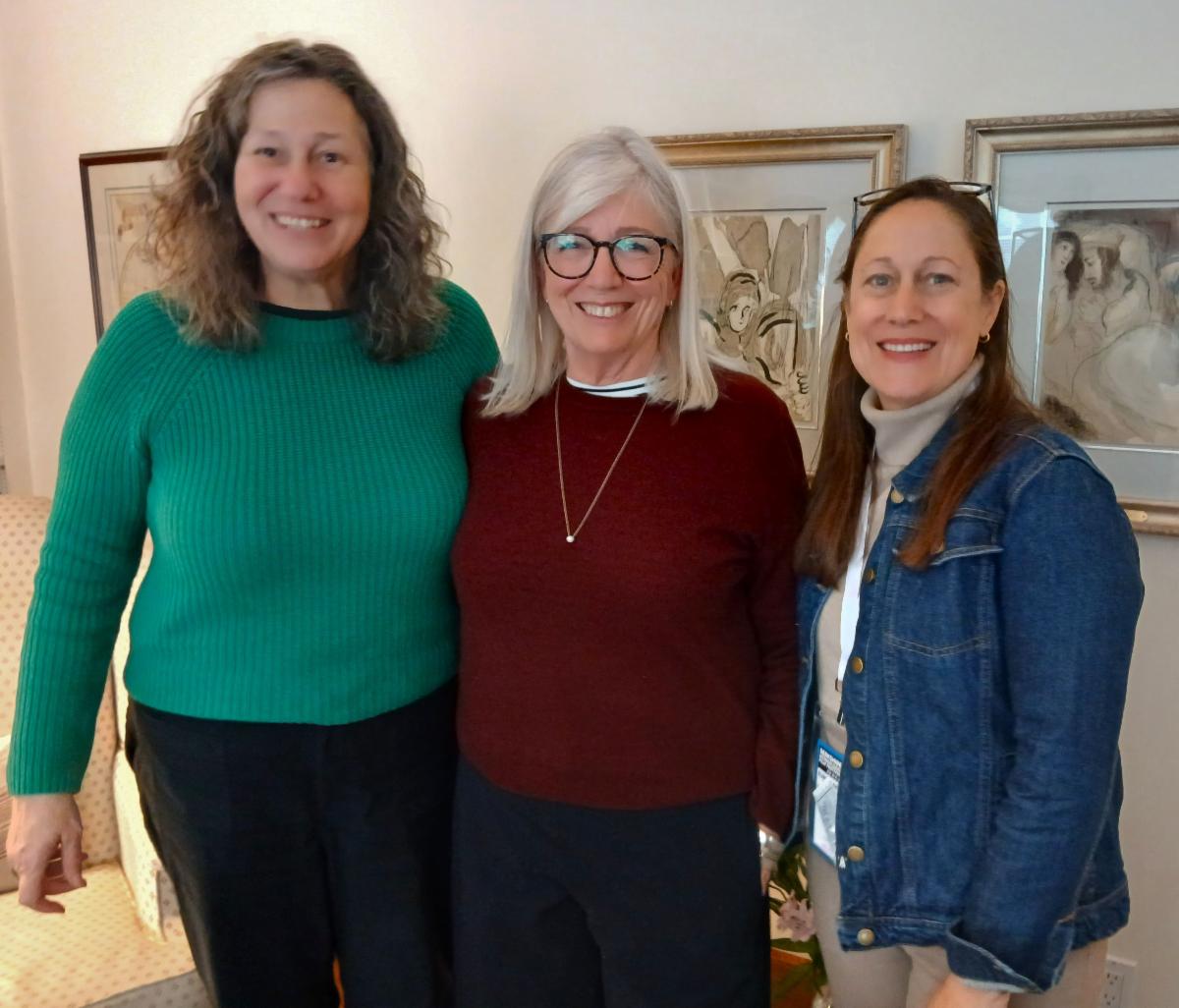
| | Photo, left to right: BAV Executive Director Rebecca Busansky; Mary Berry; Lisa Holmes | | |
This month and throughout the year, BAV stands in allyship with our LGBTQIA+ farmers, partners, staff, Board, and wider community. Individually and collectively, we are committed to being a safe space in which all people feel confident they will be accepted, respected, and understood.
As part of that commitment, BAV staff recently took part in the Berkshire Pride Certified Safe Space Project. This education program helps individuals and organizations in our community build confidence in their knowledge and understanding of LGBTQIA+ identities, struggles, and joys. Educator Emma Lenski spent the day at BAV presenting the course material and guiding our discussion with thoughtfulness, care, and a great sense of humor.
BAV staff members each completed all three courses to attain our Berkshire Pride Certified Safe Space Project series completion certificates. We are committed to putting our learning into practice and working internally and with our community partners toward our shared goal of safe and brave spaces for all people.
Our thanks to Emma and Berkshire Pride for their knowledge, teaching, and advocacy! We encourage you to learn more about Berkshire Pride’s mission, resources, and educational classes here.
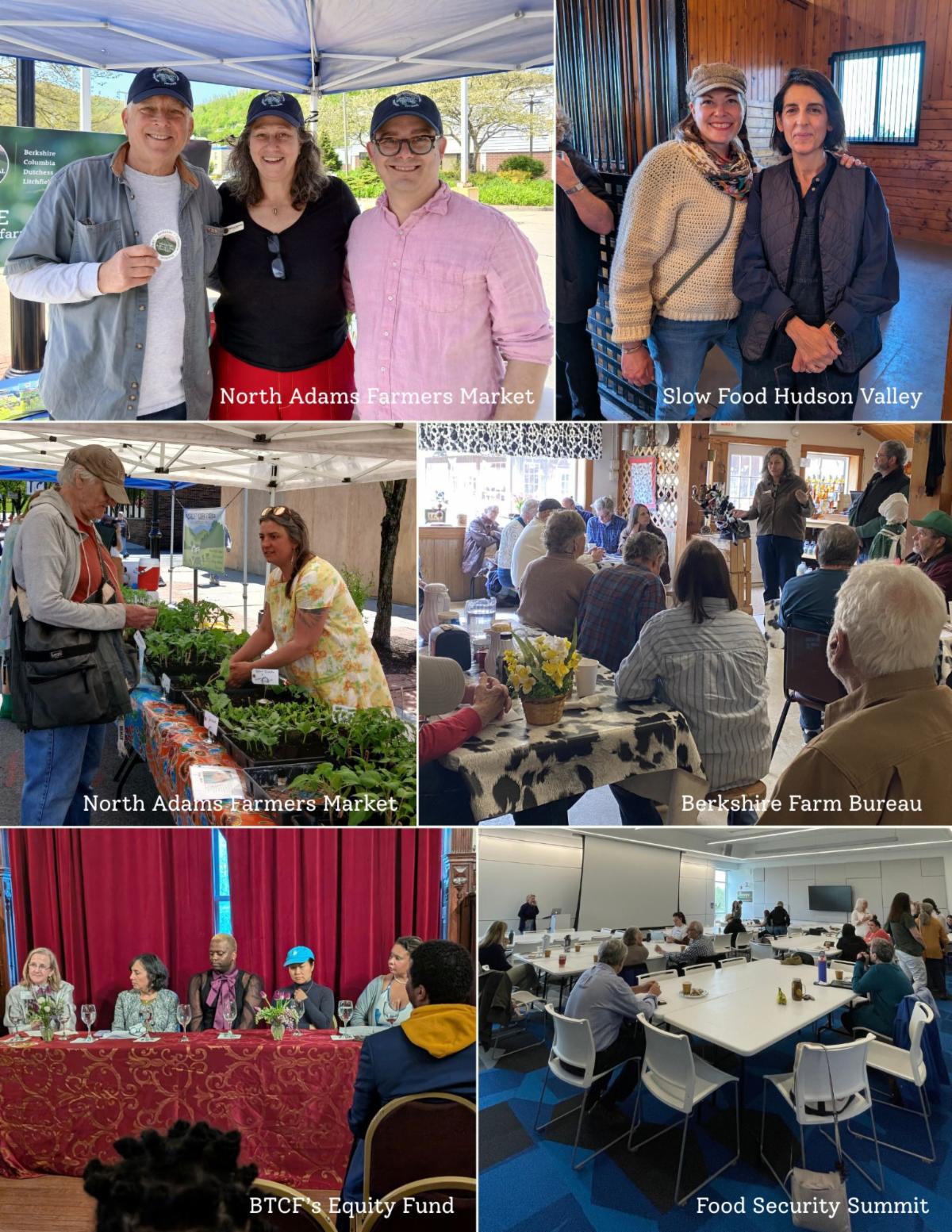
| | BAV staff and Board have taken part in regional events and gatherings this spring focused on food systems, farm policy, equity-focused philanthropy, and more. We are pleased to share a few photos here! | | |
BAV is hiring! We are seeking an experienced, detailed, and solutions-oriented Development and Operations Associate to manage core components of resource development and operational support. This pivotal role focuses on data integrity, gift processing, and systems coordination in support of strengthening the organization and achieving fundraising goals.
Please refer to our position description for details. Applications will be reviewed as they are received. Priority will be given to applications received by July 7, 2026.
| | |
Berkshire Business Journal | May 2026
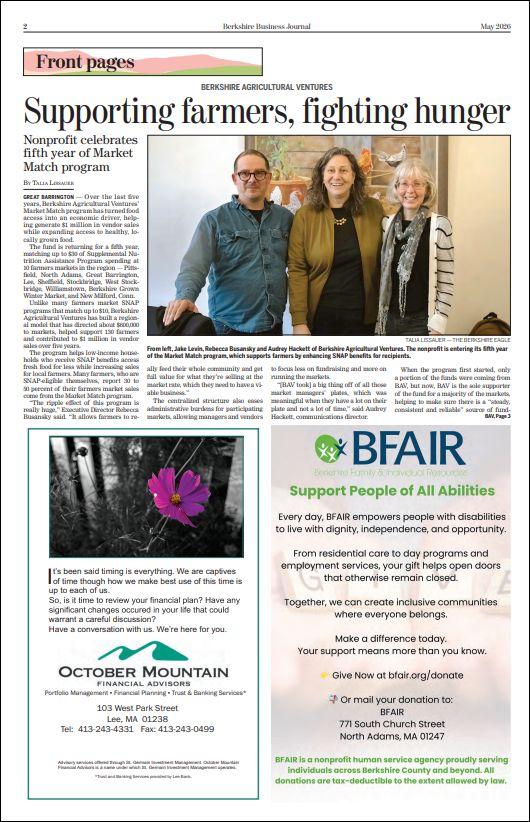
“Over the last five years, Berkshire Agricultural Ventures’ Market Match program has turned food access into an economic driver, helping generate $1 million in vendor sales while expanding access to healthy, locally grown food. ... ‘The ripple effect of this program is really huge,’ Executive Director Rebecca Busansky said. ‘It allows farmers to really feed their whole community and get full value for what they’re selling at the market rate, which they need to have viable businesses.’”
| | FARMER EVENTS & RESOURCES | | |
Grant opportunities
🎯BAV provides grant-writing and business planning support to help farmers submit competitive grant applications to access federal and state funding. Depending on your situation and the timing of the grant, we can help you move forward this year or help you plan for next year. Reach out to us to learn more!
| |
Application deadline: August 7
USDA Meat and Poultry Processing Expansion Program, Phase 4. Federal funding opportunity to help local processors expand capacity and upgrade equipment. Note that to be eligible, local processors must currently slaughter and process beef. However, funds can be used to improve processing for other species as well. Two grant tiers are available.
| |
Events and programs for June and July
Tuesday, June 16, 10am-12pm
Cover Cropping with Drones. A UConn workshop to demonstrate interseeding cover crop by drone. Valleyside Farms, Woodstock, CT.
Wednesday, June 17, 6:30-7:30pm (online)
Maximizing Photosynthesis and Summer Growth. Free Zoom call with NOFA/Mass, part of their Soil Health in Organic Systems series that continues through September. This call will focus on practical strategies for keeping plants thriving through the early summer season.
Thursday, June 18, 4:30-7pm
Whole-Farm Stewardship: Buffers, Perennials & Biodiversity. On-farm networking event and farm tour showcasing a resilient, whole-farm ecosystem at Indian Line Farm in South Egremont, MA. Organized by NOFA/Mass. Free; pre-registration required.
Tuesday-Wednesday, June 23-24
Cultivating a Farmer-Led Regional Agroforestry Transformation. Join NOFA-VT, NOFA-Mass, CISA, and others for a regional gathering of agroforestry farmers. Tour five farms over two days. $50 for farmers for both days.
Tuesday, July 14, 9:30am-3:30pm
NYC Urban Agroforestry Summit. Join the Cornell Small Farms Program and Harvest New York to learn and network with urban agroforestry practitioners, service providers, and city government partners on ways to scale agroforestry in NYC.
Wednesday, July 22, 9am-12pm (online)
Massachusetts USDA Natural Resources Conservation Service (NRCS) State Technical Committee meeting. A vital forum for stakeholders to provide advice on the implementation and direction of USDA conservation programs in Massachusetts.
Friday-Sunday, July 31-August 2
Northern Nut Growers Association & Chestnut Growers of America Joint Conference. Registration is open for the 2026 conference, featuring programming geared to researchers, commercial growers, hobbyists, and nut enthusiasts. Held at UMass Amherst. Early-bird registration for full conference is $270 through June 15.
| |
Additional resources
USDA Payment for Specialty Crop Farmers
Enrollment and payment information for farmers who grow specialty crops, have their USDA farm tract number, and have been filling out your crop acreage reports with FSA. Payment rates are $65/acre to $650/acre depending on crops. Deadline is August 7.
Conference Recordings Available - 2026 Northeast Grazing & Livestock Conference
Check out these conference recordings, now available on YouTube, from the New England Grazing Network’s 2026 Winter conference, co-organized with BAV.
CT FarmUP Program
The CT Resource Conservation & Development Area’s FarmUP and Veteran FarmUP programs offer technical assistance to new and existing farms and agricultural businesses. Farmers can sign up for one-on-one consultation for guidance and resources. Learn more here.
| | Your gift to BAV supports local farmers, expands local food access, and creates a more vibrant and viable local food system. During a time of challenge and change in our world, thank you for making a difference! | | | | |