June 2023 Program Newsletter | |
|
On June 20, SMPDC held its 58th annual meeting – our first in-person annual meeting since 2019! Attendees came together to celebrate SMPDC’s accomplishments over the past year and enjoy an enlightening presentation from Maine State Economist Amanda Rector (pictured above with SMPDC Executive Director Paul Schumacher) on migration in Maine. Amanda Rector discussed the recent trend of Maine’s population getting larger and younger, a change from the previous trend of Maine having a declining and aging population. This shift is due to in-migration of families from other states and internationally, an exciting economic prospect for our state that has one of the lowest unemployment rates in the country.
During the Q&A, climate migration was brought up as a potential source of additional in-migration in the future. As the extreme effects of the climate crisis continue to impact the country, Maine has experienced fewer wildfire and extreme heat hazards than other areas, making it an attractive relocation option. To learn more about the potential causes and impacts of climate migration, check out the Key Note Address delivered by Dr. Linda Shi at the Maine Sustainability and Water Conference this spring.
| |
Read on to learn what the RSRP has been up to! | | |
|
The Regional Sustainability and Resilience Program is pleased to welcome Aliyah Kingsley, who will be interning with us this summer. Aliyah is currently a graduate student at Vermont Law School and will obtain a Master’s in Environmental Law and Policy in December. She got her undergraduate degree in History and Asian Studies at Clark University. She is excited to learn about climate adaptation and mitigation in Southern Maine. She lives in New Hampshire and enjoys walks in the woods with her dog, Penny. | | |
All Service Provider Communities are Now Enrolled in the Community Resilience Partnership (CRP) | |
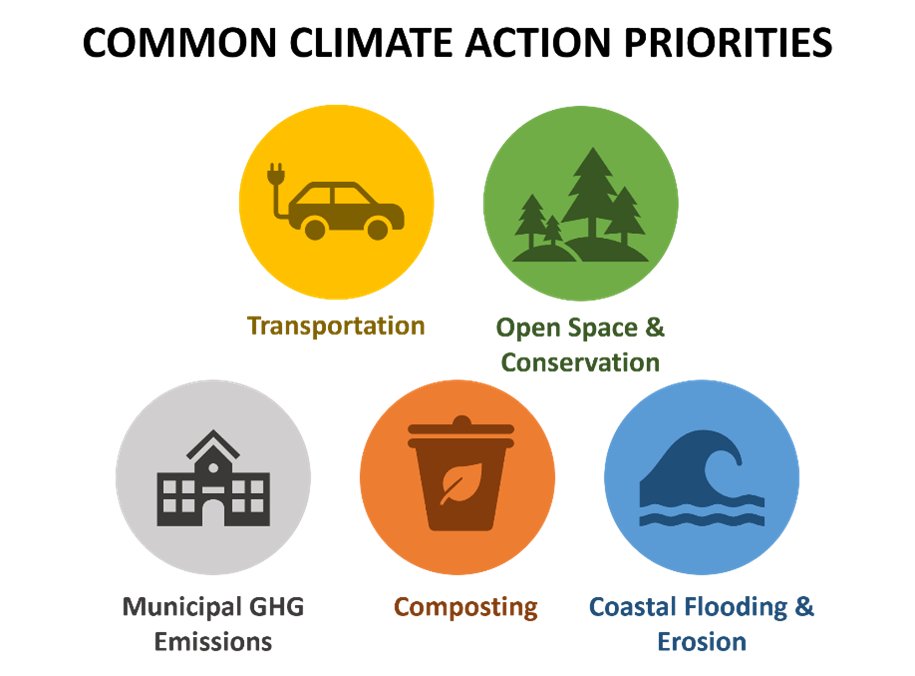
The towns of Berwick, Eliot, Fryeburg, Old Orchard Beach, and Ogunquit are now enrolled in the Community Resilience Partnership (CRP)! We have been assisting these towns with the CRP enrollment process since last fall. We guided the towns through a self-assessment, hosted community workshops, and helped the towns identify priority climate action areas based on staff and community member input. Each of the five towns identified the following priority action areas: | | |
-
Clean and alternative transportation – Supporting alternative transportation modes such as walking, biking, and transit was a common theme across the five towns. A couple of towns also identified expanding EV charging infrastructure and municipal EV fleets as top priorities.
-
Open space and conservation – Each town identified protecting open space and the environment as a top priority. Specific priority actions varied across the five towns and included building parks to increase green space, protecting floodplain buffers, and addressing biodiversity loss and invasive species.
-
Municipal energy efficiency and renewable energy projects, community composting, and nature-based solutions to flooding and erosion hazards were also identified as priorities by two or more towns.
We are currently assisting each of the five towns with Community Action Grants to support selected priority actions, and we look forward to seeing where each of them goes in the future!
| | |
Climate Change Impacts in Southern Maine: A Regional Summary | |
|
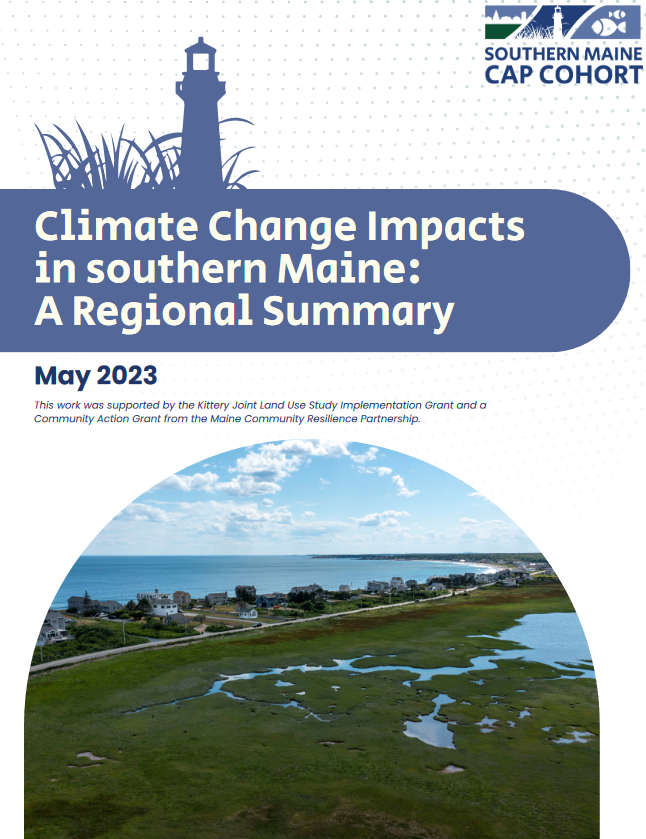
As part of the Southern ME Climate Action Planning Cohort, we’ve created a short, high-level report summarizing the ways climate change is impacting Southern Maine. Key takeaways include:
- Southern Maine's natural environment – the ecosystems, plants, and animals that make this region special – are already being stressed by climate change.
- Southern Maine’s roads, bridges, and critical infrastructure are at greater risk of damage due to sea level rise and increasing storm severity and frequency.
- Large sectors of southern Maine’s economy including tourism, fishing, recreation, and agriculture will need to adjust to climate change impacts.
- The essential public services that southern Maine municipalities provide will be greatly strained by climate change impacts.
- Climate change is altering the availability of recreation activities traditional to southern Maine.
- Climate change impacts are negatively affecting the health of southern Maine community members.
| | |
|
Climate Ready Coast - Southern Maine
NEW Visual Renderings Show Potential Coastal Resilience Solutions at Sites Vulnerable to Flooding
| |
|
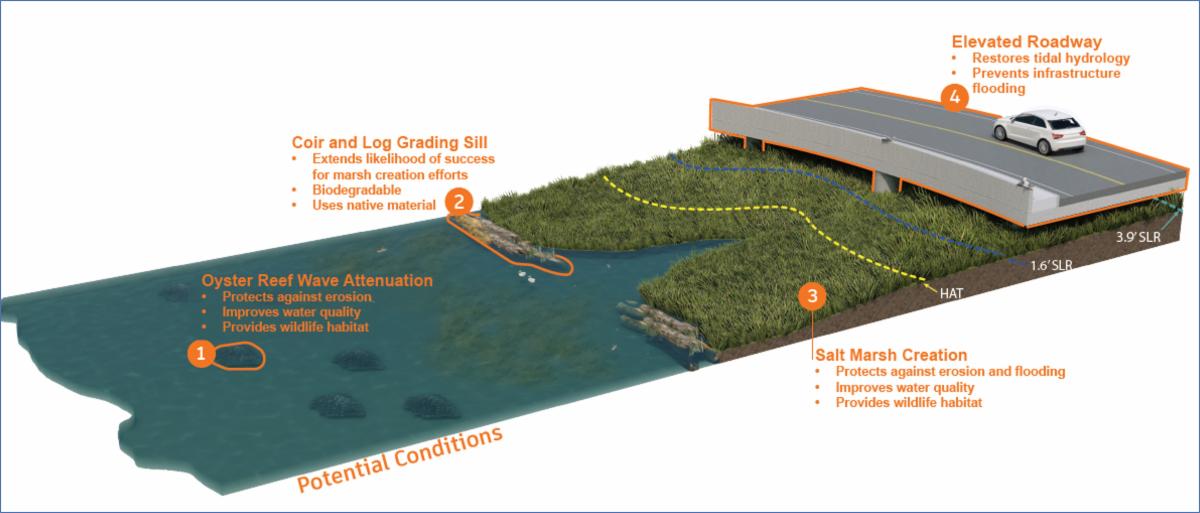
The Climate Ready Coast project has hit an exciting milestone: the completion of visual renderings that show examples of nature-based coastal adaptation strategies at sites that are particularly vulnerable to flooding and sea level rise across the region. The project team worked with wonderful staff from environmental consulting firm SWCA to create the illustrative examples of how adaptation projects, such as dune restoration, salt marsh expansion, structure elevation, living shorelines, and even managed retreat, might look on the landscape at 15 priority vulnerable sites that were previously identified by the project Working Group.
The renderings will serve as a valuable communication tool to show what nature-based adaptation projects could look like in southern Maine communities compared with existing conditions and more traditional 'gray' infrastructure approaches. In addition to the renderings, the project team and SWCA also created a matrix of coastal adaptation strategies that could be appropriate for southern Maine based on local vulnerabilities and conditions.
| Example Visual Rendering of Coastal Adaptation Strategy | | |
Recent Virtual Workshop: Coastal Water Quality in Southern Maine | |
|
Last month, the RSRP led an informative virtual workshop on coastal water quality issues in southern York County with guest speakers Shri Verrill, York County Soil & Water Conservation District; Meagan Sims, Maine Healthy Beaches; and Luke Frankel, FB Environmental Associates. During the workshop, our guest speakers discussed coastal water quality issues, challenges, impacts, and monitoring and management efforts in the region, and opportunities for regional coordination and collaboration to address these issues.
| | |
|
Solar Development: Helpful guidance for municipalities for Southern Maine Planning and Development Commission regarding the legal landscape for planning and regulating the development of large-scale solar arrays. View here.
2023 Edition of the Maine Community Resilience Workbook: A Maine-based framework and how-to guide for climate change assessment, collective climate action, and achieving community resilience outcomes. Download the guide.
Centering Equity in Climate Resilience Planning and Action: From Antioch University Center for Climate Preparedness & Community Resilience, this synthesis paper introduces and amplifies principles and best practices for centering equity in climate resilience planning and action. The audience is primarily users of the U.S. Climate Resilience Toolkit and its Steps to Resilience. Learn more and download the paper here.
Sea Level Rise Community Engagement Tools: The Island Institute has created multiple resources to help engage and guide communities to become more resilient to sea level rise. Learn more about sea level rise in Maine, its impacts on coastal communities, and some of the steps being taken to increase resilience on the Island Institute’s website. View here.
| | |
Resilience
-
Community Resilience Partnership Community Action Grants: The Governor’s Office of Policy Innovation and the Future (GOPIF) is pleased to announce the opening of a third round of grant opportunities for municipal and tribal governments and unorganized territories through the Community Resilience Partnership (CRP). Community Action Grants enable eligible communities to implement projects that reduce energy use and costs, transition to clean energy, and make communities in Maine more resilient to climate change. Applications due July 7, 2023. Learn more here.
-
Wastewater Treatment Facility Climate Adaptation Planning Grants and Fiscal Sustainability Planning Grants: The Maine Clean Water State Revolving Fund provides $50,000 grants to municipalities and quasi-municipal corporations (i.e. village corporations, sanitary, sewer & utility districts, etc.) for wastewater Fiscal Sustainability Plans (FSP) – asset management plans with a water component. Matching funds are required. Climate Adaptation Planning funds up to $25,000 are also available to assess a wastewater system’s resilience to climate hazards are also available without required matching funds. Learn more here.
-
Small Public Water System Emerging Contaminant Grants: Maine Center for Disease Control and Prevention Division of Environmental and Community Health is offering grant funding for up to $60,000 for small public water systems projects to mitigate PFAS contamination. Grants are up to $50,000 with additional $10,000 available for engineering fees. This grant is offered on a rolling basis. If PFAS contamination is a concern for your community, contact Bill Dawson at Maine Department of Health and Human Services to discuss your project: William.Dawson@maine.gov or (207) 287-6196. Learn more here.
-
USDA Community Facilities Direct Loan Program: The CF Direct Loan Program provides affordable funding to develop essential community facilities. An essential community facility is defined as a facility that provides an essential service to the local community for the orderly development of the community. It must carry out a function customarily provided by a local unit of government. The facility must be located in a rural area and primarily serve rural residents. Funding in the form of grants and low interest loans is available for rural areas including cities, villages, townships, and towns including Federally recognized Tribal lands with no more than 20,000 residents. Contact your Regional Planning Office for more information. Learn more here.
Energy
-
Energy Improvements in Rural or Remote Areas (ERA) – Fixed Award Grant Program: This program is designed to support small community-driven clean energy projects from $500,000 to $5 million. Technical assistance from the Department of Energy’s national laboratories is available by filling out a form here for pre-application preparation. Communities enrolled in the Community Resilience Partnership (CRP) in Region 1 may contact Gabe McPhail (gabe@rcmaine.org) for guidance. Pre-application due July 13, 2023. Learn more here.
| | |
Thanks for reading.
Feel free to reach out to learn more, and follow our social media accounts for more frequent updates.
| |
Southern Maine Planning & Development Commission | Website | |
| | | |