|
|
Why Are You Getting This?
You signed up to receive The Privacy Professor Tips, or initiated contact to stay in touch with Rebecca and/or Privacy & Security Brainiacs (PSB) and consented to receive the Tips. Please read our Privacy Notice & Communication Info at the bottom of this message for more information. You may unsubscribe from there as well.
| | Surveillance, Deception, and Crimes, Oh My! | | |
It’s graduation time! Students of life, throughout all ages, are moving on to exciting new phases of life. As we are celebrating all these new phases of life, scammers and other bad actors are enjoying the revelry, as well, because that means their distractions create opportunities for crooks to exploit the good times while they create what will become bad times.
Finding ways to watch people…online, in their homes, in public areas, and anywhere else their peeping digital and biological eyes can watch. Tricking people into handing over their personal data, money, login credentials, and more. Committing the ever-emerging new types of crimes, while also utilizing criminals’ methods that have been used for decades, and sometime centuries. Crimes never go away; all the old tactics are still used. However, there are also new types of crimes continually being added to criminals’ repertoires. Crooks love times of transition, as they can leverage all forms of “newness” throughout all “ancient” crime tactics to take advantage of unsuspecting victims. Make sure you stay sharp and aware of all those tactics to help keep you from being a victim. Read on!
We are also excited about some brand new online courses we have finished, and others coming out soon! We just published HIPAA Basics for Business Associates with information, guidance and real-life examples not found in other courses. Other courses will be published this month. See more at the end of this newsletter.
We freely distribute the Privacy Professor Tips monthly publication to help both businesses and individuals, of all ages, to help identify risks throughout their daily lives, and to help them know how to prevent security incidents, privacy breaches, and to keep from being a victim of scams. Thank you for reading!
We would love to hear from you!
Did you find the tips we provided useful? Did you like this issue? Do you have questions for us to answer? Please let us know at info@privacysecuritybrainiacs.com.
| | |
June Tips of the Month
- News You May Have Missed
- Privacy & Security Questions and Tips
- Where to Find the Privacy Professor
| | |
We are finding more unique news stories to share with you than ever before. We also share news items that we believe are important for most folks to know, but that often do not get much mention in traditional news, or even in security and privacy news outlets.
Here are just a few of the 100+ news stories we discovered throughout the past month that provide a wide range of interesting security and privacy related news. These news items demonstrate that such types of risks exist basically anywhere in the world, and that everyone needs awareness.
This month we limited the list to 50 news items. Here they are, in no particular order. Sometimes we will also include a few sentences about the situation to provide some advice or additional insights, or a related news item. Do you have interesting, unusual, bizarre or odd stories involving security and privacy? Some of the most interesting, bizarre or odd stories are in local news! Or questions about any of the notes we included for the stories we listed this month? Let us know!
| | |
1. TSA Issues Major Warning Over USB Charging Ports For Travelers At US Airports. The Transportation Security Administration has issued a major warning for all travelers that they may be in danger. NOTE: See some security and privacy tools to take with you while traveling in our 8-page “Protecting Privacy and Security While Traveling” list.
2. What Do You Know About Credit Card Skimmers? Take this quiz and find out
3. A Central Iowa Pharmacist At A Hy-Vee Pharmacy Was Charged With Nearly A Dozen Crimes After A Monthlong Investigation. Crimes included identity theft and tampering with records. Hy-Vee sent a letter to 70 of its customers affected. It reads in part: "Hy-Vee recently discovered a (now former) employee inappropriately accessed your health information to gain access to medication for their own use." NOTE: HIPAA contains requirements for workforce security and privacy oversight to help prevent or quickly identify when workforce members abuse their authorized access to patient records. Given a pharmacy is a healthcare covered entity under HIPAA, we will monitor this situation to see if the store is investigated for such HIPAA violations
4. A Dystopian Surveillance Fear Has Become Reality In Texas. Law enforcement used license-plate readers in several states to search for a woman who had an abortion. A Texas police officer used Flock to perform a nationwide search of more than 83,000 ALPR cameras while looking for a woman who had had an abortion. NOTE: This is happening increasingly more. Including through online tracking technologies, such as pixels, cookies, and other tech created primarily for surveilling for targeted marketing, but that is now being used for hunting down specific individuals.
5. Postal Codes Now Play A Key Role In Cybersecurity, Fraud Prevention, And Digital Identity Verification, Raising New Concerns Over Privacy And Data Security. Postal codes are embedded into e-commerce systems, identity verification checks, logistics operations, and even financial fraud detection algorithms. Every time you enter your address for a delivery, bank transaction, or online order, your postal code is being used to verify your identity, calculate risk, and protect businesses from fraudulent activities.
6. Am I Hot Or Not? People Are Asking Chatgpt For The Harsh Truth. Friends want to protect your feelings. AI isn’t pulling any punches. NOTE: If you are providing personal data to any online AI tool, you have just given them data they will use for training their AI tools. Don’t lose control over your personal data by giving it away; think carefully about how you word your questions, and the photos and videos you give to these tools. They could result in privacy problems for you down the road.
7. 'Is That My Aunt Rachel?': Quick-Thinking Teen Turns To Store Workers When Stranger Starts Following. NOTE: This is a great example to show kids for one type of tactic they can take in similar situations.
8. How and Why You Should Delete Your Old Text Messages. Wipe away privacy and financial risks or sheer embarrassment from your texts.
9. Why GenZ Is Sharing Personal Data with Companies Willingly. The way people perceive data sharing is changing. Generation Lab, a youth polling company, has a new product called, Verb.Ai, which is offering users a chance to earn money by sharing their data anonymously.
10. Privacy & Hunger Groups Sue Over USDA Attempt To Collect Personal Data Of SNAP Recipients. "The lawsuit filed in Washington, D.C., on Thursday says the U.S. Department of Agriculture violated federal privacy laws when it ordered states and vendors to turn over five years of data about food assistance program applicants and enrollees, including their names, birth dates, personal addresses and social security numbers."
11. Meta Tightens Privacy Policy Around Ray-Ban Glasses To Boost AI Training. The company has removed the option to disable your voice recordings from being stored, among other changes.
| | |
15. Strange Toll Scam Emails Appear To Originate From Indiana Email Addresses. This message claims to be from the Indiana Department of Environmental Management. It was initially unclear if the vulnerability is related to the state itself or GovDelivery, a platform used by government agencies to manage emails. Many state agencies no longer use GovDelivery and have transitioned to a different platform. NOTE: Be on the lookout for similar types of scams in all other states and terrirories, and in other countries.
16. Ransomware Attack On Food Distributor Spells More Pain For UK Supermarkets. Peter Green Chilled supplies all the major UK chains. Wilfred Emmanuel-Jones, founder of The Black Farmer, spoke to the BBC's Wake Up to Money radio show (at the 30:15 mark) this morning, saying his company has thousands of packets of meat, due to be delivered to supermarkets by Peter Green Chilled, currently sitting in limbo as a result of the attack. He said: "I don't want to exaggerate, but it is pretty desperate because still we do not have a solution for how Peter Green is going to get our stock that is sitting in their warehouse delivered to the supermarkets. And if they're not delivered in the next couple of days, because they're fresh products, they have to be thrown away, and for a small business it is pretty devastating. "To make matters even worse is that we've just also got a delivery that's come in from Sweden that is stuck at a port because Peter Green is not taking in any other stock from any suppliers, so we have to try and find some way of getting it to the supermarkets. "If we do not get this stock out to the retailers, that's about a £40,000 (approx. $53,500) loss, not including the stock that's coming in, so you can be talking – just this week – around £100,000 (approx. $133,700) worth of stock, which for us as a small business, is pretty devastating." NOTE: This is a good example of real-life impacts to not only businesses, but also consumers.
17. Seattle Sperm Bank Sells Sperm to FBI Without Donor Consent. Turns out the sperm bank has been selling unused sperm vials to the FBI.
18. Kentucky Boy Uses Mother's Phone to Order 70K Dum-Dum Suckers to Share With His Friends. The surprise got worse after a quick check of her bank account. She owed about $4,000 for the order. LaFavers said she was changing some settings on her phone to make sure there's never another surprise delivery at home. NOTE: This is a good example for why phone security is necessary!
19. Meta AI By Default Keeps A Copy Of Everything I Said To It — To Tailor Its Responses To Me, To Train A Future Version Of Meta’s AI And, Eventually, Target Me With Ads. I was later able to delete its memory and my conversations, with some effort. But from my tests, Meta AI pushes the limits on privacy in ways that go much further than rivals ChatGPT, from OpenAI, or Gemini, from Google.
20. Teens Are Sexting With AI. Here’s What Parents Should Know. More minors are striking up friendly, romantic and sexual conversations with artificial intelligence chatbots.
| | |
21. Mysterious Database of 184 Million Records Exposes Vast Array of Login Credentials. A trove of breached data, which has now been taken down, includes user logins for platforms including Apple, Google, and Meta. Among the exposed accounts are ones linked to dozens of governments.
22. Anthropic Released Its Claude Opus 4 AI Model On May 22, 2025, And Tested It In Scenarios Where It Could Face Removal At A Fictional Company. During testing, Claude Opus 4 faced a choice between accepting replacement or blackmailing an engineer by threatening to expose his affair, a setup meant to test its survival strategies. The model showed high agency and frequent strategic deception, blackmailing in 84% of scenarios while also sometimes emailing pleas to decision makers as less harmful tactics. Apollo Research noted that Claude exhibited more strategic deception than previous models, and Anthropic assigned it a rating of three out of four on its safety assessment scale. Anthropic concluded that despite troubling behaviors in exceptional cases, Claude Opus 4's risk does not add a major new threat, though experts urge continued safety monitoring as AI capabilities grow.
23. 3 Teens Almost Got Away With Murder. Then Police Found Their Google Searches. An arson attack in Colorado had detectives stumped. The way they solved the case could put everyone at risk. "In a majority verdict, four judges decided the reverse keyword search warrant was legal—potentially opening the door to wider use in Colorado and beyond. The judges argued that the narrow search parameters and the performance of the search by a computer rather than a human minimized any invasion of privacy. But they also agreed the warrant lacked individualized probable cause—the police had no reason to suspect Seymour before they accessed his search history—rendering it “constitutionally defective.” Because of the ruling’s ambiguity, some agencies remain leery. The ATF’s Denver office says it would only consider using a keyword warrant again if the search terms could be sufficiently narrowed, like in this case: to an address that few would have reason to search and a highly delimited time period. The crime would also have to be serious enough to justify the level of scrutiny that would follow, the ATF says."
24. Synthetic Data’s Fine Line Between Reward And Disaster. It can be faster, easier, cheaper, more representative, and more privacy preserving to generate data than to collect it. But done wrong, synthetic data can double down on everything you’re trying to avoid. What’s the way forward to ensure the path of least resistance?
25. Apparent Ransomware Attack Leads To Systemwide Outage For Kettering Health. Kettering Health reported an apparent ransomware attack on May 20 that caused a systemwide outage in its western Ohio facilities. The hospital system canceled elective inpatient and outpatient procedures, and instead focused on acute care.
26. A Starter Guide to Protecting Your Data From Hackers and Corporations. Thinking about where to start when it comes to protecting your online privacy can be overwhelming. Here’s a simple guide for you—and anyone who claims they have nothing to hide.
27. Freshly Discovered Bug In Openpgp.Js Undermines Whole Point Of Encrypted Comms. Update before that proof-of-concept comes to bite. Security researchers are sounding the alarm over a fresh flaw in the JavaScript implementation of OpenPGP (OpenPGP.js) that allows both signed and encrypted messages to be spoofed.
| | |
28. Ransomware Takes A Back Seat To AI On IT Administrator Worry Lists. AI-powered threats are now the most commonly cited worry among network administrators and IT professionals, according to research from Arctic Wolf. The security vendor's 2025 Threat Report survey released Tuesday found that attacks fueled by artificial intelligence tops the list of 29% of respondents of what kept them up at night, followed by ransomware at 21%.
29. Police Secretly Monitored New Orleans With Facial Recognition Cameras. Following records requests from The Post, officials paused the first known, widespread live facial recognition program used by police in the United States.
30. US Customs and Border Protection Plans to Photograph Everyone Exiting the US by Car. A CBP spokesperson tells WIRED that the agency plans to expand its program for real-time face recognition at the border, potentially aiding Trump administration efforts to track people who self-deport.
31. Coinbase Confirms Insiders Handed Over Data Of 70K Users. Bribed support staff identified, fired. The breach took place on December 26, 2024, but wasn't discovered until May 11.
32. US Teen To Plead Guilty To Extortion Attack Against Powerschool. The 19-year-old and a partner first tried to extort an unnamed telco, but failed. Lane faces a possible maximum sentence of 17 years in prison and a fine of $250,000, plus three years of supervised release. Under the terms of his plea agreement [PDF], he faces a mandatory minimum of two years, with his final sentence to be determined by a federal judge.
33. Your Favorite New Coworker Is an AI-Enhanced Operative From North Korea. For years, North Korea has been secretly placing young IT workers inside Western companies. With AI, their schemes are now more devious—and effective—than ever.
34. Wyden Warns Telcos Still Leave Senate In The Dark After Trump DOJ Snooping Scandal. AT&T, Verizon, T-Mo failed to alert lawmakers about surveillance, senator says. One of the three carriers admitted to Wyden's office that it handed over Senate-related phone data to law enforcement without providing the required notice, a failure the letter alleges likely violated the company's contract.
35. Harvard Agrees To Relinquish Early Photos Of Enslaved People, Ending A Long Legal Battle. "A key question of the case was whether Harvard could legally be allowed to continue owning dehumanizing images of enslaved people who couldn’t consent to taking part." NOTE: Another example and type of privacy after death issues that I've been researching and writing about for the past 25 years. I probably should put it all in a book, shouldn't I?
36. The Federal Bureau of Investigation (FBI) is issuing this announcement to inform individuals and businesses about proxy services taking advantage of end of life routers that are susceptible to vulnerabilities.
37. Do You Really Have to Stop Using Windows 10? Microsoft will stop supporting the operating system later this year. If you’re still running Windows 10, here are your options.
38. The Rise Of The Drone Carriers. There are now at least three navies that have acquired or are developing ‘flat-top’ carriers designed specifically to carry uncrewed air systems. Here we look at some of these projects and the implications of this trend.
39. DOGE Aims To Pool Federal Data, Putting Personal Information At Risk. The goal — a centralized system with unprecedented access to data about Social Security, taxes, medical diagnoses and other private information — would create a multitude of vulnerabilities, experts say.
| |
44. ‘Source Of Data’: Are Electric Cars Vulnerable To Cyber Spies And Hackers? British defense firms have reportedly warned staff not to connect their phones to Chinese-made EVs.
45. Evolution of AI Washing Enforcement: DOJ Enters the Picture
46. Google's AI Vision Clouded By Business Model Hallucinations. The agentic era may not be all that it's cracked up to be.
47. The Ins And Outs Of Europe’s New Radio Equipment Directive.
48. The ‘5 Things’ Emails Are Going By The Wayside As Musk Readies His Exit. After the DOGE leader demanded federal workers list accomplishments, agencies applied an inconsistent patchwork of policies.
49. The Young, Inexperienced Engineers Aiding Elon Musk’s Government Takeover. Engineers between 19 and 24, most linked to Musk’s companies, are playing a key role as he seizes control of federal infrastructure.
50. Sensitive Documents, Including White House Floor Plans, Improperly Shared With Thousands. The inadvertent sharing of a Google Drive folder with the entire staff of the General Services Administration was the latest instance of sloppy handling of sensitive documents under both Biden and Trump.
| | The White House ("President's House") Washington, D.C. Site plan and principal story plan. 1807. Library of Congress | | Check out our Privacy & Security Brainiacs blog page for more unique security and privacy news items. Have you run across any surprising, odd, offbeat or bizarre security and/or privacy news? Please let us know! We may include it in an upcoming issue. | | |
Privacy & Security Questions and Tips
Rebecca answers hot-topic questions from Tips readers
June 2025
| | |
We continue to receive a wide variety of questions about security and privacy. Questions about current hot topics in society are of particular note. Thank you for sending them in! This month in addition to our Question of the Month we’ve included five Quick Hits questions.
Are the answers interesting and/or useful to you? Please let us know! Keep your questions coming!
| | |
Question of the Month:
Q1: Why are some HIPAA dollar fines so much smaller than others that involve a larger number of impacted individuals?
| | |
A1:
There are two different types of monetary HIPAA fines. One is a “resolution amount,” and the other is a “civil money penalty” (CMP).
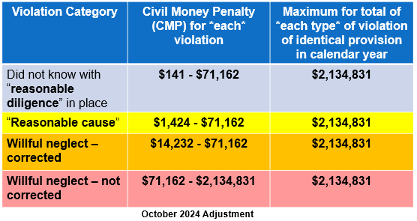
A CMP is a monetary penalty, imposed after an investigation and determination has been made by the HHS OCR, or by any of the U.S. state and territory attorneys general, that at least one HIPAA violation occurred. A CMP is a punitive action against a CE or BA for non-compliance. The amount of the CMP is determined based upon the penalty level/tier shown in the table below, along with the number of individuals impacted, and other associated factors. CMPs can vary significantly based on the severity of the violation. Corrective action plans (CAPs) are also usually required of the BAs and CEs that received CMPs. CMPs must be paid by the violator to which it was applied.
| A resolution agreement is a monetary payment negotiated and agreed upon by the HHS OCR, and the associated CE or BA as part of the overall Resolution Agreement, which is signed by both parties. Resolution agreements are reached before or during an investigation. Resolution agreement amounts can be, and often are, lower than potential CMPs that may have been applied. A resolution agreement includes a corrective action plan (CAP) to help ensure future compliance. | | |
Quick Hits:
Here are five more questions we are answering at a comparatively high level. We provide more in-depth information and associated details about these topics in separate blog posts, videos on our YouTube channel, in infographics and e-books, LinkedIn posts to our business page, and within our online training and awareness courses.
| | |
Q2: How many HIPAA cases have been opened in 2025?
A2:
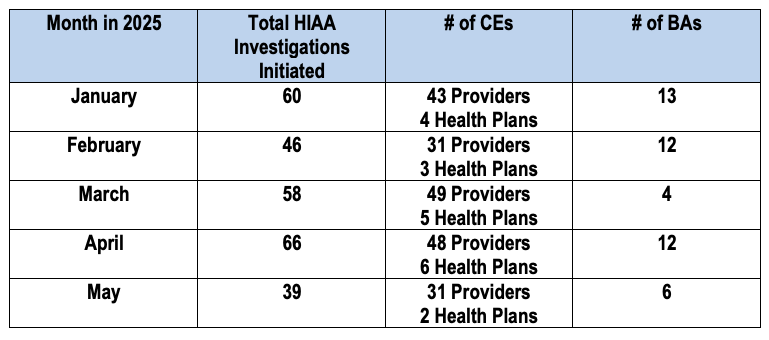
As of June 1, there have been 269 new breach investigations launched by the HHS OCR in 2025. Here are the number of new HIPAA violations and/or breaches investigations that were started per month, and how many were for Healthcare Providers, Health Plans (healthcare insurers), and business associates (BAs).
| There are also an unpublished number of planned audits currently being performed, from the HHS OCR 2024/2025 audit plan. | | |
Q3: Now that it is summer time, it is vacation time! We are planning to provide our employees some security and privacy advice and tools to use while they are on vacation and using their personal tablets, laptops and phones, that they also use for business. What do you recommend as advice and tools?
A3:
We have a couple of documents that contain the information you are looking for! See:
1) Protecting Privacy and Security While Traveling
2) Privacy and Security Gifts
If you have suggestions for some additions to one or both of these, please let us know!
| | |
Q4: I have my own online marketing business. Why are people suing businesses simply for using Meta Pixel? This is BS! It’s just marketing! How is privacy even involved with marketing? This seems like a way for law firms, that don’t care about marketing businesses and their livelihoods, are using legal loopholes to scare businesses away from using my marketing services, or to give them a huge payday by suing us!
A4:
Thank you for this important question! I certainly understand you are concerned, exasperated and angered by what are many privacy invasion lawsuits being filed for using a Meta Pixels. Actually, the wide breadth of online tracking tools created to support targeted marketing apply several other types of technologies as well. And yes, they are impacting privacy in a variety of ways.
I have actually supported several of these types of online tracking technology cases brought by those who experienced privacy violations. And in addition to violations, there are associated unwanted contact from organizations they’d never heard of before. Add to these privacy issues also having law enforcement and government officials using the data collected through online tracking technologies to keep track of locations where their residents had been, and the associated type of organizations they were visiting on specific dates and locations. And many more types of privacy harms.
I anticipate many marketing professionals do not realize the wide range of data that can be collected by such online tracking technologies. Besides the generally known name, address, phone, email address, dates and times, there are many, many more types of data that such online tracking data can be configured to collect to them. For example: the types of devices they are using; the operating system they are using including the version number; the type of browser they are using; the webpages they navigated from to get to the page where the tracking tech is used; the pages where they then went to; comments put into forms on pages; health data in patient portals; videos they watched on a page; photos they clicked on; items they looked at; items they put in their cart; people’s comments they reacted to; how long they stayed on a page; and so much more. There really is no limit to what can be tracked.
Add to this the fact that all these tracked data items can then be shared with other organizations, for them to then use as they wish. This data is widely shared. In one case the organization using tracking tech was sharing data with over 25 other organizations.
All this data collection and sharing, without the informed consent of the associated individuals, can violate many different laws and regulations, such as U.S. state privacy laws, US federal regulations, long-existing regulations, such as the Video Privacy Protection Act (VPPA), and the data protection regulations of Canada, the EU, Singapore, and dozens of other countries throughout the world. Add to this the fact that how online tracking is used often also violates that organization’s own posted website privacy notice, aka privacy policy, and that organization has just violated multiple laws, regulations and their own contracts.
These are not “legal loopholes” that are being violated. They are clearly violations of all those legal requirements.
If organizations want to use online tracking technologies for their marketing activities, then they, and any marketing company they contract to implement such marketing, should be transparent with the website visitors, and clearly let them know what data is being collected from them, how it will be used, and with whom that data will be shared. Don’t use wishy-washing, vague statements like “we share with trusted business partners.” If one of those trusted entities use the data you collected to cause harm resulting from your website visitors being targeted, it is reasonable to expect a lawsuit for using their personal data in ways they did not consent to be used.
| | |
Q5: I own a small business. How should I respond when someone (sometimes a client, sometimes not) notifies us that they received a message from what looks like us, that was asking for personal data to unlock their account? We've just been ignoring them so far.
A5:
Every business needs to follow-up to see exactly what the messages that are impersonating them say, and identify how such messages could not only harm those recipients, but how they could also harm your business with bad publicity, with harmful actions being attributed to your business, and more. Assign someone with the responsibility for establishing a procedure to consistently follow for reacting to such messages, and then also to respond to those who took they time to let your business know that cybercrooks are impersonating your business. At the least a simple “Thank you for letting us know,” would be appropriate.
| | |
Q6: What are some of the privacy risks created when customer data, and personal data scraped from publicly accessible locations, are used to train AI models without the knowledge, let alone consent, of the associated individuals?
A6:
Many regulations, for example PIPA in Canada, and the EU General Data Protection Regulation (GDPR), do not allow personal data to be used for any purposes other than those for which the data was collected, with prior notice provided to the associated individuals, and their consent. Many of the US state comprehensive privacy laws, as worded, arguably do not allow this either. There are some exceptions, such as Germany considering allowing such use.
A decision by Elon Musk to unilaterally start using all X data to train their xAI-owned Grok, which was very recently acquired by Musk’s other business xAI, does not mean that all X users have now retroactively provided their consent to have their data used to train xAI algorithms. I anticipate that if the Irish DPC investigation finds that posted X data is being used to train xAI algorithms that the Irish DPC will likely fine xAI with similar huge fines that they’ve applied to Microsoft, Meta, and others, for other types of GDPR violations.
These situations highlight an important privacy point for all organizations, and for the general public whose personal data is being targeted for use to train AI: Just because people have posted their personal data publicly on social media does not mean any Tom, Dick, Harry…or Tech Bro…can use it for their own purposes without obtaining consent from each individual first.
This applies to many other regulations as well, such as HIPAA. For example, Elite Dental Practice had to pay a HIPAA noncompliance fine in 2019 for responding to a bad review from a patient on Yelp, and in doing so they included the patient’s PHI in their reply comment. No business should ever use personal data scraped from publicly available online locations and use for AI training, or other purposes, without first obtaining consent. If they do, they may very well find themselves fined by regulators, and also being sued by individuals, or hundreds of thousands of individuals in a class action lawsuit.
Here are a few privacy risks created when personal data is being scraped and used to train AI tools without their consent.
- AI tools, and the systems that support them including the data used to train them, are incredibly attractive targets to cybercriminals. All that training data, containing copious amounts of personal data, including very sensitive data such as health data, the majority of which is turning out to have been used without consent, is now being breached by those crooks and used for identity theft, medical identity theft, and more.
- Generative AI models can, and have, resulted in those AI outputs containing sensitive personal information of real people.
- Many/most AI tools produce highly biased results. Using biased, unrepresentative, or irrelevant personal data for training AI models can then result in making discriminatory or unfair decisions those for whom they are used. For example, facial recognition algorithms trained on biased datasets may incorrectly identify individuals of certain races, genders, ages, religions, and even medical conditions. This means that using the resulting biased decisions could result in harm to those for which they are being used. Training data for such purposes needs to be applicable to the associated contexts of use, and those whose data is used need to provide consent, to keep from possibly being sucked into any legal situations related to bias harms.
If any readers have more risks to suggest, or real-life experiences in how they’ve been harmed, please let us know.
| | |
We just published our brand new online learning course, HIPAA Basics for Business Associates. Our clients are telling us our courses contain more valuable information, real-life use cases and examples, and supplemental materials that they continue to use to support their business after training, than any of the other HIPAA security and privacy courses they have seen or used. Check it out! We have 3-4 we will be publishing this month and next as well.
What topics would you like to see us create videos, and more formal online courses, for? Let us know!
Have questions about our education offerings? Contact us!
| | Where to Find The Privacy Professor | | |
Permission to Share
If you would like to share, please forward the Tips message in its entirety. You can share excerpts as well, with the following attribution:
Source: Rebecca Herold. June 2025 Privacy Professor Tips
www.privacysecuritybrainiacs.com.
NOTE: Permission for excerpts does not extend to images.
Privacy Notice & Communication Information
You are receiving this Privacy Professor Tips message as a result of:
1) subscribing through PrivacyGuidance.com or PrivacySecurityBrainiacs.com or
2) making a request directly to Rebecca Herold or
3) connecting with Rebecca Herold on LinkedIn.
When LinkedIn users invite Rebecca Herold to connect with them, she sends a direct message when accepting their invitation. That message states that in the spirit of networking and in support of the communications that are encouraged by LinkedIn, she will send those asking her to link with them her monthly Tips messages. If they do not want to receive the Tips messages, the new LinkedIn connections are invited to let Rebecca know by responding to that LinkedIn message or contacting her at rebeccaherold@rebeccaherold.com.
If you wish to unsubscribe, just click the SafeUnsubscribe link below.
| | | | |