|
There's something magical about June. The sun doesn't just shine—it lingers, stretching the days longer and filling everything with light. I don't know if it's the extra daylight, the energy of summer fully arriving, or simply the feeling that anything is possible, but June always brings me a sense of clarity I don't experience any other time of year.
Ideas that felt murky in March suddenly come into focus. Decisions that seemed impossible in the depths of winter feel surprisingly clear. It's as if the light outside creates light inside too, illuminating paths forward I couldn't quite see before. I've been thinking about how much our clients need this kind of clarity.
So often, the people who come to us are living in fog. They're overwhelmed by conflicting medical opinions, buried under paperwork they don't understand, and exhausted by a system that seems designed to confuse rather than help. They can't see a clear path forward because there's just too much noise, too much complexity, too much fear clouding their vision. And what strikes me most is that, as patient advocates, we have the profound privilege of bringing clarity to that fog.
We do this in so many ways. We translate medical jargon into plain language that someone can actually understand. We organize scattered information into a coherent picture. We help people identify what truly matters most to them when everything feels urgent. We cut through bureaucratic confusion to find the actual next step. We ask the clarifying questions that no one else thinks to ask.
Yet clarity isn't just about information, it's about perspective too. Sometimes the most powerful thing we can offer is helping someone see their situation differently. Reminding them of their own strength when they've forgotten it. Showing them options they didn't know existed. Helping them separate what they can control from what they can't. Creating space for them to hear their own inner wisdom beneath all the external noise.
This month, as the days stretch long and bright, I want to encourage you to lean into the clarity that June brings. Use this energy to:
Get clear on your own goals. What do you want to accomplish in your advocacy work? What's been nagging at you that needs attention? Let the light in and see what becomes visible.
Bring clarity to your clients. Ask yourself: what's the one thing that would help this person see their path more clearly? Sometimes it's information. Sometimes it's an organization. Sometimes it's just sitting with them and helping them articulate what they actually want.
Simplify something complicated. Pick one process, one explanation, one resource that's more confusing than it needs to be. and make it clearer. Your future clients will thank you.
Clarity is a gift. In a world that profits from confusion and thrives on complexity, helping someone see clearly is a radical act of compassion.
May this bright, beautiful month bring you the clarity you need, and may you share that gift generously with everyone you serve.
With light and purpose,
Malynnda Stewart
Board Chair, HealthAdvocateX
P.S. What's become clearer for you lately? I'd love to hear what insights this season is bringing you, whether in your work or your life. Sometimes sharing what we're seeing helps others see more clearly, too.
| |
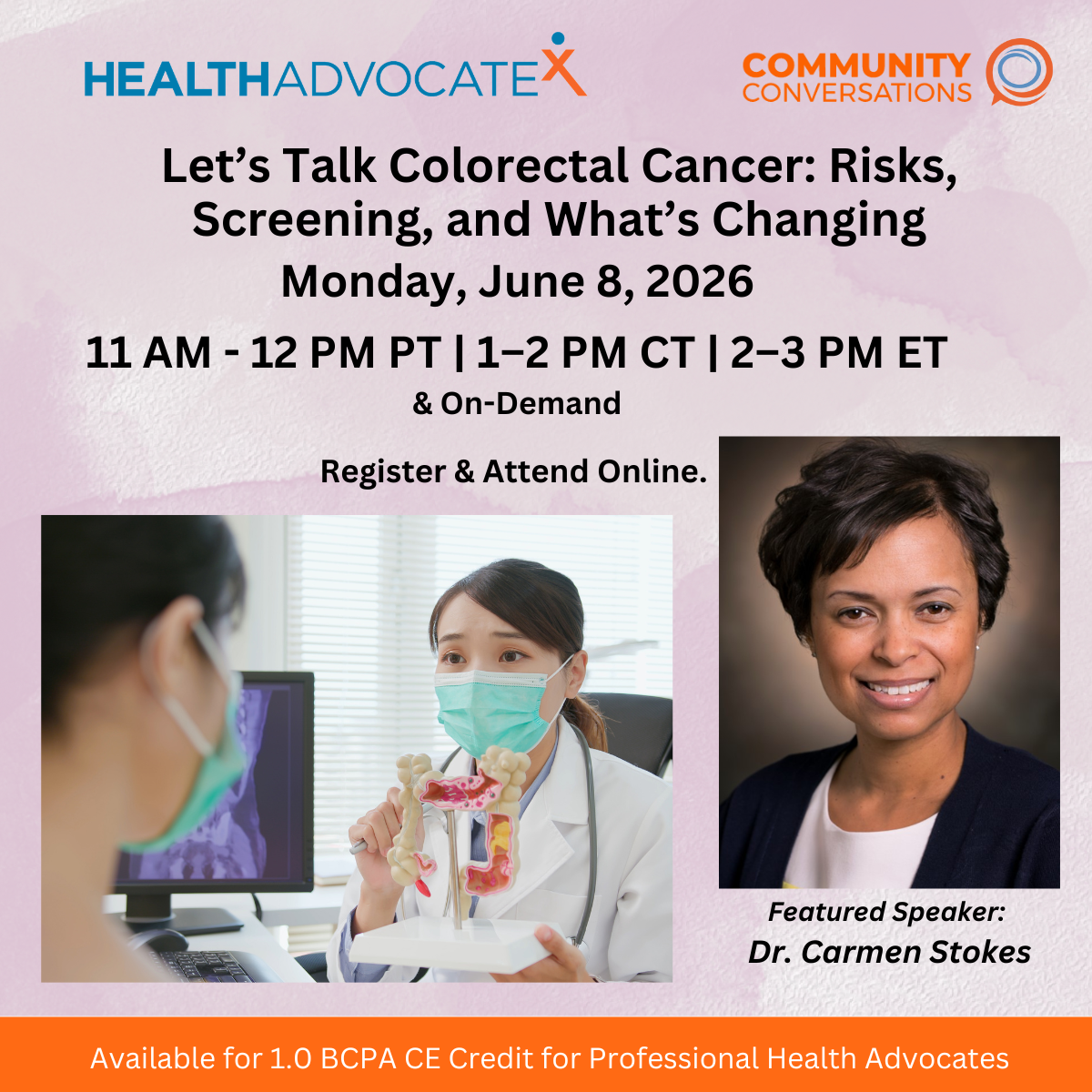
June 8 Community Conversation - Let’s Talk Colorectal Cancer: Risks, Screening, and What’s Changing
REGISTER HERE
When: Jun 08, 2026 | 11 AM–12 PM Pacific Time | 1–2 PM Central | 2–3 PM Eastern
Where: Online via Zoom
Cost: Free to the general public. Purchase 1.0 CE Credit for $10 for HealthAdvocateX Members; $30 for Non-Members.
Join us for an engaging and interactive community conversation focused on colorectal cancer and its growing impact on individuals and families—particularly the concerning rise in diagnoses among younger adults. Topics will include modifiable and non‑modifiable risk factors, the range of colorectal cancer screening options, and why early detection matters. We will also explore persistent disparities in colorectal cancer outcomes and how access, awareness, and structural inequities affect prevention and screening—especially in under‑resourced communities.
Learning Objectives:
- Describe current trends in colorectal cancer, including the rise in cases among younger adults, and identify both modifiable (e.g., lifestyle-related) and non‑modifiable risk factors.
- Recognize and compare colorectal cancer screening options, including who should be screened, when screening should start, and how different methods support early detection.
- Understand disparities in colorectal cancer prevention and outcomes, and discuss ways community education, advocacy, and systems-level changes can help advance health equity.
About The Speaker –
Dr. Carmen Stokes has been a Registered Nurse for almost 32 years, and a certified Family Nurse Practitioner for 26 years. Dr. Stokes currently works as a Navigator for the Gavini Center for Cancer Prevention, with an emphasis on cancer prevention and the prevention of cancer recurrence. Her personal experience with cancer: close family & friends, developed her awareness of both the fear that can arise with a cancer diagnosis, but also the POWER that comes from developing community and understanding that can be achieved through navigation and support.
| |
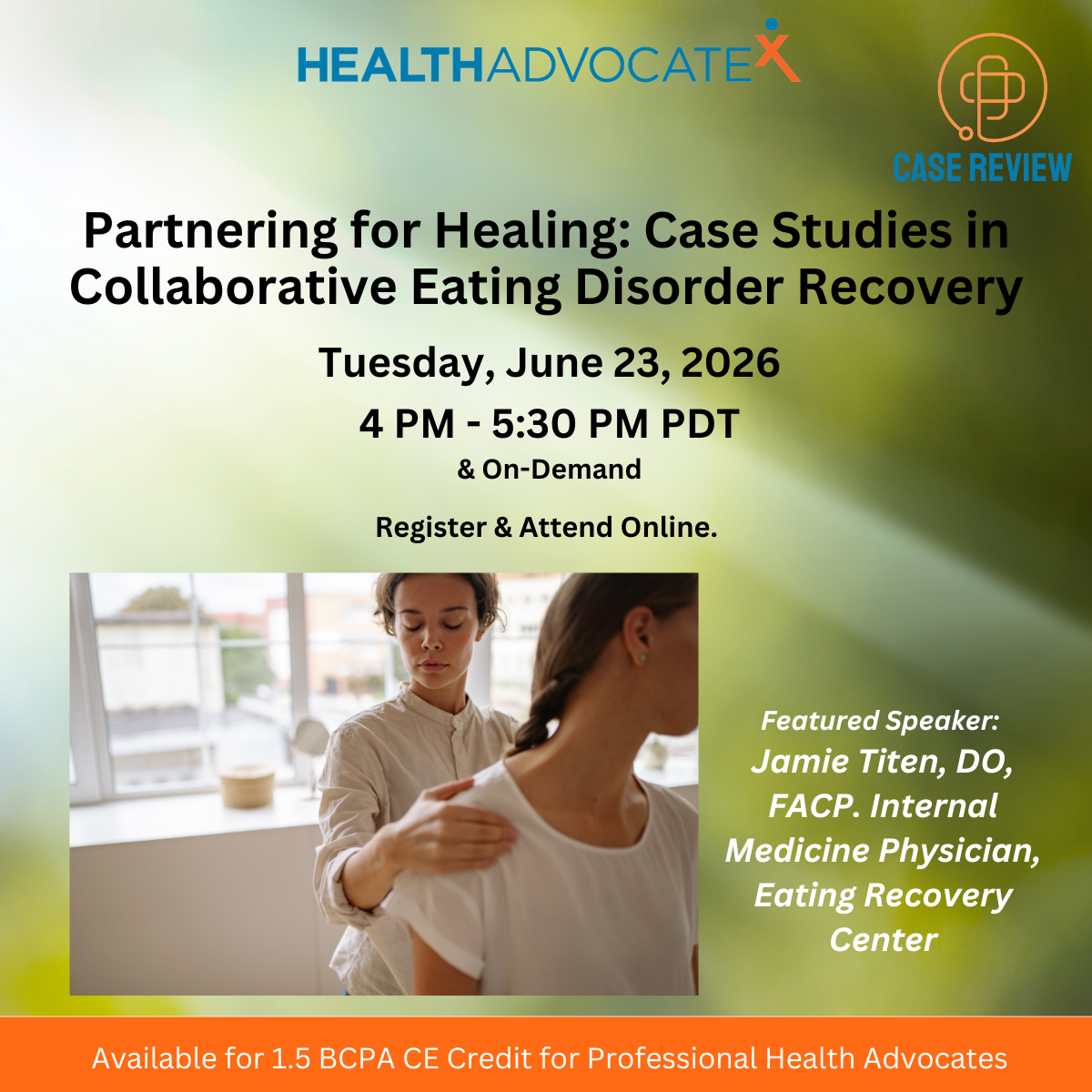
June 23 Case Review - Partnering for Healing: Case Studies in Collaborative Eating Disorder Recovery
REGISTER HERE
When: Jun 23, 2026 | 4–5:30 PM Pacific Time | 6–7:30 PM Central | 7–8:30 PM Eastern
Where: Online via Zoom
Cost: FREE to HealthAdvocateX Professional Members to attend. $15 for HealthAdvocateX Professional Members earning CE Credit; $40 for Professional Non-Members earning credit
Dr. Titen will discuss the complexities of aiding those who are struggling with eating disorders. Dr. Titen plans to expand on the pathology of eating disorders, outline how treatment works, and briefly discuss the different levels of care. Through the discussion of two challenging cases, we will explore how a patient advocate can best support and advocate for a patient struggling with a difficult psychiatric disease.
Learning Objectives:
- Understanding the etiology of eating disorders
- Navigating the multidisciplinary team and how to support the patient maintaining that team
- Understanding how a patient advocate would best help a patient struggling with an eating disorder
About The Speaker –
Jamie Titen, DO, FACP. Internal Medicine Physician, Eating Recovery Center, Denver, CO
Dr. Jamie Titen is a internal medicine physician whose career has been defined by a deep commitment to complex patient care. Originally from Florida, she moved to Chicago for her medical training at NorthShore University Health Systems. Her professional journey eventually led her through the mountain landscapes of Utah before she settled in Colorado with her family, where she currently specializes in the highly nuanced field of eating disorder recovery. Outside of her clinical practice, Jamie is a proponent of a well balanced, grounded lifestyle. She loves traveling and exploring new destinations with her family. When she isn’t practicing yoga, she can usually be found in her kitchen trying a new recipe or unashamedly unwinding with a marathon of truly terrible reality television. She believes that a life well-lived requires both profound professional purpose, the simple joy of a good laugh and being kind to others.
| | IN CASE YOU MISSED IT – FABULOUS CONTENT STILL AVAILABLE THROUGH OUR ON-DEMAND/ CLASSROOM | |
Skills Lab: Decoding the Bill: A Hands-On Skills Lab for Catching Errors, Appealing Denials, and Knowing Who to Call
ACCESS HERE
Medical bills and insurance denials are where patients lose the most money, and where advocates can make the biggest difference. This 90-minute interactive skills lab gives patient advocates practical, immediately usable tools for reviewing itemized bills line by line, spotting the errors that most commonly inflate charges, and building appeals that actually get overturned. Participants will work through real-world billing scenarios, learn which hospital and payer personnel to escalate to (and in what order), and leave with a repeatable workflow they can apply on behalf of their clients and communities starting the next day.
Learning Objectives:
1. Identify the most common billing errors on itemized hospital statements, including duplicate charges, upcoding, unbundling, charges for canceled services, and room/level-of-care discrepancies.
2. Request and interpret an itemized bill (UB-04 / HCFA-1500) and cross-reference charges against the EOB, medical record, and CPT/HCPCS codes to flag discrepancies.
3. Draft a structured appeal letter that includes the key elements payers and hospital billing departments look for: medical necessity documentation, supporting codes, contract/policy references, and a clear requested remedy.
4. Map the escalation path for billing disputes, identifying the right internal contacts (patient financial services, billing supervisors, patient advocates, compliance officers, CFO office) and external avenues (state insurance commissioner, hospital nonprofit compliance, No Surprises Act helpline) to use when initial outreach stalls.
5. Apply a repeatable bill-review and appeals workflow to their own advocacy practice, using templates and checklists provided during the session.
| | |
Explore Our Online Classroom
Did you miss one of our past events? Our online classroom is always open! Browse all courses available purchase with BCPA CE credit.
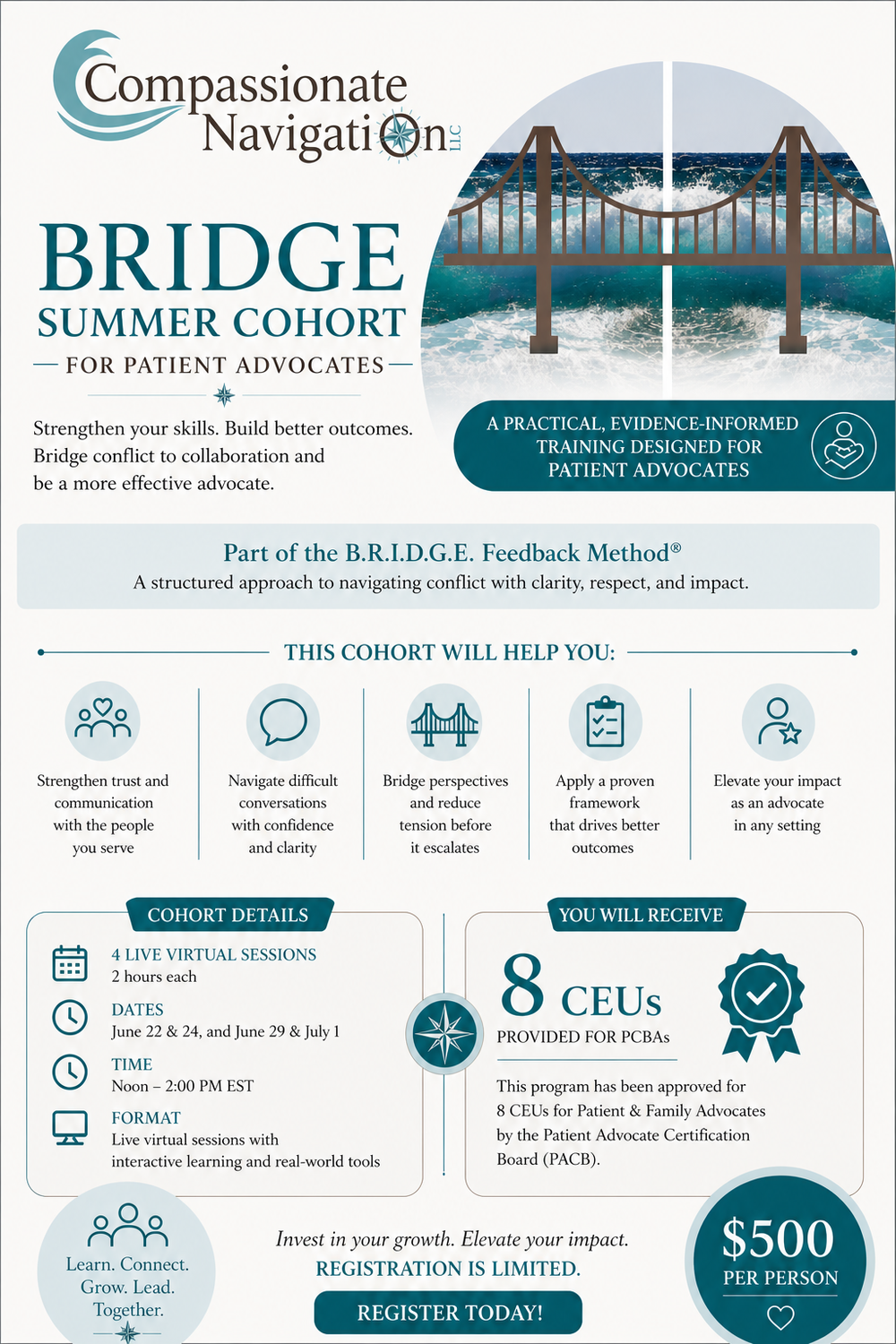
| | 8 CEUs Feedback Method Training Cohort | | |
Transform the way you navigate difficult conversations with Compassionate Navigation’s upcoming BRIDGE Feedback Method training.
The BRIDGE Framework is a neuroscience-informed communication method built on decades of research in psychological safety, interpersonal neurobiology, conflict resolution, and organizational communication.
This training offers a practical framework for giving feedback with clarity, compassion, and confidence. Participants will explore strategies that support trust, collaboration, and more effective communication in professional relationships and team environments.
Whether you are leading a team, supporting colleagues, teaching students, or working directly with clients or patients, the BRIDGE Method provides tools that can be applied immediately in real-world conversations.
| | Inclusion, Diversity, Equity and Access (IDEA) Statement | | |
OUR COMMITMENT
Approved by the Board September 21, 2022
Inclusion, Diversity, Equity and Access (IDEA) Statement
Our mission is to help people transform into active participants and partners in their own health care. To make this possible, we must advocate for inclusion, diversity, equity, and access (IDEA) for all individuals.
We recognize that:
- Racism is a public health issue that impacts various intersections and communities differently.
- Each person is unique and therefore experiences health care differently.
- Every individual deserves health advocacy regardless of their race, ethnicity, language, nationality, gender, sexual orientation, gender identity and expression, spiritual practice, financial status, education, geography, disability, mental and physical status, age, weight, substance use disorder or other factors.
- Our organization is uniquely positioned to raise awareness on IDEA in health and health care.
We are committed to:
- Raising awareness about the importance of IDEA in health and health advocacy in all aspects of care.
- Expanding diverse representation within our organization, expert presenters, and educational offerings.
- Intentionally messaging our values, sharing IDEA expectations for ourselves, affiliated advocates, and partnering groups.
- Creating space for respectful dialogue about representation, equitable access, and inclusive practices in health care and health advocacy.
- Educating our community and participating in opportunities about IDEA events and exercises to keep these issues in the forefront of our work.
- Implementing systems to ensure IDEA is pervasive in our organization.
We will reflect on our accomplishments with humility and grace. We will recognize our limitations and remain open to what we may not see or realize so that we can improve and or repair any harm.
| | |
HealthAdvocateX is headquartered in Seattle, Washington. We acknowledge that we are on the traditional land of the first people of Seattle, the Duwamish, Suquamish, Stillaguamish, and Muckleshoot People past and present, and honor with gratitude the land itself and each tribe. We invite you to join us in acknowledging and thanking indigenous people for their ongoing stewardship wherever you are located.
| |
Do you have something you would like to share with the HealthAdvocateX community?
| | | | |