Juneteenth is an American holiday that commemorates the June 19, 1865 announcement of the abolition of slavery in the state of Texas, and more generally the emancipation of enslaved African Americans throughout the former Confederate States of America. Its name is a blending of the words "June" and "nineteenth," the date of its celebration.
Juneteenth is recognized as a state holiday or special day of observance in forty-seven states and the District of Columbia.
Today it is observed primarily in local celebrations. Traditions include public readings of the Emancipation Proclamation, singing traditional songs such as "Swing Low, Sweet Chariot" and "Lift Every Voice and Sing," and reading of works by noted African American writers such as Ralph Ellison and Maya Angelou.
Celebrations include street fairs, cookouts, family reunions, park parties, historical reenactments, or rodeos. The Mascogos, descendants of Black Seminoles, of Coahuila, Mexico also celebrate Juneteenth.
During the Civil War, President Abraham Lincoln issued the Emancipation Proclamation on September 22, 1862, with an effective date of January 1, 1863. It declared that all enslaved persons in the Confederate States of America in rebellion and not in Union hands were to be freed. This excluded the five states known later as "border states," which were the four "slave states" not in rebellion - Kentucky, Maryland, Delaware, and Missouri - and those counties of Virginia soon to form the state of West Virginia.
Slavery in the United States did not officially end until the ratification of the 13th amendment to the Constitution on December 6, 1865, which abolished slavery entirely in the United States and territories.
More isolated geographically, Texas was not a battleground state. Planters and other slaveholders had migrated into Texas from eastern states to escape the fighting, and many brought enslaved people with them, increasing by the thousands the enslaved population in the state at the end of the Civil War. Although most enslaved people lived in rural areas, more than 1000 resided, by 1860, in both Galveston and Houston, with several hundred in other large towns. By 1865, there were an estimated 250,000 enslaved people residing in Texas.
Confederate General Robert E. Lee surrendered on April 9, 1865 but news of this did not reach Texas until later in the month. The western Army of the Trans-Mississippi did not surrender until June 2nd. On June 18th, Union Army General Gordon Granger arrived at Galveston Island with 2,000 federal troops to occupy Texas on behalf of the federal government. The following day, standing on the balcony of Galveston's Ashton Villa, Granger read aloud the contents of "General Order No. 3" announcing the total emancipation of those held as slaves:
The people of Texas are informed that, in accordance with a proclamation from the Executive of the United States, all slaves are free. This involves an absolute equality of personal rights and rights of property between former masters and slaves, and the connection heretofore existing between them becomes that between employer and hired labor. The freedmen are advised to remain quietly at their present homes and work for wages. They are informed that they will not be allowed to collect at military posts and that they will not be supported in idleness either there or elsewhere.
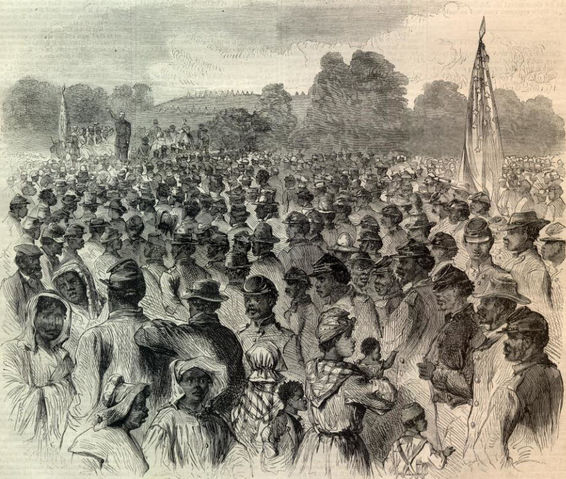
Formerly enslaved people in Galveston rejoiced in the streets after the announcement. The following year, freed people in Texas organized the first of what became the annual celebration of "Jubilee Day" on June 19th.
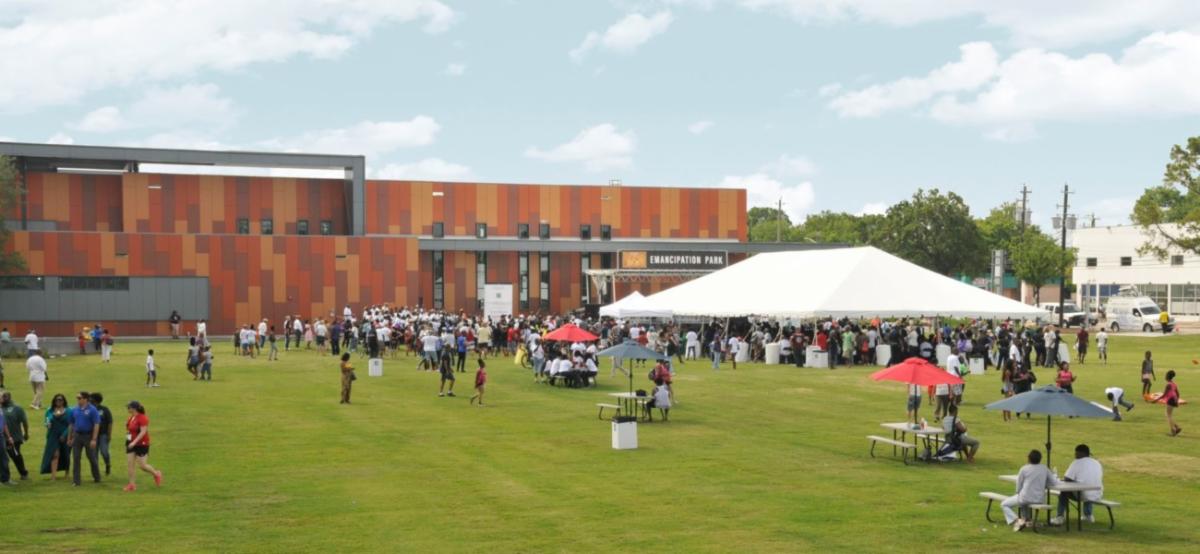
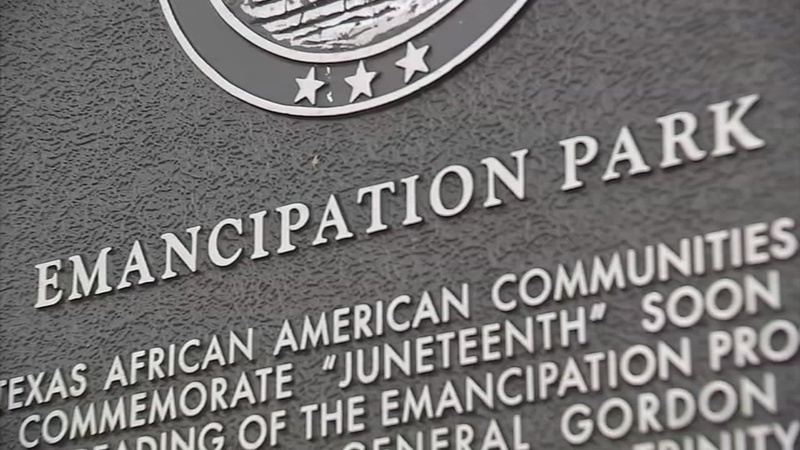
In some cities African Americans were barred from using public parks because of state-sponsored segregation of facilities. Across parts of Texas, freed people pooled their funds to purchase land to hold their celebrations, such as Houston's Emancipation Park, Mexia's Booker T. Washington Park, and Emancipation Park in Austin.
Emancipation Park,
Houston
In the early 20th century, economic and political forces led to a decline in Juneteenth celebrations. From 1890 to 1908 Texas and all former Confederate states passed new constitutions or amendments that effectively dis-enfranchised black people, excluding them from the political process.
White-dominated state legislatures passed Jim Crow laws imposing second-class status. The Great Depression forced many black people off farms and into the cities to find work. In these urban environments, African Americans had difficulty taking the day off to celebrate.
The Second Great Migration began during World War II, when many black people migrated to the West Coast where skilled jobs in the defense industry were opening up. From 1940 through 1970, in the second wave of the Great Migration, more than 5 million black people left Texas, Louisiana and other parts of the South for the North and West Coast. As historian Isabel Wilkerson writes, "the people from Texas took Juneteenth Day to Los Angeles, Oakland, Seattle, and other places they went."
(From Wikipedia, edited)