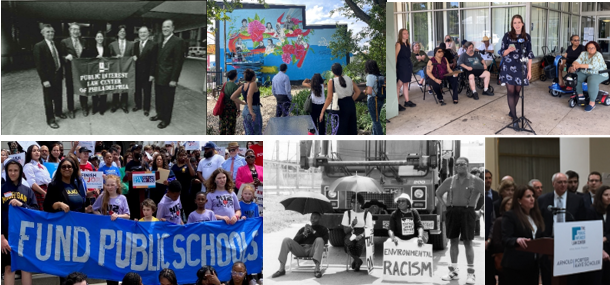
As 2024 wraps up, we’re taking time to reflect on all the past year brought. This year, we’ve secured victories, faced challenges, and made inroads for equity. We did it with the support of people like you. As we gear up for what is sure to be a busy 2025, we know that we can count on our community to help us take on whatever obstacles arise on our collective path to justice. | |
Thank you for your support on Giving Tuesday! | |
|
Thank you for standing with the Public Interest Law Center this Giving Tuesday! Your generosity fuels our mission to advance justice and equity for communities that need it most.
With your support, we can continue to fight for fair education funding, protect voting rights, and advocate for housing, health, and environmental justice. Every contribution strengthens our ability to take on powerful interests and ensure that everyone’s voice is heard.
We are inspired by your commitment to progress justice and grateful for your trust in our work. Together, we are making a lasting impact.
Thank you for being part of our community.
| |
A Victory for Tenants of Columbus Property Management | |
|
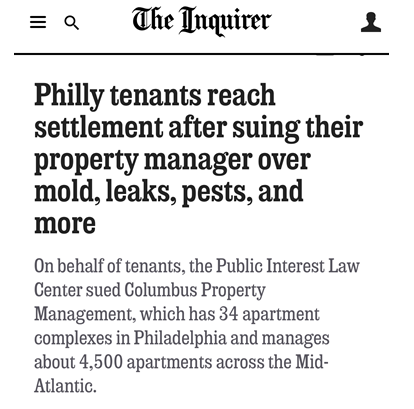
In June, the Law Center filed a lawsuit on behalf of nine tenants from three of the 34 apartment complexes owned by Columbus Property Management in Philadelphia, a publicly subsidized nonprofit tasked with providing housing for low-income tenants and tenants with disabilities. The plaintiffs sued their landlord after reports of health and safety hazards such as security failures, leaks that turned to mold, rampant pest infestations, useless appliances, and other serious habitability issues that went unaddressed for months and years.
We have now secured a favorable settlement our clients: Columbus began making improvements immediately, a third party was contracted to monitor and ensure it keeps its commitments, Columbus will create and enforce a comprehensive plan to improve the management across all of its properties, and the tenants can take Columbus back to court if it doesn’t comply.
“Columbus is doing what is right — making serious, enforceable commitments to comply with the letter and spirit of federal, state, and local housing laws, so that right is made real for their tenants,” said Dan Urevick-Ackelsberg, senior attorney at the Law Center. “Philadelphia renters have the right to safe, healthy, and decent housing, period.”
| |
Decision in Crawford v. Commonwealth | |
|
In Crawford et al. v. Commonwealth of Pennsylvania et al., the Law Center filed suit on behalf of family members of victims of gun violence, CeaseFirePA, and the City of Philadelphia, arguing that state preemption laws preventing municipalities from addressing the gun violence epidemic through local initiatives are unconstitutional. We sought to limit the constraints of two state statutory provisions that restrict municipalities from regulating firearms, ammunition, or their transfer.
In its opinion, the Court acknowledged the unacceptable state of gun violence and the tragic ways it has impacted many Pennsylvania residents. But the Court ultimately rejected our constitutionality challenge to the preemption laws that blocks cities like Philadelphia and Pittsburgh from enforcing local, sensible gun safety laws that would save lives.
The outcome is frustrating, and it’s disappointing we were not able to get a better result for our clients, their loved ones, and the many residents whose lives have been destroyed by the epidemic of gun violence. At the same time, the request for the Pennsylvania Supreme Court to hear City of Philadelphia v. Armstrong remains pending. In that case, the Law Center intervened on behalf of mothers who have lost sons to gun violence as well as several organizational clients to defend Philadelphia’s enforcement of its ordinance requiring firearm owners to report the loss or theft of a firearm to the police. Unlike Crawford, the Armstrong litigation involves interpretation of the text of the preemption statute, not its constitutionality.
We remain committed to advancing the critical issues highlighted by this lawsuit and urge the Pennsylvania state legislature to enact common-sense gun safety laws, such as Permit to Purchase, that have the proven potential to save many lives.
| |
Protecting Pennsylvanians' Right to Vote | |
|
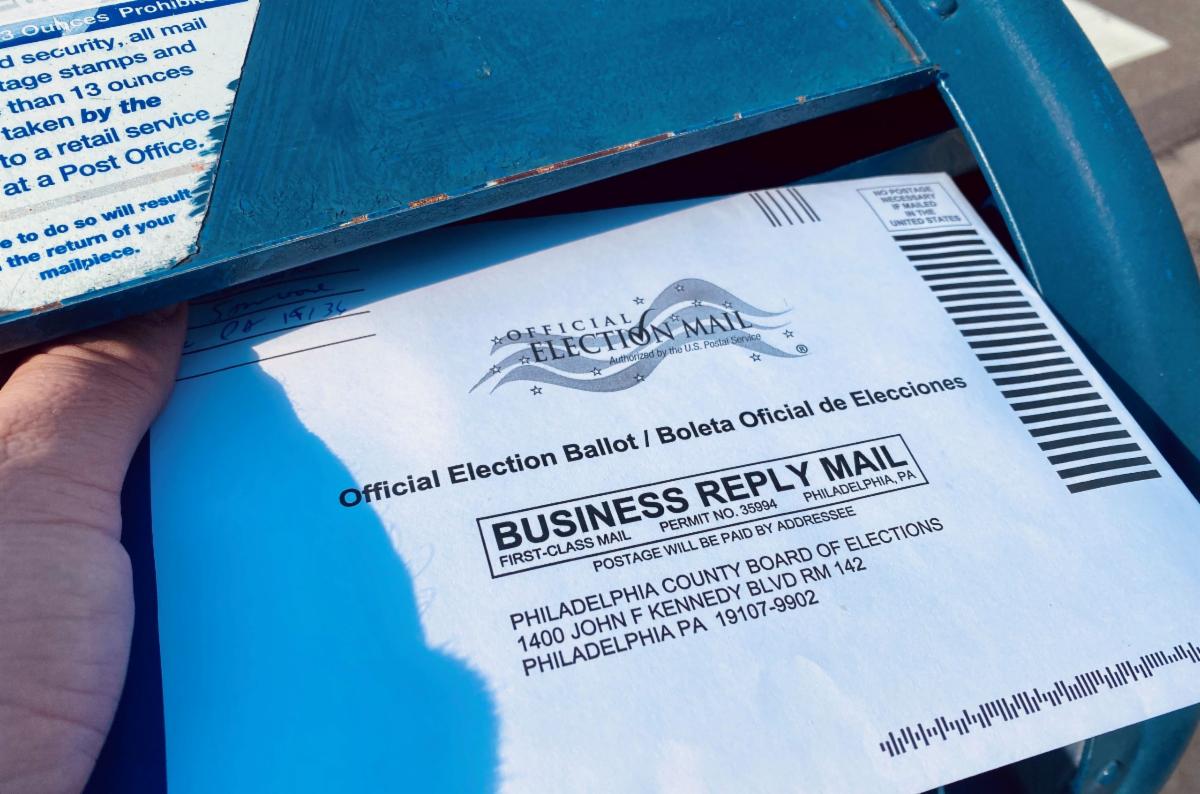
Every election, the Law Center closely monitors the legal issues that arise across the state on and around Election Day, including voter registration issues, long lines, provisional ballot challenges, and eligibility challenges to voters. Nearly one-third of Pennsylvania voters use mail-in ballots, and it’s important to protect these voters from having their ballots rejected over simple errors such as forgetting to date their envelope. In Baxter v. Philadelphia County Board of Elections, a case arising out of a special election in Philadelphia, we are continuing to litigate whether rejecting ballots due to irrelevant envelope-dating requirements violates the Pennsylvania Constitution. The Commonwealth Court ruled in favor of voters, holding that under the Pennsylvania Constitution’s Free and Equal Elections Clause, a mail ballot cannot be disqualified merely because the voter failed to date or wrote an incorrect date on the mail-in ballot declaration envelope. Our opponents have now petitioned the Pennsylvania Supreme Court to hear the case on appeal, and we are awaiting the Court’s decision.
And in November, the Law Center, along with our co-counsel at the ACLU of Pennsylvania and Arnold & Porter, intervened in litigation to protect the rights of Pennsylvanians living abroad to cast a ballot in federal elections. We represented five overseas voters from Lawrence County whose mail-in ballots were challenged. This resulted in a ruling from the Court of Common Pleas upholding their right to vote under the Uniformed and Overseas Civilian Absentee Voting Act.
| |
Transforming Urban Gardening Through Improving the Philadelphia Land Bank | |
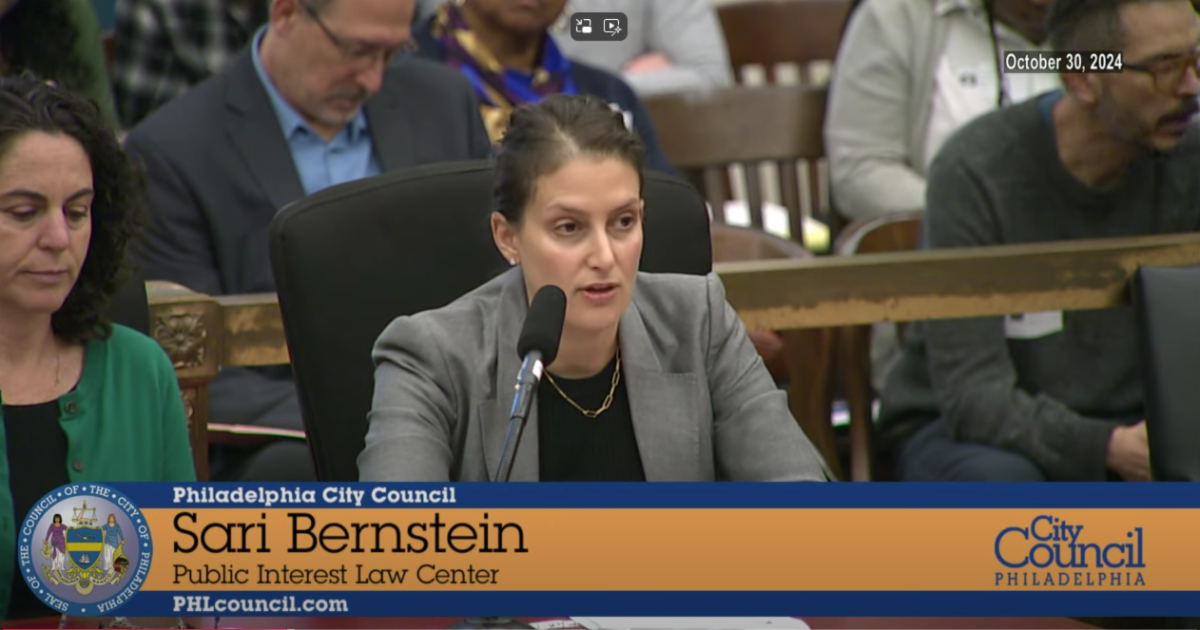
On October 30, Sari Bernstein, staff attorney at the Law Center, testified to the Philadelphia City Council Committees on Housing, Neighborhood Development, Public Property, and Public Works to address the Philadelphia Land Bank’s role in preserving green spaces in the city.
There are more than 40,000 vacant lots in Philadelphia. Most of them are neglected, often owned by the City or a private entity that has abandoned it. Philadelphians have been gardening on some of these lots for generations. There are more than 450 gardens on over 900 parcels, but scores of gardens are in jeopardy because gardeners do not have land security, which is when a garden’s parcels are owned by the gardeners or a trusted third party.
Neighborhoods with community gardens are happier and safer. Gardens help reduce gun violence and mitigate climate-related environmental hazards such as stormwater flooding and the urban heat island effect. Urban gardeners are essential members of their communities.
The Law Center, as part of our Garden Justice Legal Initiative, provides legal and policy support to these gardeners. A decade ago, we advocated for the creation of the Philadelphia Land Bank – intended to be a transparent system through which the city can manage the thousands of vacant properties and facilitate a range of community-led development and uses. Unfortunately, the agency has yet to reach its full potential.
“The City asks everything of the stewards who tend to abandoned land and transform it into green resources for their neighbors -- sometimes for decades -- in the communities needing the most support, and then fails to offer clear guidance to permanently protect the community assets they foster,” said Bernstein. “But the status quo need not continue. A prosperous Philadelphia depends on the Land Bank meeting its mandate to return abandoned land to productive use.”
The Law Center and other community garden advocates used the hearing to encourage the City to improve the Land Bank through revisiting their acquisition and disposition policies, improving their application and reporting processes, and by creating more opportunities for public input.
Read our full testimony here.
| |
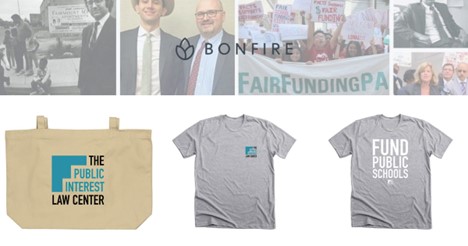
Show Your Support in Style! | |
The official registration and financial information of the Public Interest Law Center may be obtained from the Pennsylvania Department of State by calling toll-free, within Pennsylvania, 1-800-732-0999. Registration does not imply endorsement. | | | | |