|
In this tense and consequential final sprint, voters’ support for safe and effective criminal justice reform is stronger than ever. Voters want to hear more from candidates on these commonsense and much-needed approaches and, luckily, there’s lots to say. | |
Friends,
If, like me, you are somehow energized and exhausted and anxious all at once, then my hope today is to offer some tangible, low risk/high reward tips to connect with voters on safety and justice. We’re all reading a lot of takes on whose support is winnable and how to win it. I am not here to convince you that criminal justice reform is a top five election issue. Criminal justice reform isn’t dominating the airwaves and we aren’t suggesting that needs to get changed today. Rather, in an election that will be determined by a small number of votes in a handful of battleground states, these final arguments really matter and polling shows that engaging in the right way on criminal justice reform can help tip the scales.
Save the scare tactics for the trick-or-treaters
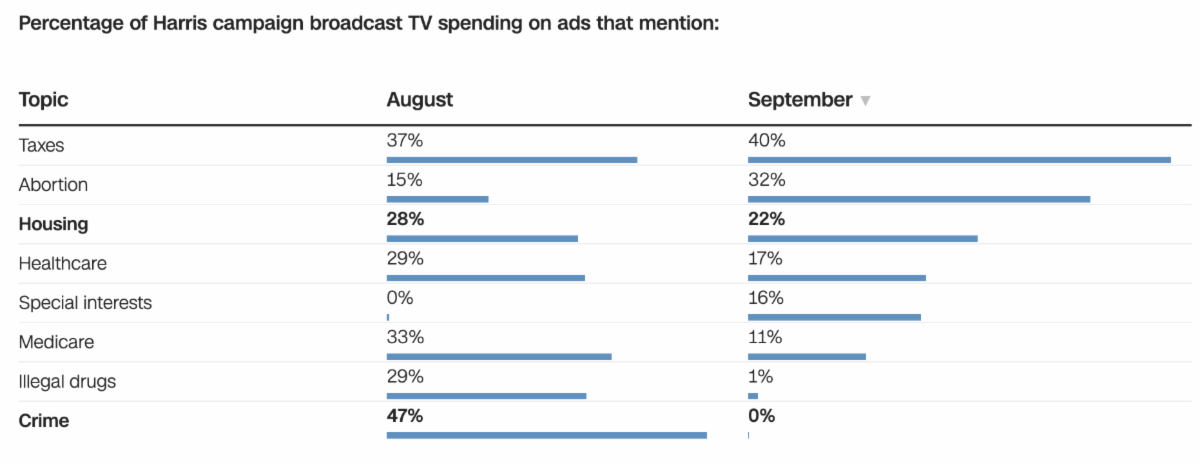
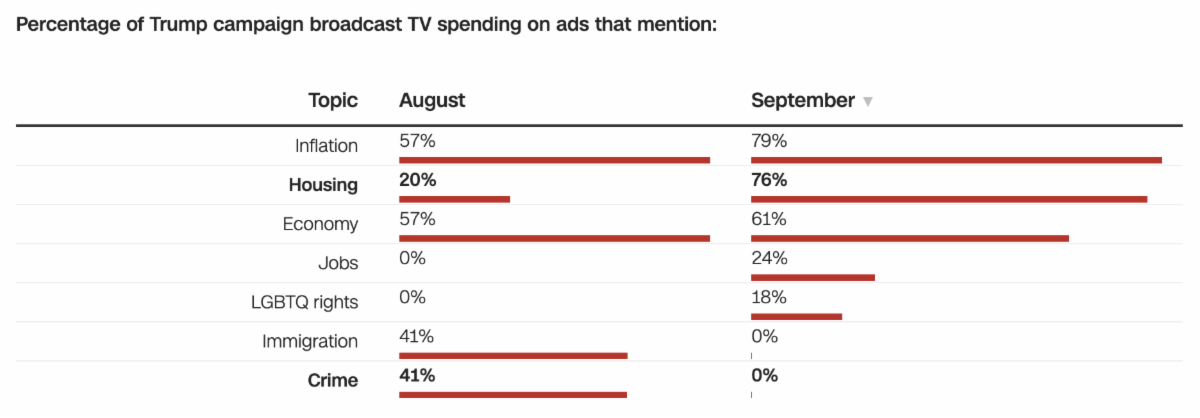
I was struck by this CNN article showing that the Harris and Trump campaigns have dramatically lowered the volume on crime in their paid ads in the final months leading up to election day. The graphs below show a steep decrease in the amount that both campaigns are emphasizing crime in this critical time (lower spending continued in October). Poll after poll shows that voters want real solutions for advancing safety, not scare tactics. Maybe these ad shifts are a coincidence but I hope not because this trend makes for a welcome change.
|  |  |
New poll alert
Not to bury my own lede, but FWD just released a new poll. We wanted to take another look under the hood after the debates and as voting begins and political temperatures and advertising reaches an all-time high. We asked a lot of the same questions we’ve been asking for years. And some new ones. We oversampled Black and Latino voters and we ran four additional polls in the battleground states of Georgia, Pennsylvania, Arizona, and Michigan.
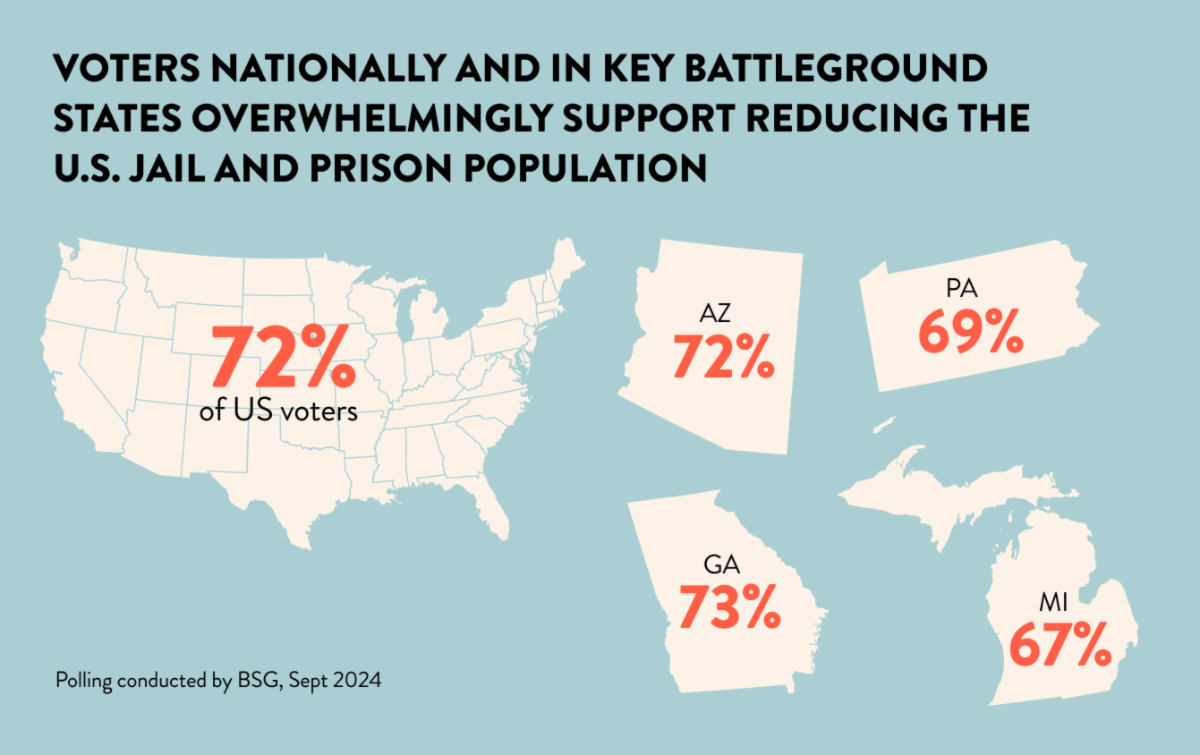
Get this: The share of likely voters who say it is important to reduce the jail and prison population in the United States is higher today (72%) than in February 2024 (65%) or October 2022 (70%). An even higher share of Black (80%) and Latino voters (74%) believe it is important to reduce incarceration. Similar shares of voters in battleground states also believe it is important to reduce the jail and prison population in the U.S.
|  | |
Moreover, candidates have a real opportunity to strengthen their position with voters–all voters, and particularly with Black and Latino voters – by taking a strong position on criminal justice reform. Sixty-two percent of voters who are likely to vote for Harris or are leaning towards her say they would be more likely to vote for her if she took a strong position in support of criminal justice reform, including 67% of Black voters and 63% of Latino voters. For Donald Trump, 47% of his likely voters and leaners say they would be more likely to vote for him if he took a strong supportive position, and that number jumps to 62% for Black voters and 51% of Latino voters.
Voters are also clearer than ever that mass incarceration does not solve our social problems. In a year when a Trump-designed Supreme Court gave broad permission to criminalize and incarcerate people who are unhoused, it is notable that more people than ever believe that mass incarceration creates these social problems rather than solves them. And it follows that nearly three-fourths of likely voters believe that the best way to keep our communities safe is to invest in prevention and increase funding for programs such as affordable housing, job training, and drug and mental health treatment.
| 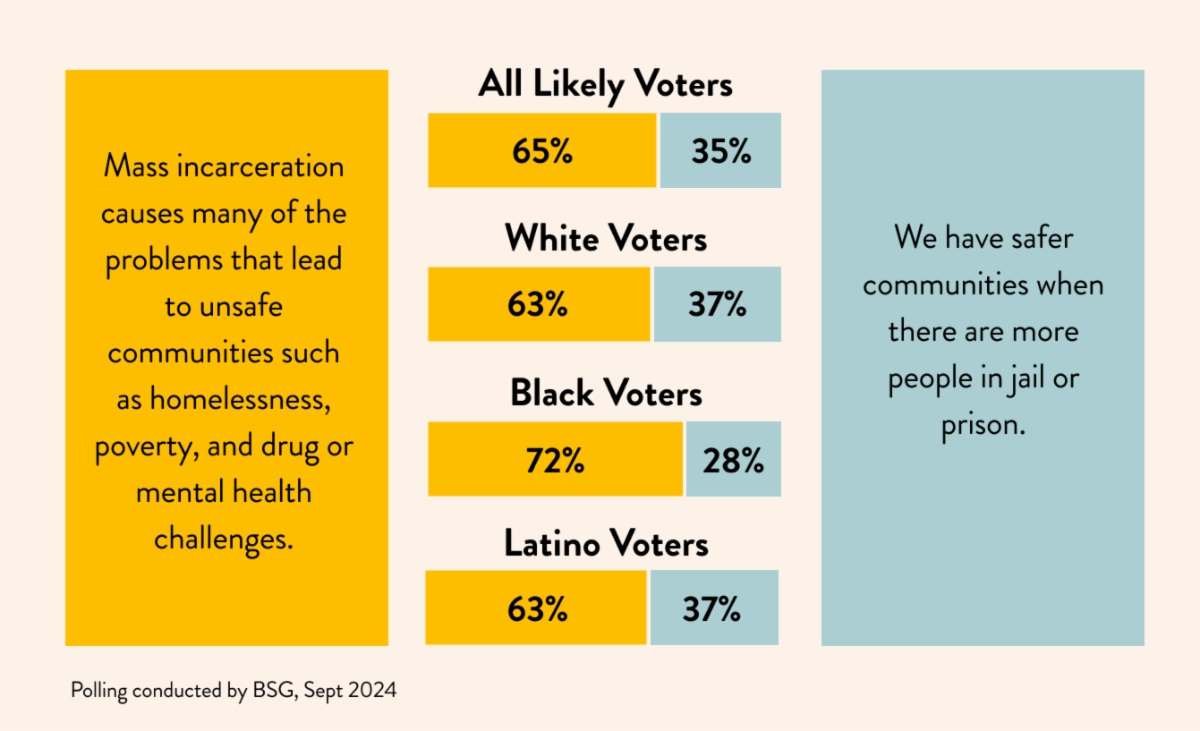 | What do I see when I look at these results? Supporting safe and effective criminal justice reforms is a low-risk proposition with tons of upside. Contrary to the traditional political thinking, criminal justice reform is not a “left-leaning” idea and it’s not viewed as radical in either direction. It really, really inspires some key voters and–importantly–turns very few people off. Just one in ten voters are less likely to vote for candidates who back criminal justice reform. In a time when many important policy positions lose the support of half the country or more, this is an issue with uncommon levels of support. | 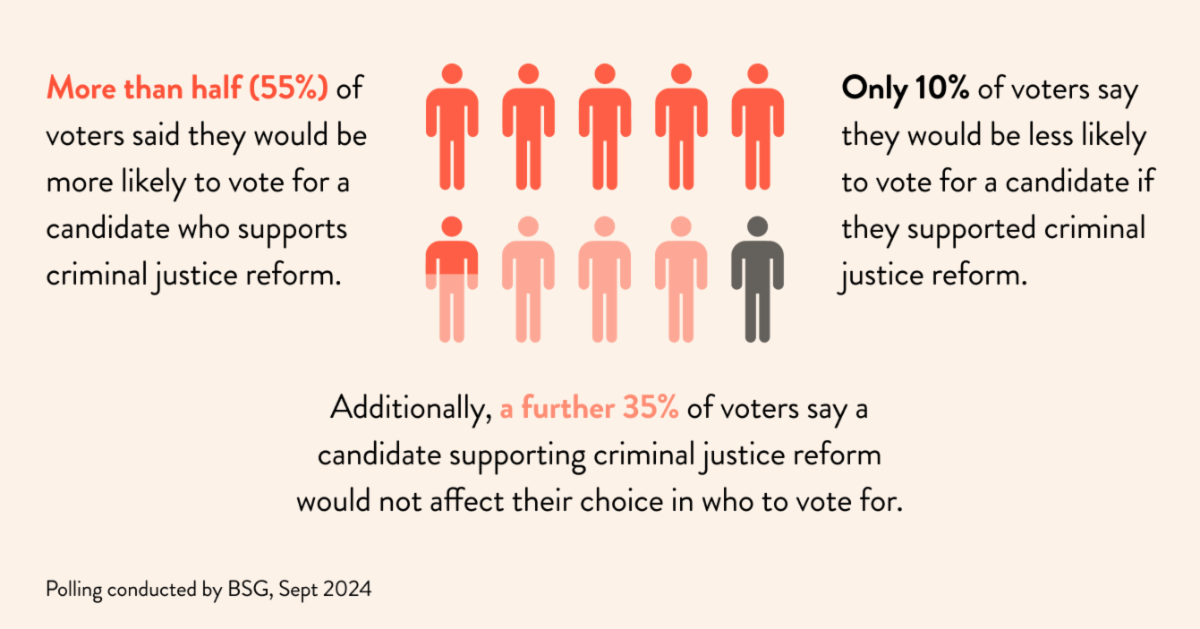 | |
None of this means that campaigns can’t freak people out with “tough-on-crime” lies about a particular story or policy reform. Of course those tactics can work in the short term, though their power seems to be diminishing. Rather, what this means is that when you tell voters the truth about criminal justice reform, they want more of it. Of course, as with all policy, it matters how we talk about it. Notice me talking about “safe and effective” criminal justice reforms? Well, that’s because the reforms we are talking about are backed by tons and tons of evidence showing their effectiveness across all kinds of individual and community indicators including public safety.
We get that sometimes big policy ideas can feel far away and hard to explain. Behind the national statistics and the research indicators are specific choices that governments can make to turn the tide on incarceration and bend this country’s future towards greater safety and justice. Below, I want to offer you three tangible stories about what progress can look like and how a new President can deliver more of exactly what voters want to see.
Onward to November.
Zoë Towns
Executive Director, FWD.us
| |
|
As you’re out there making a final push over these next few weeks, real stories that show a commitment to safety and justice can help tip the scales and win, up and down the ballot. Here are three such stories:
1) DeAnna Hoskins champions reform as a White House Fellow. The Biden-Harris Administration has named DeAnna Hoskins one of the 2024-2025 White House Fellows. She is the first formerly incarcerated person to be named a Fellow in the 57 years of the program. DeAnna has served as President/CEO of JustLeadershipUSA, a national nonprofit that empowers people most affected by incarceration to drive policy forward. She is a nationally-recognized advocate and policy expert who has shifted the national conversation on the impact and limitations of having a criminal record. DeAnna is serving as Special Assistant to the Secretary of the Army to improve the fairness of their criminal justice process as well as the prevention and response processes that ensure a safe military.
2) Biden-Harris DOJ invests in innovative reentry housing incubator. For several years now, Impact Justice has been running an innovative housing and reentry program that seeks to address the housing, affordability, and incarceration crises all at once. People coming home from prison are matched with homeowners (think Airbnb) who welcome them with safe and stable housing and with the community they need to rebuild their lives. One hundred percent of participants have left the program with stable housing of their own. Ninety-five percent have secured employment or enrolled in job training or educational programs. And no one has returned to prison. As a bonus, the homeowners, who may need help making mortgage and bill payments, get to be a part of a broader community housing solution that also helps keep them in their homes. Now, with support from the Department of Justice under the Biden-Harris Administration, Impact Justice will expand this model in California and support similar projects across the country.
3) Minnesota creates a more merciful clemency process. Under the leadership of Governor Tim Walz, Minnesota has reformed its clemency process to make it more transparent, efficient, and fair. The new law establishes a clear process and eligibility criteria for clemency, creates a commission to oversee that process, and allows for the Board of Pardons to grant clemency by a majority vote. In the words of St. Thomas Professor Mark Osler, who helped advocate for the reforms, the changes make it so that “the core idea of clemency—the mercy granted to the person presenting themselves to the board—will have more room to breathe.”
| |
|
“We cannot continue the cycle of mass incarceration that has separated so many Latino families and overshadowed real public safety solutions. Latino voters want more opportunities, and the tools to build a better future for our families and communities.”
– Melissa Morales, Founder & President, Somos Votantes
| |
|
“When I talk to voters in Pennsylvania, criminal justice reform comes up again and again. We know it’s the right policy, and this poll shows that the politics are on our side.”
– Pennsylvania Speaker of the House, Joanna McClinton
| |
|
“Black voters will play a huge part in determining the outcome in this presidential election, in Georgia and across the country, and ending mass incarceration matters to them.”
– LaTosha Brown, Co-Founder of Black Voters Matter Fund and Black Voters Matter Capacity Building Institute and Founder of Southern Black Girls & Women’s Consortium
| |
Navigating conversations on crime, safety, and justice can be challenging in the simplest of times. This election season is not a simple time. Defend Justice is our attempt to get you the facts and messages you need to defend the progress America has made advancing safe and effective criminal justice reforms. You can see our first newsletter here, our second here, our third here, our fourth here, and our fifth here. | | | | |


