Kentucky Coalition For Healthy Children Newsletter | | Working collaboratively on policies and practices in and around schools that promote equity and improve the physical, social, and emotional health and well-being of children, youth, and families. | | The opinions and viewpoints expressed in this newsletter do not necessarily reflect the positions of all coalition partners. | | |
Webinar Series│ State & Federal Policy Updates
Join the ThriveKY Coalition’s webinar series for important updates on the economy, Medicaid, KCHIP, SNAP, housing, transportation, child care, public health, and behavioral health. Virtual programs are being held on February 2 and 23. For more information about the series, CEUs, and how to register- click here.
Bill Trackers│2026 Legislative Session
KCHC Steering Committee organizations are tracking important bills that could impact children’s health during this 2026 legislative session. Kentucky Youth Advocates’ General Assembly Bill Tracker highlight bills related to priorities included in the Blueprint for Kentucky’s Children. Kentucky Voices for Health’s (KVH) Health Justice Bill Tracker highlights proposals that shape programs like Medicaid, behavioral health, maternal and child health, public health infrastructure, and the social drivers that influence health across the Commonwealth. The Foundation for a Healthy Kentucky (FHKY) 2026 Kentucky Legislative Session web page follows bills introduced in the legislature that can influence health, with a focus on FHKY’s ongoing advocacy efforts and initiatives.
Training Series | Eating Disorders
Aetna SKY and the Kentucky Eating Disorder Council have partnered with Viamar Health to offer an Eating Disorder Training Series in February of 2026. Viamar Health is an Eating Disorder Treatment Center in Florida. The first training, From Disordered Eating to Eating Disorders: Identifying the Threshold Using Growth Charts and Screening Tools, will take place on February 4, 2026. Registration info is here. The second training, Understanding Eating Disorders: Core Features of Anorexia, ARFID, Bulimia and Binge Eating, will take place February 18, 2026. Registration info is here.
Save-the-Date | Conference on Problem Gambling
The Kentucky Council on Problem Gambling is hosting its 29th Annual Conference on Problem Gambling, focused on “A Cultural Perspective of Gambling in Kentucky.” This two-day conference is designed for Kentucky-based counselors, behavioral health professionals, peer supports, and community partners who want to deepen their understanding of problem gambling and its impact across communities. The conference is being held March 19 & 20 in Bowling Green. Download the save-the-date for more info.
| | What's New in Children's Health | | |
Vaccines: Children’s Health is the Priority
The American Academy of Pediatrics (AAP) is continuing to recommend several childhood vaccines no longer advised for routine use by the Centers for Disease Control and Prevention (CDC), according to its newly released 2026 immunization schedule. AAP says its recommendations are grounded in science and in the best interests of children and are endorsed by the Governors Public Health Alliance and 12 other medical organizations.
AAP’s schedule, which is largely unchanged from previous years, includes vaccines for respiratory syncytial virus, hepatitis A and B, rotavirus, influenza, and meningococcal disease, vaccines the CDC no longer recommends for routine administration. AAP is challenging the CDC’s policy shift in a lawsuit against the U.S. Department of Health and Human Services, arguing the changes depart from longstanding medical evidence.
The 2026 schedule is endorsed by organizations including the Infectious Diseases Society of America and the American Pharmacists Association. AAP leaders say the recommendations are based on extensive scientific review and on prior work conducted with the CDC’s Advisory Committee on Immunization Practices before AAP members were removed from ACIP work groups in 2025.
| | |
The Staggering Cost of Broken Promises
A new report, Broken Promises to Our Children, has been released by The Campaign for Tobacco Free Kids, The American Heart and Lung Associations, The American Cancer Society, The Truth Initiative and Americans for Non-Smokers Rights. Presenting concerning data on tobacco continuing to be a leading cause of death, the report urges states to sharply raise tobacco taxes to cut tobacco use and generate billions to fund prevention and other health programs. Released as legislatures open their 2026 sessions, the report notes states face revenue gaps worsened by recent federal health cuts, including efforts to eliminate the CDC’s Office on Smoking and Health and reduce Medicaid funding.
The evidence is clear: higher tobacco taxes are among the most effective ways to reduce smoking, especially among youth, while also lowering health care costs and boosting state revenues. The report also calls for greater investment in tobacco prevention and cessation, which save lives and reduce tobacco-related costs, but remain severely underfunded. In FY 2026, states will spend $728.6 million, just 22% of the $3.3 billion the CDC recommends. Meanwhile, tobacco companies spend over $8.6 billion a year, nearly 12 times what states spend on prevention, to market their products.
| | |
Study Urges Smarter Use of AI to Protect Kids’ Education
As generative Artificial Intelligence (AI) tools become more common, educators are weighing their potential benefits and harms. Rather than waiting years to assess the impact, the Brookings Institution’s Center for Universal Education conducted a yearlong global “premortem” study to identify risks to students and steps to address them now, contained in their report, A New Direction for Students in an AI World: Prosper, Prepare, Protect.
Drawing on input from more than 500 students, teachers, parents, education leaders, and technologists in 50 countries, along with a review of 400 studies, the researchers conclude that the risks of generative AI in children’s education currently outweigh its benefits. Many of these risks threaten children’s foundational learning, social and emotional wellbeing, relationships, and privacy, potentially undermining any gains AI might offer.
The study finds that AI can either enrich or diminish learning, depending on how it is used. Well-designed tools can support learning when integrated into sound teaching practices, but overreliance on AI can weaken core learning skills. To guide action, the report outlines three pillars, Prosper, Prepare, and Protect, with recommendations for governments, technology companies, educators, and families to ensure AI strengthens, rather than harms, students’ development.
| | |
Expanding Rural Access to Healthy Summer Meals for Kids
Kentucky is emerging as a national leader in non-congregate summer meals, dramatically increasing access among rural children who have traditionally faced significant barriers to participating in the USDA Summer Nutrition Programs for Kids. The non-congregate summer meal option in rural communities, also known as SUN Meals to Go, allows children in rural communities the option to not only consume all meal components off site but also to receive multiple days’ worth of meals at one time.
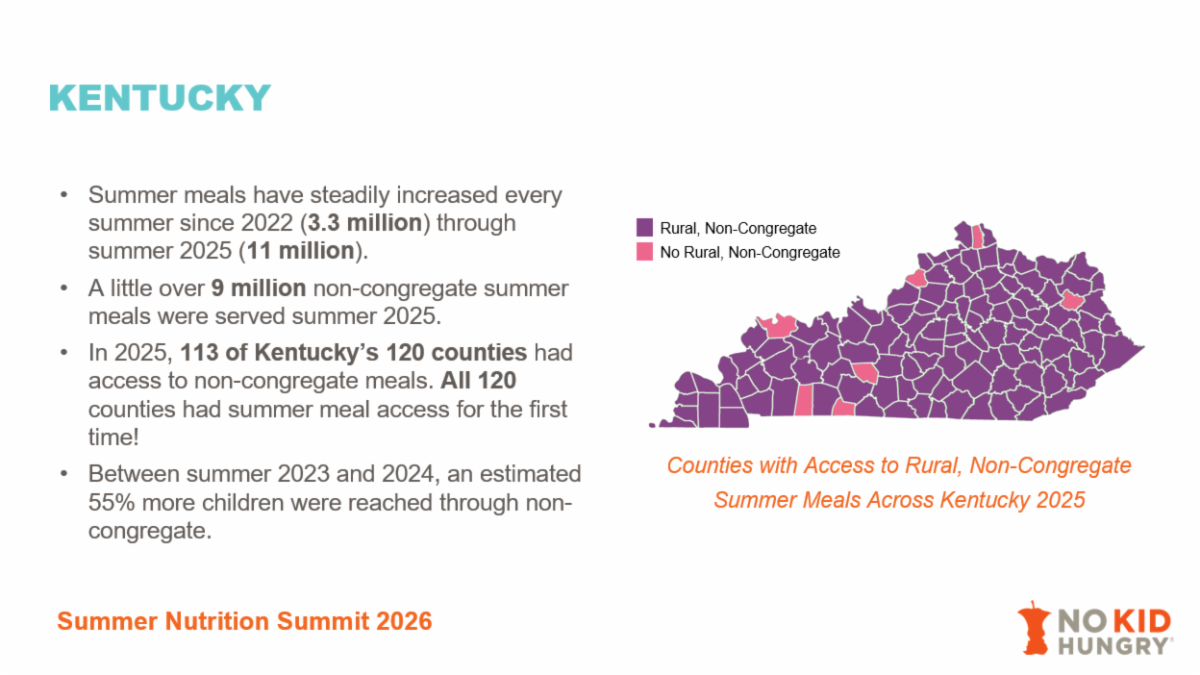
With rural designated communities in every Kentucky county, the non-congregate option is allowing more summer meals to be served in Kentucky than ever before. According to a recent report by No Kid Hungry Kentucky, non-congregate meals have had a rapid growth and have sustained momentum. In 2025, nearly 11 million meals were served, 9.1 million non-congregate meals, and 1.9 million congregate meals. In 2023, summer meals were just over 5 million and they had already increased to more than 8 million in 2024, reaching a new high this past year.
This growth strengthens not only child nutrition but also the schools and community organizations serving meals. Increased federal reimbursement allows sponsors to reinvest in program quality and meal improvements.
| |
Kentucky-Strong Partnerships
Kentucky has made it possible for all 120 counties to offer summer meals for the first time in 2025, with 113 counties offering non-congregate meals. This has been possible thanks to strong partnerships between the public entities, sponsors, and sites.
The Kentucky Department of Education’s (KDE) Summer Food Service Program prioritized accessibility from the start. Beginning in 2023, the inaugural summer of non-congregate summer meals, KDE offered weekly office hours, relationship-focused site visits, and hands-on technical assistance, in that way, building trust and encouraging participation rather than emphasizing compliance.
Kentucky’s long history of mobile meal programs laid the groundwork for non-congregate expansion. Additionally, County-Wide Eligibility (CWE) further reduced barriers by streamlining site approval. The CWE designation applies when a high percentage of children qualify for free/reduced meals and allows school districts to qualify all sites within a county for No Kid Hungry summer meal programs, bypassing the need for individual site applications.
Expansion depended on broadening both sponsors and sites. While school districts make up 84% of sponsors, KDE also partnered with libraries, food banks, and community organizations. In 2025, 53 libraries served as meal sites; one served as a sponsor. Family Resource and Youth Service Centers (FRYSCs) played a critical role connecting families to meals.
Overall, with the partnerships, 83% of meals served were non-congregate, 65.3% of sponsors offered non-congregate meals, and 45.3% of sites operated non-congregate models. Across Kentucky, summer meals sponsors have created a variety a non-congregate models that work for their rural communities. No Kid Hungry Kentucky also has behind the scenes looks at non-congregate models in Caldwell, Owen, Livingston, Boyle, Russell, and Metcalfe counties.
Kentucky’s success shows how innovation, trust, and collaboration can transform rural access to summer nutrition—ensuring more children are fed, wherever they live.
| | |
The 2026 Kentucky General Assembly convened on January 6 and will run through April 15. This session is especially significant, as lawmakers will adopt a new biennial state budget, along with a companion revenue bill.
Advocacy organizations are gearing up for Days at the Capitol to champion policies that improve the health and well-being of Kentucky’s children and youth. Everyone is encouraged to attend and make an impact.
Check out the links and details below to join these important advocacy efforts.
| | | | Do you have an upcoming event or exciting news to celebrate with our coalition? Please email Ally Wells at awells@heatlhy-ky.org to be featured in an upcoming KCHC Newsletter! | |
Amalia Mendoza | KCHC Newsletter | 502-326-2583
| | Current KCHC Steering Committee Member Organizations: | | | | |