Kentucky Coalition For Healthy Children Newsletter

Issue 14 | July 2023

Working collaboratively on policies and practices in and around schools that promote equity and improve the physical, social, and emotional health and well-being of children, youth, and families.
The opinions and viewpoints expressed in this newsletter do not necessarily reflect the positions of all coalition partners.
Visit our Website
Become a Member
Facebook  Twitter  
KCHC Member Highlights

Issue Explainer | Medicaid Renewals 


Kentucky Voices for Health (KVH) has prepared a comprehensive Medicaid renewals explainer and urges action on Medicaid renewals!  Due to COVID-19, states provided continuous enrollment in Medicaid. As the pandemic protections end, many Kentucky families will need to take action to ensure that they stay covered.  If you or a family member currently has health coverage through Medicaid or the Kentucky Children’s Health Insurance Program, called KCHIP, use the explainer below to learn more about Kentucky’s Medicaid renewals timeline, what the renewals notices look like, some tips on what to do first & MORE.


Explainer.


Training Opportunity | Trauma Informed Training Opportunity for Elementary Schools in Western/Eastern KY


The Bounce Coalition has received funding from the Foundation for a Healthy Kentucky to provide two years of training and technical assistance to one elementary school in Eastern KY school district and one in a Western KY school district around Adverse Childhood Experiences (ACEs) and creating a trauma-informed school culture.


This program would include training for school staff at all levels, technical assistance, parent and community engagement opportunities, and evaluation services to assess for change. The Bounce team of experts would also work to create sustainability within the school to ensure the work can continue beyond the two-year project. 


If you are a representative of an elementary school in Eastern or Western Kentucky interested in brining this program to your school, email info@bouncecoalition.org. Learn more here.


Data Release | School Health Profiles


The Kentucky Department of Education School Health Profiles (Profiles) is a system of surveys developed by the Centers for Disease Control and Prevention (CDC) to assess school health policies and programs in states and large urban school districts. The Profiles survey is conducted in Kentucky biennially among middle and high school principals and lead health education teachers. The 2022 School Health Profiles have just been released and include reports on nutrition, health services, physical activity programs and a trend report.

Read more here.


Advocacy Series | State & Federal Policy Updates


The ThriveKY coalition and the Cabinet for Health and Family Services will hold their Quarterly Advocacy Update on state and federal policies with an impact on Kentucky families on July 11 2023, 2:00 to 3:00 ET. Details here.


Advocacy Series | ThriveKY Regional Advocacy for Thriving Communities Series


Kentucky Voices for Health (KVH) & the coalition of ThriveKY partners will provide in-person around the Commonwealth events this year, April through November, with updates on state and federal policies that impact the health and wellbeing of Kentuckians. Speakers will discuss how to advocate for a stronger safety net through public assistance programs designed to support thriving communities. The series includes important updates on the economy, Medicaid, KCHIP, SNAP, housing, transportation, childcare, public health, behavioral health, and others. They provide tools to assist community members with meeting basic needs and tips on being a more effective advocate in your community. Click here for more information.


Register here for the July 18th event in Hazard from 10am-1pm EDT.

What's New in Children's Health

Brief | Healthy Schools Can Mitigate Ongoing Racial Inequities in Education


Children of color in the U.S. have faced inequitable learning conditions and disparate outcomes largely due to ongoing discrimination, segregation, bias and unequal funding and resources. A new brief by Child Trends shows a number of ways how creating healthy schools that specifically support the health and well-being of students and teachers is critical to addressing these inequities. The brief outlines interventions in the following:

  • chronic absenteeism – by promoting consistent school attendance.
  • school violence – by fostering positive school climates.
  • school discipline – by promoting strong personal relationships.
  • special education – by providing access to health services and supports.
  • school infrastructure – by focusing on high-quality infrastructure.
  • school staffing – by ensuring that school staffing reflects the diversity of today’s students.


Read more here. 

Consensus Document | Elevating the Role of School Nurses in School Based Mental and Behavioral Health


Schools play a vital role in preventing, identifying, and supporting students with mental health problems. School based mental health (SBMH) providers lead the way in helping schools fulfill this role. This is increasingly important given that the number of students experiencing poor mental health is growing. 


As this Consensus Document from the Centers for Disease Control and Prevention (CDC) indicates

“School nurses have tremendous potential to work with other SBMH providers to implement school mental health programs (…) School nurses can build their SMHG team’s capacity to deploy a multitiered system of supports that is responsive to student’s needs. As members of interdisciplinary teams, school nurses can collaborate with school personnel –including teachers, psychologists, social workers, counselors, and principals—to assess, identify, conduct interventions for, refer, and follow up with children who need behavioral health services.”


Full report link here: CDC


Federal Rule | Proposed Rulemaking on Parental Consent to Bill Medicaid


The federal Department of Education is aiming to streamline Medicaid billing permissions for students with disabilities and align program requirements. As is stated in the summary:


“The Secretary proposes to amend regulations under Part B of the Individuals with Disabilities Education Act (Part B of IDEA or the Act) that govern the Assistance to States for the Education of Children with Disabilities program, including the Preschool Grants program. Specifically, the Secretary proposes to amend the IDEA Part B regulations to remove the requirement for public agencies to obtain parental consent prior to accessing for the first time a child's public benefits or insurance (e.g., Medicaid, Children's Health Insurance Program (CHIP)) to provide or pay for required IDEA Part B services. As there are no comparable consent requirements prior to accessing public benefits for children without disabilities, the removal of this consent requirement would align public benefits consent requirements for children with disabilities to those for children without disabilities and ensure equal treatment of both groups of children.”


Comments can be submitted, due August 1, at the following site: Notice of Proposed Rulemaking (NPRM) on parental consent to bill Medicaid. 

Kentucky Begins Final Rounds of P-EBT Payments*


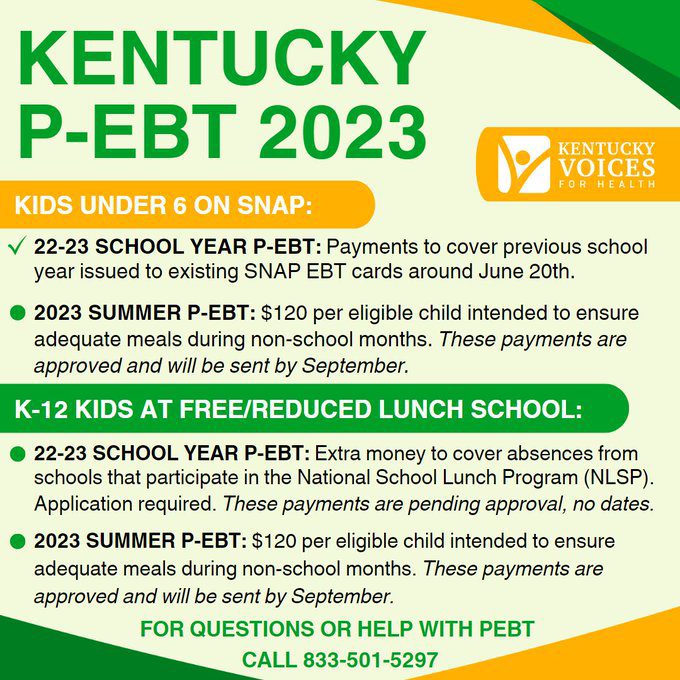
P-EBT payments for SNAP-enrolled kids under age 6 were sent out last week. This begins the final P-EBT payments before the program finishes in September. P-EBT, or Pandemic Electronic Benefit Transfer, is a federal program to provide emergency funding for nutritional assistance during the pandemic. P-EBT works just like regular SNAP EBT allowing parents and caregivers to purchase food at participating grocery stores and authorized retailers. In Kentucky around 179,030 kids (1 in 6) are dealing with food insecurity. The P-EBT program has generated a lot of interest over the last several years of rising grocery prices and economic uncertainty.


With the end of the federal health emergency for COVID, it’s likely these will be the final rounds of P-EBT.


There are two waves of payments left: one to cover the previous school year (2022-2023) and one to cover summer’s out-of-school period. Each has slightly different rules and eligibility depending on age. School year payments for kids under six were based on SNAP enrollment and issued around June 20th to existing EBT cards. The payment for school-aged kids (K-12) is going to be more complicated. Because these payments are intended to cover COVID-related absences that kept a child from accessing free/reduced meals from the National School Lunch Program, eligibility will likely depend on how schools tracked (or didn’t) COVID absences. Kentucky’s plan for these payments is still under review and subject to USDA approval, but it’s very likely that there will need to be an application process where proof of COVID-related absences would be required.


For the summer P-EBT, things are much simpler. In fact, the state’s plans for both age groups are already approved. A one-time payment of $120 per eligible child will be issued for kids under 6 on SNAP and for K-12 kids who participate in the National School Lunch Program (free/reduced lunch). There is no firm timeline for these payments yet, but they’ll need to be issued by September. There’s good news, though: thanks to approval in last year’s budget omnibus, summer P-EBT payments will transition to permanent EBT going forward.


Parents and caregivers can check with their school if they are unsure about NSLP participation, otherwise questions about eligibility can be directed to DCBS at 833.501.5297.


*This article was published in Kentucky Voices for Health News. KVH is a KCHC Executive Partner. Subscribe to their news bulletins here: KVH


Children’s Data | The 2023 Kids Count Data Book


The Annie E. Casey Foundation has released the 2023 Kids County Data Book, State Trends in Child-Well Being. The data book presents national and state data across four domains: economic well-being, education, health and family and community, and ranks states in overall child well-being, sharing the latest information of its kind available. Kentucky’s overall ranking in child well-being is 40th in the nation. Kentucky also ranks 40th in Health, 41st in Economic Well-Being, 29th in Education, and 42nd in family and community. 

In Your Community

Perry County’s Carrot for Healthy Eating


Kids getting excited about eating healthier is one of the outcomes of a program in Perry County which has evolved and grown over the years, Carrot Cash. The Perry County Wellness Coalition was one of seven local health coalitions selected to receive an Investing in Kentucky’s Future initiative grant by the Foundation for a Healthy Kentucky. This was a six-year initiative (2013-2019) to improve children’s health through local cross agency collaboration. One of the programs established in Perry County as a childhood obesity prevention strategy was the Carrot Cash program, a food prescription program (“veggie Rx”) designed to increase access to healthy food while supporting local farmers markets.


When it was first established, the criteria to receive the Carrot Cash vouchers was to be a child 5 to 18 years of age who was in the 80th percentile in body weight. The eligible children would receive $20 Carrot Cash each week to use at a farmer’s market, for a predetermined number of weeks. Along with the voucher they would also receive nutrition counseling with a dietician on staff at the North Fork Valley Community Health Center.


The program was redesigned because it did not initially lead to influencing the eating habits of children as was expected. From conversations with families enrolled in the Carrot Cash program, some of the barriers to its success included lack of affordable transportation to the market, low-income families not used to visiting the farmers market for their groceries, family food preferences, and not being familiar with preparing the foods, or simply preferring processed foods that require only minimal preparation. The Carrot Cash program was then modified and distributed directly to children at various points in the community (e.g., schools, child development centers). This worked well in getting children who showed up at the market excited about fruits and vegetables, however a lot of the Carrot Cash was never brought to the market.


The next iteration gave Carrot Cash directly to children and youth who showed up at the market with the opportunity to earn additional Carrot Cash by participating in a market activity (e.g., a taste testing, market scavenger hunt, a physical activity). This worked very well, and children showed up and asked for Carrot Cash when they came to the market.


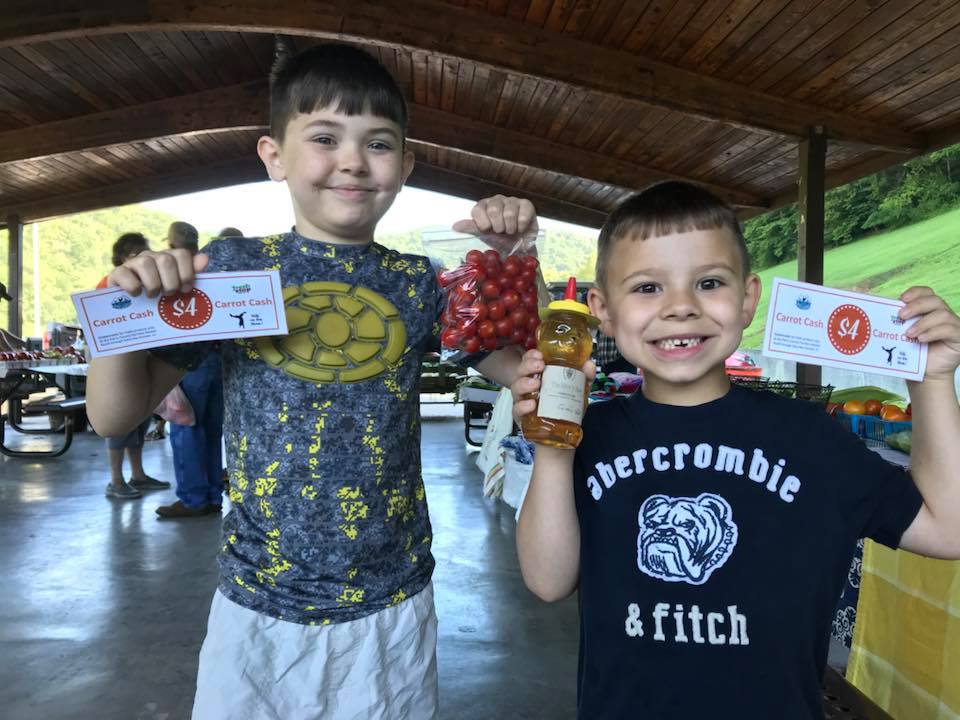
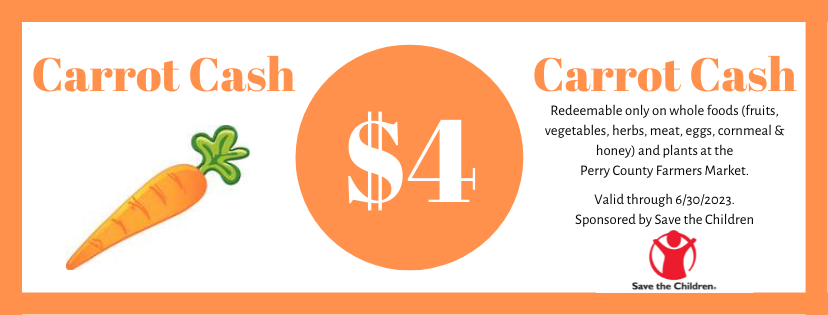
Carrot Cash proved to be a popular enough item with the customers and board so that when the initial funding ran out, the board engaged in fundraising to keep the program going. In the past several years, Save the Children has been funding Carrot Cash. Carrot Cash evolved from being used only for produce to being used on whole foods, plants, and soap. Any child or youth under the age of 18 who goes to the market these days will get a $4 Carrot Cash voucher.


 “We now see kids come directly to the information table to get their Carrot Cash, kids who will pool their vouchers with their siblings to get something larger they all can enjoy, and even some kids who have ‘saved’ up their vouchers from a market or two to buy something bigger than $4. We also see vendors who will package some items in a $4 container or who will make special deals with our younger customers (selling a $6 melon for $4 in Carrot Cash),” tells Jennifer Weeber, Northfork Local Food Coordinator from Community Farm Alliance, one of the developers of the program since its early years.


Carrot Cash has been a great tool for helping children develop the desire and habit of going to a farmers market, as well as providing children and youth with their own agency to purchase their own food. The program now also sees families whose children's Carrot Cash provide not only an incentive to come to the market, but also a way for them to contribute to their family's limited food budget.

Take Action!

Senate Bill 150 is a wide-reaching and harmful piece of legislation which will have implications for the health of children and youth, in particular LGBTQ+ youth. As the Commissioner of the Kentucky Department of Education has said in his statement on the law: “The bill contains provisions that will put our young people at risk, have the government interfere with decisions between doctors, patients and families and puts Kentucky at the front of a series of similar hateful, ignorant and shameful efforts around the country.”


Take action:

  • Share the Resource Guide for the Trans & LGBTQ+ Community
  • Raise awareness regarding the harmful impact of the bill.
  • Invite experts to present in front of legislative committees this summer. These committees will be tasked with “fixing” and implementing this and other bills.
In Case You Missed It

Courier Journal | Judge blocks Kentucky's ban on gender-affirming care for trans kids


Kentucky Lantern | Child care in Kentucky is at risk of collapse as federal pandemic funding runs out


The Spencer Magnet | Kentucky Kids Still Aren’t as Immunized as They Were Before Pandemic


Sandy Hook Promise | National Gun Violence Awareness Day and Month


Cook With Us!

Follow along as we make healthy, kid-friendly recipes with a focus on seasonal ingredients.


Grilling season is upon us! Switch things up with these zesty turkey burgers.


Contact Us!

Do you have an upcoming event or exciting news to celebrate with our coalition? Please email Alexandra Kerley at akerley@healthy-KY.org to be featured in an upcoming KCHC Newsletter!

Amalia Mendoza | KCHC Newsletter | 502-326-2583
amendoza@healthy-ky.org | www.kentuckyhealthychildren.org
Become a Member
Current KCHC Steering Committee Member Organizations:

Kentucky Department for Public Health

Kentucky Family Thrive

Kentucky Department of Education

Kentucky Health Departments Association

Kentucky Nurses Association

Kentucky Primary Care Association

Kentucky Public Health Association

Kentucky Psychological Association 

Kentucky Voices for Health

Kentucky Youth Advocates

KY Parent Teacher Association – 16th District

Pritchard Committee for Academic Excellence

Seven Counties Services

Spalding University

St. Elizabeth Healthcare

Trans Parent Lex

United Healthcare

University of Kentucky College of Health Sciences

University of Louisville School of Public Health & Information Studies