KDIGO and ERA Sign New Memorandum of Understanding | | |
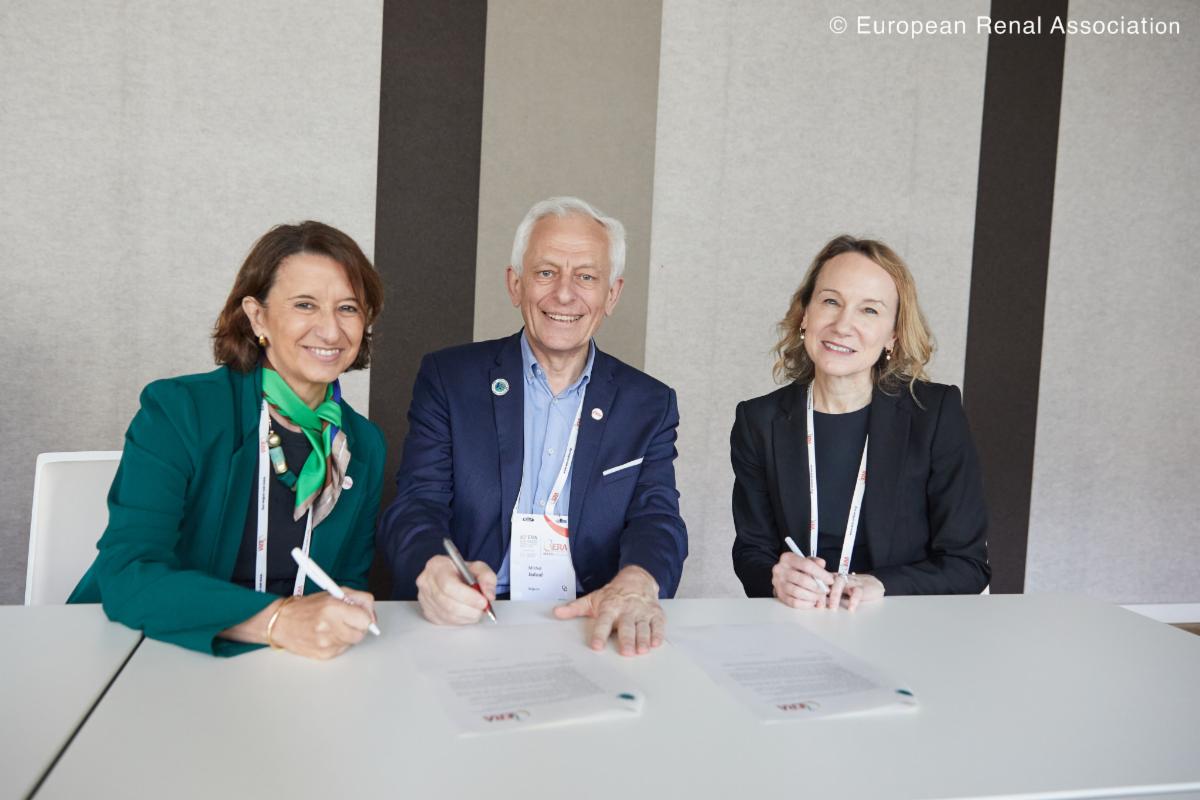
KDIGO has signed a new Memorandum of Understanding (MOU) with the European Renal Association (ERA), reinforcing their collaboration to advance kidney health in Europe and around the world. The agreement sets out new ways for the two organizations to work together, from joint educational initiatives to collaborative dissemination and implementation projects. Regular leadership meetings will help align priorities and identify opportunities to address the challenges facing the global kidney community. Pictured above, left to right, are ERA President Roser Torra, MD (Spain), and KDIGO Co-Chairs Michel Jadoul, MD (Belgium), and Morgan Grams, MD (United States).
The collaboration will also focus on engaging ERA Working Groups in offering commentary on KDIGO Guidelines, and coordinating dissemination and implementation projects to address barriers and opportunities in different countries and regions. One important project underway is the translation of KDIGO Guideline Key Takeaways into several languages with the help of ERA’s Young Nephrologists’ Platform. These translations will make it easier for clinicians and patients to access and apply the latest evidence-based recommendations in their own languages.
“This MoU represents a shared vision for uniting expertise and energy to improve care for people living with kidney disease," said KDIGO Co-Chair Michel Jadoul, MD (Belgium). "By working together, KDIGO and ERA can accelerate the implementation of best practices and ensure that knowledge translates into better outcomes.”
| | KDIGO APOL1 Kidney Disease Controversies Conference Report Published in Kidney International | | |
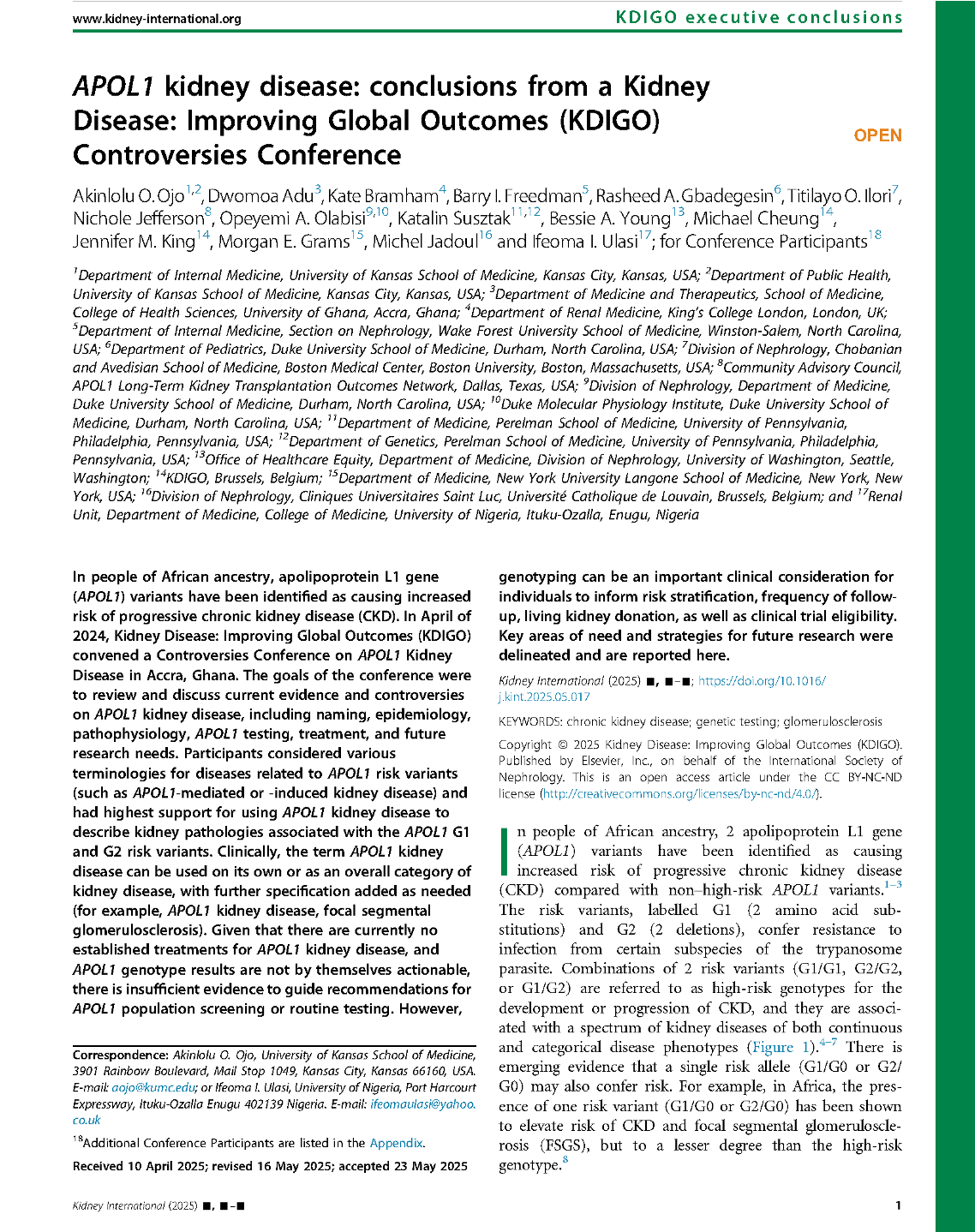
KDIGO has released the report from its Controversies Conference on APOL1 Kidney Disease, published in Kidney International. Co-chaired by Akinlolu Ojo, MD (United States) and Ifeoma Ulasi, MD (Nigeria), the conference brought scientists, clinicians, and patient representatives together in Accra, Ghana, to assess current knowledge and chart a course forward for addressing a pressing and inequitable burden in kidney health caused by APOL1.
The three-day meeting explored the latest science and clinical approaches, including disease mechanisms, epidemiology, diagnostics, targeted therapies, and ethical considerations in genetic testing, with the goal of improving outcomes for those most at risk.
“This report represents a milestone in global kidney health,” said Dr. Ojo. “Given the prevalence of APOL1 high-risk genotypes in regions of West Africa, the burden of APOL1 kidney disease is high and potentially catastrophic. Our report highlights the urgency of understanding how high-risk genotypes, along with additional factors, contribute to the development and progression of kidney disease as well as the importance of advancing biomarker development and accelerating therapeutic trials that can improve outcomes for millions of people, particularly in Sub-Saharan Africa and throughout the global African diaspora.”
The report emphasizes the importance of building strong regional data and research infrastructure, especially in countries like Nigeria and Ghana, and calls for expanded studies in underrepresented populations, including the Caribbean and Latin America.
“As we face the devastating burden of APOL1 kidney disease, it is vital to build research infrastructure, enhance genetic literacy, and support ethically sound testing practices. We must also center the experiences of patients and families,” said Dr. Ulasi. “This report is not just a scientific summary—it is a call to action for equitable investment in research, prevention, and treatment. The promise of targeted therapies is real, but we need sustained global focus to turn that promise into accessible care.”
The full report, APOL1 Kidney Disease: Conclusions from a KDIGO Controversies Conference, is available in Kidney International and on the KDIGO website.
| | Take the KDIGO Guideline Global Survey | | |
KDIGO has launched a global survey to better understand how its clinical practice guidelines are being used in real-world settings and how they can be made more accessible, relevant, and practical for kidney care professionals and patients everywhere.
Developed by Adrian Liew, MD (Singapore), KDIGO Executive Committee Member and Implementation Subcommittee Chair, the survey aims to identify both the successes and the gaps in how KDIGO Guidelines are applied across different regions, specialties, and clinical environments. It explores where recommendations are being used effectively, where uptake is limited, and the reasons behind these variations, including challenges related to language, infrastructure, clinical relevance, or ease of implementation.
By gathering input from physicians, nurses, pharmacists, dietitians, researchers, and trainees, KDIGO aims to develop more effective tools, formats, and strategies that support the implementation of its guidelines in daily practice. The insights gained will directly inform efforts to enhance the clarity, accessibility, and impact of KDIGO guidance. Take the survey.
| | |
KDIGO at SLANH 2025
Guayaquil, Ecuador
August 27 - 30, 2025
Join KDIGO in Guayaquil, Ecuador, at SLANH 2025 for two dedicated guideline update sessions. On Thursday, August 28, from 11:45 a.m. to 12:30 p.m., Gregorio Obrador, MD (Mexico), and Laura Solá, MD (Uruguay) will present the latest on CKD risk and evaluation, and implementation of SGLT2 inhibitors in clinical practice.
On Saturday, August 30, from 11:45 a.m. to 12:30 p.m., Hernán Trimarchi, MD (Argentina), and Irene Noronha, MD (Brazil), will discuss emerging therapies for IgA nephropathy and what's new in the KDIGO Lupus Guideline. Learn more and register.
| |
KDIGO at the 60th ANZSN Congress
Perth, Australia
August 30 - September 3, 2025
Join KDIGO at the 60th ANZSN Congress in Perth, Australia, for a breakfast symposium on Wednesday, September 3, titled Precision Medicine in IgAN Treatment: Selecting the Right Therapies for the Right Patient at the Right Time. Enjoy breakfast from 7:00 to 7:30 a.m., then dive into the latest updates from 7:30 to 8:30 a.m.
Meg Jardine, MD (Australia), will open with a welcome and introduction, followed by Muh-Geot Wong, MD (Australia), presenting the KDIGO 2025 IgAN Guideline Update, highlighting key changes since 2021 and insights from the forthcoming update. Meg Jardine will then explore new ways to target IgAN pathophysiology, from traditional approaches to cutting-edge therapies, including B cell modulators, anti-complement agents, and other promising treatments in development. The session will wrap up with an interactive Q&A. Learn more and register.
| | |
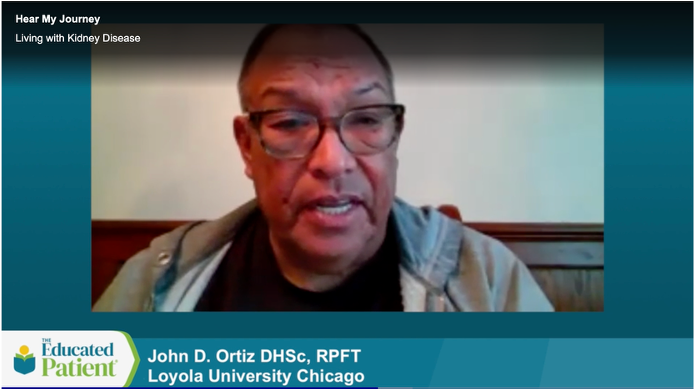
Hear My Journey: Living with Kidney Disease
Patient Experience Video
At 43, John D. Ortiz, DHSc (United States), felt healthy and active until a routine checkup revealed his kidneys were functioning at only 50%. A decade later, he was diagnosed with polycystic kidney disease, a genetic condition that can lead to kidney failure. His care team, including Holly Mattix-Kramer, MD (United States), explains how kidneys quietly work nonstop to filter waste—often without any symptoms until serious damage occurs.
In this inspiring video, John shares how early testing, lifestyle changes, and staying informed have helped him keep working, traveling, and enjoying life—even while on dialysis. Dr. Mattix-Kramer offers valuable insights on why everyone should get simple blood and urine tests, and how new treatments can slow disease progression by up to 50%.
Hear John’s advice, see how his family has supported his journey, and learn from Dr. Mattix-Kramer why early detection can make all the difference. Watch the video.
| | |
Understand C3G and IC-MPGN & Know Your Treatment Options
On-Demand Webinar
Complement 3 Glomerulopathy (C3G) and Primary Immune Complex Membranoproliferative Glomerulonephritis (IC-MPGN) are rare kidney diseases that can cause swelling, high blood pressure, fatigue, and, in some cases, lead to kidney failure. These conditions occur when the immune system’s complement pathway becomes overactive and attacks the kidneys.
This engaging, on-demand webinar brings together leading nephrologists, patient advocates, and individuals living with C3G and IC-MPGN. Together, they explain what these rare kidney diseases are, how they affect the kidneys, and what patients and caregivers need to know to navigate them with confidence. Hear about current and emerging treatment options, learn how KDIGO Guidelines can help guide care decisions, and explore the potential benefits of participating in clinical trials. Register.
| | |
About KDIGO
KDIGO is a Belgian foundation committed to developing and implementing global nephrology guidelines that improve outcomes for people with kidney disease. KDIGO is independent, volunteer-led, self-managed, and accountable to the public and the people it serves. Learn more.
| | | | |