|
KGK BRIGADE
FIVE PHOTOMONTAGE POSTERS
| | |
Offered here are five posters by the KGK Brigade, the trio of designers Viktor Koretsky (1909-1998) along with his wife, Vera Gitsevich (1897-1976), plus Boris Knoblok (1903-1984). "Such collective work was common in this era when artists sought to develop new collective forms of creation-parallel to the brigades of workers engaging in the construction of socialism at industrial work sites."
These posters by the KGK Brigade represent the earliest works by these young designers, "emulating the work of the first generation of photomontage artists including Klucis, Vasilii Elkin, Nina Kulagina, Natalia Pinus and Sergei Senkin".
While each member of the KGK Brigade was an accomplished designer in their own right, Koretsky was far more prolific, creating posters into the 1980s. Late in the 1930s, Koretsky shifted to a conventional style, which continued throughout his career.
See, Erika Wolf, Koretsky: The Soviet Photo Poster: 1930-1984, 2012, The New Press, New York, for quotes and various content herein.
[Please contact us for details and pricing]
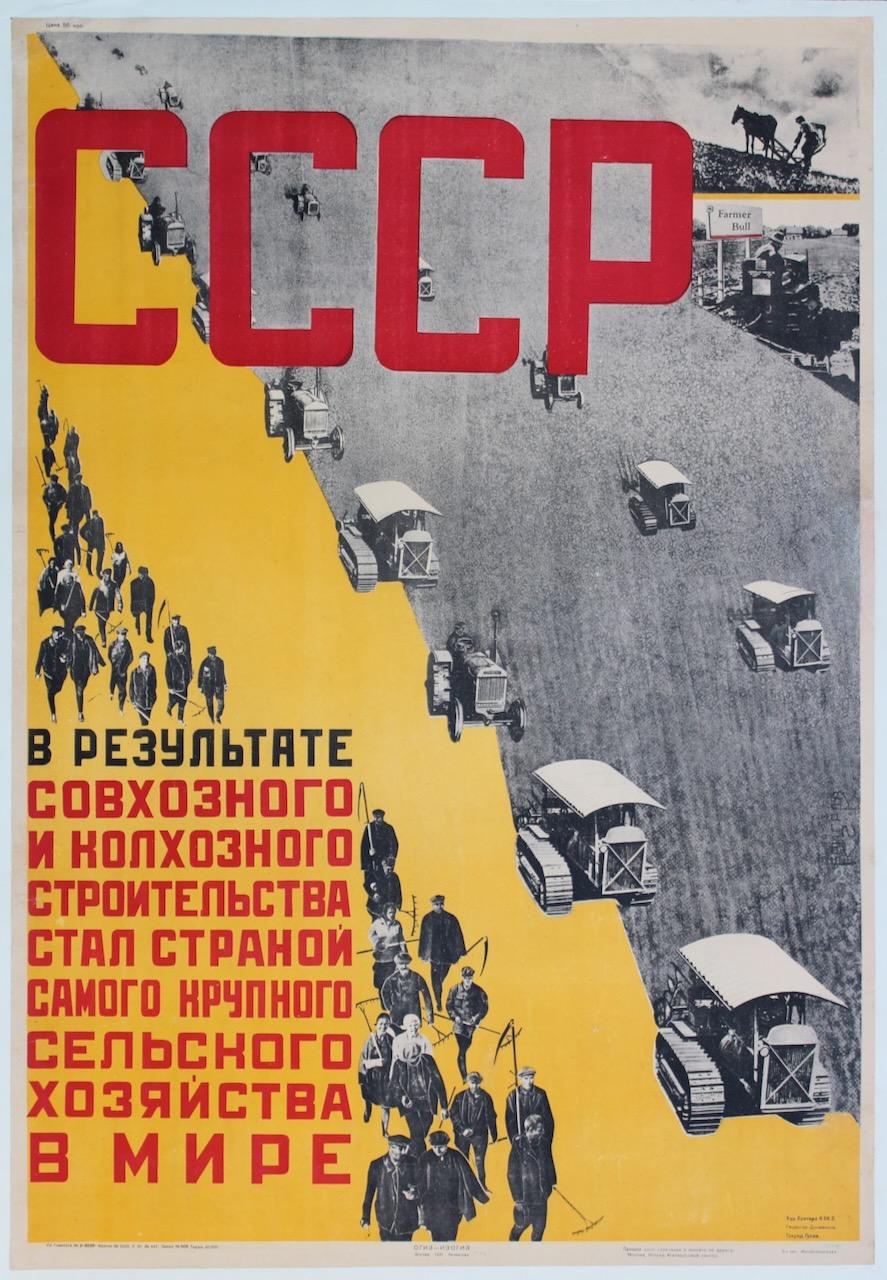
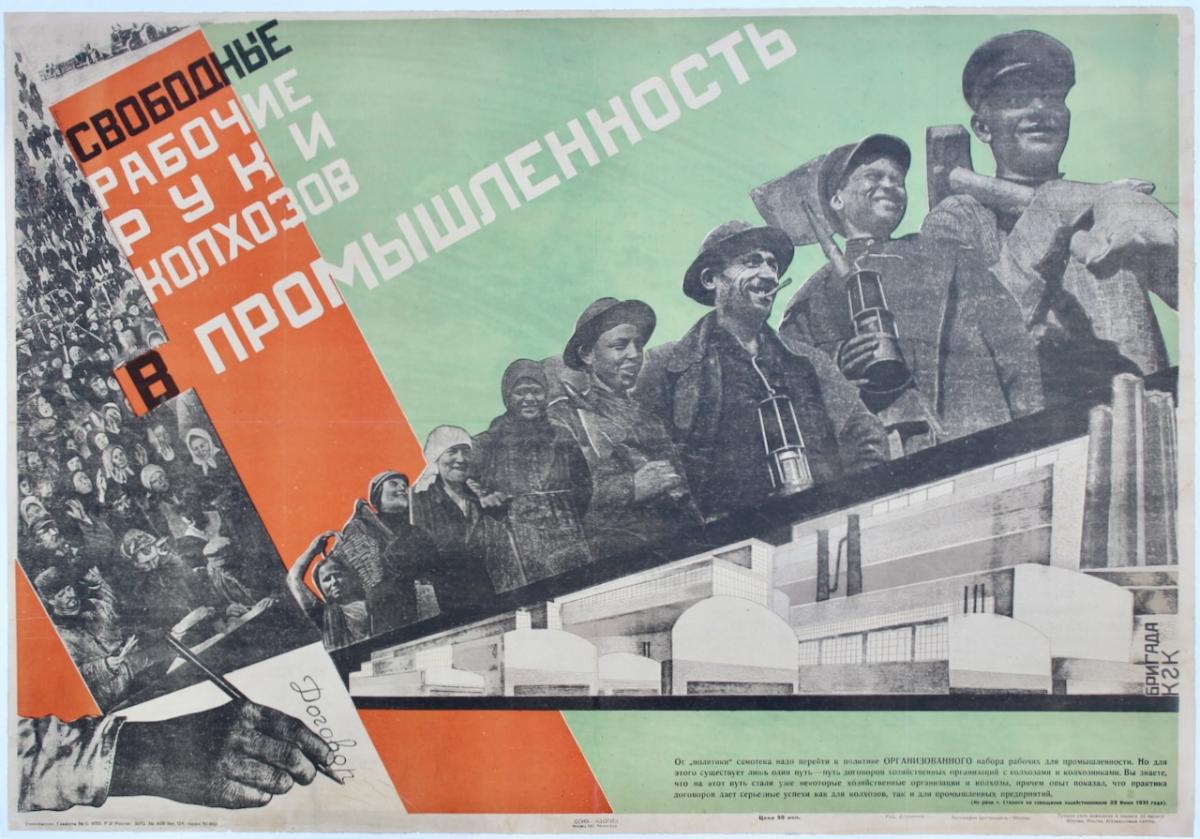
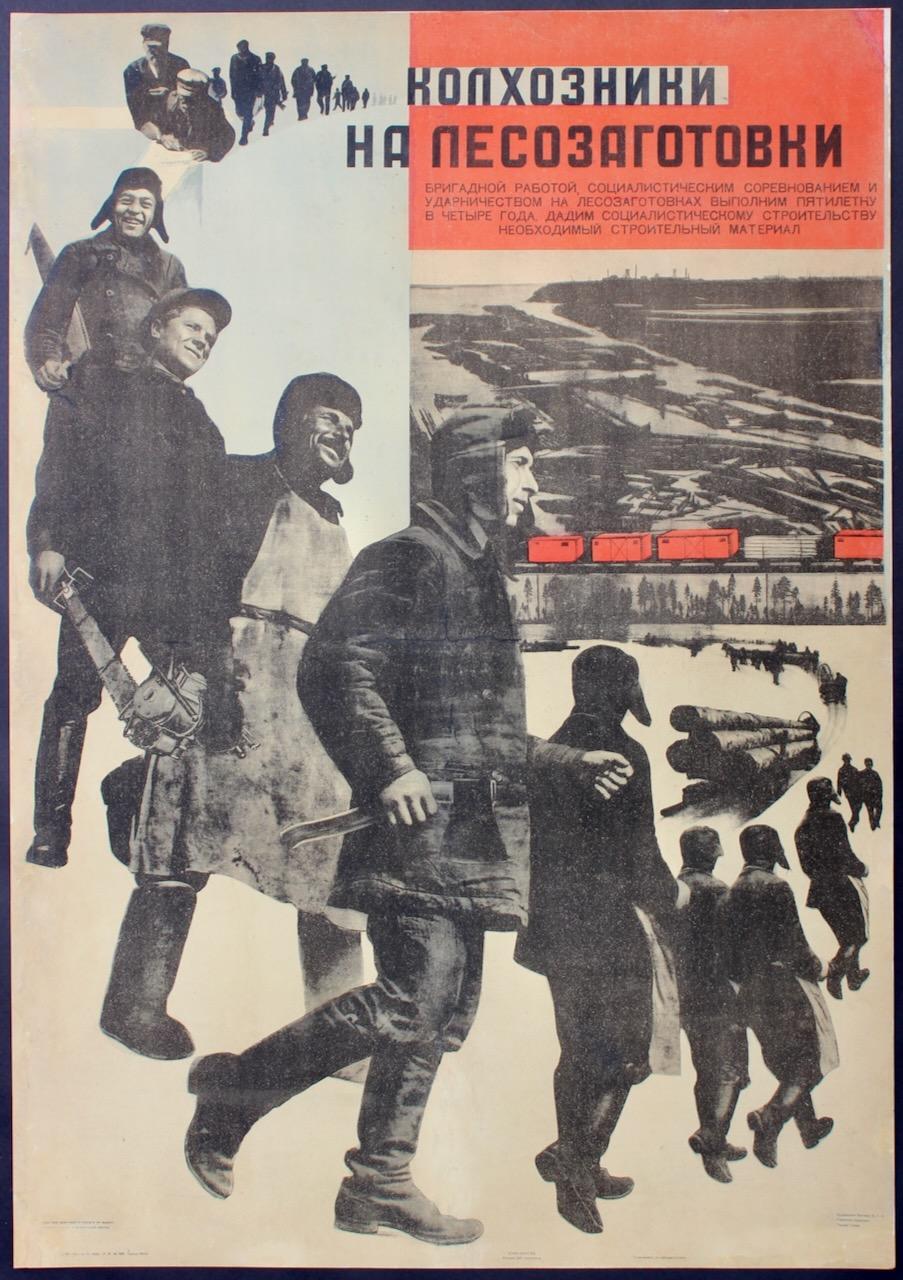
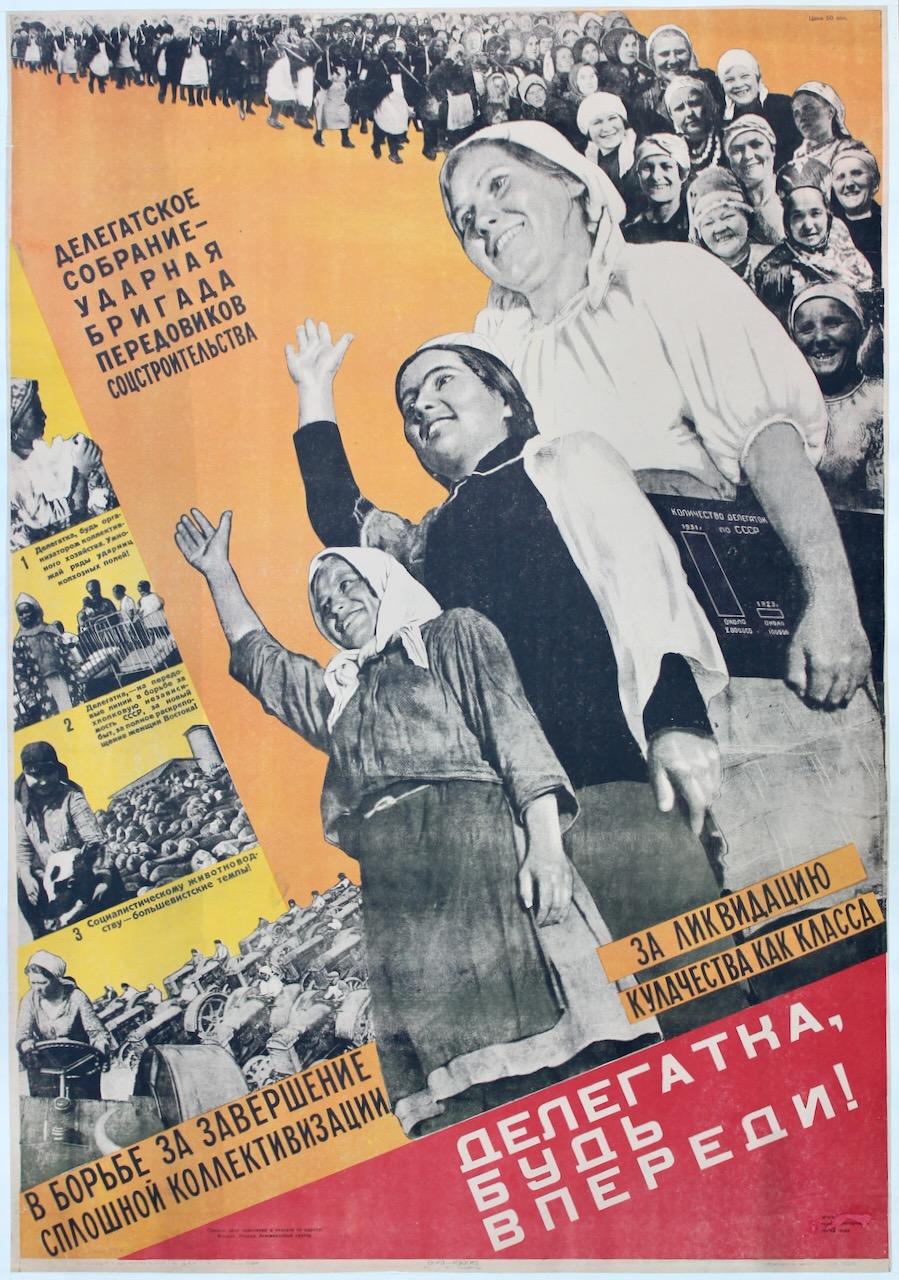
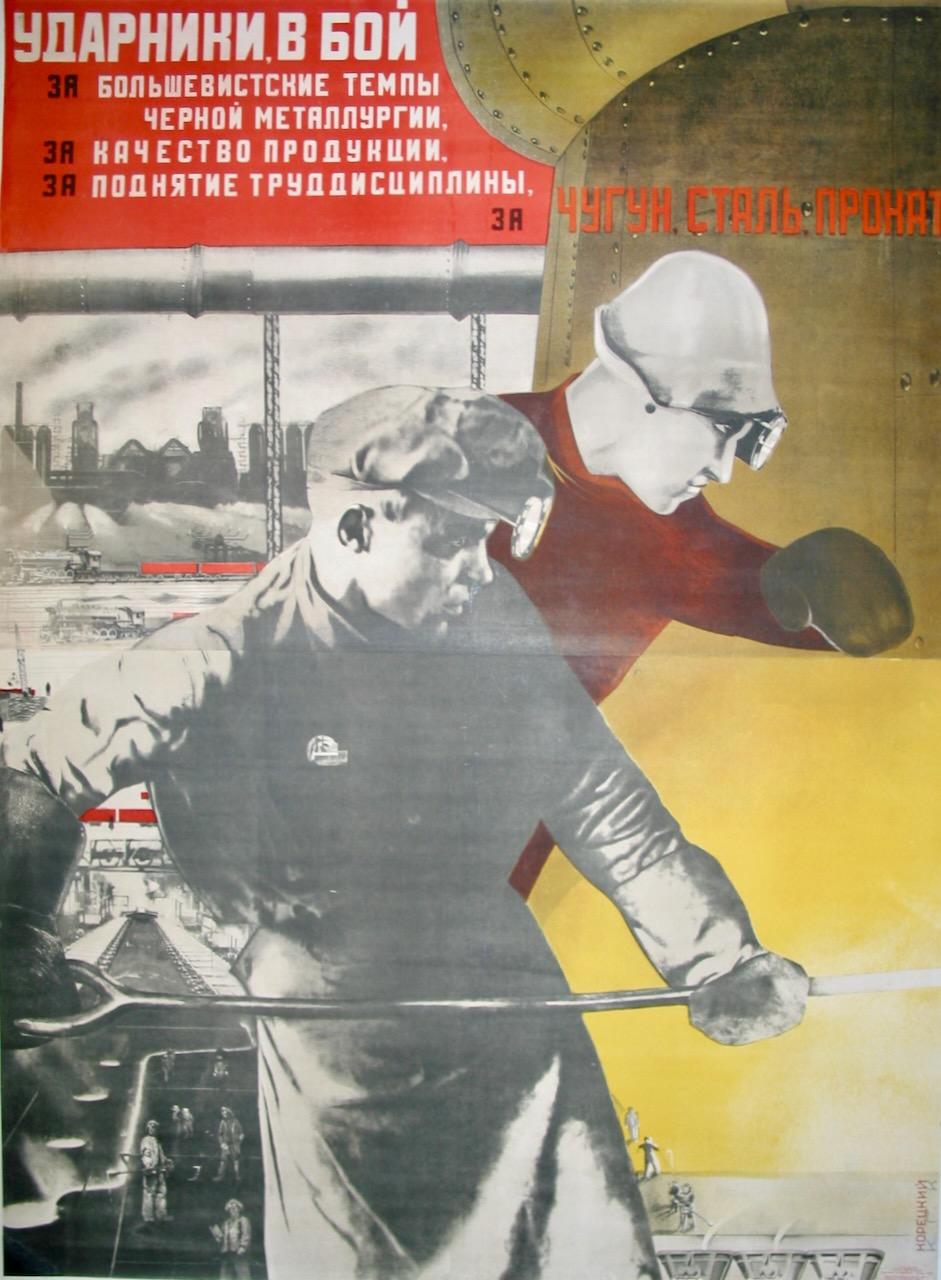
| | As a Result of State and Collective Farm Construction, the USSR Became the Country of the Most Powerful Agriculture in the World. 1931. "(T)his poster visually and verbally extols the successes of the collectivization of agriculture. Below the gigantic letters 'USSR' are ranks of farmers carrying scythes and rows of tractors crossing fields." Conversely at the upper right are farmers toiling with horse and plow and a single outdated tractor; thus evidencing the modernization of the Soviet agricultural system. Backed on linen. See, Erika Wolf, Koretsky: The Soviet Photo Poster: 1930-1984, 2012, The New Press, New York at pp. 22-23; Alla Rosenfeld, Defining Russian Graphic Arts-From Diaghilev to Stalin 1898-1934, 1999, Rutgers Univ. Press, New Brunswick at plate 73; Yelena Barkhatova, Propaganda! Russian and Norwegian Posters 1920-1939, 2012, Forlaget Press, Oslo at 152-53; Tomas Bojar, Power of Images-Images of Power, 2005, Galerie U Krizovniku, Prague at p. 219. Tirage, 30,000. 40 1/4 x 27 3/4". | | Available Working Hands of the Collective Farms-To Industry. 1931. "(T)his poster presents people coming together to participate in state programs aimed at the transformation of the Soviet economy during the First Five-Year Plan." In response to industrial labor shortages, idle farmers were enlisted to fill the gaps. At the left are throngs of collective farmers represented by the hand contracting them into industrial roles. They are then remade into the line of workers on the diagonal central plane. Backed on linen. See, Erika Wolf, Koretsky: The Soviet Photo Poster: 1930-1984, 2012, The New Press, New York at pp. 26-27; Catherine Cook, The Great Utopia: The Russian and Soviet Avant-Garde, 1915-1932, 1992, Guggenheim Museum, New York at plate 441; Matthew Witkovsky, Revoliutsiia! Demonstratsiia! Soviet Art Put to the Test, 2017, Art Institute of Chicago, Chicago at pp. 236-37. Tirage, 50,000. 27 3/4 x 39 5/8". | | Collective Farmers to the Timber Harvest. 1931. "At the top left, figures emerge from the distant background, leading to a table where an older peasant signs a collective agreement to participate in the timber harvest." The curved trail of former collective farmers transformed into timber workers moving to forests and lumber transport "creates a cinematic sense of movement..." Backed on Japon paper. See, Erika Wolf, Koretsky: The Soviet Photo Poster: 1930-1984, 2012, The New Press, New York at pp. 18-19 (maquette only). Tirage, 15,000. 40 1/2 x 28 1/4". | | Woman Delegate, Take the Lead! 1931. "This poster propagandizes both the collectivization of agriculture and the organized women's movement in the USSR. During the 1920s and 1930s, the basic organizational unit of the Soviet women's movement was the delegates' meetings. With collectivization of agriculture, these delegates' meetings became a key forum for the promotion of state agendas within the collective farms." At the top are many women of diverse backgrounds followed by larger images of women with hands raised showing approval of various state policies. This signaled the transformation of Soviet women to a more active role in the economy as depicted by the images on the left. Backed on linen. See, Erika Wolf, Koretsky: The Soviet Photo Poster: 1930-1984, 2012, The New Press, New York at pp. 24-25; Robert Bird, Christina Kiaer, Revolution Everyday-A Calendar 1917-2017, 2017, Smart Museum of Art, University of Chicago, Mousse Publishing, Milan at entry for April 29. Tirage, 20,000. 38 7/8 x 27 1/8". | | For Cast Iron, Steel, Rolled Metal. 1933. "Both Koretsky and later critics identified this poster as marking a transition away from the modernist fragmentation and abstraction of his early work. In contrast to the dynamic shifting planes of the preceding posters, this image focuses primarily upon the activity of two steelworkers. The foremost worker wears a badge that identifies him as a shock worker (udarnik)." As such, this poster reflects the increased role of the individual as a force of production, foretelling the Stakhanovite movement. Large two-sheet format, backed on linen. See, Erika Wolf, Koretsky: The Soviet Photo Poster: 1930-1984, 2012, The New Press, New York at pp. 34-35; Matthew Witkovsky, Revoliutsiia! Demonstratsiia! Soviet Art Put to the Test, 2017, Art Institute of Chicago, Chicago at pp. 232-33 (maquette only); Tomas Bojar, Power of Images-Images of Power, 2005, Galerie U Krizovniku, Prague at p. 86 . Tirage, 15,000. 53 x 38 5/8". | | We have a large inventory of important 1920s-30s Russian/Soviet posters. Please contact us for details. | | | | |