| | |
Grundy-Kendall Regional Office of Education #24
Regional Superintendent Meghan Martin
| | | | |
Building a Better Tomorrow
Supporting schools, staff, and students with essential professional development and educational resources
| |
Building Blocks
Issue 5 September 2025
| |
Welcome back!
As we begin another academic year, we're dedicating this month to exploring one of the most fundamental yet often misunderstood aspects of literacy instruction: the Word Recognition Rope.
While many educators associate word recognition primarily with early elementary instruction, research shows that explicit attention to word recognition development is essential across all grade levels—from prekindergarten through high school.
This newsletter will provide you with research-based strategies, grade-level specific recommendations, and leadership guidance to ensure that word recognition instruction remains a priority throughout your students' academic journey. Whether you're working with emergent readers or supporting high school students with complex academic texts, understanding and implementing the Word Recognition Rope framework will strengthen your instructional impact.
| | | Have colleagues that are new to the district? Know someone that's not getting our emails? Make sure to forward this along so they can subscribe! | | Tools and Tips for Grundy-Kendall Teachers | | Understanding the Word Recognition Rope | |
The Word Recognition Rope, part of Hollis Scarborough's comprehensive Reading Rope, consists of three essential strands: phonological awareness, phonics, and sight words (automaticity). In primary grades, students must develop this Word Recognition Rope independent of the Language Comprehension rope. However, as decoding skills become automated, the Language Comprehension rope and Word Recognition rope begin to work together seamlessly to support skilled reading.
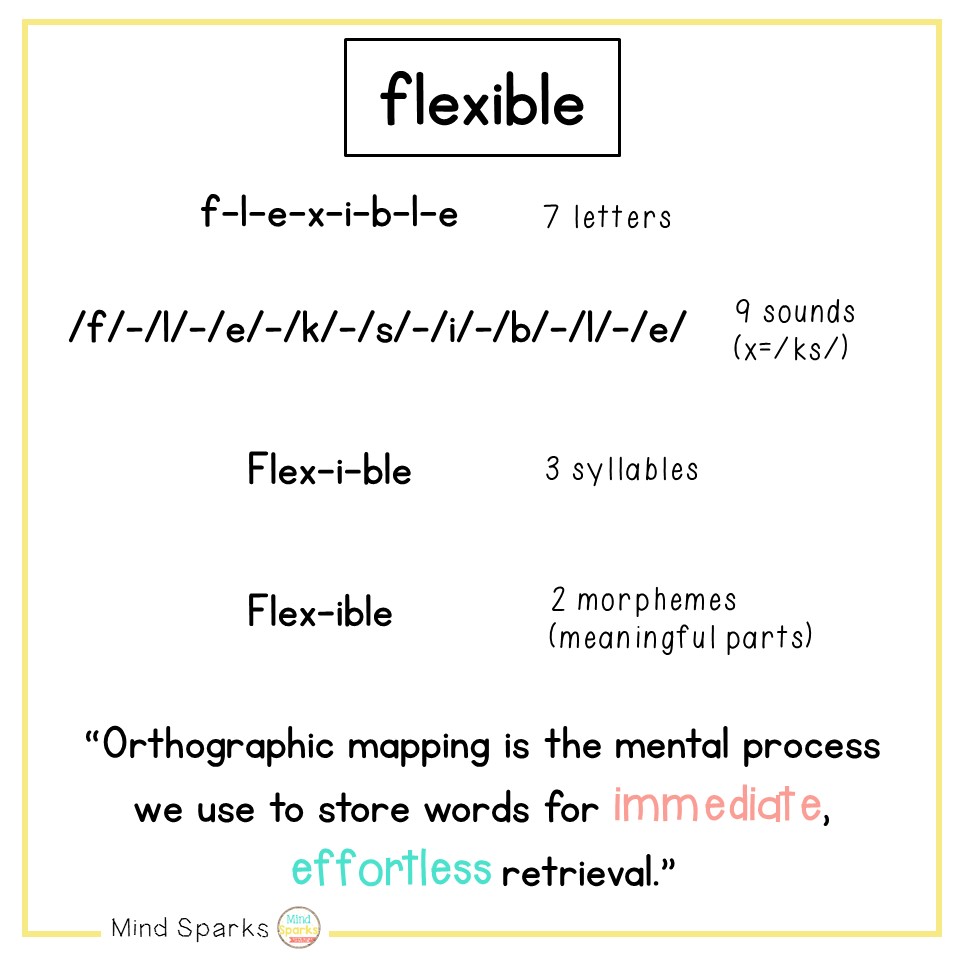
In primary grades, our focus is on developing students' ability to match sounds to print so that they can access text without having to laboriously sound out each word. Students need explicit instruction in phonological awareness to manipulate sounds in spoken language, systematic phonics instruction to understand how letters represent sounds, and extensive practice to build automatic recognition of high-frequency words. This foundational work creates the orthographic mapping necessary for fluent word recognition (Ehri, 2005).
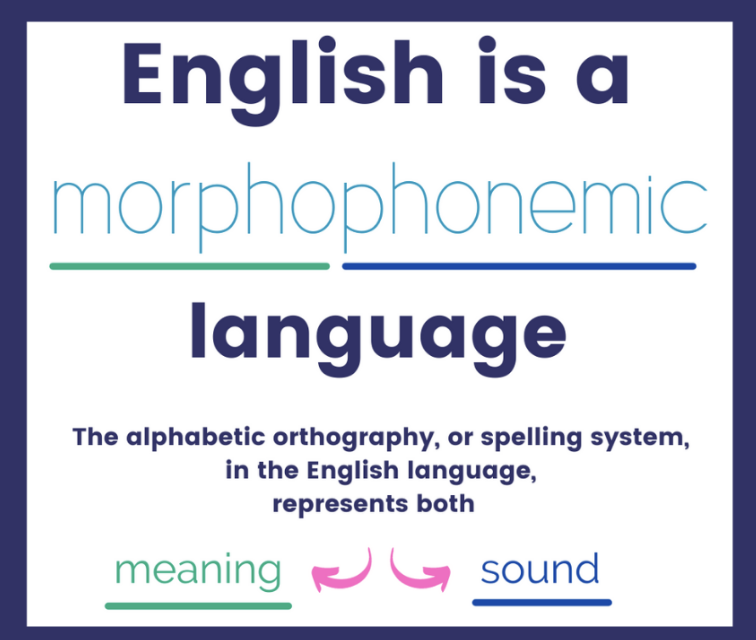
However, as students develop more automaticity with basic word recognition, our instructional focus for this rope changes—it does not end. At intermediate and higher levels, we need to continue teaching students word recognition skills, but now focusing on how letters represent meaning, otherwise known as morpheme study. This instruction begins with prefixes and suffixes, continuing through Greek and Latin morphemes, complex derivational relationships, and nuanced semantic connections.
A weak Word Recognition Rope at any level impacts fluency and comprehension across all content areas. Research demonstrates that continued morpheme study results in higher vocabulary skills (Bowers & Kirby, 2010), which directly contributes to better reading comprehension. When students can automatically recognize and understand the meaningful parts within complex academic words, they can focus their cognitive resources on comprehending increasingly sophisticated texts rather than struggling with word-level processing.
| | |
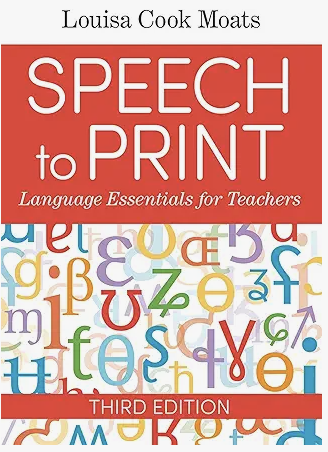
Speech to Print: Language Essentials for Teachers
by Louisa Cook Moats
The definitive guide to understanding the structure and function of language, providing educators with comprehensive knowledge of phonology, morphology, syntax, and semantics. This updated edition includes ten years of new research and expanded guidance on assessment and instruction, filling critical gaps in teacher preparation with accessible explanations of how English works..
| | |
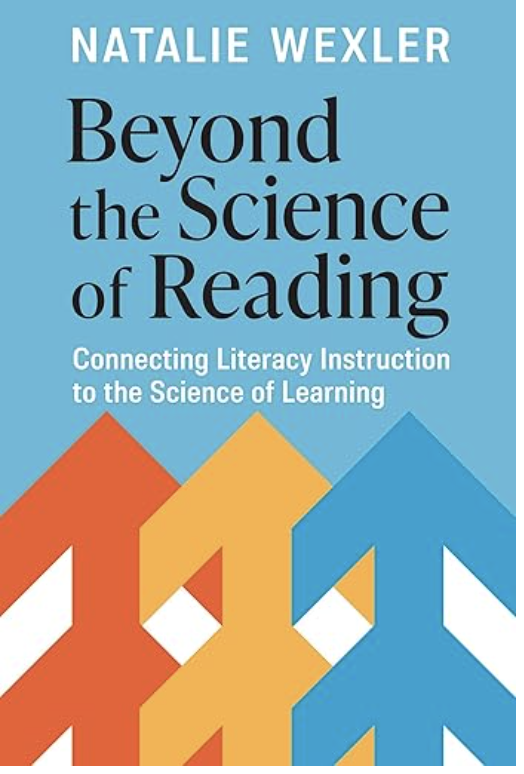
Beyond the Science of Reading: Connecting Literacy Instruction to the Science of Learning
by Natalie Wexler
Argues that effective literacy instruction must connect the science of reading with the broader science of learning. Wexler demonstrates that while phonics instruction is important, building knowledge and vocabulary through content-rich curricula is equally essential for reading comprehension, and shows how typical reading comprehension instruction often conflicts with evidence-based learning principles.
| | |
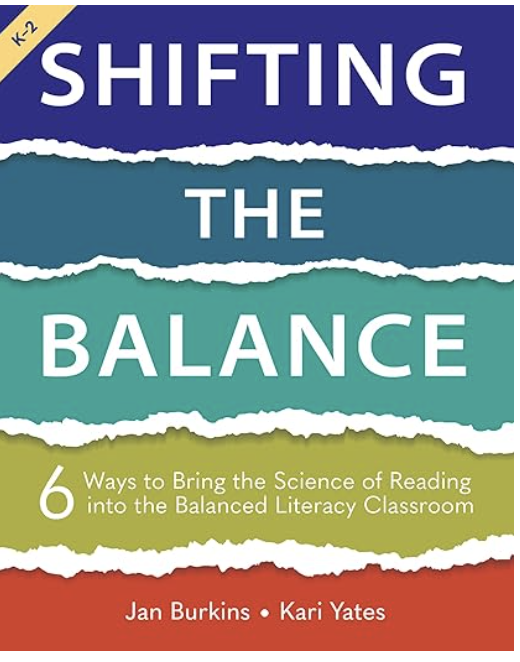
Shifting the Balance: 6 Ways to Bring the Science of Reading into the Balanced Literacy Classroom
by Jan Burkins and Kari Yates
Practical guidance for integrating science of reading into classroom practice with six research-based shifts. Note: There are three versions available - the original general book, a K-2 specific edition, and a 3-5 edition co-authored with Katie Cunningham, allowing educators to choose the most relevant content for their grade level.
| | |
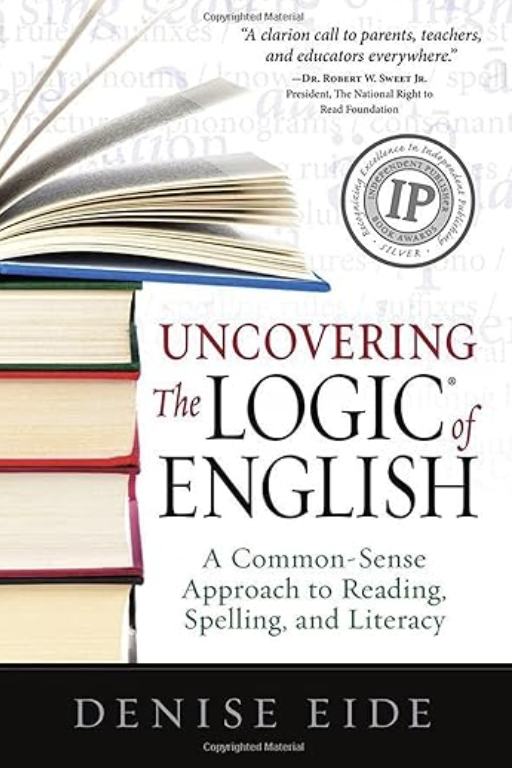
Uncovering the Logic of English: A Common Sense Approach to Reading, Spelling, and Literacy
by Denise Eide
Challenges the notion that English is illogical by revealing the systematic patterns underlying 98% of English words. Eide explains 75 phonograms and 31 spelling rules in an accessible, engaging style, demonstrating how understanding these logical patterns can eliminate guessing and provide students with the tools to decode and encode words accurately.
| |
K-2
Build the Foundation
Strengthen foundational skills through fun, hands-on activities.
Phonological Awareness
- Engage in phonological awareness activities daily
- Sing songs and play rhyming games
- Phonemic awareness should be done WITH the grapheme as soon as students have the ability to isolate individual sounds
- Use Blending Boards and Word Chains
Phonics:
- Explicitly teach the the graphemes and rules
- Provide daily opportunities to read and write with the targeted sound
- Follow a systematic pacing guide
High Frequency Words
- Introduce high frequency words with the goal of providing access to more text
- Teach. the part. of the word that doesn't "follow the rule"
Decodable Text
- Use Decodable texts aligned to your scopes and sequence
- Provide frequent opportunities for students to read decodable texts, including sending books/passages home
- Explicitly teach how to attack words by coding the word or breaking into syllables
Key Strategy: Use Elkonin boxes or letter tiles
| | |
3-5
Expand and Refine
Support independence and fluency through structured but flexible activities.
Morphological Awareness
- Introduce systematic study of prefixes, suffixes, and root words using word sorts and morpheme matrices
Advanced Phonics Patterns
- Teach complex vowel combinations, silent letter patterns, and consonant clusters through explicit instruction
Fluency with Complex Words
- Use repeated reading with multisyllabic words and teach syllable division strategies
Content-Area Vocabulary
- Pre-teach academic terms using morphological analysis to unlock meaning (e.g., "photograph" = light + writing)
Key Strategy: Use morpheme study to bridge phonics knowledge to vocabulary development - students analyze word parts to predict meanings of unfamiliar terms.
| |
6-8
Vocabulary through Morphemes
Grow vocabulary through intentional word study
Greek and Latin Morphemes
- Systematically teach common roots (bio-, geo-, -logy, -graphy) with explicit connections to content-area terms
Derivational Relationship
- Explore word families and how adding morphemes changes meaning and part of speech (create/creative/creativity)
Context Plus Structure
- Combine morpheme knowledge with context clues to determine meanings of sophisticated academic vocabulary
Cross-Curricular Connections
- Apply morpheme analysis to science terms (photosynthesis), social studies vocabulary (democracy), and literary terms (autobiography)
Key Strategy: Create morpheme journals where students collect, analyze, and connect word parts across subjects to build vocabulary systematically.
| |  |
9-12
Advanced Word Analysis
Analyze historical language development and nuances
Etymology and Word Histories
- Study how understanding word origins aids comprehension of complex academic and technical vocabulary
Discipline-Specific Morphemes
- Focus on specialized morphemes in STEM (micro-, -ology, -osis) and humanities (-ism, -archy, -phobia)
Semantic Relationships
- Analyze how morphemes create nuanced meanings and explore connotation differences in word families
Independent Word Learning
- Teach students to deconstruct unfamiliar vocabulary using morpheme knowledge for lifelong learning
Key Strategy: Implement "morpheme detective" activities where students break down complex vocabulary to understand precise meanings in challenging texts.
| | | Professional Development Opportunities | | |
ROE Workshops
Grow your professional knowledge through synchronous and online or in person sessions
| | |
Online Academies
Learn something new when it's convenient for you! Asynchronous courses are available for a variety of topics
| | | | |
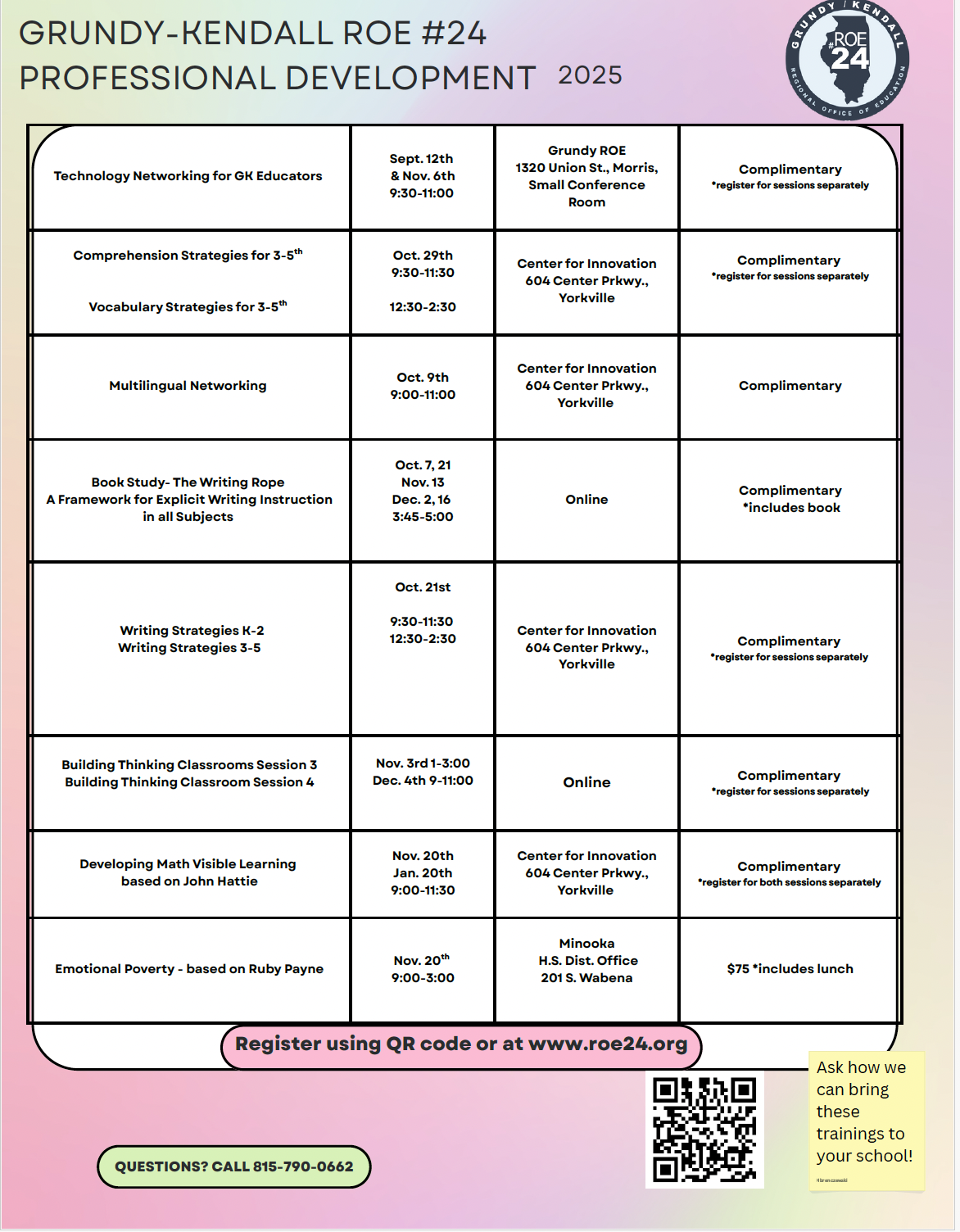
- Technology Networking- Free
- Comprehension Strategies for 3rd-5th grade- Free
- Vocabulary Strategies for 3rd-5th grade - Free
- Multilingual Networking- Free
- The Writing Rope Book Study- Free
- Writing Strategies Kinder-2nd grade- Free
- Writing Strategies 3rd-5th grade- Free
- Building Thinking Classrooms Session 3 and 4- Free
- Developing Math Visible Learning- Free
- Emotional Poverty - $75
| | | |
Considering Further Education?
Thanks to a partnership between the Grundy-Kendall ROE and the American College of Education (ACE), all Grundy-Kendall educators are eligible for an exclusive 3% tuition discount on ACE’s affordable, fully online degree programs. With master’s degrees starting under $10K and doctorates under $25K, you can earn your degree in as little as 12 months—on your schedule, without breaking the bank.
Whether you're pursuing leadership, literacy, special education, instructional design, or STEM, ACE offers flexible, accredited programs designed with working professionals in mind.
Text Link
| | | |
Coaching and Leading Moves that Matter | | | |
Empower Teachers to Identify Individual Student Needs
Educational leaders play a critical role in ensuring teachers have the knowledge and tools necessary to identify which strand of Scarborough's Reading Rope needs support for individual students. When teachers can accurately assess whether a student's difficulty stems from word recognition challenges (phonological awareness, phonics, sight word automaticity) or language comprehension issues (vocabulary, background knowledge, language structures), they can provide targeted, effective instruction. Leaders must build systems that support diagnostic thinking, provide access to quality assessment tools, and ensure teachers understand the developmental progression of both word recognition and language comprehension skills.
| | | |
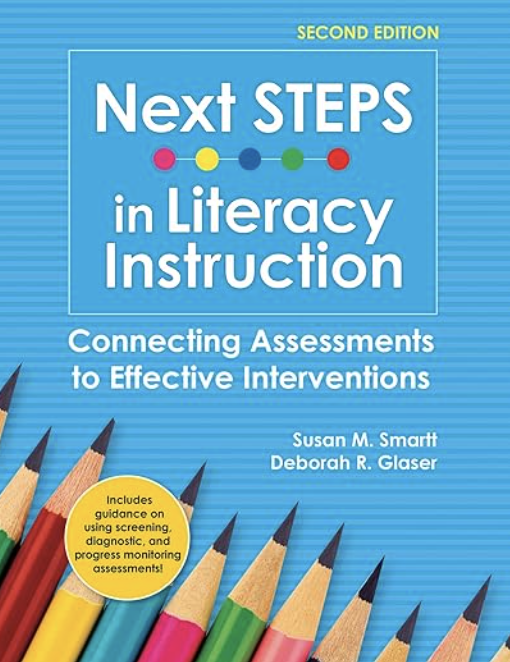
Next Steps in Literacy Instruction: Connecting Assessments to Effective Intervention
by Susan M. Smart and Deborah R Glaser
This comprehensive guide helps educators translate assessment results into evidence-based instruction and targeted interventions. Fully updated with the latest reading research, this teacher-friendly resource matches today's most popular reading assessments (DIBELS 8th Edition, Acadience Reading, easyCBM, aimswebPlus) with specific Tier 1, 2, and 3 interventions. The book provides explicit connections to Scarborough's Reading Rope and includes 90+ activities, planning worksheets, and downloadable templates that help teachers make data-driven decisions for struggling readers within MTSS frameworks.
| |
Admin
Building Systems for Data-Driven Word Recognition Support
Create Assessment Systems That Identify Specific Needs
Implement comprehensive assessment systems that pinpoint which strand of the Reading Rope requires support for each student.
- Create intentional assessment plans that include universal screeners ,local assessments, and diagnostic tools
- Create data dashboards that track individual student progress
- Establish assessment schedules that include progress monitoring for students receiving targeted support
- Train staff to interpret assessment data and translate results into instructional decisions
- Develop communication systems between interventionists and teachers as well as parents and teachers
Use diagnostic information to make informed decisions about staffing, materials, and intervention time.
- Assign interventions based on student need patterns (phonics gaps vs. vocabulary deficit vs. explicit comprehension)
- Purchase instructional materials that target identified weaknesses in specific strands
- Schedule intentional intervention blocks that allow for skill based groups rather than grade level groups
- Create professional learning priorities focused on areas where student data trends shows greatest need
Learn more about assessments at Reading Rockets
| |
Coaches
Supporting Teachers in Diagnostic Assessment and Word Recognition Instruction
Build Teacher Capacity in Assessment Analysis and the Word Recognition
Help teachers understand how to identify which strand needs support for individual students.
- Co-analyze screening data to identify patterns and students needing support
- Support teachers in creating groups based on specific needs rather than general reading levels
- Provide tools and templates for tracking student progress in targeted areas
.Help Teachers Structure Developmentally Appropriate Word Study
- Co-plan phonological awareness and phonics lessons for K-2 teachers, ensuring systematic progression through letter-sound correspondences
- Support grades 3-5 teachers in refining students phonics knowledge and implementing regular morpheme study,
- Collaborate with middle and high school teachers to plan Greek and Latin root instruction connected to content-area vocabulary
- Model using morpheme analysis strategies as a strategy to access grade appropriate text
| |
|
Did you know the Regional Office of Education can help connect your district with expert consultants for professional development?
We work with a wide range of specialists who can support your staff in areas such as:
- Leading Institute Days
- Facilitating Ongoing Professional Learning
- Hosting Book Studies
- Providing Instructional Coaching
Whether you're looking to strengthen literacy instruction, implement new curriculum, or build staff capacity, we can help you find the right match.
We understand that recent funding shifts have created challenges—but mini-grants are once again available to support professional learning in districts across Grundy and Kendall Counties.
📩 Interested in bringing customized PD to your team?
Reach out to Hallie Brenczewski at hbrenczewski@roe24.org to explore your options.
Let’s work together to empower educators and elevate student learning!
| | | | The IGA Grant for Instructional Coaching has returned! | |
| |
We are excited to announce the return of grant funds for instructional coaching.
ROE 24 has Literacy and Math coaches available to support your building teachers and admin in designing and/or implementing professional development, school improvement planning, curriculum review, or side by side coaching in the classroom .
Interested in bringing customized support to your team?
Reach out to instructionalcoaches@roe24.org to see how we can partner with you!
| | | | | |
Raffle!
Do you want to know more about the word recognition rope? Enter for your chance to win a copy of From Speech to Print: Language Essentials for Teachers
Enter here!
| | | |
Your copy should address 3 key questions: Who am I writing for (audience)? Why should they care (benefit)? What do I want them to do (call-to-action)?
Create a great offer by adding words like "free," "personalized," "complimentary," or "customized." A sense of urgency often helps readers take action, so consider inserting phrases like "for a limited time only" or "only 7 remaining!"
|
ROE 24
www.roe24.org
1320 Union St. 109 W. Ridge St.
Morris, IL Yorkville, IL
| | | | |