Message from the Chair - The Year Ahead | |
As we look ahead to the year before us, Australia’s accommodation sector stands at an important moment in time, with 2026 bringing opportunities and responsibilities.
Our mission to be at the forefront to advocate, unite and influence for our members is what guides my resolve. Your support, collaboration and encouragement to make our great sector an even better one keeps us focused and inspired.
Although we still have challenges, the last few months of 2025 proved a welcome turning point in occupancy, profitability and above all else, a sense of optimism that the worst years are now definitely behind us.
Demand for travel continues to evolve, shaped by shifting visitor expectations, workforce and skill pressures, sustainability imperatives and the need for continued investment across our cities and regions.
Our industry has repeatedly shown its resilience, adaptability and capacity to innovate — and those qualities will be essential in the year ahead.
Accommodation Australia’s focus will be firmly on advocacy that delivers practical outcomes for members. This includes progressing reforms that support workforce participation, the right migration settings and championing policies that encourage responsible investment and development, and ensuring the voice of our sector is heard clearly at every level of government.
This year we will see state elections in South Australia and Victoria. We know that getting things right in Melbourne will have a positive impact across Australia because we all see that across almost all measures and indicators, Melbourne could and should be doing better.
We will continue to engage constructively with policymakers to help create an environment where accommodation providers can thrive while contributing to broader economic and community outcomes.
To this end, only this week I was representing the sector at the Victorian Parliament at the Melbourne Economic Revitalisation Forum. It was encouraging to see business leaders invited to share concerns and work on potential solutions to unlock investment and drive economic growth.
I was also reflecting at this forum that most importantly, Accommodation Australia, will always remain a strong, collaborative advocate for our members when we share insights, strengthen partnerships and speak with a united voice.
Together, we can shape a future that is both commercially successful and socially responsible.
I would like to thank our members, board, partners and team for their ongoing commitment and leadership. I am confident that, together, we can meet the year ahead with clarity, confidence and ambition.
Many thanks,
| |
Message from the CEO's Desk | |
It’s encouraging to report the accommodation sector moves into 2026 in a much better position than we were at this time last year – especially in the bigger capitals.
Major gateway cities such as Sydney and Melbourne have benefited in the first few weeks of the year from a “Summer of events” from The Ashes to the Australian Open which have seen tourists pouring in. Other capitals have also seen a great start to the year, particularly Perth, Hobart and Adelaide. There are more details below but the occupancy figures from the end of 2025 and into January certainly bode well for the first for what’s to come in 2026.
We all know every major event means more tourists, more tourism dollars, more hotel rooms filled, more tables in restaurants booked. That means more jobs and a more thriving sector.
The Federal Parliament has resumed and although there’s much talk about the internal machinations and the future of the Coalition, the AA is staying focused on representing you to the decision makers in Canberra.
The cloud on our horizon as we head into what I hope will be a bumper year is the chronic shortage of skilled workers.
There’s been a 160% increase in key positions like chefs and cooks advertised since COVID and there are more than 30,000 hospitality job vacancies.
Where are these skilled workers to come from?
The hospitality industry already employs more than 1.33 million Australians, including 200,000 cooks, chefs and bakers.
Regional jobs are a third of the sector, and no matter what efforts are made to hire locally, job vacancies remain stubbornly high especially when it comes to skilled chefs; which was the most sponsored occupation in 2025.
We all want to hire Australian workers first, and where we can we do, but the skilled workforce is already at capacity. We see nationwide many kitchens and restaurants closed on some days or having restricted hours, especially in the regions.
That’s why we want to work closely with the Federal Government, and all sides of politics, on common-sense measures to improve the situation.
AA recently made a submission to the Joint Standing Committee on Migration and we have backed this up in our comprehensive Pre-Budget Submission to Treasury. I thank Jenny for her leadership in bringing together these documents and there’s more detail below.
In short, to help bring relief to members we want Government to increase employer-sponsored permanent skilled migration places and allow all occupations classified as skilled to be sponsored by employers for both permanent and temporary skilled migration. We need to improve visa processing times, reduce the Core Skills Income Threshold (CSIT) for regional employers and simplify labour agreements.
It is also vital that skills and training is prioritised. Our sector is increasingly exiting the formal skills framework yet employers and employees in hospitality and tourism are contributing significantly to the government revenue. We need a better balance to see our industry recognised for the value it adds to the economy.
My approach is that we don’t want to just complain, we want to be part of the solution, so we look forward to working with the Albanese Government - and all sides of politics - on policies to boost our workforce and get the right skills, training and migration settings that really work for our industry.
Kind Regards
| |
James Goodwin
Chief Executive Officer
| | By Jenny Lambert OAM, National Policy Director | | |
The Federal Parliament sits over the next couple of weeks, having already sat in January to deal with legislation in response to the devastating Bondi tragedy. Accommodation Australia has already made two substantial submissions this year, with engagement scheduled on migration and skills in this sitting.
Pre-Budget Submission
The annual pre-budget submission made to Treasury last week provided a good opportunity to comprehensively set out the policy and advocacy agenda for the accommodation sector, as well as update all of key data relating to our economic contribution and employment. Linking migration outcomes with skills funding, the submission pointed out that sectors such as hospitality have been de-prioritised in training support, including a reduction in apprenticeship funding, resulting in a fall in the number of apprentices (see below). At the same time, our industry's need for skilled migrants has increased which resulted in over 10,000 visa grants in 2024-25 and a contribution of around $64 million to the Skilling Australians Fund, which is a compulsory levy paid by sponsoring employers. We have called for the SAF levy to be halved and for more of the proceeds go to training funding that will benefit the industries that are contributing. In addition to skills and migration, the submission, which can be seen here, covers tourism promotional funding, airline capacity, short term rental accommodation, taxation and energy.
Migration Update
Earlier in January, AA and the AHA in a substantial submission to the Joint Parliamentary inquiry into Skilled Migration, we mounted strong arguments in favour of a more responsive, simpler and less expensive skilled migration scheme to help the hotel sector fill our skills gaps. The submission firstly built a comprehensive picture of the economic contribution of the hotel sector, including its workforce size and challenges including skills shortages and a decline in funding support for apprenticeships. The submission then made a number of recommendations including:
- the importance of retaining a pathway to permanency for all skilled temporary migrants.
- allowing employers to sponsor any skilled occupation for temporary or permanent skilled migration, rather than the uncertainty created by annually reviewed occupation lists.
- considering a reduction in the core skilled migration income threshold particularly in regional areas
- improving processing times for visa applications
- halving the Skilling Australia fund levy to reduce overall costs and more fairly reflect the contributions to the SAF fund made by industries through better training funding including reversing the reduction in apprenticeship employer incentives for chefs
Apprenticeship numbers continue to fall
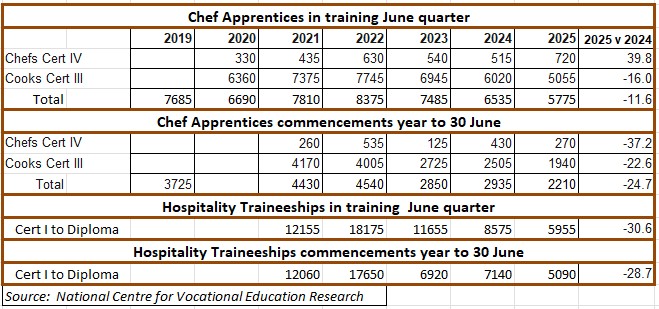
The latest data released by the National Centre for Vocational Education Research show that across all industries as at 30 June 2025, there were 307,080 apprentices and trainees in training, with almost three-quarters in trade occupations. The total number of in-training contracts decreased by 11.3% from 30 June 2024. Trade contracts decreased by 7.3%, to 221,510, while non-trade contracts declined by 20.2%, to 85,550. Compared to 2024, in the June quarter 2025, commencements in trades declined by 29.2% and for non-trade traineeships the decline was 26.5%. The largest trades decreases were among Food Trades Workers (down 1,345, or by 58.7%, to 945) and Construction Trades Workers (down 1,340, or by 27.1%, to 3,615). The table below show the figures for chefs, cooks and hospitality traineeships specifically. In the year to June the number of apprentices commencing as cooks and chefs fell by 25% to 2,210 compared to the 2,935 that commenced the previous year. Those in training fell by 12% to 5,775. These numbers compare unfavourably to the pre-COVID levels when the number of cooking apprentices in training in September 2019 were 7,685, and 3,725 commenced their training in the year to September 2019. The data also reveals that hospitality traineeships continued to dramatically fall following the removal of government funded employer incentives on 1 July 2024. Commencements fell by 29% to 5,090 in the year to June 2025 compared to the previous year, and as the table shows, there were only 5,955 traineeships in training as at June 2025.
| | |
Regards,
Jenny Lambert OAM
| | Please Note: Accommodation Australia releases a fortnightly Advocacy Update Newsletter. If you are interested in receiving this information, please click here to register your email address. | | |
Hotel Performance in December 2025
CoStar data for December shows that hotel performance remained relatively strong for all States and Territories compared to December last year with Victoria and South Australia the standout improvers in occupancy.
- National average occupancy was up 4.3% to 72.7% for December, ADR up 8.7% to $277.68 resulting in a strong rise in RevPAR of 13.4%;
- NSW experienced an average occupancy of 76.8%, up 2.8% compared with last year, with ADR up 8.9% to $252.20;
- Victoria's occupancy strongly rose 10.6% to 74.9%, and ADR also strongly up 11.6% to $244.10;
- Queensland occupancy was marginally up 0.3% to 68.8%, and ADR rose by 7.8% to $309.99;
- SA finished a strong second half of year with occupancy up 9.5% to 72.0% for December and ADR strongly up 14.3% to $252.21;
- WA occupancy up 3.7% to 76.5% and ADR up 8.7% to $271.07;
- Tasmanian occupancy up 1.4% to 76.9% and ADR up 7.5% to $263.70;
- NT occupancy up 1.6% to 39.6% but ADR down 2.1% to $166.87; and
- ACT & Canberra occupancy up 6.4% to 66.0% and ADR up 7.8% to $197.23.
Preliminary capital city CoStar data for the month to January 24th shows that hotel performance remained relatively strong for most cities compared to the previous corresponding period last year but with some modest falls in occupancy in three cities namely Melbourne, Darwin and the Gold Coast. Sydney started the year reasonably well, with a 3.5% improvement in occupancy to 77.0%, and ADR rose by 9.7% to $300.55 compared to the corresponding period in 2025. Melbourne's occupancy fall 1.2% to 73.8%, and ADR was also down by 1.2% to $248.08 (hopefully this will turn around once the full months figures are in, as the Australian Open was one week later this year); Brisbane occupancy was unchanged at 68.4% and ADR marginally down 0.6% to $220.79; Adelaide occupancy up by 6.9% to 76.7% and ADR up 4.5% to $196.27; Perth occupancy slightly up 0.7% to 75.8% and ADR up 7.7% to $253.62; Hobart occupancy up 3.0% to 90.7% and ADR up 10.5% to $273.47; Darwin occupancy down 5.2% to 33.6% but ADR up 2.5% to $147.70; Canberra occupancy strongly up 9.9% to 67.7% and ADR up 1.1% to $187.19; and Gold Coast occupancy down 4.2% to 77.4% but ADR up 7.6% to $411.34.
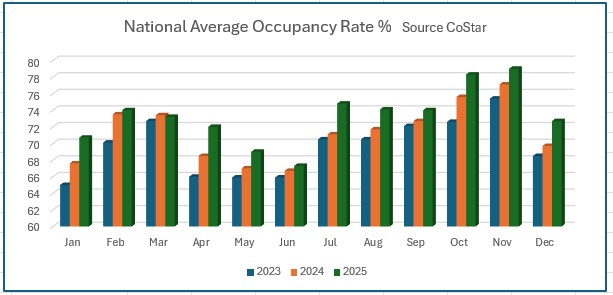
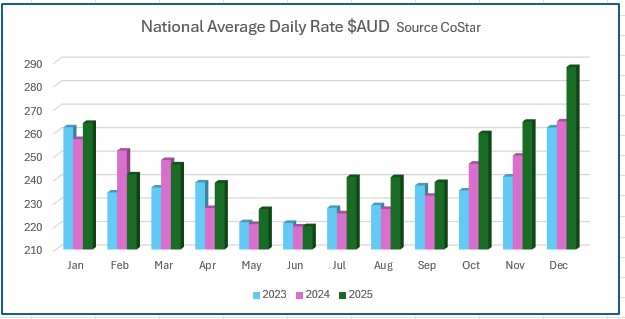
The graphs below show the national average occupancy rate and ADR for each month since January 2023.
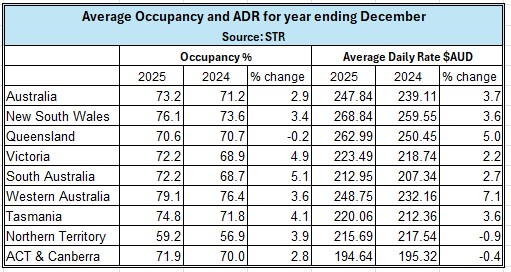
| | The CoStar hotel performance figures for the whole of 2025 as compared with 2024 are shown in the table below. The full year figures for Queensland reflected the issues they were having throughout the year, with occupancy down but one of the best results for an increase in the ADR. Western Australia's consistently strong performance is evident in a 3.6% rise in occupancy and a 7.1% increase in ADR. South Australia saw the biggest increase in occupancy for the year, but the ADR increase was more modest at 2.7%. Both of the Territories would be disappointed to see their ADR fall compared to 2024. | | |
eeger Platform Update – Strong Growth, New Features & Expanded Training Support
| | |
The eeger platform continues to scale rapidly, delivering strong performance, new capabilities, and deeper value for employers across the Tourism, Hospitality, and Travel sectors.
Free job posting until 30 June, with strong user growth across the platform
With thousands of employers and jobseekers now registered, eeger continues to grow as a key workforce tool for the industry.
What Jobseekers Are Looking For
Across the past five months, accommodation roles have consistently ranked among the most viewed jobs on eeger. Jobseekers are showing strong interest in core hotel operations such as Room Attendants, F&B Attendants, Guest Services and Front Desk roles, as well as senior and specialist positions including General Manager and Revenue and Distribution roles. Engagement has been particularly strong across luxury and large hotel brands including The Langham, Accor, Park Hyatt, The Grace Hotel, Crystalbrook Collection and Rydges, highlighting active candidate demand across both premium and high-volume accommodation environments during sustained seasonal activity.‑volume accommodation environments during sustained seasonal activity.
Expanded Directories – Training, Industry Information & Resources
The eeger directories continue to expand, with both the Training Directory and the Industry Information & Resources Directory updated regularly to provide a comprehensive view of all available programs, tools and support materials across the industry.
These directories are continually growing to list all available training programs, workforce resources and sector specific guidance — many of which are free to access. Explore them here:‑specific guidance — many of which are free to access. Explore them here:
- Training Directory: https://eeger.com.au/profile-search-results/training
- Industry Information & Resources: https://eeger.com.au/profile-search-results/industry-information-and-resources Directory
How eeger Supports Your Hiring & Training Needs
For registered employers, eeger now offers:
- Large, active talent pools with thousands of jobseekers browsing daily.
- AirCV Skills Matching to help candidates understand job requirements and improve fit.
- Integrated training resources to support onboarding, upskilling, and staff retention.
- Coming soon: industry events to help you and your staff upskill, network, and connect.
📣 Ready to get started?
Register now: https://eeger.com.au
Need help? Reach out to us at hello@eeger.com.au
| | |
Warm Regards
Emilie Howe
General Manager, eeger
| | Accommodation Australia is hosting numerous events across the country. Please visit the links below for updated list of events in each state/territory. | | Other events include Hotel Market Updates across Australia. Please keep an eye out for the calendar of events from your state /territory representatives. | | |
American Express Travel has released its Trending Destinations list for 2026, spotlighting the ten locations expected to shape global travel demand next year.
The list reflects what travellers are craving most: authentic experiences, nature led escapes, cultural immersion and premium stays that feel connected to that place.
Recent Amex Travel research reinforces this shift, with 89% of global travellers feeling more excited when visiting somewhere entirely new, and 87% wanting hotels that offer locally inspired elements. Discover the ten Trending Destinations for 2026 here. Your copy should address 3 key questions: Who am I writing for (audience)? Why should they care (benefit)? What do I want them to do (call-to-action)?
Create a great offer by adding words like "free," "personalized," "complimentary," or "customized." A sense of urgency often helps readers take action, so consider inserting phrases like "for a limited time only" or "only 7 remaining!"
| | |
Hostplus takes a hat trick
Hostplus was recently named #1 three times over, taking out Mozo and Money magazine’s Best Super Fund and Finder’s Provider of the Year.
These awards are more than just trophies on a shelf – they’re proof that Hostplus is a fund that Australians can trust. Especially in a climate where security and reliability matter more than ever.
Choosing a trusted fund is critical in today’s super landscape
The collapse of managed investment schemes First Guardian and Shield saw many hardworking Australians lose their retirement savings. Hostplus was saddened and alarmed by these stories. Read more
| | |
*Hostplus Balanced (MySuper) investment option compared to the SuperRatings Accumulation Fund Crediting Rate Survey – SR50 Balanced (60-76) Index at 30 September 2025. Past performance is not a reliable indicator of future performance.
Awards and ratings are only one factor to consider when choosing a super fund. Visit hostplus.com.au/awards to learn more about our awards.
This information is general advice only and does not take into account your personal objectives, financial situation or needs. You should consider if this information is appropriate for you in light of your circumstances before acting on it. Please read the relevant Product Disclosure Statement and Target Market Determination available at hostplus.com.au/pds and hostplus.com.au/ddo before making a decision about Hostplus.
Issued by Host-Plus Pty Limited ABN 79 008 634 704 as trustee for the Hostplus Superannuation Fund ABN 68 657 495 890.
| | |
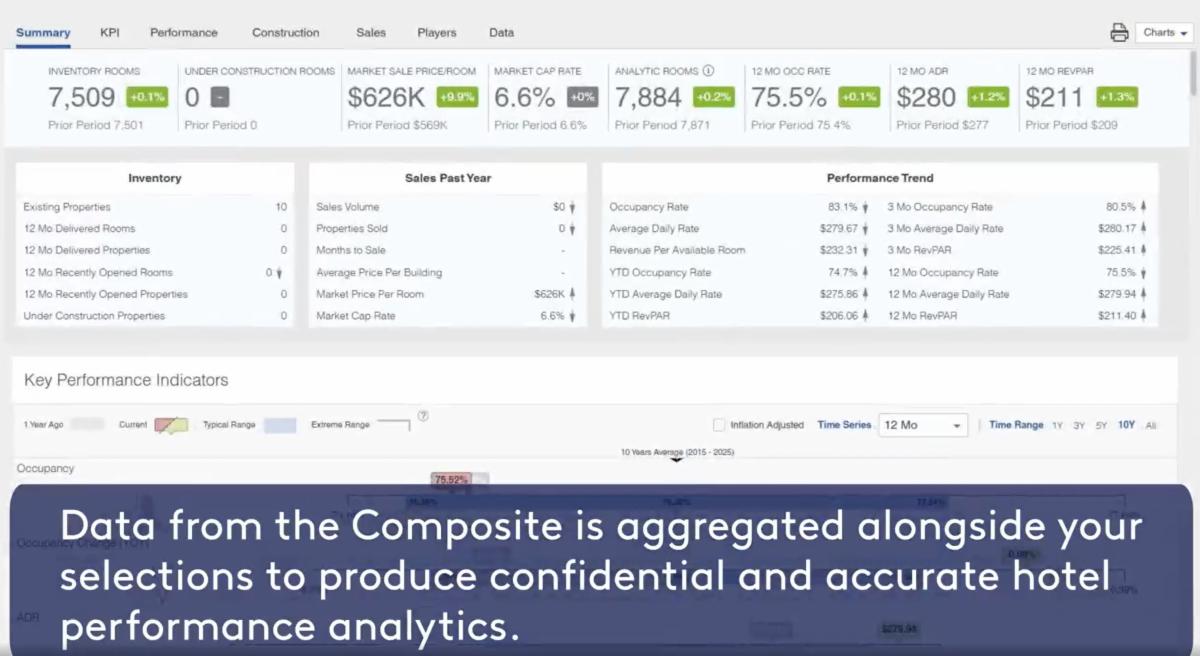
Major upgrade to CoStar’s Property Analytics tool for Hospitality
Say goodbye to static Trend reports—and hello to dynamic, on-demand insights.
No more participation lists, manual approvals or restrictions around data set volume. Moving forward, user-selected hotel data sets will be delivered through the Property Analytics tool and innovative Composite Methodology within CoStar.
This modern solution empowers our clients with unlimited access to aggregated data and analytics—secured and vetted by advanced technology to ensure confidentiality.
| | | | |