|
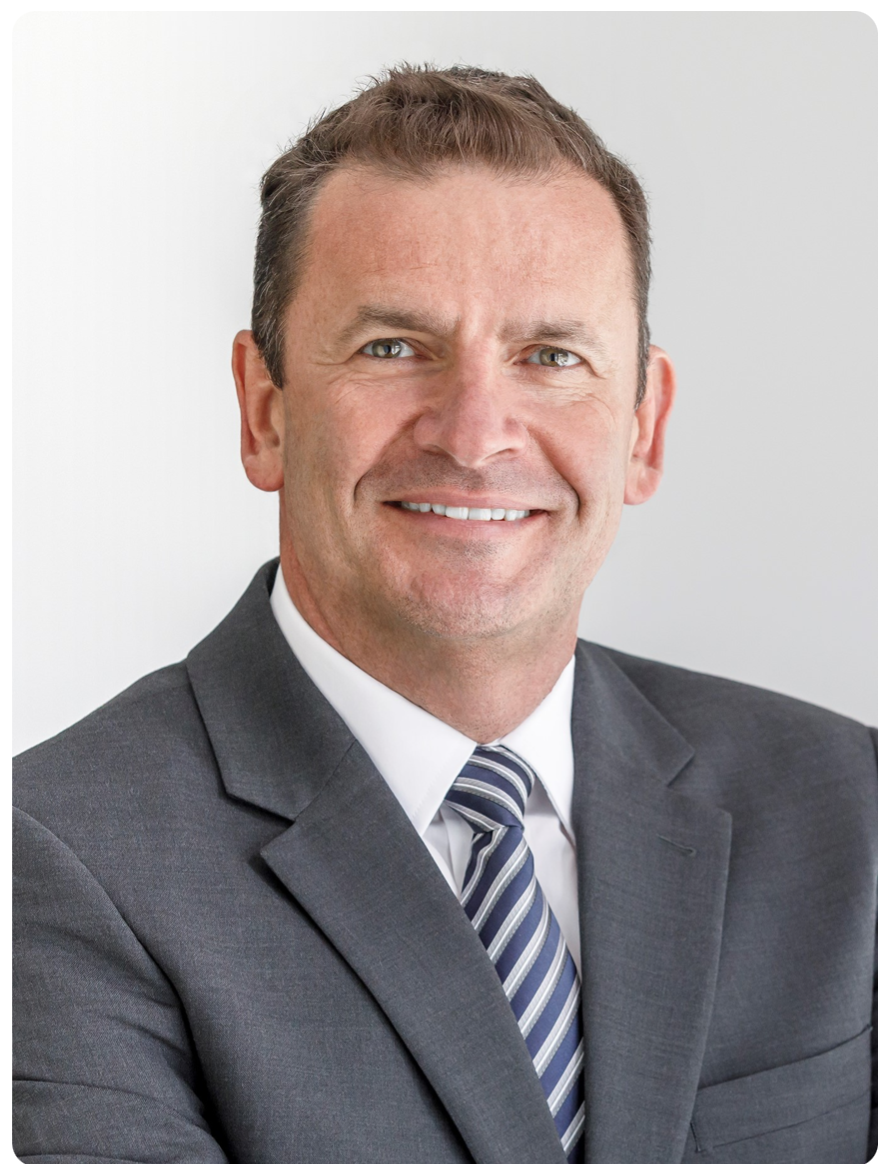
I’m pleased to write this update. The past few weeks have seen a number of important milestones for Accommodation Australia.
We confirmed our new streamlined board and structure - representing each state and territory - following member elections across the country.
The 11-person board, elected for three years, has two new members including newly elected Treasurer Andrew Bullock (1834 Hotels) of South Australia and Tasmania’s Shelley Verdouw (RACV Hobart).
I was honoured to be re-elected as Chair and great to see Emma Hynes (IHG Hotels) re-elected as Deputy Chair.
I congratulate all re-elected board members and welcome both Andrew and Shelley to the team.
This is a board that is strong on industry and governance experience, and I look forward to working with everyone to deliver against our new strategic plan to get the best possible outcomes for our members and the broader tourism sector.
The new board structure is now made up of directors representing each state and territory. This means they will be able to provide first-hand accounts of the unique issues impacting our members in their jurisdiction while having shared, national goals.
| | |
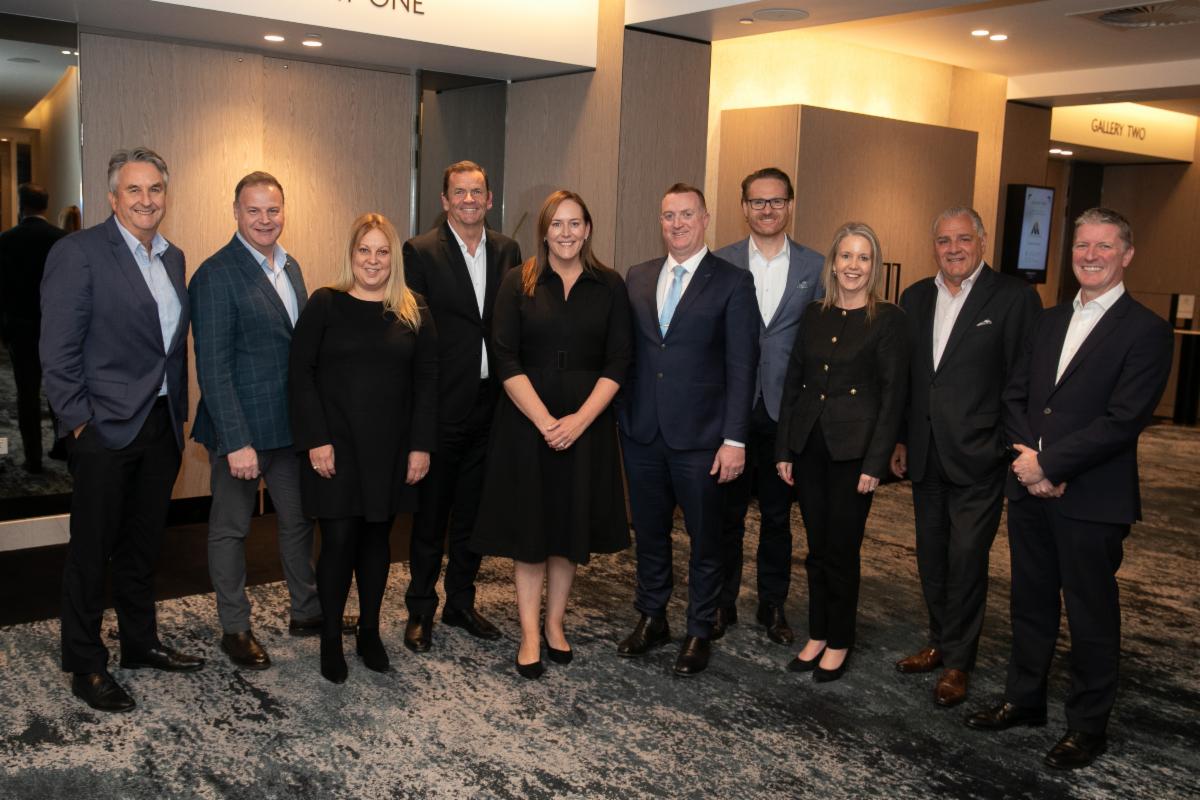
Accommodation Australia National Board
L-R: QLD - Geoff York – Crystalbrook Collection, NSW - Jason Nuell – Marriott, TAS - Shelley Verdouw – RACV Hobart, VIC - David Mansfield – The Ascott Limited, NSW - Emma Hynes – IHG Hotels & Resorts, SA - Andrew Bullock – 1834 Hotels, VIC - Adrian Williams – Accor, Pacific, ACT - Joanna Carruthers – EVT, NT - Paul Hutton – Hilton and WA - Andrew Cairns – Crown Hotels & Resorts (Absent QLD - Barry Robinson - Travel+Leisure Co
| | |
These changes successfully complete the transition and amalgamation period of the new organisation, and I have to say that the first meeting of the new Board a few weeks ago was straight down to business, approving a new strategic plan for the next three years.
Our direction is based on three pillars, evidence-based policy and advocacy, engaged members and strong governance. Combined, these pillars all work to achieve our vision of sustainable growth for members and are underpinned by our values.
| | |
I want to take the opportunity to thank and farewell three outgoing board members, particularly former Treasurer/Secretary Bruce Copland.
Bruce has put in decades of service to the accommodation sector and I would like to thank him for his tireless efforts on behalf of the industry.
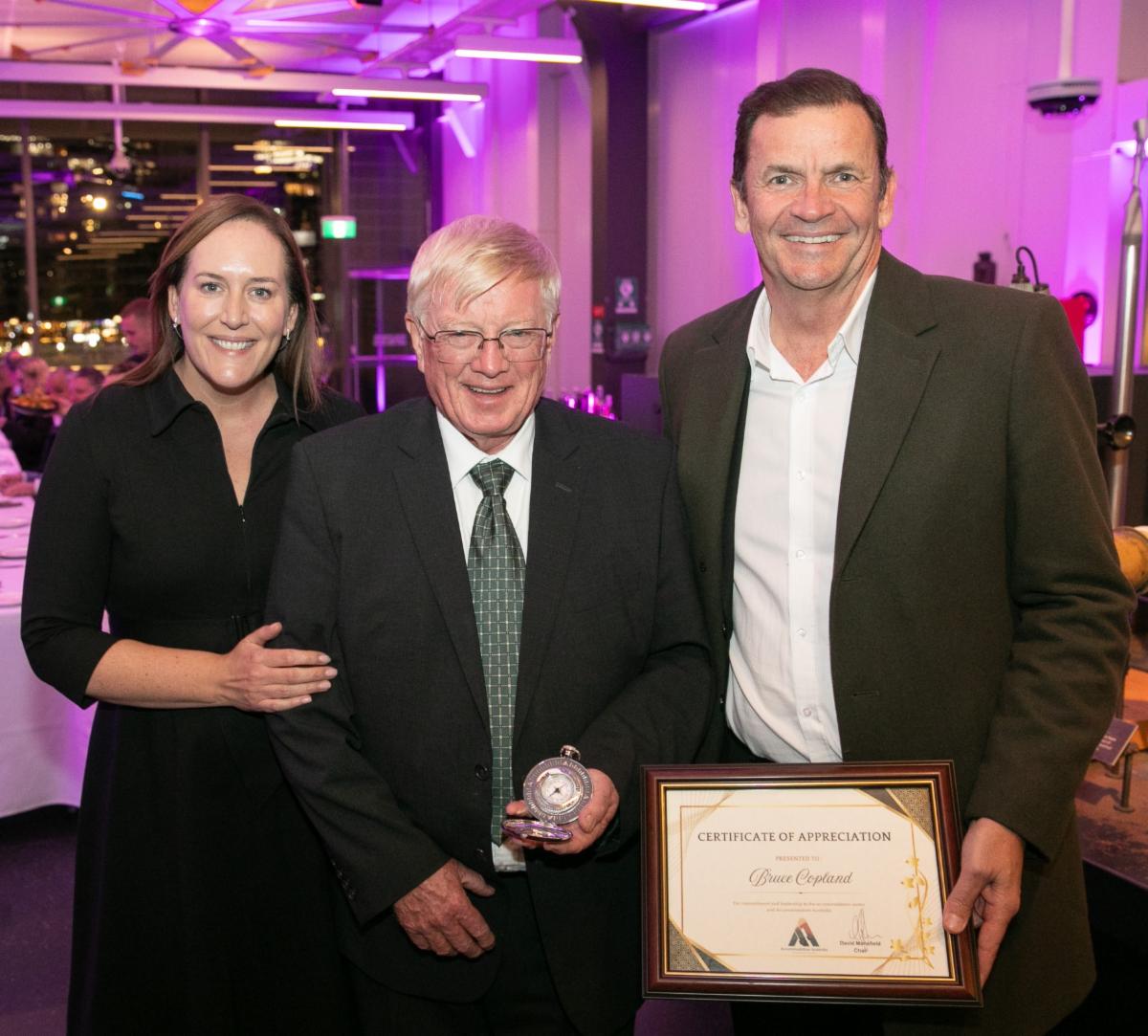
We held a special dinner in Sydney to welcome the new Board and to acknowledge Bruce’s service. I was pleased to present him with a Certificate of Appreciation for his leadership to accommodation associations over the past two decades - as well as making a valuable contribution to the broader industry over his successful hotel career.
I’d also like to pay tribute to out-going board members Julian Clark - who has stepped down from the board after many years’ service to our sector - and to Wayne Taranto. All three are champions of our industry.
This is an exciting period for Accommodation Australia and for the sector. There is a renewed energy with our new Board and a re-elected Federal Government in Canberra. It’s important we leverage the opportunities.
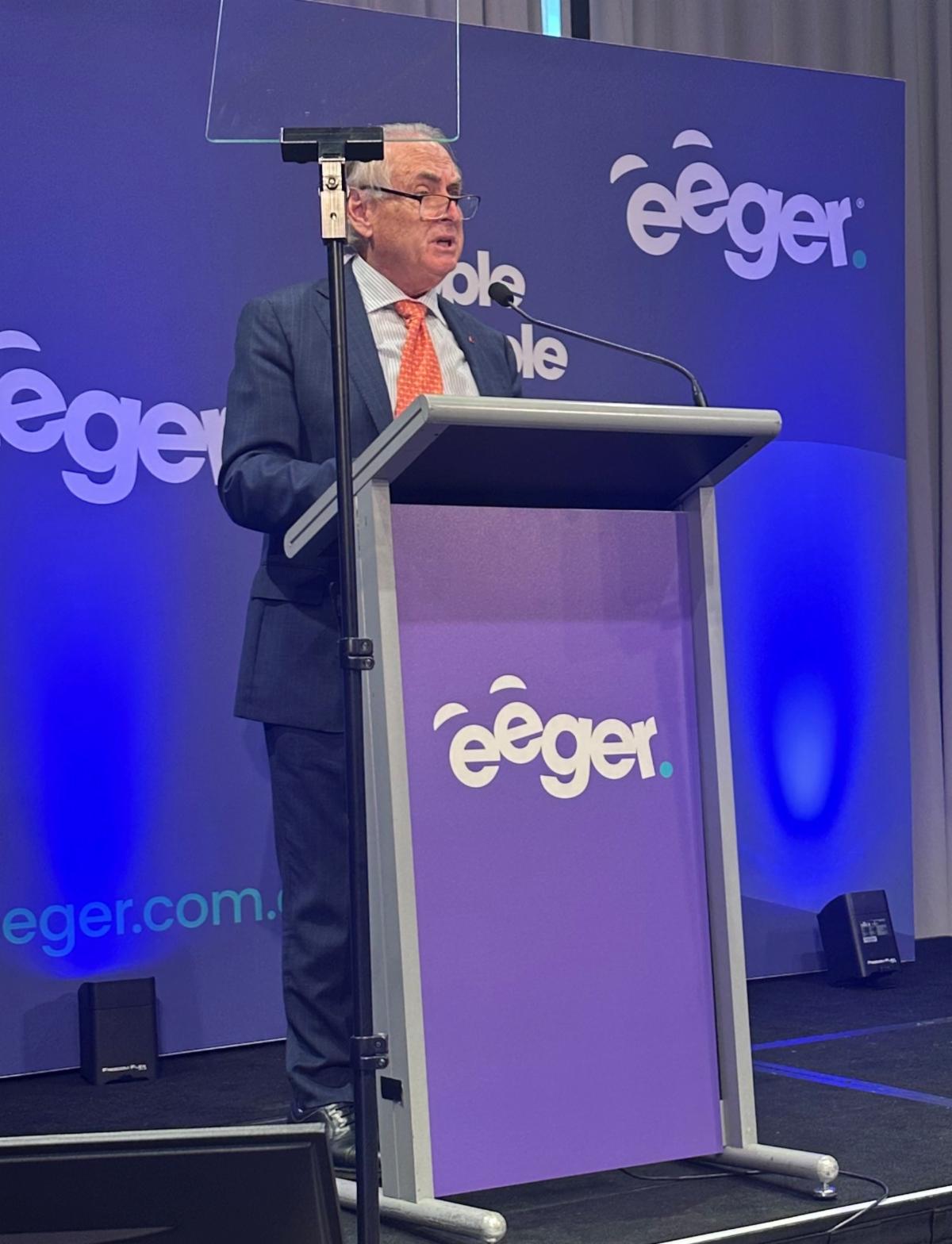
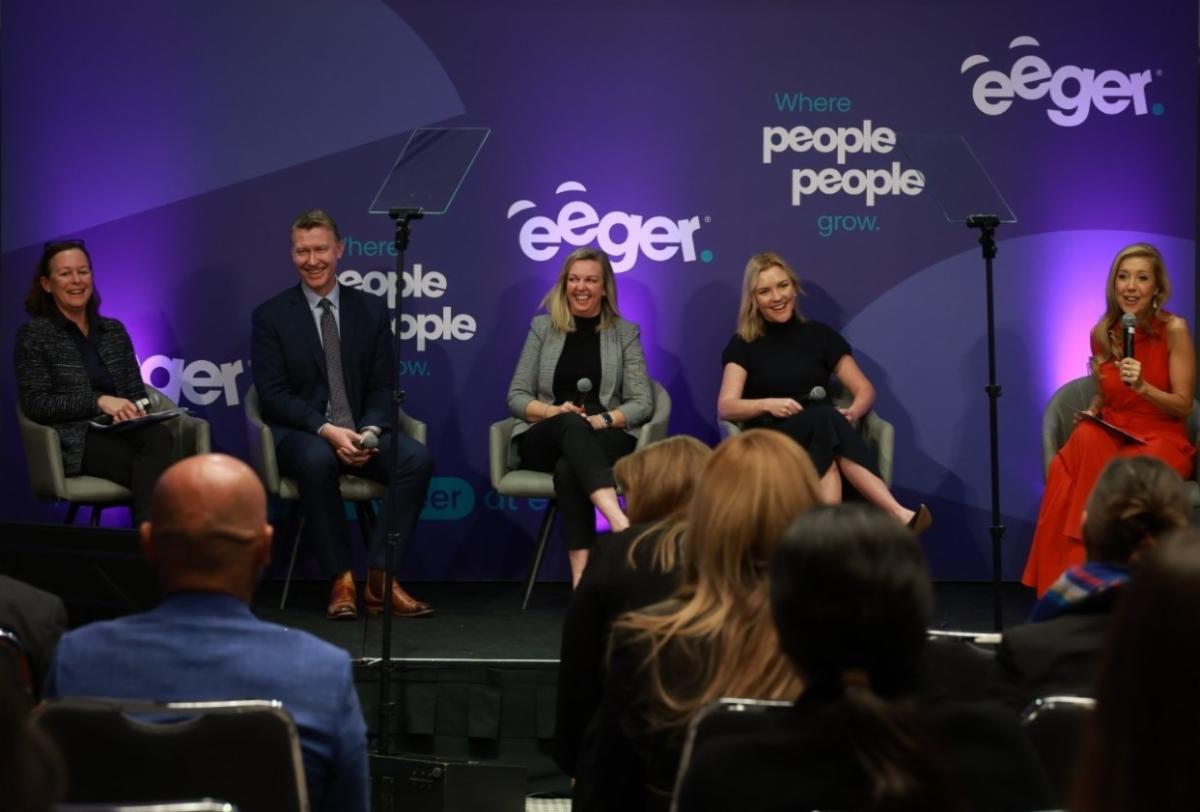
To this end, I was pleased to see the launch of the new employment and skills platform “eeger” in Sydney by the Federal Minister for Trade and Tourism, Hon. Don Farrell. Accommodation Australia has developed and is managing this Government-funded program for the entire tourism and hospitality industry – a tangible acknowledgement of our trusted relationship with government and broader stakeholders. Thank you to the eeger team for their efforts and my appreciation to the Steering Committee of Board Members who’ve provided governance and leadership over the past 18 months.
Appreciate your support,
| |
Message from the CEO's Desk | |
The mid-way point of 2025 shows the Australian accommodation sector to be in a generally positive and confident situation with workforce shortages easing slightly and occupancy rates solid – although more growth would be welcome!
Consumers are prioritising travel but pressures on household budgets remain and many Australians are increasingly choosing to holiday overseas as they hunt for value for money due to expensive domestic airfares.
It was with this in mind that I met with the Interim Aviation Industry Ombudsperson. This new federal role will establish new industry standards for airports and airlines while assisting consumers who are experiencing challenges with things such as refunds due to cancellations and lost baggage. I emphasised to the new Ombudsperson the accommodation sector’s interest in having a reliable and competitive aviation sector. Disruptions in aviation flow through to hotels, so efforts to improve consumer confidence to travel are in the broader tourism industry’s strong interest.
Much of my focus since the previous Key News Update has been on the Federal Election campaign and its outcome. The Federal Labor Government was returned to power in May, surprising many with the largest majority in generations. Prime Minister Anthony Albanese now has a strong mandate to govern which is good for business. However, the key focus of the AA will be to monitor that the emboldened Labor Government does not seek to implement new or expand the scope of policy areas that were not tested at the election including on industrial relations and environmental regulation.
Ahead of parliament resuming this week, the Prime Minister headed a delegation to China where it was encouraging that tourism was a key focus. China is critical to Australian accommodation sector and is currently the second highest country of origin after New Zealand. A return to anything close to the pre-pandemic visitation could yield a further $5 billion in revenue.
With the politicians returning to Canberra for the opening of parliament, AA was also there. The government’s key priority at the moment is improving productivity and has announced an Economic Reform Roundtable to be held in August. I attended the Visitor Economy portfolio meeting as well as the Small Business workshop which was chaired by the Minister for Small Business Anne Aly. AA has consistently raised that productivity gains can be made through the simplification of the visa and migration system, reducing red tape and duplication of state and federal arrangements as well as the potential for changed taxation arrangements for the short-term rental accommodation (STRA) property investors.
Jenny Lambert and I also met separately with the office of the Minister for Housing to raise the need for a national approach to the regulation of short-term rental market to not only level the playing field for hotel and motel operators but to also assist with addressing the housing crisis.
I was able to meet with the new Opposition Leader Sussan Ley, Deputy Ted O’Brien as well as Shadow Education Minister Jonno Duniam and Chair of the new policy committee Senator Claire Chandler. It is important we continue to engage with the Opposition because we know good government includes having a strong opposition. Jenny and I also met with the Department of Home Affairs on migration and the office of the Trade and Tourism Minister.
Overall it has been a busy week.
I end by thanking Emilie and Todd for their hard work and leadership in launching today the new employment and skills platform eeger. Minister Don Farrell spoke at the launch and is a great advocate for the sector who also enables us to have strong links with him and his Department as we deliver the project on behalf of the tourism, travel and hospitality industries. This is an exciting new project to help attract, retain and train our valuable workforce and I encourage you read more in this update and hop on-line to get involved at eeger.com.au.
Kind Regards
| |
James Goodwin
Chief Executive Officer
| | By Jenny Lambert, National Policy Director | | |
This week sees the return of Federal Parliament after a long break following the election. As James has highlighted in his CEO update, Accommodation Australia has been walking the corridors and meeting with Departments in order to progress the issues that concern members. The following are just some of the key issues that we have been engaging with over the last three months.
Demand Generation
Although the international visitor numbers continue to rise post-COVID, the 12-month rolling total overseas arrival data from the ABS illustrate how far we still need to go to return to pre-COVID visitor numbers, particularly for holidaymakers. In the year to May 2025, there were 8.37 million arrivals up by 5.6% on the year to May 2024. You need to go back to 2017 to see a similar yearly total (excluding all of the COVID-impacted years). For international holiday makers the picture is even more sobering as you need to go back to 2016 to see a yearly total at a similar level to the 3.63 million holidaymakers that arrived in the year to May 2025 (as a comparison, holiday arrivals in the year to May 2019 totalled 4.4 million). As we raised in our meeting with one of the Tourism Minister’s senior staffers this week, the need to increase the number of holiday arrivals further reinforces the importance of increasing Tourism Australia's funding to excite more interest in travelling to Australia. China and Japan remain countries with enormous potential to return to numbers previously experienced, and it was positive to see tourism receive a high profile in the Prime Minister’s China visit last week. If Chinese visitors return to close to the pre-COVID visitation, then the additional contribution to the economy will be around $5 billion. For our media release see here.
Temporary migration income threshold rises
Our industry's use of temporary skilled migration to help fill staff shortages has risen significantly in the last year, with a 206% increase in temporary skilled visa applications in the year to March 2025 from the accommodation and food services industry, up from 4,200 to 12,850. The income threshold is an important component of this process, as the salary offered to the migrant, and the market salary of the role, need to be above the threshold which was previously known as the TSMIT and now known as the Core Skills Income Threshold. (CSIT). On 1 July 2025, this threshold rose from $73,150 to $76,515. The level of the CSIT will continue to inhibit access to skilled migrants as, particularly in the regions, not only is this level well above the award wage for key occupations such as chef, but above the likely guaranteed annual earnings or market salary of the worker. This concern was raised this week with both the Assistant Minister for migration and the Department.
Action needed on chefs
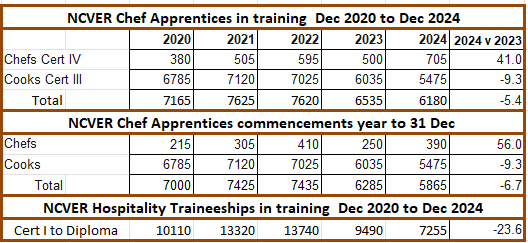
Over the next few months AA and AHA will be consulting with members about how best to address ongoing chef shortages. Solutions will include actions on apprentices, innovative training pathways, career marketing and migration. The problem has been exacerbated by falling apprenticeship numbers and the increase in the Core Skills Income Threshold. The National Centre for Vocational Education Research (NCVER) apprenticeship data for December quarter 2024 released last month shows that the number of food trades workers (including cooks, chefs, bakers and butchers) in training is down to 11,390, 5.9% less than a year ago as those who commenced during the subsidised period work their way through the system. Specifically for commercial cookery, the picture is more concerning, as the table below shows. There are only 6,180 in training as at 31 December 2024, compared with 6,535 in Dec 2024. Commencements have also fallen, down 6.7% to 5,865 for the quarter. The only glimmer of positive news is the rise in Certificate IV trades, but the numbers are still very low. In relation to the one-year hospitality traineeships, as AA had predicted, the loss of employer incentives on 1 July 2024 has resulted in a significant reduction in traineeship commencements and there were only 7255 hospitality trainees as at 31 December 2024, compared with 9,490 the previous year and 13,740 in December 2022 when the wage subsidies were in place.
| | |
Seafood country of origin labelling
The Department of Industry, Science and Resources confirmed with the AHA/AA last month that the information standard for country of origin labelling for seafood in hospitality settings (seafood CoOL) has now been finalised. From 1 July 2026 it will be mandatory for restaurants, cafes and other hospitality businesses to label where their seafood comes from in accordance with the Australian-Imported-Mixed (AIM) model. The AHA worked extensively with government to ensure these standards were as practical as possible, given the inevitability of this policy's introduction. The department has indicated that during the transition period, they will release staged education materials to support labelling changes. The standard requires that the origin of the seafood served needs to be displayed in a way obvious to the customer before they order including on printed menus, a menu board or a clear sign in the business. The labelling method is known as AIM - A for Australia, I for imported and M if it is of mixed origin. For example, on the menu it would read "Grilled barramundi (A), Pad Thai noodles with prawns and squid (M)", with a legend appropriately placed on the menu telling the customer what AIM means. More detailed information on the requirements can be found on the department's website.
NABERs Building Energy rating meeting
This week Accommodation Australia met with representatives of the Department responsible for recommending that all hotels over 100 rooms in CBDs should be required to undertake the NABERS building rating system. At the moment CBD office buildings are required to have their building rated before sale or lease. The draft plan will require both office buildings and hotels to undertake certification periodically every three years. The process comes at a cost in time and money, and there are concerns about the difficulty some heritage hotels would experience in achieving a high rating. At the moment only about 120 hotels have voluntarily undertaken the NABERs ratings process so the proposal for it to be mandated would see many more hotels having to go through what is a costly exercise. We have strongly advocated that hotels are already undertaking significant energy improvements driven by international pressures as part of a global group, or by customers or simply to reduce energy costs which have risen substantially. We have made it clear that we are opposed to mandating the scheme, and that much can be achieved through better education and also a clearer understanding of how customers will be influenced by the rating system.
Regards,
| | |
Hotel Performance in June 2025
The latest STR accommodation data released for June 2025 showed a more modest performance compared to the stronger last couple of months with both occupancy and ADR slightly up compared to June last year. In what is generally the weakest month of the year, the average occupancy in the month of June across Australia was 67.3% compared with 66.7% in 2024, and the Average Daily Rate was flat at $219.93 compared with $219.77 in June 2024. Revenue per available room in June 2025 was $147.92, a rise of 0.9% from $146.62 in 2024. Occupancy rates for June 2025 were up compared to last year in all States and Territories except for Queensland but ADR changes were more variable, rising in Queensland, SA, Tasmania, ACT and WA, but falling in the remaining states. In the year to June 2025, Australia's average occupancy rate was 71.0% compared to 69.4% for the previous year, and the ADR average was up 1.0% to $239.60, a rise which is still below the inflation rate. New Zealand saw a drop in both occupancy and ADR in June 2025 with occupancy 53.9% in May last year to 54.5% this year. with ADR down by 2.3% to NZD188.36 compared to last year.
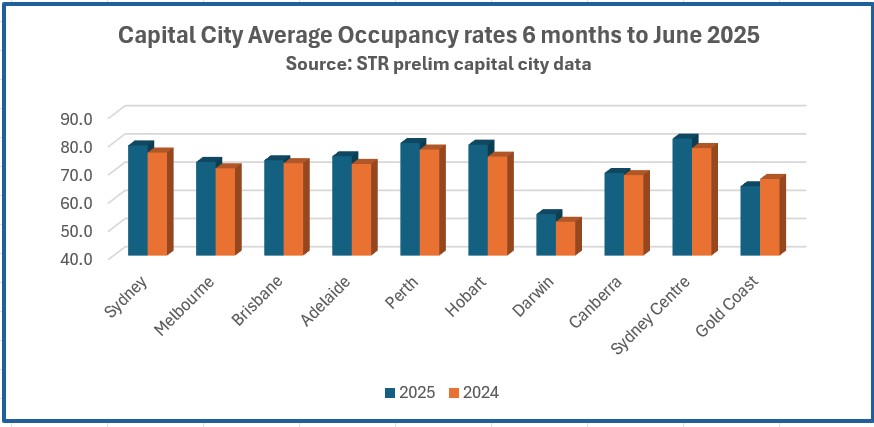
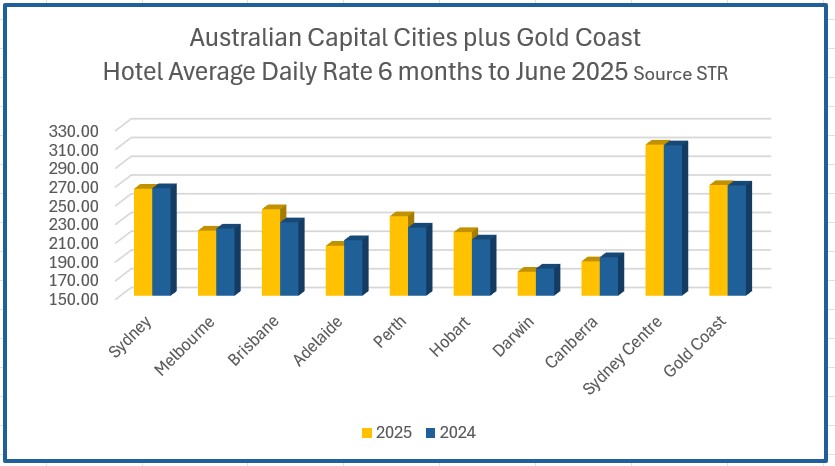
Preliminary capital city STR data for the month to 19th of July shows that hotel performance strengthened compared to June and also compared to the previous year with only Brisbane seeing a drop in occupancy compared to last year but the city was well up on ADR and RevPAR. Compared to the same period last year, Sydney experienced a strong 11.3% improvement in occupancy in the month to the 19th of July to 80.4%, and ADR rose 6.5% to $246.12. Melbourne's occupancy rose 7.3% to 73.6%, and ADR up 0.9% to $199.93; Brisbane occupancy down 0.8% to 80.2%, and ADR strongly up 19.0% to $284.31; Adelaide occupancy up 9.7% to 76.2% and ADR up 12.4% to $201.14; Perth occupancy up 10.7% to 81.0% and ADR up 8.7% to $226.14; Hobart occupancy up 11.6% to 75.7% and ADR down 0.4% to $180.94; Darwin occupancy down 6.5% to 83.6% and ADR up 2.8% to $265.25; Canberra up 3.5% to 84.3% and ADR up 1.2% to $205.41; and Gold Coast occupancy up 5.2% to 77.0% and ADR up 10.3% to $295.96.
The graphs below derived from the STR data show the monthly average performance of occupancy and ADR across Australia since January 2023.
| | | | Information provided by STR | | |
eeger is now live — and it’s transforming the way our industry connects!
| | |
We’re proud to introduce eeger, the first-of-its-kind central hub designed to power the future of our workforce. Whether you're hiring, training, or developing your workforce, eeger brings together jobs, careers, training opportunities, and industry resources, all in one place.
✅ Free job advertising throughout 2025
With over 5,000 job seekers already registered, now is the perfect time to post your vacancies and tap into a growing talent pool.
Build your employer brand
Create an employer profile to showcase your business, even if you're not hiring right now. Your presence helps attract future talent and strengthens your pipeline.
Grow with us
Your engagement is key to shaping eeger into the complete workforce solution our industry needs. By participating, you're not just filling roles, you’re helping build a stronger, more connected future for our industry.
📣 Ready to get started?
Register now: https://eeger.com.au
Need help? Reach out to us at hello@eeger.com.au
| | |
Warm Regards
Emilie Howe
General Manager, eeger
| | Accommodation Australia is hosting numerous events across the country. Please visit the links below for updated list of events in each state/territory. | | Other events include Hotel Market Updates across Australia. Please keep an eye out for the calendar of events from your state /territory representatives. | | |
Ecotourism Australia’s Sustainable Tourism Certification is designed for all businesses that operate in the tourism supply chain in a non-nature space, such as accommodation providers, who focus on and prioritise sustainable practices. Our certification program is a comprehensive business development tool that helps businesses ensure that they are operating responsibly by empowering them to meet global best practice sustainability standards.
On top of assuring travellers that your business is backed by a strong, well-managed commitment to sustainable practices, Sustainable Tourism Certification offers numerous benefits, including:
For more information on Sustainable Tourism Certification, follow the link here: https://ecotourism.org.au/sustainability/businesses/sustainable-tourism-certification/
| | |
CoStar has launched powerful hospitality property analytics directly within CoStar + Benchmark! Need insight for a feasibility or quick analysis of another location or type of properties. Through Property Analytics, instant access to comprehensive data on occupancy, ADR, RevPAR, and market trends. New functionality that maintains confidentiality with speed and flexibility to have insight in your hands. No more questions or additional costs, just insightful aggregated competitor insights in real-time.
Stay ahead with the most trusted name in commercial real estate intelligence — CoStar’s hospitality analytics are here to elevate your strategy. Read More.
| | | | |