|
The global uncertainty created by the escalating conflict in the Middle East was the key focus of the national Accommodation Australia Board meeting held in Adelaide this month. Having the data, insights and understanding of what’s happening and what can be done, are crucial for the organisation and the sector it represents.
It is clear there is a noticeable impact on Australia’s accommodation sector, with many operators already reporting softer forward bookings and growing consumer hesitation around travel spending.
While Australia remains a safe and attractive destination, international events of this scale inevitably affect traveller confidence, airline capacity, fuel prices and broader economic sentiment. Our industry has experienced this before — and once again, accommodation providers are being asked to navigate circumstances largely outside their control.
Members across metropolitan, regional and resort markets are telling us that consumers are becoming more cautious with discretionary spending, particularly around holidays and corporate travel. Rising aviation costs and ongoing volatility in global markets are also contributing to uncertainty in forward demand.
The Board also noted despite a downturn, workforce pressures remain across the country and the sector remains heavily reliant on migration. The AA is right across the political context and meeting with a range of politicians so they understand our needs, but it is also good to see the AA working and getting results for you on practical measures to improve visa processing. My thanks to Jenny Lambert for leading this work and the respect that she has within Home Affairs provides us with invaluable access to help address member concerns.
Despite the challenges, I believe Australia’s tourism and accommodation sectors remain resilient. The strength of our domestic market, the quality of our tourism offering and the professionalism of our operators continue to position us strongly for the long term. I encourage members to remain focused on operational resilience, customer experience and workforce retention while continuing to adapt to changing market conditions.
Accommodation Australia will continue advocating on behalf of members to ensure governments understand the importance of maintaining consumer confidence and reducing unnecessary cost pressures on businesses during periods of instability. To this end, we’re investing in our membership engagement so we can do better and be stronger. Never has our Vision “To lead sustainable enduring growth for our members” been more important.
In coming weeks you’ll see a refreshed website making it easier for stakeholders to know who we are and what our key issues are and we’re also increasing our policy and advocacy resources as more pressure is coming from governments for research and submissions. I always think the key difference between us and some other groups is that we have the policy depth to not only raise issues but work through solutions – reinforcing to me the organisations’ purpose to be an “influential advocate for a better future”.
I want to end by saying how pleased I am to see the workforce platform developed and run by the AA, eeger, has had a one year Australian Government funding extension. There’s more details from Emilie below but the importance eeger continues with 340 businesses and close to 16,000 registered job seekers.
Thank you for your continued commitment and membership.
| |
Message from the CEO's Desk | |
The global tourism industry has once again been reminded how quickly geopolitical events can influence international and domestic traveller confidence, aviation capacity, and economic sentiment. The continuing conflict in the Middle East and the flow-on impact to domestic fuel supplies and cost are impacting travel patterns, operating costs, and consumer confidence.
Despite these challenges, the medium- and longer-term outlook for Australia’s accommodation industry remains cautiously positive. Domestic travel demand continues to provide a strong foundation for many operators, particularly across city and regional destinations that are not too far from major cities. We know regional areas, particularly those reliant on the ‘drive’ market are struggling and remote areas are under financial stress.
International visitation is steadily rebuilding, with key markets across Asia showing encouraging momentum. Importantly, fresh research from Tourism Australia shows we remain viewed globally as a safe, stable, and highly desirable destination. In periods of international uncertainty, those attributes become even more valuable.
The recent Accommodation Australia Board meeting – held in Adelaide this month – highlighted that the operating environment for accommodation providers remains complex. Workforce shortages, insurance costs, energy prices, taxation settings, and broader affordability pressures continue to impact businesses across the country. Accommodation Australia will continue advocating strongly for policies that support investment, workforce development, aviation competition, and sustainable tourism growth.
The Federal Budget was handed down in Canberra last week and thanks to National Policy Director Jenny Lambert for attending the Budget Lock-Up and leading the summary – more below. Her efforts with Chris Gatfield from AHA ACT meant it was well researched, well put together and issued to members very quickly on Tuesday night. Certainly a mixed bag of results for our sector, but this was a tough budget and complex political environment.
The main point of concern in the Opposition’s Reply was the focus on cutting migration numbers. The speech was light on details but follows the same general tone of the past few months that immigration is too high, standards too low and migration numbers should be linked to the number of houses available. The AA has consistently said to the Coalition that our sector relies on migration to fill workforce needs and if they were to proceed with their plans, we would strongly push for a separate hotel industry labour agreement to essentially “ring-fence” the sector from the conditions of the broader migration reforms. We will continue to engage the conservative parties about our needs.
And finally, I am pleased to report Minister for Trade and Tourism Don Farrell has approved an extension of funding for our workforce and careers platform - eeger. This is welcome news and in coming weeks we will meet with the Advisory Committee to refocus and review priorities as eeger enters the new financial year as a supported but commercial enterprise.
Thank you for your continued commitment to our industry and to the millions of guests who choose to stay in Australia each year.
Kind Regards,
| |
James Goodwin
Chief Executive Officer
| | By Jenny Lambert OAM, National Policy Director | | |
The Federal Budget has come and gone and, this year, it has made a bigger splash than normal due to the significant taxation changes. It will be interesting to see over the coming weeks how that plays out in the opinion polls as well as in parliament.
Federal Budget
The big focus in this year’s budget is on changes to taxation arrangements, but there was some sting in the tail for our industry with increases in the passenger movement charge and further detrimental changes to apprenticeship incentives.
Key measures relating to hospitality, accommodation, and tourism are:
- 2026-27 migration planning levels – the government has kept the permanent planning levels the same as for this year which is a positive. Further shift to taking in on-shore applicants so as not to affect the net overseas migration numbers.
- Taxation changes – as foreshadowed before budget night, changes to negative gearing, capital gains tax and taxation of trusts.
- Instant asset write off for purchases below $20,000 has been made permanent for small business
- Apprentice employer incentives – incentive payments for large employers (over 200 employees) removed completely which is sure to further affect cooks
- Passenger movement charge – to increase by $10 to $80 from 1 January 2027.
- Tourism Australia funding reduced by $10 m in 2026-27 (and $50 million over five years) and does not return to current funding levels over the forward estimates
- Working Holiday makers – tightening controls and introducing more ballots to control numbers
For a full budget summary prepared by AA and AHA in the Budget lock up, click here.
Migration
Migration is becoming an increasingly political issue with a great deal of misinformation and emotion swaying much of the public against migration.
Following the substantial submission to the Joint Parliamentary inquiry into Skilled Migration earlier this year, this week the AHA and AA appeared before the Committee to further our advocacy support for migration and the important role it plays in our industry. We mounted strong arguments in favour of a more responsive, simpler and less expensive skilled migration scheme to help the hotel sector fill our skills gaps. the importance of retaining a pathway to permanency for all skilled temporary migrants.
Over the last few months, AA has had extensive engagement with the Department of Home Affairs to address some of the concerning refusals that members have received to sponsorship applications and better educate the department about our needs. This has been a very productive engagement which has resulted in a checklist of key issues that members should address in their applications to ensure a better chance of success. This list was included in Issue #65 of our fortnightly advocacy update, a copy of which can be seen here. Members are reminded that they are welcome to opt in to receive the fortnightly update by emailing the office at mail@accommodationaustralia.org. Back copies of the Advocacy Update can be found here.
Apprenticeship numbers continue to fall
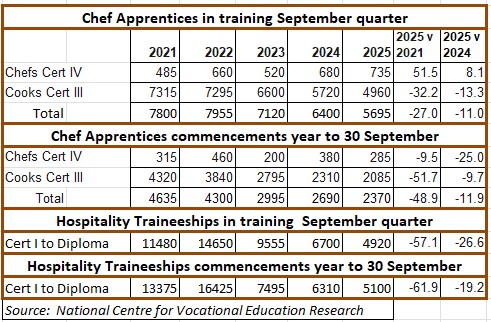
The latest apprenticeship figures released by the NCVER for September 2025 tell a story of winners and losers. The Key Apprenticeship Program which saw incentives for construction and energy workers go up has had an impact. Commencements in construction trades rose by 36.5% and electrical and telecommunication apprentices up 14.4%. As the table below shows, cook and chef commencements fell in the year to September 2025 by 12%, and the number in training has dropped by 11% to 5,695. The previous loss of incentives for hospitality traineeships continues to see those numbers fall, with commencements down 19.2% on the previous year, and the hospitality traineeships in training fall by 27% to 4,920. Importantly, these falling chef numbers predate the further reduction in incentives which took effect on 1 January 2026 which is sure to make the problem worse as will the loss of incentives entirely for large employers which took effect from Budget night May 2026.
| | |
NABERs Energy rating system
AA arranged a site visit at Sydney Hotels on 17 March 2026 for officials from the Department Climate Change, Energy, the Environment and Water (DCCEEW) relating to the plan to make the NABERS building energy rating system compulsory for hotels with more than 100 rooms. The main purpose of the site visit was to demonstrate our advocacy position that although NABERs is a valuable option for addressing carbon emissions, it is not the only option and that hotels were making significant efforts using a range of different programs. The key goal is to, if possible, avoid a compulsion to put in place a program which is expensive to implement and to renew.
| | |
Regards,
Jenny Lambert OAM
| | |
Hotel Performance in April 2026
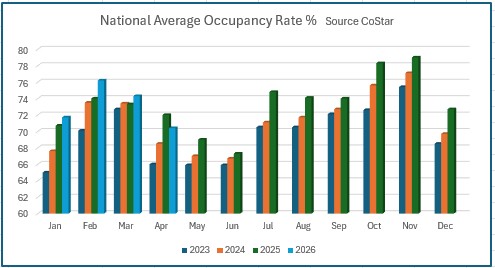
CoStar data for April 2026 shows that hotel performance slipped on average across Australia the face of global and fuel uncertainty, with most capital cities holding up, but regions slipping. In terms of occupancy, Queensland held up the best, with the worst affected being ACT, NT and WA.
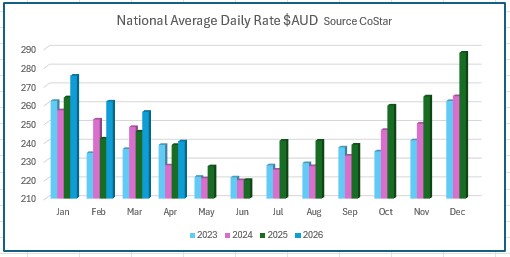
- National average occupancy was down 2.2% to 70.4% for April, ADR slightly up 0.8% to $240.41 resulting in a fall in RevPAR of 1.5%. Across the first four months, occupancy was up 0.8% and ADR up 4.4%
- NSW experienced an average occupancy of 73.7%, down 1.3% compared with April last year, with ADR up 0.3% to $253.33. In the first four months, occupancy was up 1.1% and ADR up 5.5%
- Victoria's occupancy fell 2.5% to 68.7%, and ADR fell 3.1% to $202.80; Year to Date occupancy was up 0.1% and ADR up 2.0%.
- Queensland occupancy fell by 0.8% to 67.9%, but ADR rose by 3.1% to $267.65. YTD occupancy rose 0.8% and ADR up 4.0%.
- SA occupancy down 3.3% to 71.9% for April but ADR up 3.8% to $242.05. YTD occupancy was up 2.6% and ADR up 6.1%.
-
WA occupancy down 4.2% to 74.8% but ADR up 1.3% to $246.25. YTD occupancy was up 1.2% and ADR up 6.4%.
- Tasmanian occupancy down 3.6% to 73.3% but ADR up 4.1% to $220.91. YTD occupancy down 0.2% and ADR up 8.2%.
-
NT occupancy down 4.6% to 55.9% but ADR up 4.9% to $193.67. YTD Occupancy down 1.6% but ADR up 2.4%.
-
ACT & Canberra occupancy down 10.7% to 64.1% and ADR also down 6.6% to $176.26. YTD occupancy down 0.8% and ADR down 1.3%.
Preliminary capital city CoStar data for the month to May the 16th shows that hotels in most of the capital cities are on average doing reasonably well:
- Sydney saw a 2.3% rise in occupancy to 78.5%, and ADR was up 3.3% to $259.94
- Melbourne's occupancy rose 3.7% to 72.0% and ADR rose 1.8% to $201.51
- Brisbane occupancy rose 1.8% to 75.4% but ADR fell 6.3% to $278.31 (noting ATE was in Brisbane last year)
- Adelaide occupancy rose by 0.7% to 74.5% and ADR rose 10.1% to $205.40
- Perth occupancy fell 1.1% to 77.9% but ADR was up 5.0% to $242.86
- Hobart occupancy down 4.0% to 68.8% and ADR down 4.3% to $184.71
- Darwin occupancy fell 5.8% to 68.8% but ADR rose 8.3% to $216.18
- Canberra occupancy was up 2.9% to 64.5% and ADR up 4.4% to $182.91, noting that Budget night was included in this period with an ADR for the night of $261.06 but occupancy of only 79.4%
- Gold Coast occupancy down 2.5% to 60.9% but ADR up 6.7% to $263.72
The graphs below derived from the CoStar data show the monthly average performance of occupancy and ADR across Australia since January 2023. The continued upward trend in national occupancy over the past four years has been pared back by the more mixed results for April 2026.
| | | | Data provided by STR CoStar | | |
eeger Platform Update – Continued Growth, Industry Events Now Live & Expanded Workforce Support
| | |
The eeger platform continues to demonstrate strong and sustained growth as a national workforce solution for the Tourism, Hospitality, and Travel sectors, supporting employers, jobseekers, educators, and industry partners to connect more effectively.
eeger has now reached 16,066 registered users. The platform continues to exceed key targets across jobs, career pathways, and content, reinforcing its role as a central workforce tool for the visitor economy.
Free Job Posting Continues Until 30 June
Employers can continue to post jobs on eeger for free until 30 June 2026, helping businesses promote vacancies to an active and growing talent pool across the sector.
Industry Events Now Live
The new Industry Events feature is now live on the eeger home page, providing a central national hub for industry events across Tourism, Hospitality, and Travel.
The feature highlights conferences, networking events, and professional development activities across the industry. This new capability supports workforce development, strengthens industry connectivity, and provides additional value for employers and industry professionals seeking opportunities to grow, connect, and engage.
National Engagement Supporting the Future Workforce
eeger has continued to deliver a strong national engagement program across industry events, conferences, tourism forums, education activities, and careers expos. Recent activity has included exhibiting, presenting, attending, and partnership roles across all major states, supporting stronger connections with employers, educators, students, graduates, and emerging talent.
Recent careers and education engagement have included The Big Meet in Brisbane and Adelaide, the Melbourne Careers and Employment Expo, the Adelaide Careers and Employment Expo, the Careers Expo: Pathways with Purpose in Western Australia, the Brisbane Careers and Employment Expo, and the Careers Advisers Association of NSW & ACT New Careers Advisers Day.
eeger also participated in the Young Tourism Network Career Connections Night, which generated a positive response from graduates and students studying in the Tourism, Hospitality, and Travel sectors. These events continue to reinforce the importance of direct engagement with the future workforce and provide a valuable opportunity to promote accommodation, hospitality, tourism, and travel careers to jobseekers who are actively exploring industry pathways.
This activity has strengthened eeger’s visibility nationally, supported candidate and employer growth, and helped position the platform as a central tool for career discovery, job search, training, and industry connection.
Ready To Get Started?
Register now: https://eeger.com.au
Need help? Contact us at hello@eeger.com.au
| | |
Warm Regards
Emilie Howe
General Manager, eeger
| | Accommodation Australia is hosting numerous events across the country. Please visit the links below for updated list of events in each state/territory. | | Other events include Hotel Market Updates across Australia. Please keep an eye out for the calendar of events from your state /territory representatives. | | |
This information is general advice only and does not take into account your personal objectives, financial situation or needs. You should consider if this information is appropriate for you in light of your circumstances before acting on it. Please read the relevant Product Disclosure Statement and Target Market Determination available at hostplus.com.au/pds and hostplus.com.au/ddo before making a decision.
Issued by Host-Plus Pty Limited ABN 79 008 634 704 as trustee for the Hostplus Superannuation Fund ABN 68 657 495 890.
| | |
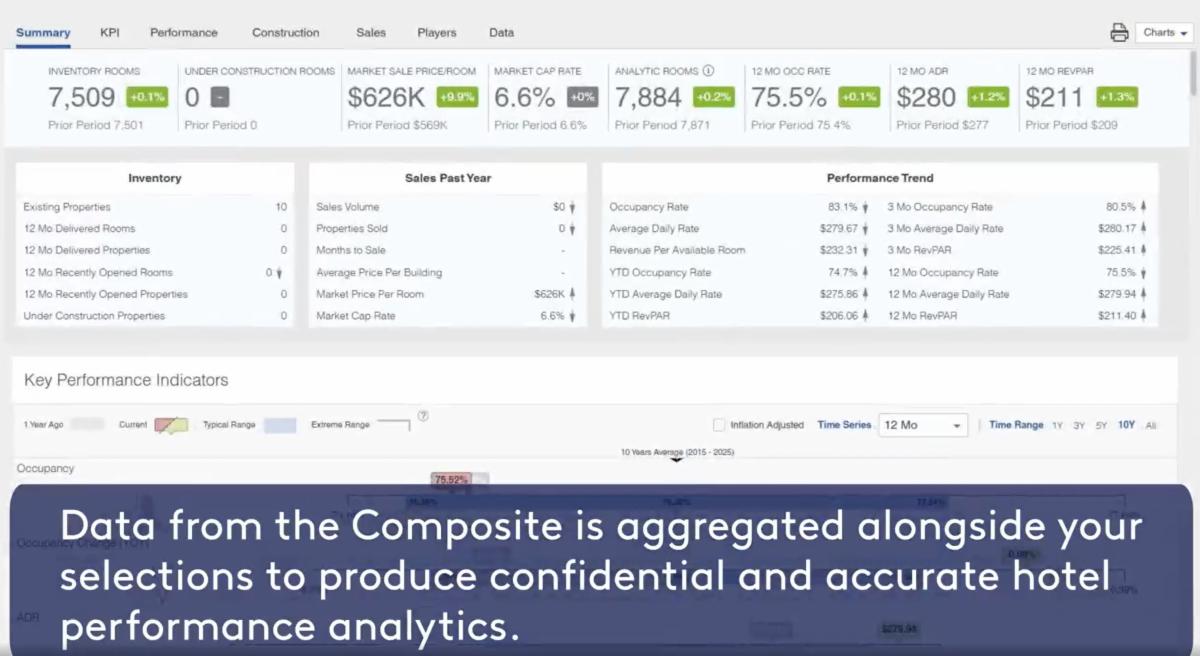
Major upgrade to CoStar’s Property Analytics tool for Hospitality
Say goodbye to static Trend reports—and hello to dynamic, on-demand insights.
No more participation lists, manual approvals or restrictions around data set volume. Moving forward, user-selected hotel data sets will be delivered through the Property Analytics tool and innovative Composite Methodology within CoStar.
This modern solution empowers our clients with unlimited access to aggregated data and analytics—secured and vetted by advanced technology to ensure confidentiality.
| | | | |
The 2026 Tourism Business Capability Subsidy is now open, offering eligible Queensland-based
accommodation providers up to $2,000 for training or accreditation — including Ecotourism Australia's
globally recognised Sustainable Tourism Certification.
Applications close 30 June.
Don't miss out, click here for more information.
| | | | |