|
It is great to see tourism and the accommodation sectors taking the positive spotlight over the past few months, with Accommodation Australia helping to drive those constructive discussions.
Prime Minister Anthony Albanese headed to China recently to strengthen the relationship between the two countries, and he had the travel and tourism sectors as a top priority. We know China is critical to the growth of the Australian accommodation sector. There's been a steady increase in the past few years, but we'd love to see Chinese visitor numbers continue to increase. A return to anything close to the pre-pandemic visitation could yield a further $5 billion into the Australian economy.
I had the opportunity to speak with and discuss these and other issues with the Prime Minister earlier this month. And although physical products like wine and steel often make the news in relation to trade, it’s clear to me that he and his federal colleagues do appreciate the importance of tourism and a healthy accommodation sector. However, our work to constantly remind them of this is never done and I commend the work of our National CEO James Goodwin, who works to keep not just the politicians but the bureaucrats well informed.
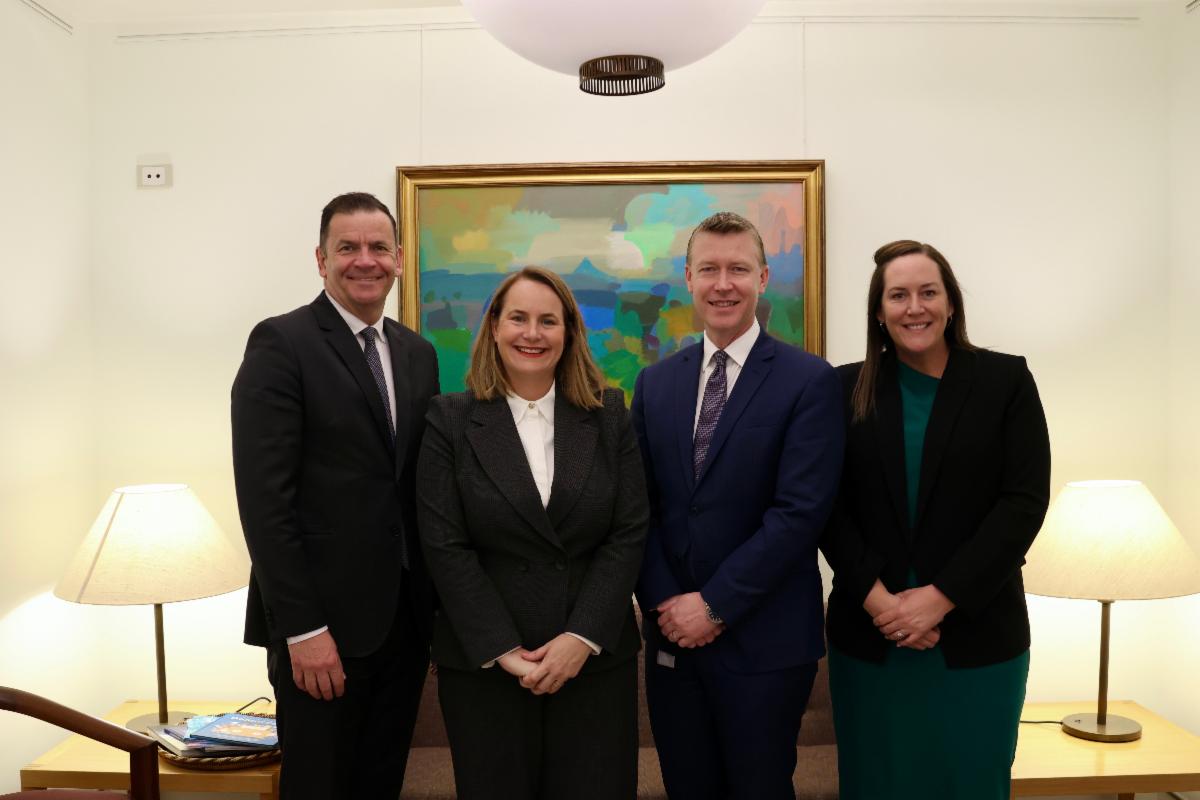
While in Canberra recently, I had an engaging meeting with the new Assistant Minister for Tourism, Senator Nita Green. I was joined by AA Deputy Chair Emma Hynes. It’s been more than a decade since we’ve had an Assistant Minister and thanks to our advocacy, the government has listened. With the Trade and Tourism Minister Don Farrell so focused on the trade part of his portfolio at the moment it is good that he, and our sector, have the support of another Minister to help prioritise our advocacy agenda. Senator Green is well across the importance of our issues being based in Cairns, but we need to take her up on her offer to help her get more informed by inviting her to workforce events, awards and property openings and re-openings. There’s nothing better than being on the ground, seeing the issues and talking to our members.
| | L-R David Mansfield, Senator Nita Green, James Goodwin and Emma Hynes | | |
Meanwhile, our two largest states, New South Wales and Victoria, have also recently launched new Visitor Economy strategies with a strong focus on increasing tourism demand and unlocking investment for the hotel industry.
New South Wales has a bold and ambitious plan to see an extra 40,000 hotel rooms in the state in the next ten years. Whether this is achievable or not, what’s welcome is the State Government focusing on our sector. In the end, it’s not governments who build hotels but the accommodation sector, so we want to keep the government focused on what it can do with aviation policy, destination marketing and attracting big concerts and sporting events.
Visit Victoria 2030 has just been launched with a five-year focus to improve the state’s competitiveness and sustainable growth in the visitor economy. This is important as the recent investment in the accommodation sector needs to be matched by attracting people to fill the new rooms. And although there’s a focus on sport and cultural events, importantly the strategy can’t forget how business events even the spread of room stays.
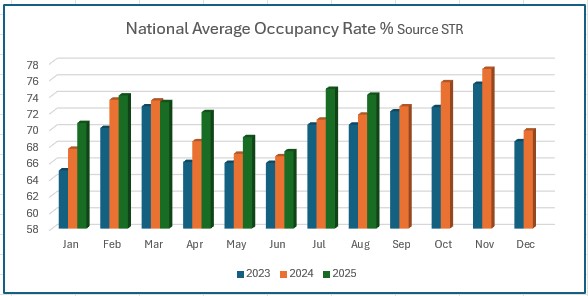
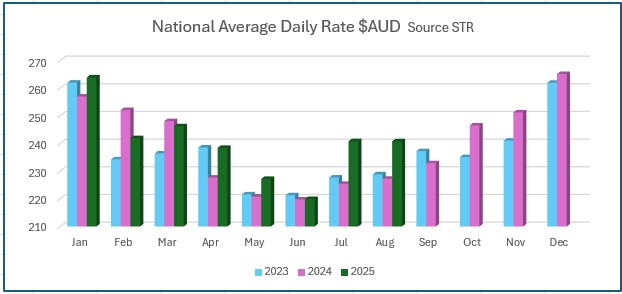
I see the latest occupancy and ADR data shows we’re reaching important milestones in the sector’s, and Australia’s, economic recovery with solid and consistent growth in occupancy almost everywhere in Australia in every month of this year. Again, those small but consistent lifts in ADR – now keeping pace with inflation – will start to see profitability improve for our operators.
Thank you for your support and encouragement as we continue to make good strides together to improve our sector.
Many thanks.
| |
Message from the CEO's Desk | |
Well, barely a week seems to go by without short-term rental accommodation companies like Airbnb being in the news. And these days, as many of you will have noticed, very little of it is complimentary.
In the last few weeks alone, we heard of neighbours along a Brisbane riverfront who have put up with years of alleged drunken nude frolics and strippers at a house rented out on Airbnb for $994 a night.
Another case was the less lewd but equally shocking one-bedroom apartment in the Gold Coast which had been booked through an online agent and turned into a “pop-up” day care centre! The owner found evidence of 14 children being housed in a single 60-square-metre apartment.
These types of horror stories are becoming common place across the country now, but so is the media coverage of the countless enquiries into how to control the STRA market.
It was South Australia’s turn recently with a parliamentary inquiry recommending - among other things - that the 8,000 short stay accommodation places in the state be subject to a registration system.
The committee also recommended the enforcement of safety standards, a code of conduct for property owners and guests and suggested the state government consider incentives to property owners to get them back into the rental market.
I was recently quoted in The Western Australian newspaper about this very issue. I said while the WA government should be congratulated for introducing registration and enticing property owners to return to the long-term market, more needs to be done to target the investor end of the market.
The stats speak for themselves - 85% of all properties on Airbnb in Western Australia are entire homes or units and more than two thirds of them are hosted by people or companies with multiple listings.
The largest host in WA manages 140 properties, all of which are entire homes or units, the second and third biggest hosts manage more than 100 properties each.
And that is just Airbnb.
STRA has long moved away from the original concept of making the couch or spare room available for tourists on a budget. This is not mum and dad’s listing their holiday home, this is big business.
These properties could and should be available for long term rental to workers in places like Perth, Byron Bay, Townsville and the Gold Coast, but they aren’t.
And we have seen here and overseas that the growth in STRA comes at a huge cost to housing stock and rental cost.
We need nationally consistent regulatory framework. To this end, AA has reviewed and updated our policy position on STRA (link)
We do not advocate for taxes or levies that are simply pushed on to the user, but instead we need to place caps, fees and obligations on the short-term sector. This would be the game changer to shift more properties from the short-term to long-term rental market.
We believe there should be a mandated cap of 90 days for un-hosted STRA with local councils authorised to implement a lower cap depending on their situation.
There should be mandatory registration and fees for all properties being made available for short-term rental - and we should ensure STRA platforms enforce compliance and establish large fines for owners of non-compliant properties
This proposal balances the needs of property owners with the needs of the community and would send a clear signal to property owners and the STRA industry that the days of unfettered, under-regulated STRA are over.
Lastly, I want to commend the work Jenny Lambert is doing on Chefs. The policy paper she’s working on and the consultation with members about the chef shortage and ways to address it is really important. I thank those who have contributed to the document and those the consultations.
Kind Regards
| |
James Goodwin
Chief Executive Officer
| | By Jenny Lambert OAM, National Policy Director | | |
The Federal Parliament sits for two weeks this month, at the beginning and the end of the month, including a session of Senate estimates. With so much going on internationally, it is hard to keep the focus on domestic issues, but our strong and active engagement continues around those matters that impact members.
Improving industry access to migration options
AA made a major submission last month to Jobs & Skills Australia (JSA) advocating for vital industry occupations to be included on the Core Skills Occupation List in order to ensure that they are available for migration sponsorship. In our joint AHA/AA submission, we highlighted the significant economic contribution made by the hotel sector, its high growth and employment prospects, and reinforced the importance of a responsive migration system to meet our workforce and skills needs. The primary role of the submission was to support key occupation for inclusion on the CSOL, with a focus on new occupations that the Australian Bureau of Statistics had included on their new standard classifications of occupations (now OSCA, previously ANZSCO). JSA had indicated that they were not revisiting decisions made on existing occupations, which means that hotel managers and chefs will remain on, but restaurant managers (excluded since December) will struggle to get back on the list this year. Despite this JSA focus, we used the submission to support all of the key occupations, including recommendations that the following occupations, which JSA targeted for consultation, should be added to the Core Skills Occupation List: Accommodation Service Manager (executive housekeeper, front office manager, rooms division manager and chief concierge), Facilities Manager (Chief Engineer), Security Manager (Non-ICT), Senior Chef (Executive Chef, Head Chef, Sous Chef), Catering Manager (including banquet manager), Hospitality Supervisory roles including bar, restaurant, housekeeping and front office and the sommelier. Even though the Café and Restaurant Manager was not targeted for consultation or review, we strongly recommended that JSA should re-evaluate this important occupation for inclusion on the CSOL.
Migration Update
In addition to work on the CSOL, AA has been actively engaging with government on a number of migration related issues. In August, we met with the Assistant Minister for Immigration, Matt Thistlethwaite, where we had the opportunity to raise skilled migration, chef shortages and the definition of specified work for working holiday makers. He recognised the important role WHM played in the workforce, particularly in industries such as hospitality, but noted that the unions still wished to see changes to address exploitation concerns arising from the farming sector. AA was also made aware that some stakeholders (particularly those who would benefit) are agitating for WHM's to undertake English language tests. AA would oppose such a move as it would add to costs, build additional barriers for the WHM, and would be contrary to the important cultural exchange aspect of the visa. Many WHM come here to improve their English language skills.
In the meantime, industry’s use of the skilled migration program continues to rise. In 2024/25 there was a massive 111.5% increase to 16,910 in temporary skilled visa applications from the accommodation and food services industry, with 10,770 granted by the end of June - the difference will be timing and slower processing. Chefs accounted for 6,380and were the highest occupation with 9.3% of all occupations granted a temporary skilled visa and cooks were the 7th highest with 1,560. Cafe & Restaurant Manager visas granted (6th highest) were up by 79.4% to 1,680, and all of these would have been prior to December when that job role lost its eligibility under the new Skills in Demand visa.
This activity led to 16,500 visa holders in accommodation and food service occupations being in country by the end of June 2025, 10,140 of which were chefs which is more than double the next occupation across all industries being the motor mechanic.
Consultation on chef shortages
As mentioned in the last Key News Update, over the last few months, AA has engaged in consultation on addressing chef shortages. The hospitality industry has long struggled to fill vital cook and chef positions, and this shortage is currently being exacerbated by a decline in apprenticeship commencements (see update below), a recent rise in the Core Skills Income Threshold (formerly the TSMIT), and a clamp down on international students which has seen a drop off in enrolments by international students studying commercial cookery in Australia. This student cohort was becoming an increasingly important pipeline for sponsorship as a temporary skilled migrant. Accommodation Australia will continue to lobby the government to improve the regulatory and funding settings for training and migration, but we recognise that the solutions to the chef shortage are broader than government policy. We have put together a paper which you can see here on addressing the chef shortage and have proposed a number of potential solutions. During on line consultations and input via email, AA has received highly valuable comments on the proposed solutions and other ideas members have to address the shortage. In the coming month AA will update the proposed solutions paper and engage with other relevant stakeholders as well as government to take the solutions forward.
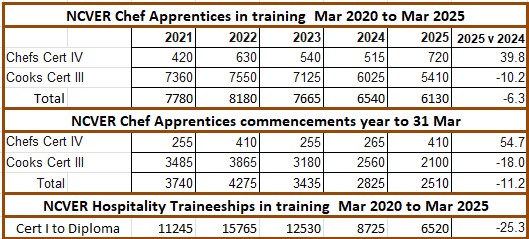
In the meantime, the latest apprenticeship figures released by NCVER for the year to March 2025 only serve to reinforce the urgent need to address the chef shortage. In the year to March, the number of apprentices commencing as cooks and chefs fall by 11.2% to 2,510 compared to the 2,825 that commenced the previous year. As the table below shows, the numbers commencing a Certificate III apprenticeship fell even more dramatically by 18%, and it is only a rise in Certificate IV apprenticeships in commercial cookery or kitchen management that made up some of the shortfall. These numbers compare unfavourably to the pre-COVID levels when the number of cooking apprentices in training in September 2019 were 7,685 with 3,725 commencing their training in the year to September 2019.
The table also reveals that hospitality traineeships continued to dramatically fall following the removal of employer incentives on 1 July 2024. Commencements in the most popular industry traineeship, the Certificate III in Hospitality fell by 26% to 4,195 in the year to March 2025 compared to the previous year, and as the table shows, there were only 6,520 in training as at March 2025.
| | |
Regards,
Jenny Lambert OAM
| | |
Hotel Performance in August 2025
The latest STR accommodation data released for August 2025 continued the improving trend seen over the last few months in both occupancy and average daily rate, with Queensland the only state to see a fall in average occupancy for August compared to last year and ACT the only state or territory to see a fall in ADR. The average occupancy in the month of August across Australia was 74.1% compared with 71.7% in 2024, and the Average Daily Rate was up 6.0% to $240.80 compared with $227.25 in August 2024. Revenue per available room in August 2025 was $178.39, a substantial rise of 9.5% from $162.86 in 2024. Occupancy rates for August 2025 saw the highest rises in Victoria and South Australia, followed by NSW and the NT, with ADR increases highest in NSW followed by Queensland and WA. In the year to August 2025, Australia's average occupancy rate was 71.9% compared to 69.9% for the previous year, and the ADR average was up 2.4% to $240.02, a rise which is at last starting to keep pace with inflation. New Zealand finally saw an increase in occupancy but a slight drop in ADR in August 2025 with occupancy 59.4% last year compared to 61.4% this year, and ADR down by 0.5% to NZD205.65 compared to last year.
Preliminary capital city STR data for the month of September shows that hotel performance remained relatively strong for most cities compared to the previous corresponding period last year but with some modest falls in occupancy in three cities including the Gold Coast. Sydney had another good month with a 4.4% improvement in September occupancy to 80.8%, and ADR rose by 1.1% to $257.35 compared to September 2024. Melbourne's occupancy rose 3.1% to 69.1%, but ADR down 0.6% to $208.29; Brisbane occupancy was down 3.7% to 74.7%, but ADR was again up by 5.3% to $248.98; Adelaide occupancy up by 4.4% to 76.6% and ADR up 2.9% to $195.72; Perth occupancy slightly down 0.5% to 84.4% but ADR up 7.8% to $240.83; Hobart occupancy up 3.6% to 74.7% and ADR up 1.7% to $188.78; Darwin occupancy up 7.6% to 73.2% and ADR strongly up 8.8% to $231.79; Canberra occupancy slightly down 0.4% to 79.8% and ADR also down 4.4% to $199.23; and Gold Coast occupancy down 1.6% to 73% but ADR up 5.4% to $276.18.
The graphs below show the national average occupancy rate and ADR for each month since January 2023.
| | |
eeger is now live — and it’s transforming the way our industry connects!
| | |
We’re proud to introduce eeger, the first-of-its-kind central hub designed to power the future of our workforce. Whether you're hiring, training, or developing your workforce, eeger brings together jobs, careers, training opportunities, and industry resources, all in one place.
✅ Free job advertising throughout 2025
With over 6, 300 job seekers already registered, now is the perfect time to post your vacancies and tap into a growing talent pool.
Build your employer brand
Create an employer profile to showcase your business, even if you're not hiring right now. Your presence helps attract future talent and strengthens the future of your workforce!
Grow with us
Your engagement is key to shaping eeger into the complete workforce solution our industry needs. By participating, you're not just filling roles, you’re helping build a stronger, more connected future for our industry.
Assets to share
📣 Ready to get started?
Register now: https://eeger.com.au
Need help? Reach out to us at hello@eeger.com.au
| | |
Warm Regards
Emilie Howe
General Manager, eeger
| | Accommodation Australia is hosting numerous events across the country. Please visit the links below for updated list of events in each state/territory. | | Other events include Hotel Market Updates across Australia. Please keep an eye out for the calendar of events from your state /territory representatives. | | |
Forethought, an independent market research company, is conducting a study on behalf of one of our partners to gather insights into its marketing activities across the industry.
Your input, via this online survey, will take 10 - 15 minutes to complete. We thank you in advance for your time and feedback.
By completing this survey, you will have a chance to win one of 13 gift cards, valued at $100.00*.
We'd like to assure you that your responses are strictly confidential. All information is used for statistical purposes and individual responses are not identified. This is purely market research and there is no selling involved.
Please click on the link below to participate in the study:
https://surveydau.pureprofile.com/survey/selfserve/5e1/250558?list=0&ptest=0&sour=9
The survey will close on Friday 31 October.
If you have any questions relating to this study, please e-mail alliance@forethought.com.au.
Thank you in advance for your participation.
Yours sincerely,
Accommodation Australia
| | |
Who is this email from?
This email is being sent by Accommodation Australia. The information you provide is strictly confidential and will be used for research purposes only. This means that your answers will not be linked to your name in any way. To view Accommodation Australia’s privacy policy, click here.
Who is Forethought?
Forethought is an independent marketing research company commissioned to undertake this research. Forethought conducts research in compliance with the Australian Privacy Act and The Research Society’s Code of Professional Behaviour. The information that you provide will be used only for research purposes. Please be assured that your contact details will not be kept by Forethought. To verify the legitimacy of Forethought, please search for Forethought in the Research Company Directory or in The Research Society directory. To view Forethought’s full privacy policy, click here.
If you have any questions or if you are experiencing any technical difficulties with the survey, please click here.
*Terms and Conditions
| | |
Unsure about sustainability? Ecotourism Australia makes starting your certification journey easy. You don’t need to have it all figured out – receive expert, judgement-free coaching, access specialised resources and use ready-to-go business templates through our dedicated online portal.
| |
Learn more about Ecotourism Australia’s certification benefits here: https://ecotourism.org.au/sustainability/businesses/eco-certification/
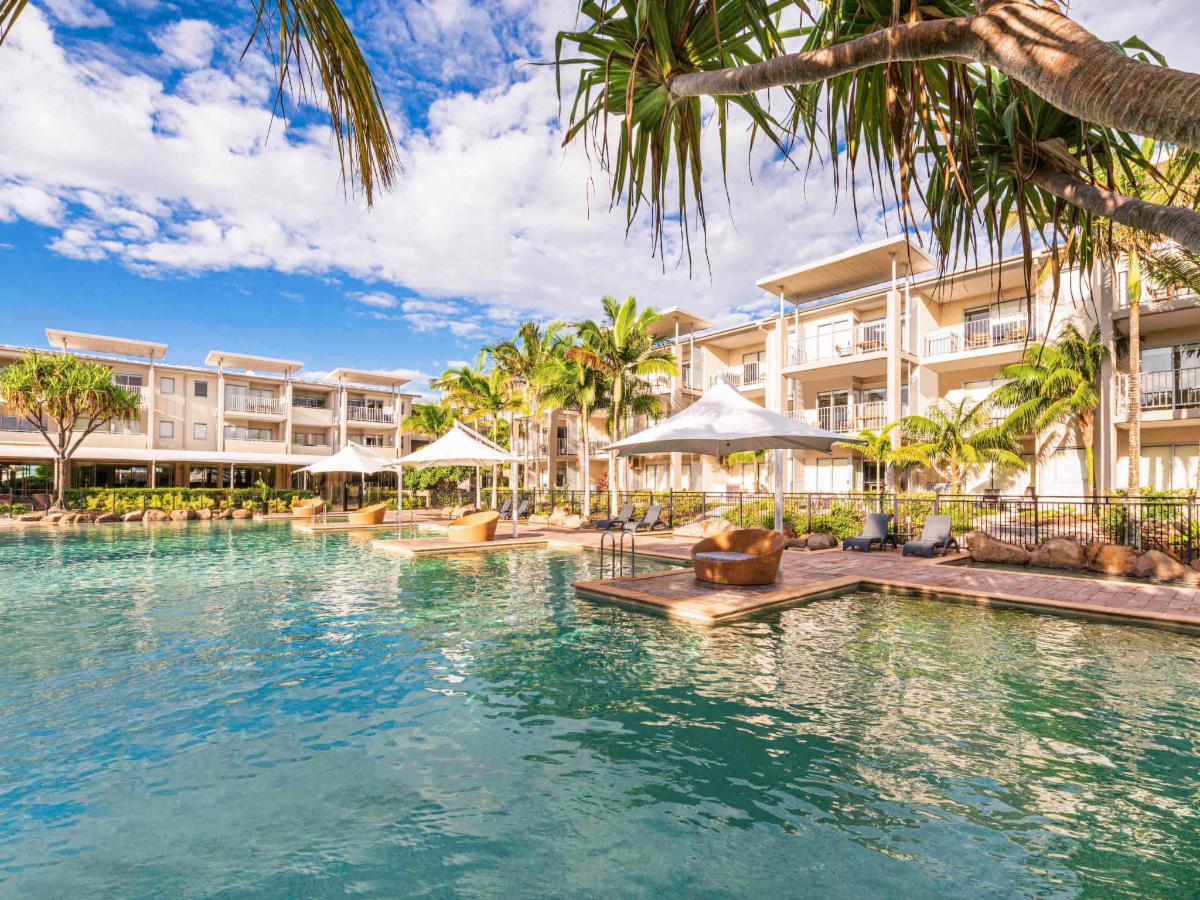
Image: Peppers Salt Resort & Spa (Sustainable Tourism Certified) | © Accor
| | |
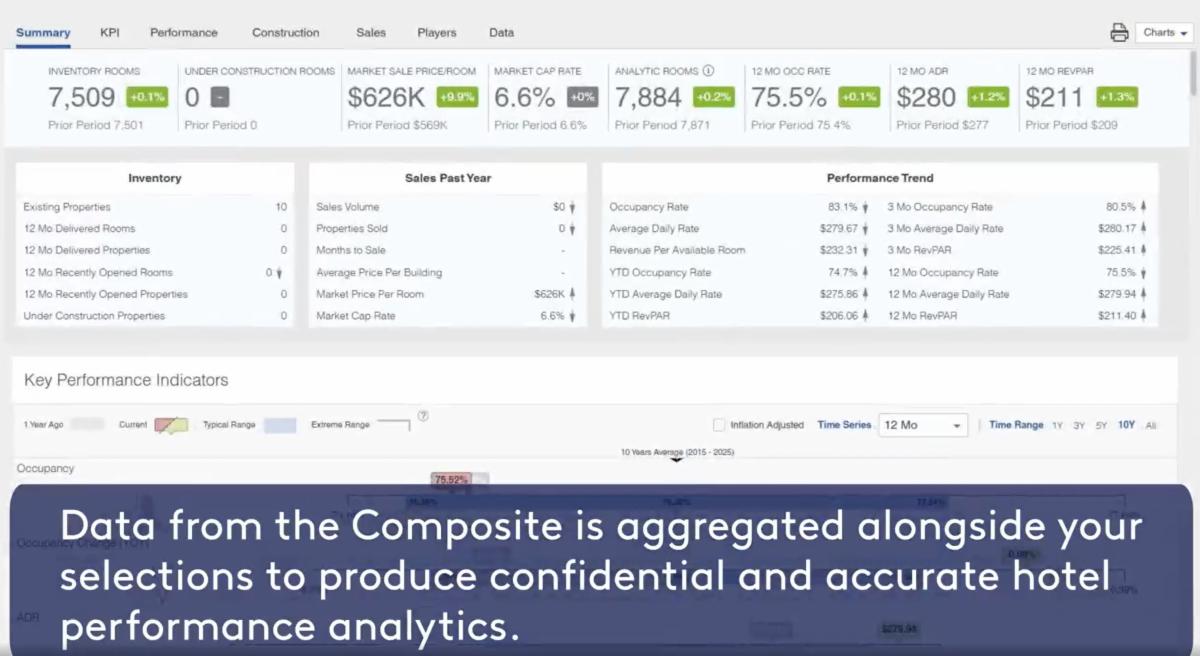
Major upgrade to CoStar’s Property Analytics tool for Hospitality
Say goodbye to static Trend reports—and hello to dynamic, on-demand insights.
No more participation lists, manual approvals or restrictions around data set volume. Moving forward, user-selected hotel data sets will be delivered through the Property Analytics tool and innovative Composite Methodology within CoStar.
This modern solution empowers our clients with unlimited access to aggregated data and analytics—secured and vetted by advanced technology to ensure confidentiality.
| | | | |