|
Dear friends,
Since our 10:00 a.m. Barn service didn’t get streamed last Sunday (All Saints Day), I am including an adapted version of my sermon. The current livestream setup in the Barn has significant limitations, which has a lot to do with why neither of the “First Sunday” 10:00 a.m. services has been streamed this program year so far. The good news is that a new, improved setup is on its way and we will begin streaming all Barn services as soon as it is in place! And now for my All Saints message:
Last Saturday was Halloween – a day to pretend to be someone else – and last Sunday was All Saints Day, which asks us a related question: Who do we really want to be?
My favorite spiritual writer is Thomas Merton, who became a monk when he was 26 in 1941. Before that, he was talking one day in NYC with a friend, Robert Lax, who would become a great poet. Lax asked Merton: “What do you want to be, anyway?” Merton replied, “I don’t know, I guess what I want is to be a good Catholic.” Lax asked him what he meant by that. He gave, in Merton’s own description, a lame explanation. Lax did not accept it. Lax said: “What you should say is that you want to be a saint.” (As recounted in Merton’s spiritual autobiography The Seven Storey Mountain.) Indeed, it's been said that the purpose of the church is to create saints.
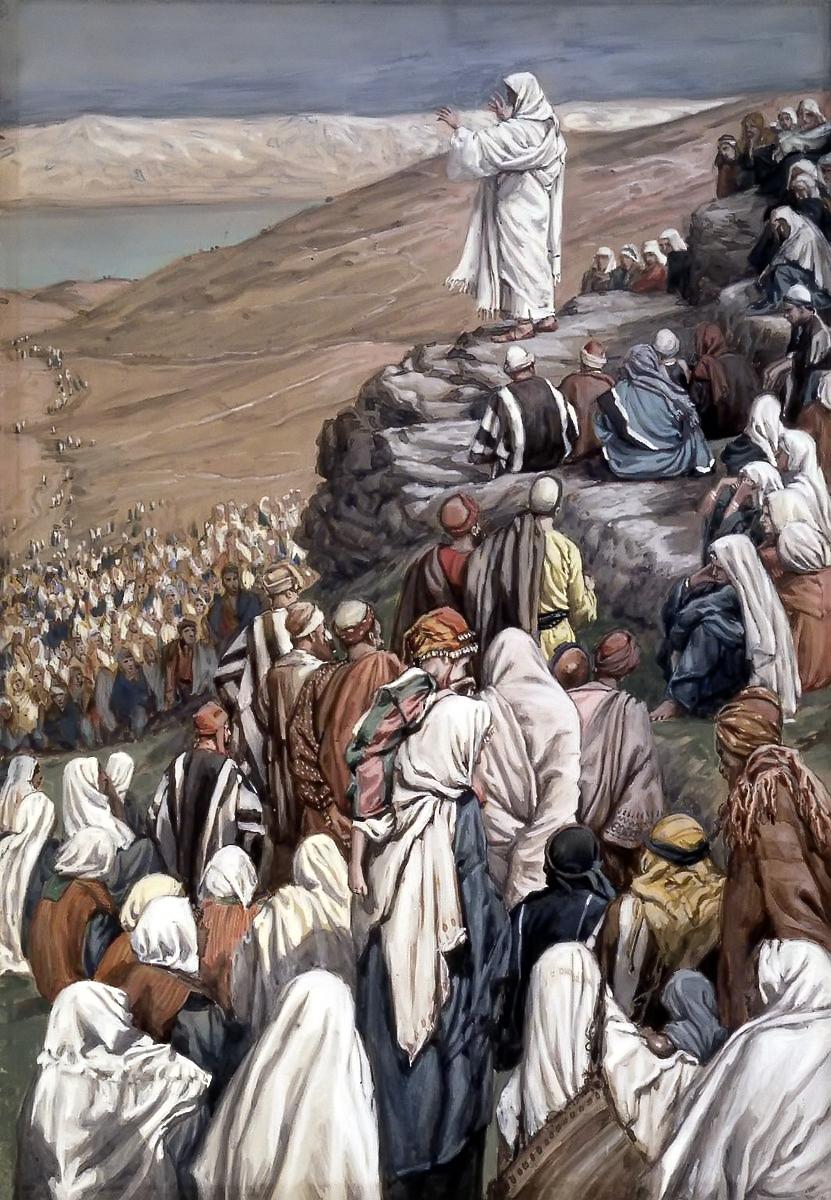
The Gospel for All Saints this year is the Beatitudes (Matthew 5:1-12). This text has been read on All Saints since the feast was established in the Middle Ages because it gives us a description of a saint.
When I was a kid, my mother had a stone tablet on display in our house. It had writing on it, and it looked like the Ten Commandments. But the first time I really inspected it, I noticed that they were not the Ten Commandments; they were the Beatitudes. My first question was, "What is a beatitude?" It was not a word I had heard before. My next question was, "What kind of list is this?!" It's not like the Ten Commandments at all. It's not really a to-do list or not-to-do list. For the most part, it doesn't have much to do directly with behavior or action. It is largely a list of inward qualities; it describes a disposition of the heart and of the soul. So perhaps a saint is not primarily defined by what they do, but by who they are.
The Beatitudes are not only a description of a saint. First of all, in the Beatitudes, Jesus is describing himself. Nor does the church exist only to create saints: C.S. Lewis said the church exists to create "little Christs” (Mere Christianity). Of course, these are two ways of saying the same thing.
But while this might sound good (I hope it does!), it is not always an easy path. It is sometimes difficult and challenging. In the Beatitudes, Jesus talks not only about mercy, purity of heart, and peacemaking, but also about suffering. He connects blessedness or happiness – that's one way to translate the word – to mourning and persecution. How does blessedness or happiness connect to these things?
Perhaps these difficulties come from the collision between the ways and will of God and the way of the world. Human life and culture are so often defined by unholy qualities and behaviors: greed, self-seeking, hostility, violence, and self-indulgence. And so if we follow another way – the way of Jesus – we can expect to encounter some turbulence when we cross paths with the ways and patterns of the world. We see this, of course, with prophets and martyrs of relatively recent times, such as Martin Luther King Jr.
Additionally, to become more like Jesus is, by definition, to become attuned and sensitized to the suffering of others. Jesus’ primary trait is compassion, which literally means to suffer with others. The most common description of his emotional life in the Gospels is: “He was moved with pity” (e.g., Matthew 14:14). And yet, these challenges are well worth it, because this is the way to be fully alive—to be grounded, centered, and connected. This is the way for God to become real to us.
Aldous Huxley, perhaps best known for works of fiction such as Brave New World, also wrote and thought deeply about matters of spirituality and religion. One of his most significant works on these matters is The Perennial Philosophy, a collection of spiritual wisdom from the world’s great religious traditions. In the introduction, he explains why he mostly ignored academics, philosophers, and theologians in this collection of quotations. He said, in so many words, that this is because one cannot arrive at knowledge of God through study or the intellect alone, but rather through the transformation of one’s inward being; through an inner awakening and enlightenment. Therefore, he was only interested in drawing from the writings of saints and mystics. Quoting Jesus in the Beatitudes, he said that divine reality can only really be perceived by those who make themselves poor in spirit, loving, and pure in heart.
A saint is someone for whom, through these blessed qualities, God becomes utterly and undeniably real. And not only that: a saint is also somebody who makes God real to others, who inspires faith and hope just through the example of their life and the quality of their being. So much of why I believe and why I try to follow Jesus is because of the example, presence, and power of saints I have come to know.
In the Beatitudes, Jesus not only gives us qualities to be pursued and realized in this life, he is also describing life in the age to come, and what we might call the culture of the kingdom of God. This is the life enjoyed by the saints in heaven whom we celebrate and remember today, and it is what awaits all the faithful departed and, as our Prayer Book says, “those whose faith is known to God alone.”
As it says in our reading from 1 John: “Beloved, we are God's children now; what we will be has not yet been revealed. What we do know is this: when he is revealed, we will be like him, for we will see him as he is” (1 John 3:2). This is what is known as the Beatific Vision, and it’s no coincidence that it shares the root of the word Beatitude. It is the ultimate, direct contemplation of God face-to-face, enjoyed by the angels and saints in heaven.
But we don’t have to wait until the next life to experience some real measure of that ineffable joy. As it says in the Psalms, “Look upon [God] and be radiant” (Psalm 34:5). This sounds like a reference to the Beatific Vision in heaven but this Psalm—as well as virtually the entire Old Testament—is focused on our relationship with & experience of God in this life, in this world.
Back to that conversation between Thomas Merton and Robert Lax:
When Lax said: “What you should say is that you want to be a saint,” Merton thought this sounded strange, and replied: “How do you expect me to become a saint?”
“By wanting to,” said Lax, simply.
“All that is necessary to be a saint is to want to be one. Don’t you believe that God will make you what He created you to be?”
Peace be with you,
John
Services This Sunday
8:00 a.m. – Historic Church – Rite I
9:00 a.m. – Bank Barn – Rite II with Christian Formation
11:15 a.m. – Historic Church – Rite II
Leaflet
Hymns
Unfortunately, there will be no 11:15 livestream this week. Please contact the office if you are interested in being trained to operate it.
|