|
Did you know that when preschoolers play, they learn? It's true! Use these activities to encourage your preschooler to play.
Print the August Books for Preschoolers!
We're learning Language and Literacy Skills
Do it!
Help your preschooler practice writing their name on paper. Show them how to start with a big letter (capital letter) and use lower case (small letters) for the rest. Provide a variety of paper sizes and textures. Write with chalk on dark paper. Use your driveway or sidewalk. Encourage your preschooler to choose their writing instrument (crayon, chalk, pencil, pen, or marker). Put sand on a cookie sheet and write letters using fingers, a stick, or a paintbrush.
Read it!
Click, Clack Moo Cows That Type by Doreen Cronin. Dear Panda by Miriam Latimer.
| | |
We're learning Social Studies Thinking
Do it!
Talk about things your preschooler likes to do now. Then they should be asked what they might want to do in the future, such as next week, next year, or when they grow up. Look through magazines with your preschooler and have them identify pictures of things they would like to do. Then help them cut out those pictures and paste them onto pages labeled now, next week, next year, and grown up.
Read it!
Maisy Goes to Preschool by Lucy Cousins. Mr. Gumpy's Motor Car by John Burningham.
We're learning Science Thinking and Technology
Do it!
Make ramps by propping cardboard on objects of different heights. Roll balls and small cars down the ramps. Talk about which one goes faster and which one goes slower. Use your own or a town park sliding board for this as well. Take various-sized balls and vehicles to roll and push.
Read it!
Oscar and the Cricket by Geoff Waring. And Everyone Shouted, "Pull!" by Claire Llewellyn.
We're learning Mathematical Thinking and Expression
Do it!
Introduce your preschooler to various measurement tools, including a timer, ruler, measuring cups, and a thermometer. Talk about what each one measures or is used for. Help them practice using the tools. Try indoor and outdoor activities, using sand, water, and dirt, and measure while working with real tools on projects.
Read it!
Lengthy. The Long Long Dog by Syd Hoff. Big Dog...Little Dog by P. D. Eastman.
| |
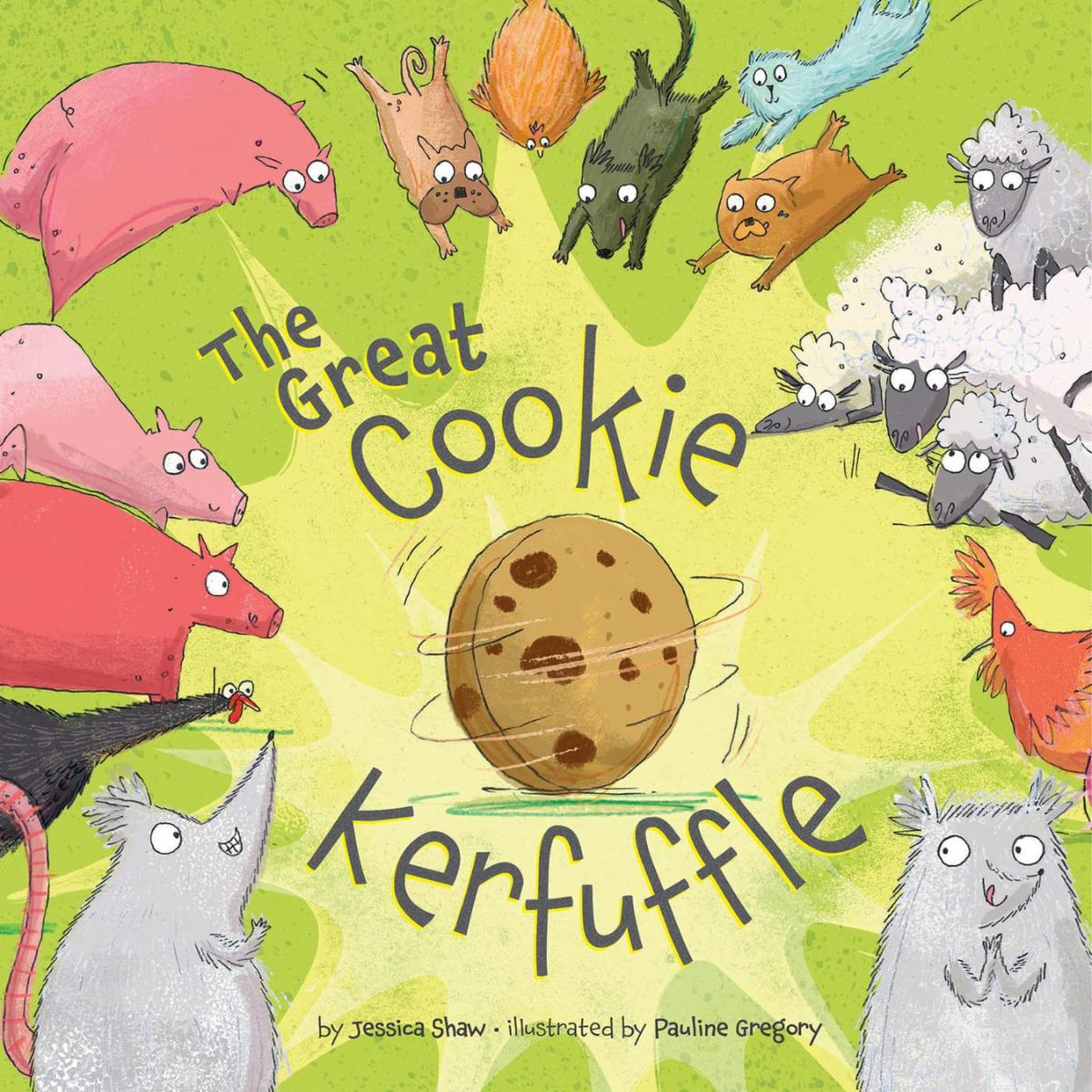
Share Your Thoughts on The Great Cookie Kerfuffle!
Have you and your child enjoyed reading the 2026 PA One Book selection, The Great Cookie Kerfuffle? We’d love to hear about your experience! Please take a few minutes to complete the online survey and share your thoughts, favorite moments, and how the story sparked learning and conversation at home.
Your feedback helps the PA One Book program better understand its impact and shape future family literacy experiences. Thank you for lending your voice!
|
Pennsylvania's SUN Bucks (Summer EBT) program
Application deadline: Aug. 31
Pennsylvania's SUN Bucks (Summer EBT) program helps eligible families purchase groceries during the summer months when school meals are unavailable. Eligible children receive a one-time $120 benefit that can be used to buy food at participating retailers. Most eligible children are automatically enrolled through programs such as SNAP, TANF, Medicaid, with qualifying income, or free/reduced-price school meals, while some families may need to apply.
Benefits for Summer 2026 began in early June, and applications remain available for eligible households. Families can also access an online eligibility navigator, outreach materials, and multilingual application resources through the Pennsylvania Department of Human Services. The application deadline for Summer 2026 benefits is Aug. 31.
| |
Pennie’s 2027 Open Enrollment Will Now Run from November 1 to January 15!
Pennie offers health coverage from the top health insurance companies in Pennsylvania. You can also get personalized help from a Pennie-certified professional at no cost to you.
Open Enrollment Period: Nov. 1 - Jan. 15
You must enroll during the Open Enrollment Period to have coverage for the year. If you have a Qualifying Life Event, such as loss of health coverage, marriage, change of residence, or many others, you can enroll during a Special Enrollment Period.
How to enroll?
- Preview. With the Plan Comparison Tool, see plans in your area and within your budget.
-
Apply. Gather your household information. See Pennie’s Shopping Checklist at pennie.com/learn/how-to-enroll.
- Shop. Filter and compare health plans by needs and cost.
- Pay. Your coverage will not begin until you pay your first month’s premium. For most health plans, you can make your first payment at the same time that you enroll.
High-Quality Coverage!
- Free preventive care.
- Covers a wide range of medical services.
- Can’t be denied because of a preexisting condition.
Free, expert help is available from Pennie Certified Assisters and Brokers. Enrollees can find in-person support and schedule an appointment at pennie.com/find-local-help.
| |
New Resources Make Pennsylvania State Parks and Forests More Accessible for All Visitors
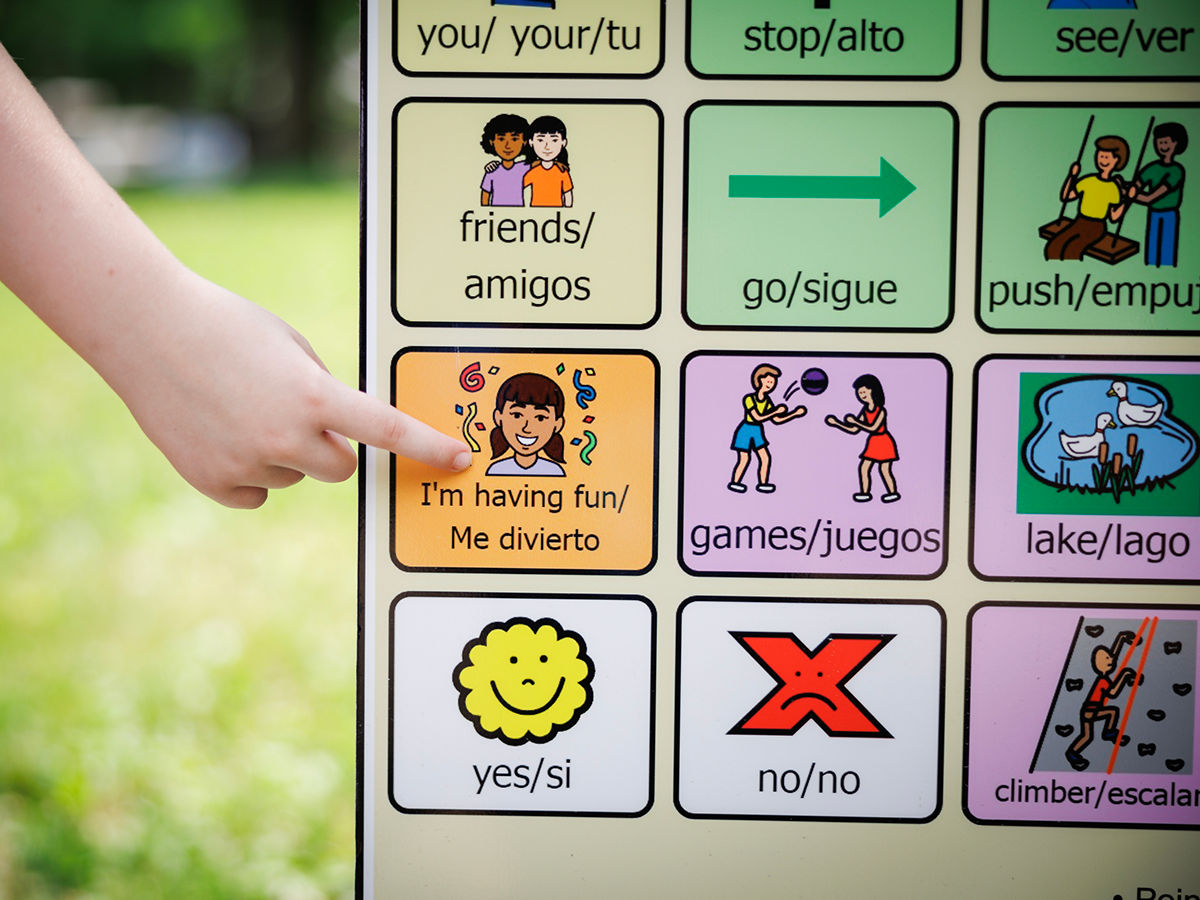
New online planning tools, communication boards, Handy Talkers, and colorblind viewing resources make it easier for all visitors to plan trips and enjoy Pennsylvania’s public lands. Communication boards are located in seven PA State Parks throughout the Commonwealth.
The Department of Conservation and Natural Resources (DCNR) also announced major updates to its accessible recreation website pages. More than 100 state park and forest webpages now list detailed accessibility features. These pages continue to be updated and include information about accessible facilities and amenities, such as lodging, pavilions, water access, fishing access, hiking, hunting, beaches, loaner equipment, colorblind viewfinders, wildlife-watching areas, theaters, amphitheaters, and environmental education centers. A new search function allows visitors to filter locations by the specific accessibility features they are looking for. Learn about the other features offered and how to access them.
| |
Virtual Conversations: Parents Rising to Child Developmental Challenges
The Brazelton Touchpoints Center invites families to join the fifth season of Parents Rising to Child Developmental Challenges, a free, 4-episode virtual conversation series that offers a warm, inviting opportunity for parents and families of children with differences in or challenges to their development to connect with one another.
Through engaging conversations with families who know what it’s like to raise children with developmental differences, challenges, delays, or disabilities, share the unique and common experiences of loving and raising children whose developmental journey is delayed or atypical.
What You'll Gain
💙 Honest conversations with families who understand
🤝 Practical insights and shared experiences
🌱 A supportive community where every family's story matters
Episodes
📅 Mondays | 3–4 pm ET
September 14 • October 26 • November 2 • December 7, 2026
🌎 Free and open to all
🗣️ Live Spanish interpretation and captioning available
👉 Register for one or all four conversations and connect with families who understand your journey
Learn more and register at the Brazelton Touchpoints Center website.
| |
A Strong Start to School Success
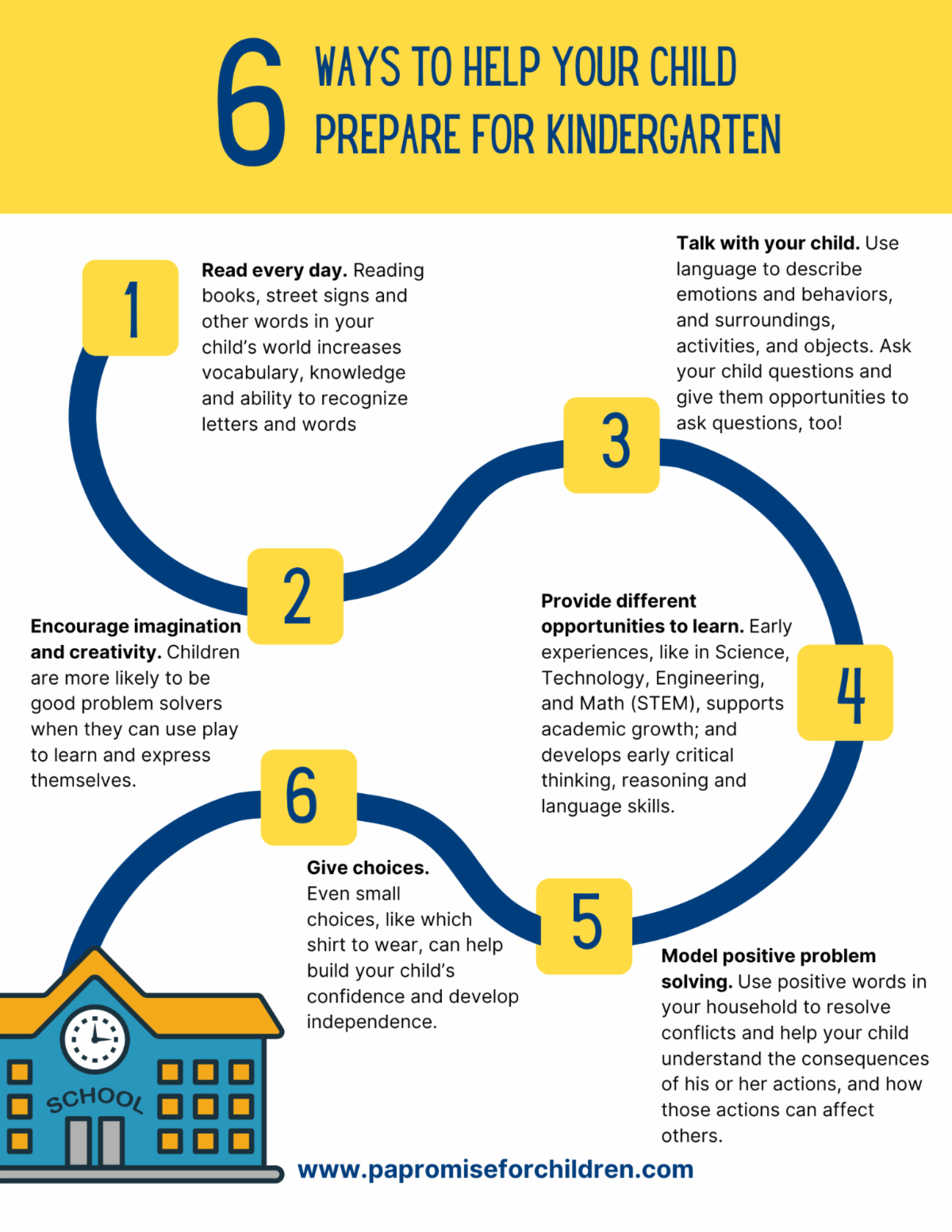
Quality pre-kindergarten can give your child a strong start in school and life. Find a preschool program that meets your child's needs. Two programs to consider are Pennsylvania Pre-K Counts and Head Start.
Pennsylvania Pre-K Counts
Pennsylvania Pre-K Counts provides free half-day or full-day pre-kindergarten for at-risk children throughout Pennsylvania.
Each program offering PA Pre-K Counts classrooms will have its guidelines, but PA Pre-K Counts is designed for children who
- are between the ages of three and younger than the entry age for kindergarten.
- meet income guidelines; and
- may also have language (English is not their first language), a disability or developmental delay, or other issues that make them at risk for failing in school.
You may be eligible to apply if your child falls into these categories.
To find PA Pre-K Counts programs near you, visit the COMPASS Child Care and Other Early Learning Programs Search and search for a program in your area, or contact your Early Learning Resource Center (ELRC) at www.raiseyourstar.org.
Head Start
Head Start programs are federally funded programs that serve children ages 3 and 4. Programs may be based in centers, schools, or family child care homes — or they may be provided at your own home. Services include education, health, nutrition, social services, and other services.
Children up to age five from families who meet the Income Guidelines published by the Federal government may be eligible for Head Start services.
Contact your Early Learning Resource Center (ELRC) at www.raiseyourstar.org to find a Head Start program.
| |
Looking for a Child Care or Early Learning Program?
There's a free, online resource to help you find a child care or early learning program. Pennsylvania families can use the COMPASS Child Care and Other Early Learning Programs Search to find programs in their community. You can also get information about help paying for child care, the different types of early learning programs, and how you can use Keystone STARS to find a quality program for your child.
You can also contact your Early Learning Resource Center (ELRC). They can help you find an early learning program, after-school program, or other resources to support your child's early learning. Go to www.raiseyourstar.org and provide your county to find the ELRC in your community.
| |
Thriving Kids: A Parenting Podcast From the Child Mind Institute
Thriving Kids is a podcast for parents and caregivers who want clear, honest answers about child and adolescent mental health. Hosted by Dr. Dave Anderson, clinical psychologist at the Child Mind Institute, each episode tackles a common parenting challenge — from anxiety to tantrums to school struggles — with practical strategies backed by science. Hear real talk, expert advice, and compassionate guidance from clinicians who work with kids every day. New episodes every other week, with companion newsletters for easy reference.
| |
August Health Trends in Early Childhood: Food Safety Matters: Preventing Food Poisoning
In 2026, the United States is experiencing a “foodborne illness summer,” and it is difficult to keep track of which foods are safe to eat and where! Dominating the news cycle is the Cyclosporiasis outbreak. The August release of Health Trends in Early Childhood focuses on Food Safety Matters: Preventing Food Poisoning.
Each year, roughly 48 million or one in six Americans (16.7%) get food poisoning (also called foodborne illness) after eating contaminated food. Foodborne illnesses occur when viruses, bacteria, parasites, or toxins (poisons) produced by them get into the foods we eat (e.g., Listeria, Salmonella, Cyclospora, Shigella, STEC, Vibrio, Yersinia, and others). Anyone can get food poisoning, but children are more likely to be affected and have a more serious illness. Read the August release of Health Trends in Early Childhood for more information on how to prevent food poisoning.
| |
Stay Up to Date with Your Preschooler's Immunizations
Preschools and early learning programs may require immunizations to attend. Check with your preschooler's early learning program or preschool to find which immunizations are needed.
PA Health Department's Vaccine for Children Program (VFC) provides vaccinations to children who do not have health insurance.
Children who are insured but whose insurance does not cover immunizations (underinsured) are eligible to receive federally funded vaccines at public sites. Ask your doctor or clinic if they are a VFC provider. If they are, you may go to them for the shots your child needs. To find a VFC-enrolled provider near you, call 1-877-PA-HEALTH (1-877-724-3258).
If your child is not covered under Medical Assistance or insurance, you can apply for PA CHIP. CHIP stands for the Children's Health Insurance Program, Pennsylvania's program that provides health insurance to uninsured children who are not eligible for or enrolled in Medical Assistance. Regardless of the reasons your children might not have health insurance, CHIP may be able to help.
| |
A Family Activity that Encourages Healthy Eating
How can your child participate in a valuable learning experience while having family fun? Where can you get your family's freshest fruits and vegetables without digging or planting? Try a Pick Your Own farm near you!
Children of all ages can help pick fruits and vegetables. Helping also means they're more likely to try an unfamiliar fruit or vegetable.
Pick-Your-Own farms allow families to pick and purchase fruits and vegetables that have been planted. There are several locations throughout Pennsylvania where families can pick their own fruits and vegetables. How much you buy depends on how much you can pick! Get more information.
| |
Cooking Fun for Families
Helping to prepare their own food can help children learn about nutrition, practice meal planning, get to know other cultures, and build basic math skills. It also encourages creativity and independence. The Alliance for a Healthier Generation has resources to help families cook safely and confidently with these kid-friendly cooking tips!
| |
National Farmers' Market Week
National Farmers’ Market Week is August 2-8! This annual celebration highlights the important role farmers’ markets play in our nation’s food system. How do you plan to celebrate? Plan a visit to a local farmers' market with your child and explore options for a variety of foods.
Find a market near you using USDA’s Local Food Directories: National Farmers’ Market Directory.
| |
Me Moments
Me Moments are practices children (and adults) can do in school and at home. These practices build self-regulation – an important social-emotional skill for identifying and managing emotions - which helps prepare you to learn and engage with others. The Alliance for a Healthier Generation created a virtual hub of Me Moments for use in classrooms, child care or early learning programs, or at home.
| |
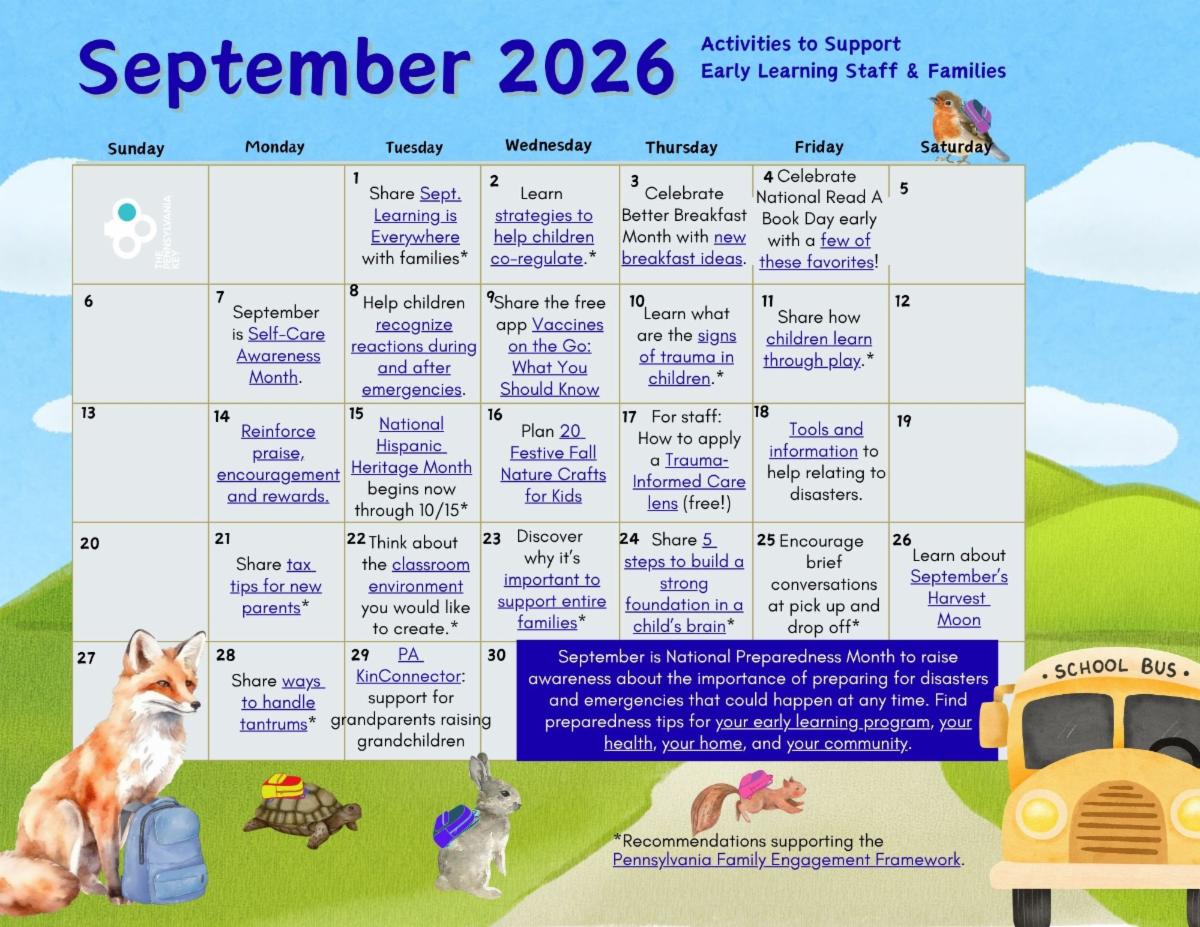
Calendar of Activities for Early Learning Professionals
September is National Preparedness Month, a time to help families and caregivers get ready for emergencies, just in case they happen.
Take a look at the September Calendar of Activities! It’s filled with helpful tips and fun ideas to support early learning professionals and staff as they guide children and families in preparing for school success.
Still need some ideas for August? The August Calendar of Activities for Early Learning Professionals is still available!
| | | | |