|
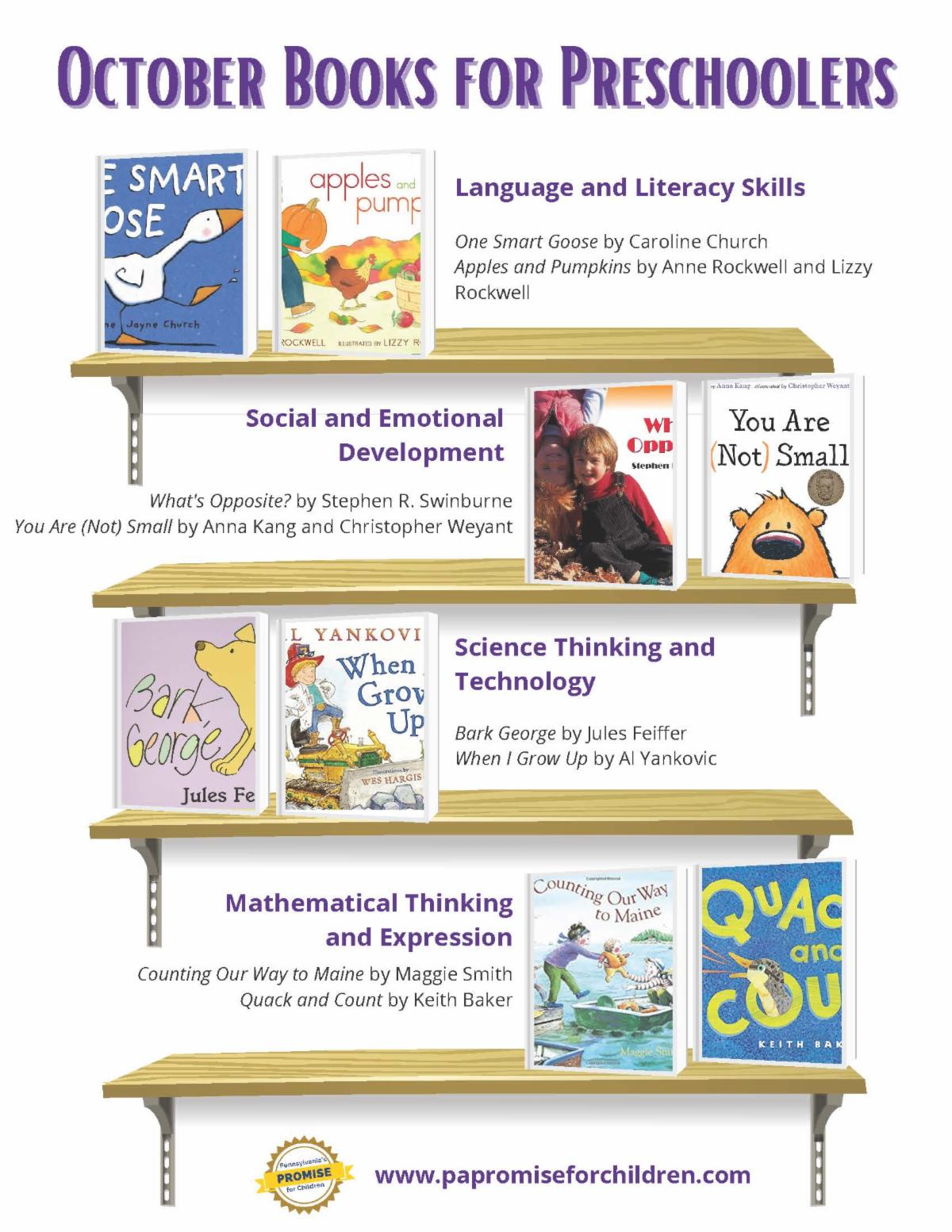
Did you know that when preschoolers play, they learn? It's true! Use these activities to encourage your preschooler to play. Visit the PA's Promise for Children website to print a copy of Kindergarten Here I Come or to print a copy of October's booklist!
We're learning Language and Literacy Skills
Do it!
Collect pictures from the fronts of cereal boxes or advertisements. Put them in a book and ask your child to read to you. You can also use this as an opportunity to get your preschooler more comfortable with things they are hesitant about, like new foods or new experiences. Encourage your preschooler to help take pictures, choose images, and print them. Use this as an opportunity to introduce vocabulary. Add print or braille to your book to increase their exposure to the written word.
Read it!
One Smart Goose by Caroline Church. Apples and Pumpkins by Anne Rockwell and Lizzy Rockwell.
We're learning Social and Emotional Development
Do it!
Share baby pictures and current pictures of your preschooler with them. Compare the pictures and talk about the differences and changes. Discuss new things they learned and are capable of doing between the two time periods. Ask your preschooler to predict what they will look like and what they will be able to do in the future. Talk about the growth and progress you have seen in your preschooler in a positive manner. Continue to talk about upcoming changes in an exciting way, and the feeling will be contagious!
Read it!
What's Opposite? by Stephen R. Swinburne. You Are (Not) Small by Anna Kang and Christopher Weyant.
We're learning Science Thinking, and Technology
Do it!
Play "Who's my baby?" Name an animal and ask your preschooler to tell you the names of the baby. For example: dog-puppy, cat-kitten. Use resources at your local library for a preschooler who needs time to continue exploring this concept. Introduce them to animals they don't see in their environment, including the Braille and sign for each animal. If possible, find books that replicate the animals' textures, or take them to a petting zoo to touch, smell, and hear the animals in person. Talk to your preschooler about what they see, hear, and notice as differences. Point out differences between the parent and baby animals, ask questions, and make observations about how the baby and parent interact.
Read it!
Bark George by Jules Feiffer. When I Grow Up by "Weird Al" Yankovic.
We're learning Mathematical Thinking and Expression
Do it!
Encourage your preschooler to count items around the house. Count the stairs, the windows, etc. For extra practice, give your preschooler objects to practice one-to-one correspondence. For example, one block is stacked for each thing you count. Introduce the visual number and the braille number as you count. Your preschooler can also label each item with the printed number.
Read it!
Counting Our Way to Maine by Maggie Smith. Quack and Count by Keith Baker.
| |
Share Your Family Engagement Story
Submission deadline Oct. 23, 2026
Meaningful family engagement happens every day, and the Pennsylvania Office of Child Development and Early Learning (OCDEL) wants to hear your story! Family engagement refers to an ongoing partnership between families and professionals, in which families’ strengths, knowledge, experiences, and voices are valued to support their children and families and to strengthen programs, communities, and the broader early childhood system.
In celebration of November’s National Family Engagement Month, OCDEL invites families, early childhood educators, and partners to share a brief story about meaningful family engagement.
Stories can be submitted by a family, by a professional or provider, or jointly by a family and a professional. OCDEL welcomes stories that highlight partnerships happening in many different places and ways, including:
- In the home, as families and professionals work together to support children and family goals
- In early childhood programs and services, where families and professionals partner in planning, learning, and decision-making
- In communities and systems, where family voices and leadership help shape programs, services, policies, and practices
- Stories might highlight Family Voice & Leadership, Family-Professional Partnerships, Systems Change & Impact, or Innovation & Success.
- Through family engagement and leadership initiatives, such as workshops, trainings, Parent Cafés, advisory groups, peer support opportunities, and other activities that help families build leadership skills, connect with other families, and contribute to positive change in their communities and systems.
Selected stories may be featured throughout November to celebrate families and professionals working together, elevate varied family experiences, and inspire meaningful family engagement and leadership across Pennsylvania.
Share your story in the format that works best for you! Submissions may be:
- A written story or article of up to 300 words, or
- A 3–5-minute video sharing your experience and the impact of the partnership.
Submit your story by October 23, 2026.
For Professionals and providers submitting a story: Please obtain consent before sharing stories on behalf of families. If your submission or any accompanying materials (e.g., photos, videos, flyers, or brochures) include images or identifiable information of a child or family, please ensure you have the appropriate permission to submit and share those materials.
Every story matters! While not every submission may not be featured during National Family Engagement Month, OCDEL will continue to look for opportunities to highlight and celebrate shared stories beyond November through future communications and other opportunities.
For questions, please contact OCDEL’s Family Engagement and Leadership Coordinator, Sadia Batool, at c-sabatool@pa.gov.
| | |
📚 10 Books about Being Afraid
It’s normal for children to have fears—whether it’s the dark, bedtime, or trying something new. As they grow, those fears may change, and sometimes they may be hard for us to fully understand. But to a child, those feelings are very real.
If your child’s fears seem overwhelming or are getting in the way of daily life, it’s always a good idea to talk with their teacher, doctor, or another trusted health care professional.
Another helpful way to support your child is by reading together. Stories can show children that they’re not alone—and that others have found ways to face their fears, too.
✨ PA’s Promise for Children has put together a list of 10 wonderful children’s books all about being afraid. Check them out and share a story that might bring comfort, courage, and connection.
| |
|
Encouraging the Development of Fine Motor Skills
🖐️ From the very beginning, children are busy building their fine motor skills! These small movements of hands and fingers help them explore, play, and learn.
Babies practice by grabbing your finger, holding a rattle, or passing a toy from one hand to another. Toddlers use fine motor skills while eating, playing, and discovering the world around them. By preschool and kindergarten, those early skills grow into big milestones—like writing, cutting with scissors, buttoning clothes, and building with blocks.
Fine motor skills are little movements with a big impact! 🌟
Tips to help your preschooler learn fine motor skills:
- Give your preschooler opportunities to explore and manipulate age-appropriate objects. Give them supervised access to crayons, child-safe scissors, finger paints, pipe cleaners, and other craft objects to draw, mold, and manipulate. Even toys like LEGOS, puzzles, and blocks can help with the development of fine motor skills.
-
Encourage use of both hands. Did you know that being left or right-handed can come from mom or dad? A study shows the same genetic markers tied to being left-handed may also play roles in brain development and communication between different brain areas. Although children may be as old as six years old before they prefer using their left or right hand, encouraging them to use either hand means they can more fully explore their world and learn.
- Expect a mess. Messes can be learning experiences! When your preschooler digs into the dirt or cuts construction paper into small pieces, these are learning experiences using fine motor skills.
| | |
Health and Safety in the Preschool Setting
When you trust your preschooler to someone else, you want to ensure that you and your child feel safe. The federal government regulates Head Start programs, and preschool or pre-kindergarten programs can be regulated by either the Department of Human Services, registered with the Department of Education, or the organization that runs them.
The regulations cover areas like
- Safety standards for the building and classrooms.
- Staff requirements, such as age and education level.
- Staff to child ratios - how many staff people must be in a classroom with a certain number of children at all times (the younger the children, the more staff per classroom);
- Classroom and playground equipment.
- Supervision of children; and
- Nutrition and adult and child health.
When you are looking for a preschool program for your preschooler, visit the program and look for safety signs.
- Department of Human Services Child Care Certificate is posted.
-
Check child care programs' inspection and violation history before visiting the COMPASS Find Child Care website.
- Does the facility appear orderly and clean?
- Are hazardous materials locked away?
- Is there an emergency plan, and is it posted?
- Are there security measures in place?
- Is there a policy for sick children and other circumstances?
- Is the program taking precautions to keep children healthy and safe?
Visit the PA's Promise for Children website for more information about finding a safe and secure location for your preschooler to learn.
|
30 Healthy Snacks for Active Kids
Not sure what you should feed your kids before their practice, game or play? The answer may be simpler than you think. Kids know when they are hungry and need a boost of energy. Often that’s after school or child care. Does that mean a choice between hours preparing “fun” snacks, or expensive and not-so-healthy fast-food options? No! Homemade kid-friendly after school snacks can be simple, cheap, fast, and nutritious. Learn more on the Active for Life website.
| |
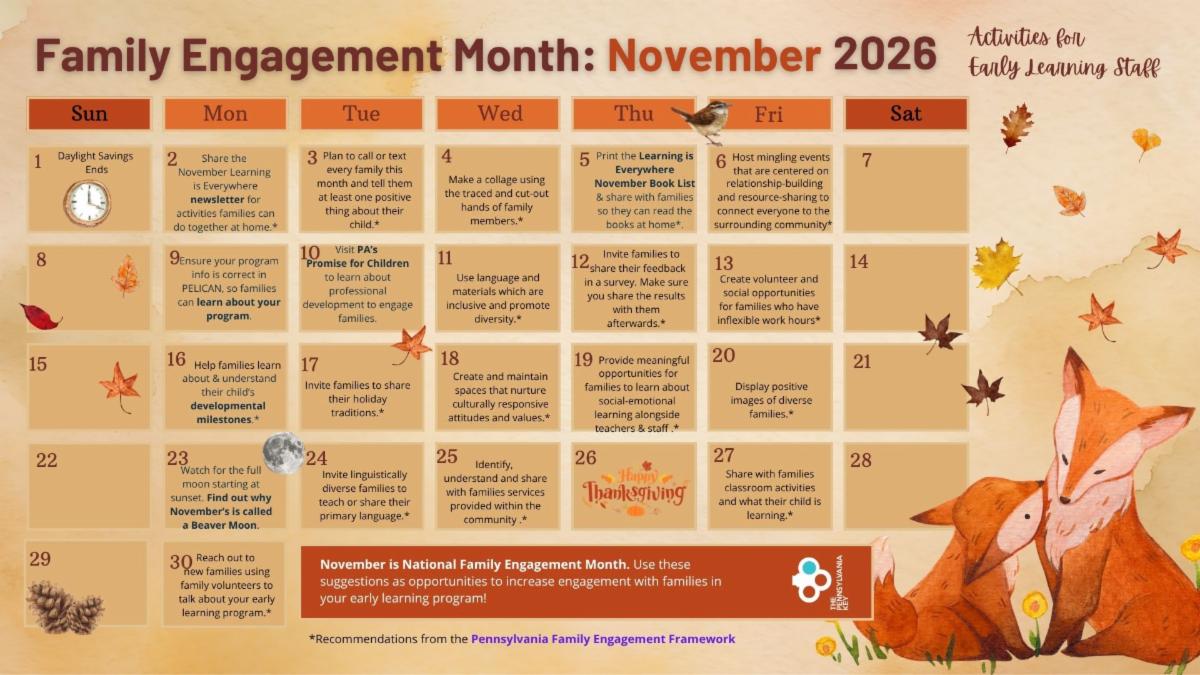
Plan Now for November's National Family Engagement Month: Celebrate Partnerships That Help Children Thrive
November is National Family Engagement Month, a time to recognize that families are a child’s first and most important teachers. Strong partnerships between families and early learning professionals help support children's social-emotional development, school readiness, and long-term success.
To celebrate, early learning programs across Pennsylvania are encouraged to participate in family-focused activities that strengthen relationships and create meaningful opportunities for engagement. The PA Promise for Children Early Learning Calendar of Activities offers simple, fun ways for staff to connect with families throughout the month, including sharing family stories, promoting literacy activities, celebrating family strengths, and creating opportunities for two-way communication and learning.
Whether it's hosting a family reading event, inviting families to share traditions and cultures, sending home engaging learning activities, or highlighting community resources, every effort helps build a welcoming environment where children and families can thrive together.
| | | | |