|
Did you know that when preschoolers play, they learn? It's true! Use these activities to encourage your preschooler to play. Visit the PA's Promise for Children website to print a copy of Kindergarten Here I Come.
We're learning Language and Literacy Skills
Do it!
Have your preschooler read a book to you by using the pictures to tell the story. There are several wordless picture books your preschooler can use to make their own story. You can also use a book they have listened to several times, so they can recall the story from memory. You can start a story, and they can select what happens next with words, sign, or picture cues.
Read it!
It is Night by Phyllis Rowand. The Bus for Us by Suzanne Bloom.
| | |
We're learning Social Studies Thinking
Do it!
Play shape-and-color hunt with your preschooler. Ask them to find something circular or blue. Do the same thing with other shapes and colors. Always show your preschooler what you're asking for or give them examples, such as, "This block is green, take this block with you and look for other things in the house that are the same color." Use this as an opportunity to reinforce vocabulary using words, picture cards, or Braille.
Read it!
Actual Size by Steve Jenkins. Say Please, Little Bear by Peter Bentley.
We're learning Science Thinking and Technology
Do it!
Look at fruits, vegetables, cans, and boxes in a book, grocery store, or farmer's market. Talk about the different shapes, colors, and sizes. Use words like same and different. Continue reinforcing this concept with word cards, signs, and braille.
Read it!
Mrs. McNosh and the Giant Squash by Sarah Weeks. Put it on the List by Kristen Darbyshire.
We're learning Mathematical Thinking and Expression
Do it!
Make a height chart with paper. Place the paper against the wall or door and ask your preschooler to stand with their back against the chart. Mark their height and date it. Try this again in three months and talk about the change. Your preschooler could also lie on the paper or use measurements to draw a line. Ask them to stretch out their arms and measure their arm span. Use the information about their height to compare it with another object in the house. For example, "You are taller than the sink" or "You can reach the shelf now, and you couldn't before." Use that information to talk about the circumference of objects. For example, "Do you think your arms could fit around that tree?"
Read it!
One Mole Digging a Hole by Julia Donaldson and Nick Sharratt. 365 Penguins by Jean-Luc Fromental and Joëlle Jolivet.
| |
Celebrate National Early Literacy Month!
September is National Early Literacy Month, a time to celebrate the important role that reading, talking, singing, and storytelling play in a child’s development. Early literacy skills begin long before children learn to read on their own. Every book shared, song sung, and conversation held helps lay the foundation for future learning and success.
You don’t need special materials or long lessons to help a child develop literacy skills. PA's Promise for Children has easy activities you can do with your child to encourage and support early literacy. Check out the resources for families and early learning professionals and see how you can become an Early Literacy Champion!
Watch the video below for a special message from Shante' Brown, Deputy Secretary for the PA Office of Child Development and Early Learning (OCDEL).
| | |
Is Your Family Ready for an Emergency?
September is National Emergency Preparedness Month. Use this month to help your family prepare for emergencies like floods, fires, and winter storms.
Check out these resources to help your family prepare for emergencies.
-
Pennsylvania Emergency Preparedness Guide: This guide will help you become better prepared by learning about different kinds of emergencies, how to create emergency plans and kits for your home, your vehicle, and your workplace, and how to plan if you have a special need.
-
Family Communication Plan for Parents and Kids: Guidelines to help your family determine who your out-of-state point of contact would be and where you would meet away from your home.
-
Helping Children Cope: Tips to help children recognize their reactions during and after emergencies and help them cope with their emotions.
-
Ready Kids: Ready Kids has tools and information to help before, during, and after disasters. Play games, learn about disasters, and get tips to prepare before a disaster strikes.
| | |
Four Tips to Help Find a Quality Child Care or Preschool Program
You want your preschooler in a quality child care or preschool program, but you may not know what to look for. Knowing what will help your preschooler be safe, happy, and learning can be hard.
Start with these four tips to help look for a quality child care or preschool program!
-
Safety and security for your preschooler. When you trust your child to someone else, you want to be sure they are in a safe place and feel secure. Children always learn, but knowing if they feel unsafe is harder.
-
Good teachers and specialists who support you and your preschooler. Your child's teacher shapes their whole day and affects who your child will become. The quality of the teacher is one of the most important pieces of a child care or preschool program.
-
A kid-friendly atmosphere with learning areas & activities, right for your preschooler's age and development. Young children learn by exploring & using many skills at once. Classrooms need to be designed to fit activities that work best for children.
-
Reach for the STARS! Keystone STARS can help you pick programs that have quality staff & activities that are the right fit for your family. Child care, PA Pre-K Counts, and Head Start programs participating in Keystone STARS meet quality standards as part of the STARS standards. Based on these quality standards, they receive a STAR rating from 1 to 4.
Learn more about choosing a quality child care or preschool program at PA's Promise for Children. When looking for a program, visit COMPASS Find Child Care or contact your local Early Learning Resource Center (ELRC). Find your ELRC at www.raiseyourstar.org.
| | |
School Success Kit for Kids With Sensory Processing Issues
Going back to school is an exciting time, but for kids with sensory processing issues, it can be overwhelming. Read about these strategies from the Child Mind Institute to help your child (and you!) feel calm, comfortable, and confident this year.
| |
September Health Trends in Early Childhood: Early Literacy and Children’s Health
September is National Early Literacy Month. This month’s Health Trends in Early Childhood highlights how early literacy helps support children’s health and well-being.
Reading, talking, and learning with young children helps build important skills that support healthy choices and lifelong wellness. Families can encourage early literacy through everyday activities that strengthen learning, communication, and healthy habits.
Health Trends in Early Childhood, a monthly resource from The Pennsylvania Key, explores health topics affecting children from birth to age 5, as well as their families and caregivers. Each edition explains why a health topic matters, its impact on young children and communities, and simple actions families and caregivers can take to support children’s health and development. It also includes trusted resources for learning more.
| | |
The Importance of Breakfast for Kids
Breakfast is an important step to refuel the body for both children and adults. Skipping breakfast can make kids feel tired, restless, or irritable, making it harder for them to learn! Breakfast eaters get better grades and score higher on standardized tests. Kids who participate in school lunch programs have fewer school absences.
Kids who eat breakfast also tend to eat healthier overall and are more likely to be physically active — two great ways to help maintain a healthy weight.
This article from KidsHealth has some great breakfast tips to help fuel your kid's body and mind and get them set on the path of learning.
| |
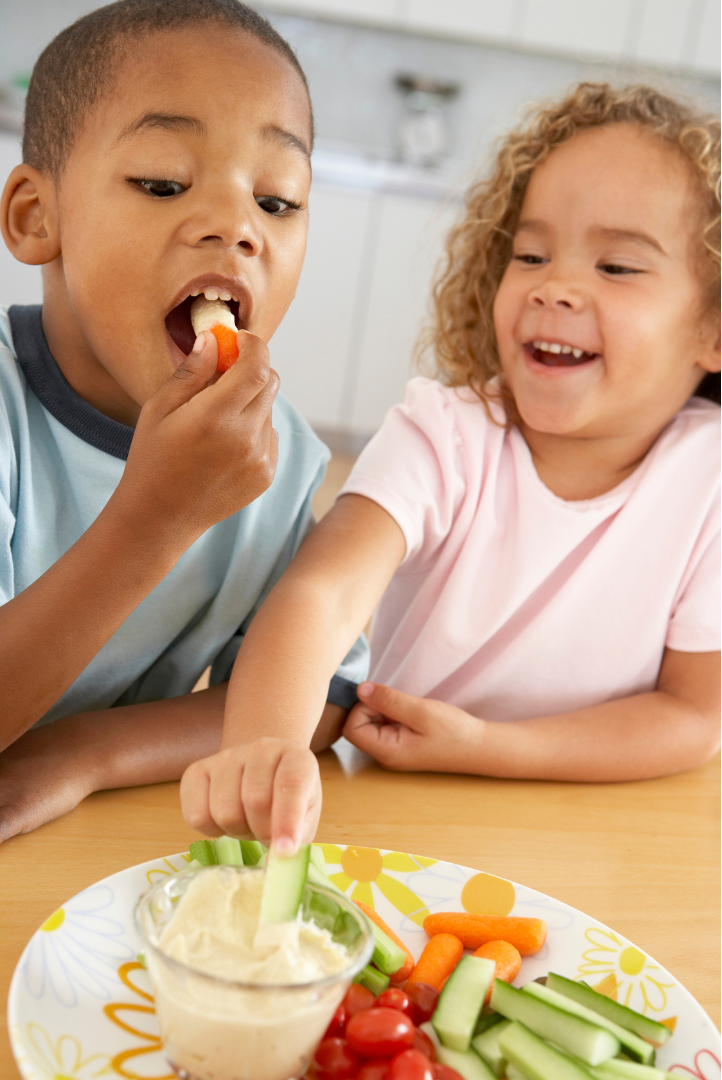
Five Ways to Encourage Vegetables
Many young children can be choosy eaters, especially when it comes to eating vegetables. It can take them 10 or more tries before they like a new food. Keep trying – it will help them have healthier eating habits later. Here are five ways to get started:
- Eat together. Let your child see you enjoying vegetables at meals and snacks.
- Prepare together. Teach your child how to tear lettuce or add vegetable toppings to pizza.
- Get colorful. Choose different colors of vegetables to eat.
- Make vegetables fun. Read about them in books. Plant a seed and watch it grow.
- Share the adventure. Try a new vegetable each week.
Check out the USDA's Nibbles for Health Newsletter, Encouraging Vegetables, for more ideas!
| | |
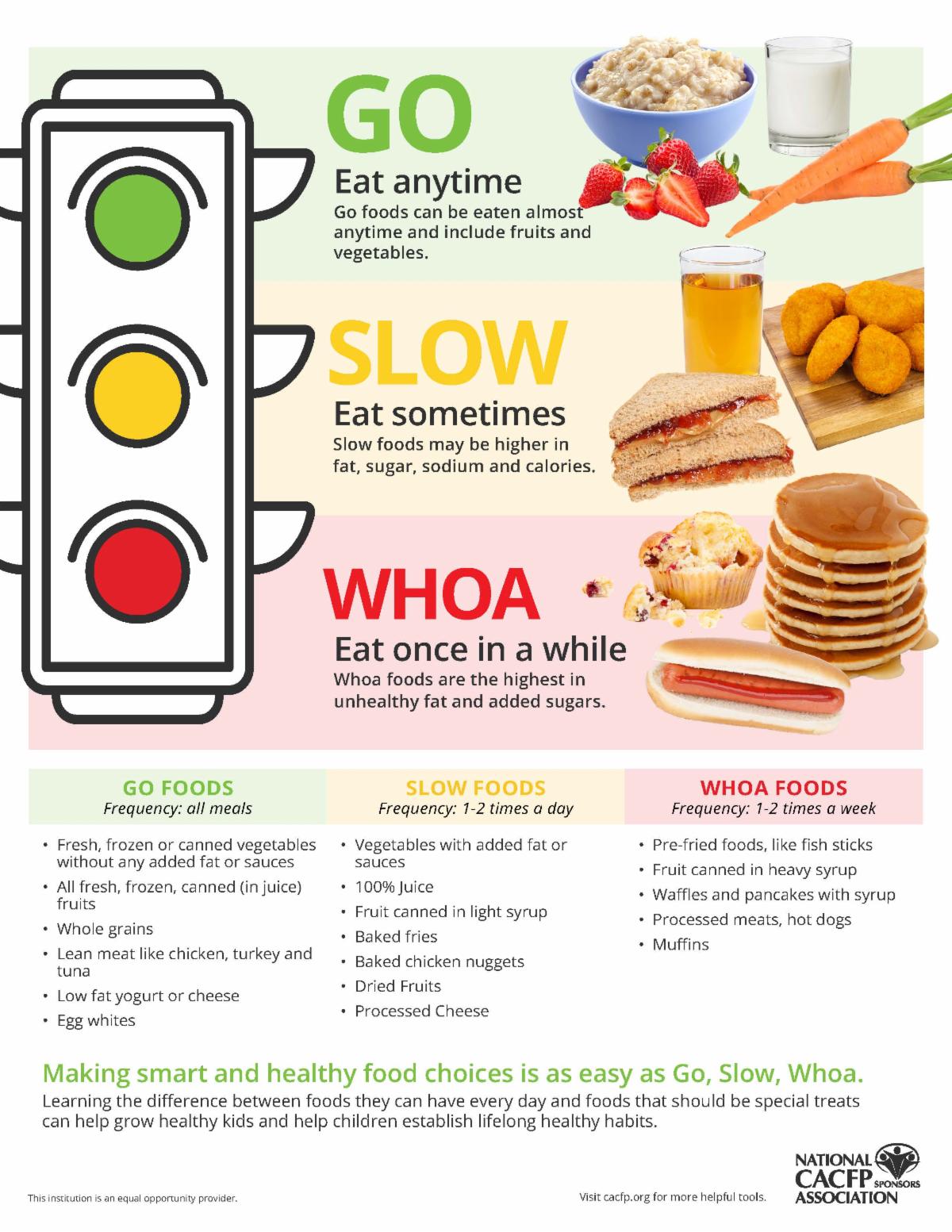
Go, Slow, Whoa
While children are being introduced to new foods, parents and caregivers should also stay informed on what foods their kids should eat anytime, sometimes, or only every once in a while. The National CACFP’s Go, Slow, Whoa handout includes quick tips for caregivers and a coloring activity to help kids understand which foods are good for their bodies.
| |
Read Aloud for 15 Minutes Per Day
The start of the school year sets the tempo and often brings chaos in its early days; therefore, it is very important to maintain good habits during this time. Reading aloud for 15 minutes every day can provide a calm moment during a hectic day and help your child develop. Find many useful free resources at the ReadAloud website.
| | |
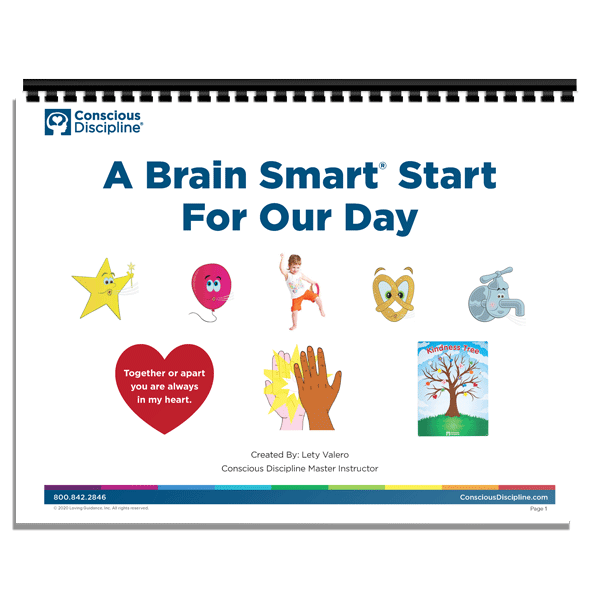
Brain Smart Start Guide: Free Download for Educators & Parents
Did you know all behavior comes from an internal state? This printable book from Conscious Discipline will help guide you so that you and your child can start the day in an optimal state and make the best out of the day.
| | |
The Ultimate Back-To-School Guide for Families of Children With Disabilities
The excitement of a new school year is in the air! For parents of children with disabilities, this time brings unique challenges and opportunities. Proper preparation can make all the difference in your child’s growth and success. This blog post from The ARC offers some practical tips to help you, and your child start the school year off right.
| | |
Free Mobile App - Vaccines on the Go: What You Should Know
It's easier than ever to get health information. But sometimes, it’s difficult to weed out the good, scientifically accurate information from the bad information, which is not based on science. This is especially true for vaccines.
To provide the public with information about the science, safety, and importance of vaccines, the Vaccine Education Center at Children's Hospital of Philadelphia (VEC) has a popular, award-winning mobile app, Vaccines on the Go: What You Should Know. Anyone can access vaccine information wherever and whenever they need it.
| | | | |