The Kolbe Center for the Study of Creation
A Catholic apostolate dedicated to proclaiming the truth about the origins of man & the universe
| | |
952 Kelly Rd., Mt. Jackson, VA 22842
Tel: 540-856-8453 E-Mail: director@kolbecenter.org
"For me You have created the skies scattered with stars...and all the beautiful things on earth."
St. Maximilian Kolbe
| | |
Dear Friends of the Kolbe Center,
Glory to Jesus Christ!
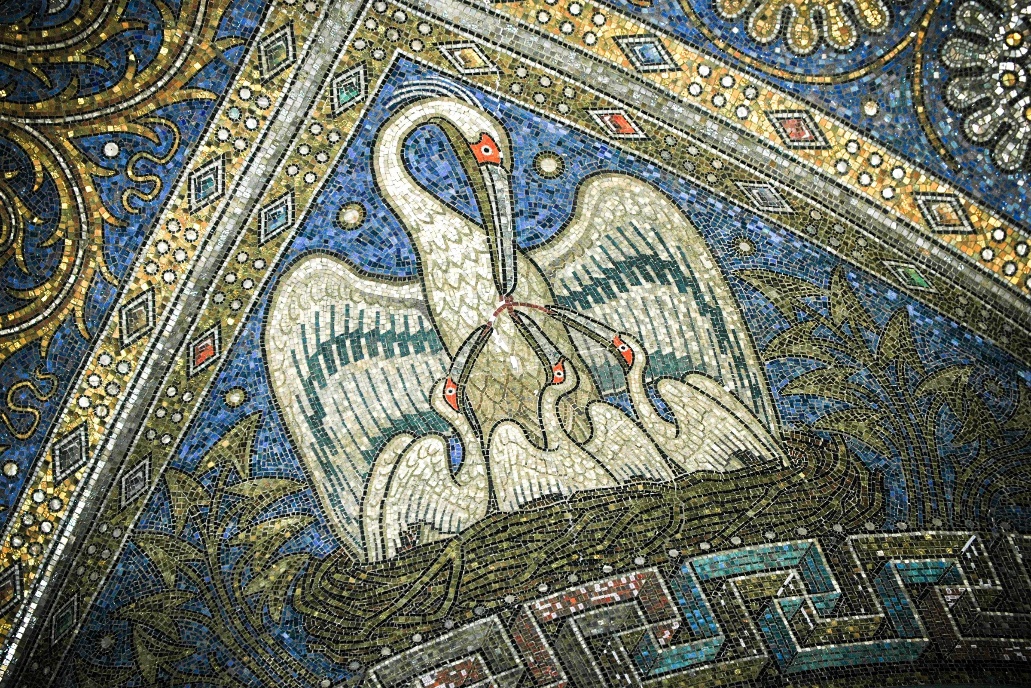
Recently one of the members of our leadership team asked me to comment on criticism by enemies of the Church who fault Her for incorporating into her sacred iconography the ancient motif of a pelican mother who cuts her own breast to feed her children. According to the critics, natural scientists have discovered that the pelican mother does not actually tear open her breast but rather regurgitates partially digested fish and feeds that to her babies, sometimes leaving a red stain on her chest, so that, the argument goes, the Church incorporated a falsehood into her sacred art and worship.
| | |
Pelican in Her Piety, 1880–81. Mosaic, Palatine Chapel, Aachen, Germany.
In this newsletter, I will demonstrate that there is no reason to fault the Church or to doubt her infallibility because the pelican motif was associated with an incomplete and only partially accurate understanding of the pelican’s habits. When Our Lord changed bread and wine into His Body, Blood, Soul and Divinity, under the appearance of bread and wine, He gave us His own Precious Blood which He had manufactured within His Body, according to the same amazing design that He had written into the human genome with the creation of St. Adam on the sixth day of creation.
Christ’s Food Became His Blood Which Becomes Our Food
How does food turn into blood? According to biologist Dr. Robin L. Stears:
Food provides nutrients such as proteins, fats, vitamins, minerals, etc. for the body to use (providing you have a healthy diet). The nutrients are picked out of the digested food by the intestinal cells, transported through the intestinal cells then deposited into the blood stream. This keeps a firm barrier between the sterile blood and body, and the non-sterile (and full of bacteria) intestinal contents.
Once in the blood stream, the nutrients get an express ride to the liver for further metabolism if needed, or they can float around the blood stream and get delivered to the cells in the body.
The cells that need certain nutrients will pluck them out of the blood stream for their own uses – with the exception of the brain – there is an extra barrier there, because it’s extra important.
In mammals (people included), red blood cells are made in the bone marrow, white blood cells are made in the spleen, lymph nodes and Thymus. Cells in these organs that will make blood cells take up the nutrients and use them to make the various blood cells
Robin L. Stears, Ph.D., Developmental and Cell Biology
| | |
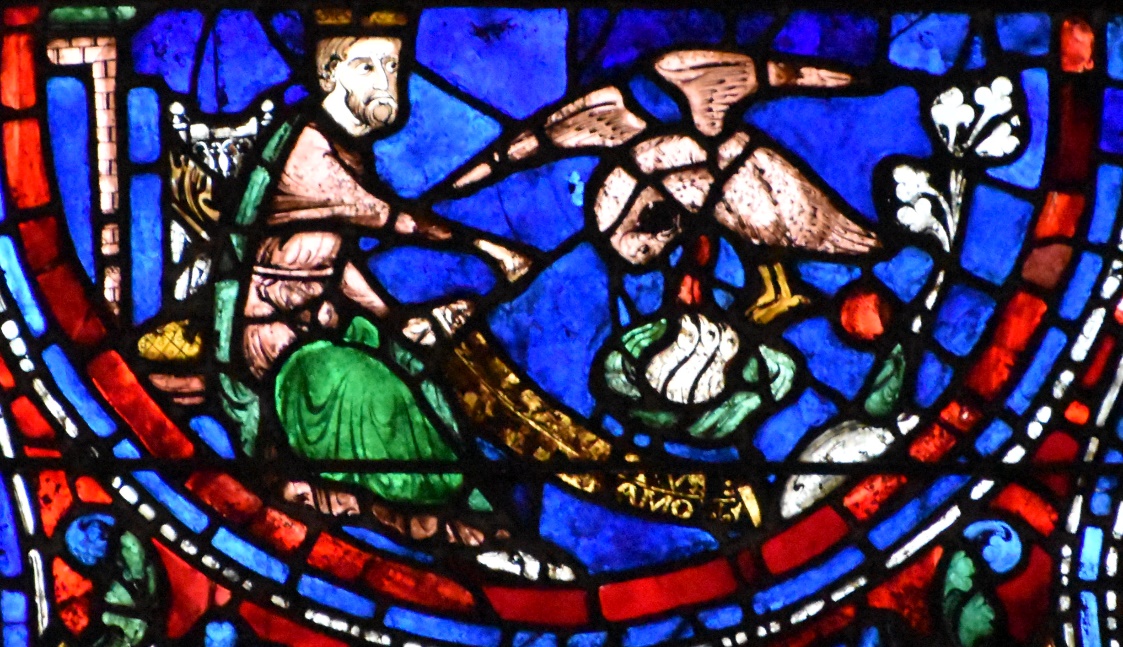
Detail from the 13th-century Redemption Window at Chartres Cathedral in France, showing a pelican (a figure of Christ) feeding her young with her own blood as King David looks on, holding a scroll with the inscription “Similis factus sum pellicamo,” from Psalm 102:6. Photo: Adrian Barlow.
With this explanation in mind, we can see that the pelican as she behaves in nature actually serves as a faithful type of Our Lord Jesus Christ. At the Mystical Supper He partook of earthly food, and this earthly food was transformed into His Body and Blood by the marvelous natural processes of digestion and chemical transformation that He wrote into the human genome on the sixth day of creation. He then gave His Body and Blood to the Apostles in the Holy Eucharist as a making-present to them of His Sacrifice on the Cross to give life to souls, as the mother pelican brings forth her food to her young to give them life.
The Fathers of the Church had no illusions that the ancient pagan lore concerning the pelican might not contain some fanciful elements. As Victoria Emily Jones explains in her article on “The Vulning Pelican as an Allegory of Christ,” pagan accounts of the pelican often relate that she was prone to kill her own offspring when they turned on her and would only then wound herself to bring them back to life:
In his commentary on Psalm 102 Augustine writes, “Let us not pass over what is said, or even read, of this bird, that is, the pelican.” Standing over her dead chicks, “the mother wounds herself deeply, and pours forth her blood over her young, bathed in which they recover life. This may be true, it may be false: yet if it be true, see how it agrees with him, who gave us life by his blood. It agrees with him in that the mother’s flesh recalls to life her young with her blood; it agrees well. For he calls himself a hen brooding over her young. If, then, it be so truly, this bird does closely resemble the flesh of Christ, by whose blood we have been called to life.”
Augustine then goes on to explain how the mother’s killing her young relates to God metaphorically killing our old self so that he can then raise us up to new life in Christ; he likens conversion to death and rebirth.
| |
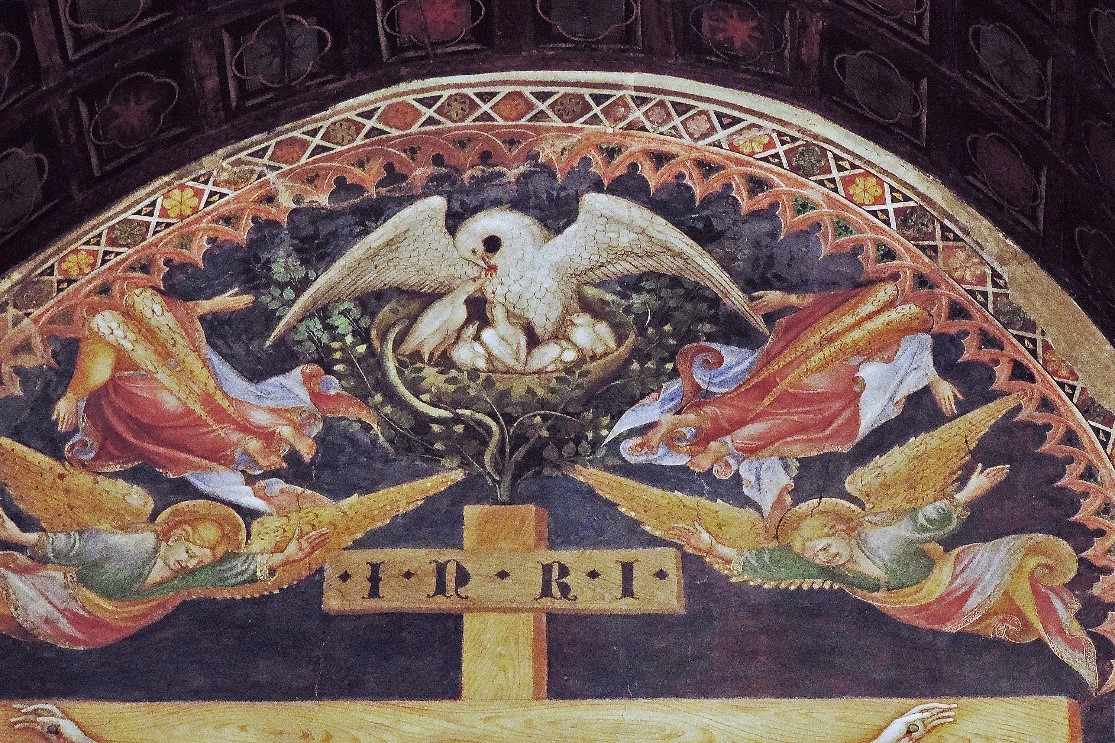
E Lorenzo Salimbeni (Italian, 1374–ca. 1418) and Jacopo Salimbeni (Italian, ca. 1370/80–after 1426), Crucifixion (detail), ca. 1416. Fresco, Oratorio di San Giovanni Battista (Oratory of St. John the Baptist), Urbino, Italy.
Adoro Te Devote
The pelican theme appears again and again in sacred art throughout Christendom, as a type of Our Lord Jesus Christ’s gift of Himself to us in the Holy Eucharist. In the Middle Ages, the Angelic Doctor incorporated the pelican theme into his famous Eucharistic hymn “Adoro te devote.” According to Victoria Emily Jones:
Probably the most universally famous poetic treatment of the pelican as an emblem of Christ is the Eucharistic hymn “Adoro te devote” (Hidden God, Devoutly I Adore Thee). Written around 1260 by Thomas Aquinas, it is one of the most beautiful medieval poems in Latin. Aquinas did not originally write it for the liturgy, but it was added to the Roman Missal in 1570 and since then has been used in the Catholic Mass. The penultimate stanza reads:
Pie pelicane, Jesu Domine,
Me immundum munda tuo sanguine,
Cujus una stilla salvum facere
Totum mundum quit ab omni scelere.
Like what tender tales tell of the Pelican,
Bathe me, Jesus Lord, in what thy bosom ran—
Blood that but one drop of has the pow’r to win
All the world forgiveness of its world of sin.
Trans. Gerard Manley Hopkins
As explained above, nothing that natural science has learned about the pelican detracts from the fulfillment of that type in Our Lord Jesus Christ. The mythical elements—the putting to death and raising to life of her rebellious children by the pouring forth of her blood—harmonize with the factual basis for the type and point to the way that Our Lord’s sacrifice surpassed all prior types while fulfilling them all.
From Ptolemy to Tycho Brahe: An Analogy
| |
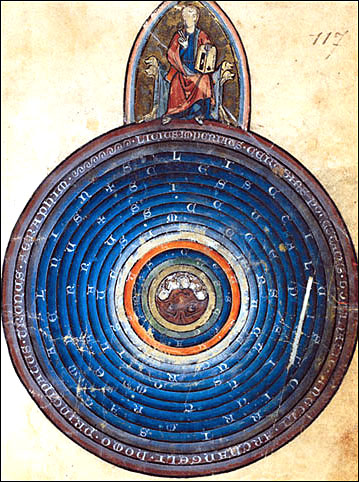
Earth at the center of the Spheres. in Gossuin de Metz, L’Image du monde. 13th-century Copy.
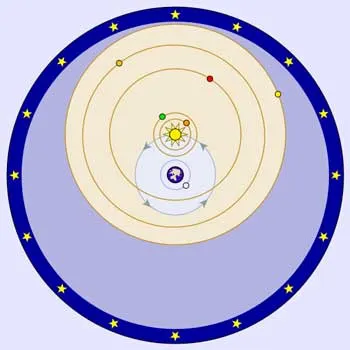
Another example of an image that loomed large in the iconography of the Medieval Church but which underwent refinement with the advance of natural science was the geocentric-geostatic map of the cosmos. As St. Robert Bellarmine explained to Galileo and his followers, many passages in the Bible had been interpreted for more than two thousand years by all the greatest Scriptural commentators as teaching that the Earth was motionless in the center of the world. Since the Egyptian astronomer Ptolemy had formulated a model of the solar system that seemed to make consistent predictions and harmonized with the geocentric-geostatic cosmology of the Bible, most, if not all, of the Church Fathers had embraced his model as a working description of the universe. The illustration shown above was typical of the way that the solar system and the cosmos were depicted throughout Christendom in the Middle Ages. Amazingly enough, however, what God showed St. Hildegard of Bingen, Doctor of the Church, was not the Ptolemaic model of the solar system. Instead, St. Hildegard was shown the Earth motionless at the center of the cosmos, with the sun going around the Earth and the planets going around the sun.
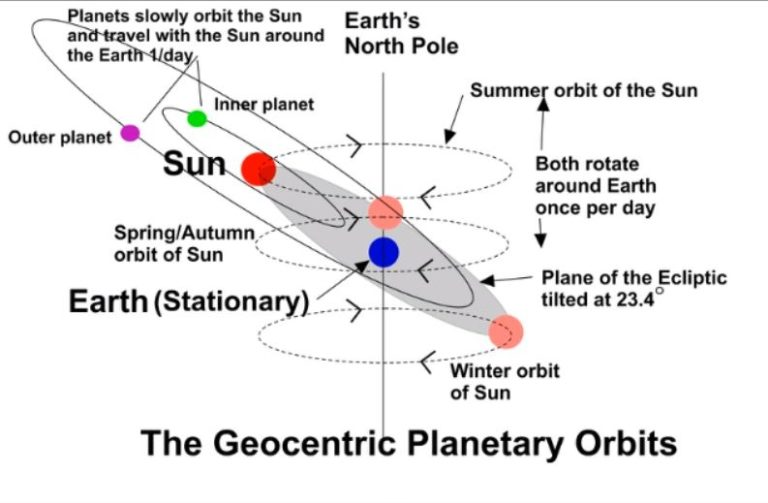
After the invention of the telescope, astronomers realized that the Ptolemaic model could not explain all of their observations, and Copernicus, Galileo and their disciples showed that a heliocentric model of the solar system had more explanatory power than the Ptolemaic model. However, the greatest astronomer of the age, Tycho Brahe, who made more observations of the heavens than anyone before him in recorded history, showed that he could explain all the observations of the solar system by having the Earth motionless at the center, the sun going around the Earth, and the planets going around the sun—the very thing that God had shown to St. Hildegard of Bingen 400 years earlier! Thus, the greatest astronomers of the age of Galileo, including the Jesuit astronomers, saw that Tycho’s system explained all the observations, without abandoning the traditional geocentric-geostatic understanding of the cosmos that flowed from the literal and obvious sense of Scripture, as it had been understood since the time of King Solomon.
| |
Tychonian Model of the Solar System
St. Hildegard’s Visions Anticipate Tycho Brahe’s Model of the Solar System
As an example of the way that Tychonian geocentrism explains the latest astronomical observations, consider Robert Sungenis’s account of the way that some of Isaac Newton’s assumptions were corrected by Ernst Mach and Albert Einstein—in a way that harmonized perfectly with the visions of St. Hildegard and the geocentric-geostatic model of Tycho Brahe:
Although Newton sought to apply his laws of motion only to the solar system so that, as he says in his 1684 Scholium:
Thence indeed the Copernican system is proved a priori. For if a common center of gravity is computed for any position of the planets, it either lies in the body of the Sun or will always be very near it…
In the end Newton realized, especially after consultation with Christiaan Huygens, that his laws of motion could be applied more expansively. In doing so, it would allow the solar system’s center of mass to be near the sun, but also allow the Earth to be the center of mass of a much larger system. As such, the sun, with its planets, would revolve around a fixed Earth as described in the Tychonian system. For this alternative to be permitted, however, Newton stipulated that an additional force outside the solar system must work in tandem with the gravitational forces inside the solar system. Several modern physicists have acknowledged Newton’s alternative, one of them being the Nobel laureate, Steven Weinberg. Here is how Weinberg describes it in his 2015 book, To Explain the World:
If we were to adopt a frame of reference like Tycho’s in which the Earth is at rest, then the distant galaxies would seem to be executing circular turns once a year, and in general relativity this enormous motion would create forces akin to gravitation, which would act on the Sun and planets and give them the motions of the Tychonic theory. Newton seems to have had a hint of this. In an unpublished ‘Proposition 43’ that did not make it into the Principia, Newton acknowledges that Tycho’s theory could be true if some other force besides ordinary gravitation acted on the Sun and planets.
Weinberg’s reference to “forces akin to gravitation” refers to inertial forces, such as centrifugal, Coriolis and Euler forces. Using Einstein’s General Relativity as the sanction, Weinberg indicates that, in the view of modern physics, a universe rotating around a fixed Earth will create inertial forces that mimic the force of gravity. As the universe’s inertial forces meet the gravitational forces in our solar system, both will contribute to how the sun and planets will move with respect to each other. Weinberg also notes that the inclusion of forces outside the solar system that will allow Tychonian geocentrism are specified in Newton’s Proposition 43, which was originally planned to be added to page 510, the last page of the Principia. In Proposition 43 Newton says:
In order for the Earth to be at rest in the center of the system of the Sun, Planets, and Comets, there is required both universal gravity and another force in addition that acts on all bodies equally according to the quantity of matter in each of them and is equal and opposite to the accelerative gravity with which the Earth tends to the Sun… For, such a force, acting on all bodies equally and along parallel lines, does not change their position among themselves, and permits bodies to move among themselves through the force of universal gravity in the same way as if it were not acting on them. Since this force is equal and opposite to its gravity toward the Sun, the Earth can truly remain in equilibrium between these two forces and be at rest. And thus celestial bodies can move around the Earth at rest, as in the Tychonic system.
|
. . . In his book, Relational Mechanics, physicist Andre T. Assis shows how the centrifugal, Coriolis and Euler forces, as real forces that determine the revolutions of the celestial bodies, can be derived from simple Newtonian and Machian physics. He writes:
In the Ptolemaic system, the earth is considered to be at rest and without rotation in the center of the universe, while the sun, other planets and fixed stars rotate around the earth. . . Now the gravitational attraction of the sun is balanced by a real gravitational centrifugal force due to the annual rotation of distant masses around the earth (with a component having a period of one year). In this way the earth can remain at rest and at an essentially constant distance from the sun. The diurnal rotation of distant masses around the earth (with a period of one day) yields a real gravitational centrifugal force flattening the earth at the poles. Foucault’s pendulum is explained by a real Coriolis force acting on moving masses over the earth . . . The effect of this force will be to keep the plane of oscillation of the pendulum rotating together with the fixed stars.
“When He, the Spirit of Truth, is Come, He will Teach You All Truth”
At the Mystical Supper Our Lord told His Apostles, “When He the Spirit of Truth is come, He will teach you all truth.” It follows that St. Vincent of Lerins was correct to answer in the affirmative when he was asked, “Is there no progress of religion in the Church of Christ?”
Certainly there is progress, [he answered], even exceedingly great progress [plane et maximus]! For who is so envious of others and so hateful toward God as to try to prohibit it? Yet it must be an advance [profectus] in the proper sense of the word and not an alteration [permutatio] in faith. For progress means that each thing is enlarged within itself, while alteration implies one thing is transformed into something else. It is necessary, therefore, that understanding, knowledge, and wisdom should grow and advance vigorously in individuals as well as in the community, in a single person as well as in the whole church, and this gradually in the course of ages and centuries. But the progress made must be according to its own type, that is, in accord with the same doctrine, the same meaning, and the same judgment [eodem sensu eademque sententia].
If we consider the two examples that we have examined in this newsletter, we can see that they both illustrate the way that an image can be incorporated into the liturgical life of the Church and undergo refinement, without the essential meaning of the image being called into question. In the case of the pelican, man’s understanding of the natural basis for the image of a bloody-chested mother developed, while the essential truth of the image—the mother pelican’s provision of life-giving food from her own body—remained the same. The primitive mythical image of the pelican mother who kills her rebellious offspring only to raise them to life with her own blood—and the refined, realistic image of the pelican mother who brings forth food from her own body to give life to her young—both types were fulfilled in Our Lord Jesus Christ through the institution of the Sacrament of His Body and Blood. In a similar way, the Ptolemaic model of the solar system upheld the essential Biblical geocentric-geostatic character of the universe throughout the first Christian millennium, but, with improvements in the telescope, the Ptolemaic model gave way to the more accurate Tychonian model of the cosmos, first heralded by St. Hildegard of Bingen, and then to the Neo-Tychonian model of the universe, confirmed by an ever-increasing body of experimental and observational evidence down to the present day.
Through the prayers of the Holy Theotokos, and of all the Holy Angels and Saints, may the Holy Ghost deliver us from all evil and error and lead us into all the Truth!
In Domino,
Hugh Owen
| | Latest Products from the Kolbe Center: | |
DAY THREE - How the World Was Made in Six Days - DVD + Online Streaming | | | | Life of Antichrist - Dionysius von Luxemburg | | By meditating on the teaching of Scripture and Tradition on the final Antichrist, the Fathers and Doctors sought to exhort the faithful to pray for the grace to be able to stand firm in the face of the final persecution of the Church, and to regard all prior persecutions, no matter how severe, as but faint foreshadowings of the future persecution of Antichrist. In this way, they sought to fortify the faithful in their trials, by helping them always to put their trials and persecutions into perspective in relation to the ultimate trial and persecution of the Church. In the true spirit of the Fathers of the Church, Kolbe advisor Eric Bermingham has done the faithful a great service by translating one of the most authoritative works on the Antichrist, by the holy and erudite seventeenth century Capuchin preacher Dionysius of Luxembourg. | | | Out of the Blue - eBook (PDF) | | In Out of the Blue author Gary Ross shows how discovering the bankruptcy of the molecules-to-man evolutionary hypothesis holds the key to escaping from the suffocating web of naturalism and secular humanism so as to be free to embrace the Gospel and enjoy the glorious liberty of the children of God. Step by step, the author takes his readers on a journey that leads to his realization that the Catholicism is the one true Faith. based on Divine Revelation. | | | |
The Rise and Fall of the Documentary Hypothesis | | |
This book traces the rise of an assault on truth, centuries in the making, called the Cartesian-Darwinian Narrative, that heavily influenced Biblical scholarship and birthed the documentary hypothesis. The foundational claims of the documentary hypothesis are then exposed as untrue, based on new archaeological discoveries. It is also shown that naturalistic accounts of origins, also based on anti-supernatural bias, have been completely discredited. Therefore, there was never the reason or necessity to depart from the traditional understanding of the Pentateuch taught by the Church from Apostolic times.
These insights have the potential to restore confidence in the Ancient Faith and destroy many falsehoods that have polluted seminaries and devastated the faith of millions. If courage can be found to restore the truth, believers will be emboldened to proclaim the Gospel, and many wayward souls will find their way home.
| | | The Rise and Fall of the Documentary Hypothesis - eBook (PDF) | | |
This book traces the rise of an assault on truth, centuries in the making, called the Cartesian-Darwinian Narrative, that heavily influenced Biblical scholarship and birthed the documentary hypothesis. The foundational claims of the documentary hypothesis are then exposed as untrue, based on new archaeological discoveries. It is also shown that naturalistic accounts of origins, also based on anti-supernatural bias, have been completely discredited. Therefore, there was never the reason or necessity to depart from the traditional understanding of the Pentateuch taught by the Church from Apostolic times.
These insights have the potential to restore confidence in the Ancient Faith and destroy many falsehoods that have polluted seminaries and devastated the faith of millions. If courage can be found to restore the truth, believers will be emboldened to proclaim the Gospel, and many wayward souls will find their way home.
| | | Evolution: Fact or Fiction? - What Should a Catholic Believe? | | God’s Revelation tells us that He created everything in the universe out of love for us—and that when we destroyed the harmony of the first created world with our sin, God came down into the misery that we made, took it upon Himself, suffered and died for us, rose again, and founded the Catholic Church so that we could become new creations in Him and cooperate with Him in restoring everything back to the beauty that it had in the beginning and to bring it to an even more wonderful perfection at the end of time. That understanding gives meaning to every human life—a meaning that the evolutionary account of origins destroys, thus clearing the way for the anti-culture of death. With this new book, Greg Clovis crowns a lifetime of prolife work as the head of Family Life International in the UK with a powerful defense of the traditional Catholic doctrine of creation, the foundation of our Faith and the only firm foundation for a culture of life. | | | Evolution: Fact or Fiction? - What Should a Catholic Believe? - eBook (PDF) | | God’s Revelation tells us that He created everything in the universe out of love for us—and that when we destroyed the harmony of the first created world with our sin, God came down into the misery that we made, took it upon Himself, suffered and died for us, rose again, and founded the Catholic Church so that we could become new creations in Him and cooperate with Him in restoring everything back to the beauty that it had in the beginning and to bring it to an even more wonderful perfection at the end of time. That understanding gives meaning to every human life—a meaning that the evolutionary account of origins destroys, thus clearing the way for the anti-culture of death. With this new book, Greg Clovis crowns a lifetime of prolife work as the head of Family Life International in the UK with a powerful defense of the traditional Catholic doctrine of creation, the foundation of our Faith and the only firm foundation for a culture of life. PDF eBook | | | A Christian's Guide to Refuting Evolution | | Microbes-to-man evolution is a theory, not a scientific fact. Yet we hear and see the word “evolution” everywhere – in theaters, museums, schools, and across social media. We are three generations into allowing only the evolutionary viewpoint to target children in our public education system – with predictable results – less than 15% of graduating college students have any interest in the Bible or Christianity. This short, succinct color softcover (filled with demonstrations, video links, and activities) objectively looks at the “best” evidence for cosmic, chemical. and biological evolution and shows how molecules-to-man evolution both undermines basic Biblical truth and is scientifically impossible. Just as any of us would jump in front of a speeding car to save a child from physical death… help protect the next generation from an intellectual and moral car wreck, leading to their spiritual deaths. Give this book to every parent you know who has children in the public education system, or to homeschooling parents as an additional science resource. | | | |
| | Creation and Time is an important work. It offers powerful reasons for holding that the modern belief in evolution, even 'theistic evolution', is alien to Catholic tradition. Of particular interest is the authors' careful analysis of the teaching of the Fourth Lateran Council. Appealing to authoritative commentaries on this Council, as well as later magisterial texts, they make a strong case that, centuries before Darwin, the Church had already definitively ruled out the idea that the multiplicity of created things, and man himself, came into being long ages after the original moment of creation. Fr. Thomas Crean, O.P., MA, Philosophy and Theology, Oxford University, STD, International Theological Institute, Trumau, Austria | | | |
Creation and Time - PDF eBook | | Creation and Time is an important work. It offers powerful reasons for holding that the modern belief in evolution, even 'theistic evolution', is alien to Catholic tradition. Of particular interest is the authors' careful analysis of the teaching of the Fourth Lateran Council. Appealing to authoritative commentaries on this Council, as well as later magisterial texts, they make a strong case that, centuries before Darwin, the Church had already definitively ruled out the idea that the multiplicity of created things, and man himself, came into being long ages after the original moment of creation. Fr. Thomas Crean, O.P., MA, Philosophy and Theology, Oxford University, STD, International Theological Institute, Trumau, Austria | | | |
Latina Ecclesiae Per Genesim Data - Volume I | | Semper Deo gratias et Mariae! Not intending any irreverence, I am thankful to God and to Holy Virgin, yes, but now also to Maria Owen for this contribution to Catholic Latin learning. I have been looking for something like this during my 22 years of teaching Latin to Catholics. I can't even say that one finds bits and pieces of this great work in other curricula or books: Maria has truly *co-created* a Latin program that is both full of grace and full of authentic Latin at appropriate levels for beginners. I'm thrilled to be using this book to teach at Ite Domum and I'll be recommending this book to all who sought something similar to it: we can now enjoy a Sabbath's rest, thanks to Maria's creative opus. Jonathan Arrington Jonathan Arrington has taught Latin for Thomas More College and Newman College Ireland, Roman and Early Church History for Christendom College, Ancient Greek for the Angelicum (Pontifical University of St. Thomas Aquinas), and Sacred Scripture for the Denver Archdiocesan Seminary's Lay Division. Maria Owen provides a refreshing approach to Latin study, patterned on the natural way of language learning. Beginning with simple sentence structure and limited... | | | |
Latina Ecclesiae Per Genesim Data - Volume I PDF eBook | | Semper Deo gratias et Mariae! Not intending any irreverence, I am thankful to God and to Holy Virgin, yes, but now also to Maria Owen for this contribution to Catholic Latin learning. I have been looking for something like this during my 22 years of teaching Latin to Catholics. I can't even say that one finds bits and pieces of this great work in other curricula or books: Maria has truly *co-created* a Latin program that is both full of grace and full of authentic Latin at appropriate levels for beginners. I'm thrilled to be using this book to teach at Ite Domum and I'll be recommending this book to all who sought something similar to it: we can now enjoy a Sabbath's rest, thanks to Maria's creative opus. Jonathan Arrington Jonathan Arrington has taught Latin for Thomas More College and Newman College Ireland, Roman and Early Church History for Christendom College, Ancient Greek for the Angelicum (Pontifical University of St. Thomas Aquinas), and Sacred Scripture for the Denver Archdiocesan Seminary's Lay Division. Maria Owen provides a refreshing approach to Latin study, patterned on the natural way of language learning. Beginning with simple sentence structure and limited... | | | |
The Rooster And The Sunrise | | Mrs. Ani Slattery has produced a beautiful children’s book that will allow you to replace the blasphemous icons of evolution with the true icons of creation while entertaining your children with a delightful story about a rooster entitled The Rooster and the Sunrise. Told in verse, the story is accompanied by the magnificent drawings of an exceptionally gifted Portuguese artist by the name of Emily Lapa. Emily not only brings the rooster, his adoring hens, and the surrounding countryside to life. In her illustrations to accompany the hens’ account of the six days of creation, she also shows the glorious condition of our first parents, St. Adam and St. Eve, when they came forth from God’s hands in the beginning. | | | | | | |
A Guide to Reclaiming Your Lost Human Heritage and Your Heavenly Inheritance
At a time when the modernist heresy is blinding so many well-intentioned souls, Loved, Lost and Found, will help many people lost in current errors to rediscover our tender “Abba” Father. Mr. Owen harmonizes faith and science with convincing evidence that supports the literal sense of the Bible, especially Genesis 1-11. I am sure that after reading this book, many people of goodwill will convert or come back to the Catholic Church founded by Our Lord Jesus Christ.
Fr. Lawrence Carney, Apostle of Devotion to the Holy Face
| | Loved, Lost and Found - PDF eBook | | |
A Guide to Reclaiming Your Lost Human Heritage and Your Heavenly Inheritance
At a time when the modernist heresy is blinding so many well-intentioned souls, Loved, Lost and Found, will help many people lost in current errors to rediscover our tender “Abba” Father. Mr. Owen harmonizes faith and science with convincing evidence that supports the literal sense of the Bible, especially Genesis 1-11. I am sure that after reading this book, many people of goodwill will convert or come back to the Catholic Church founded by Our Lord Jesus Christ.
Fr. Lawrence Carney, Apostle of Devotion to the Holy Face
| | The Only Solution to the Self-Help Problem | | |
In The Only Solution to the Self-Help Problem Roy Metter lays bare the emptiness of the contemporary self-help literature that has led many men to build their lives on a false foundation. With logic and clarity, the author demonstrates that man can only find true happiness by fulfilling the purpose for which he was created, by cooperating with the grace of God in the Catholic Church and by following her traditional liturgies and teachings on faith and morals.
Fr. Lawrence Carney, Founder, The League of St. Martin
| | | | |