|
Lake Auburn Watershed Protection Commission
Watershed Newsletter
| | |
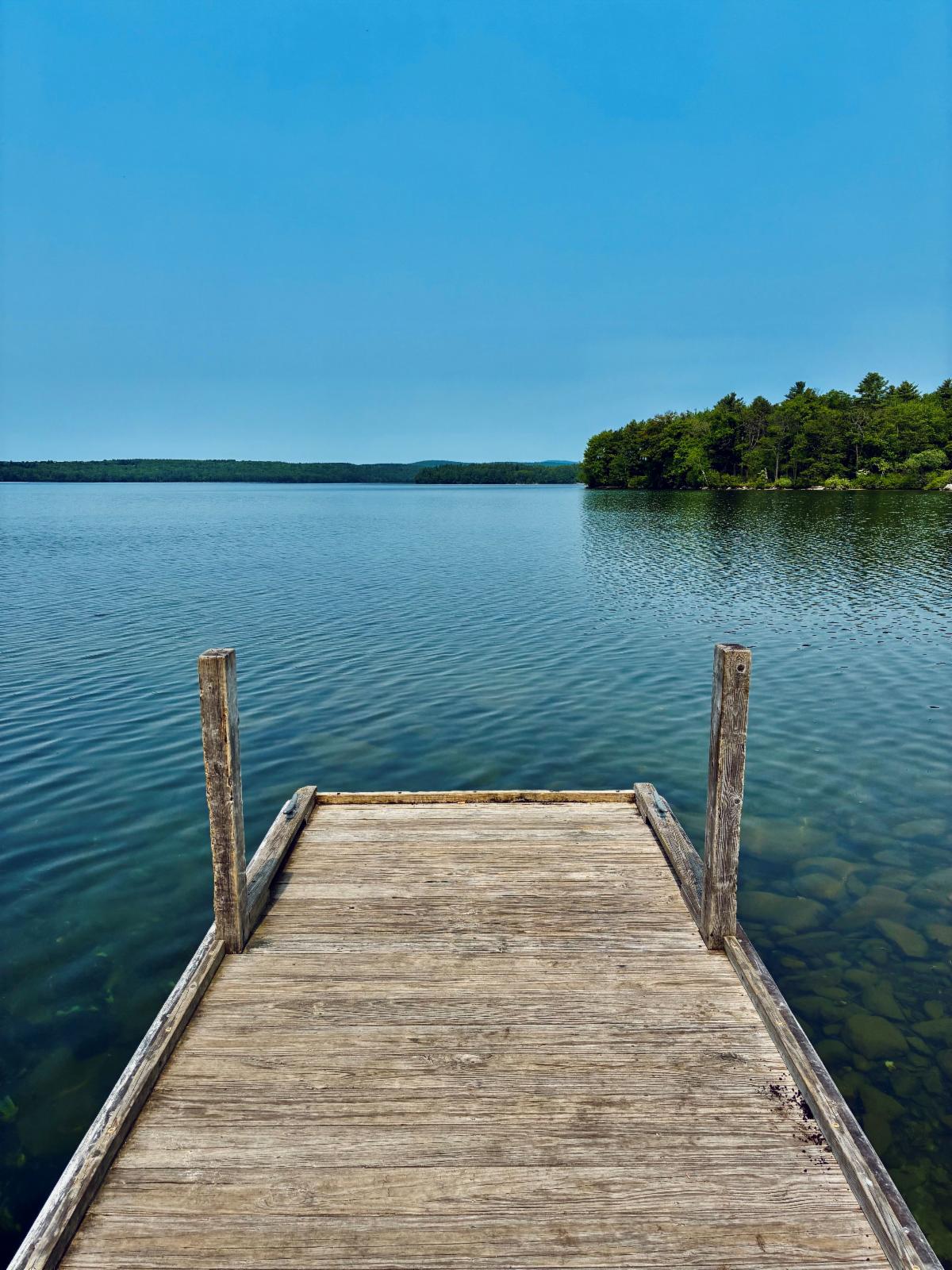
Well, summer has definitely made its presence known! After a cool and rainy spring, the sunshine and heat are finally here, and we are fully in our busy season at LAWPC. Water quality staff are conducting sampling at a number of sites around Lake Auburn and the surrounding tributaries, there are a couple of big watershed projects in the works, and we welcomed a new member to the team! Lily Gallagher, our new Shore Corps Steward, joined us in June and has hit the ground running. (Scroll a bit further down to read an interview with Lily!) I'll make sure to find time for some lake views this month between all the busyness, and I hope you can as well! Summer is fleeting in Maine, and we have to enjoy the hot days while we can.
Phoebe
| | | |
Tabling at Lewiston Farmers' Market
When: Sunday July 13, 9:30am-1:00pm
Where: Farmers' Market Community Booth
75 Lincoln Street & 2 Oxford Street, Lewiston
Come visit LAWPC at the community booth of the Lewiston Farmers' Market! We will be there to talk with community members about the importance of clean water access to agriculture, answer questions about current projects LAWPC is working on, and discuss how to be a good steward of the Lake Auburn watershed. We hope to see you there!
| | |
Tabling at Lewiston Summer Fun & Films
When: Wednesday July 23, 6:00-9:00pm
Where: Pettingill School Park
411 College Street, Lewiston
Free summer movie nights are back in Lewiston, and LAWPC will be there to share in the fun! Come visit our tent before the movie (Inside Out 2) starts to check out our full working model of the watershed. Learn more about Lake Auburn, how different activities impact water quality, and ways to keep our water source clean!
| | Upcoming Events Hosted by Our Colleagues | | |
Public Hearing: Proposed Changes to Fishing Regulations
When: Tuesday July 15, 4:00pm
Where: IF&W Offices - 3rd floor conference room
353 Water Street, Augusta
Maine's Department of Inland Fisheries and Wildlife is hosting a public hearing on proposed changes to ice fishing and open water fishing regulations in Washington, Penobscot, Piscataquis, and Aroostook counties. Members of the public are encouraged to review the proposals and provide comments, either by attending the public meeting on July 15, or by submitting written comments. The deadline for written submission is July 25, and comments should be submitted to contact person Becky Orff either by mail using the address below, or by email to becky.orff@maine.gov.
Becky Orff
Inland Fisheries & Wildlife
353 Water Street, #41 State House Station
Augusta, ME
04333
| |
An Interview with
Lily Gallagher
Shore Corps Steward
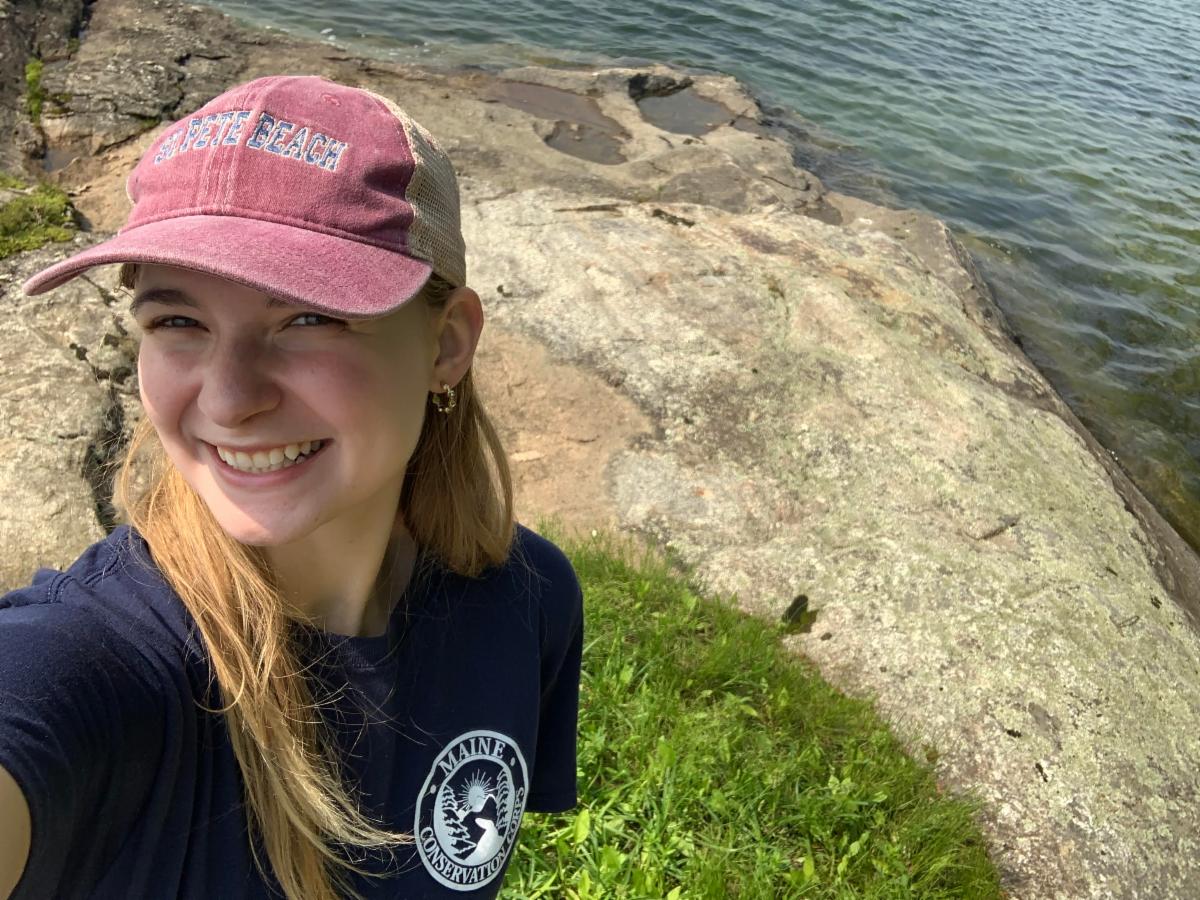
In June, LAWPC welcomed Lily Gallagher as our Shore Corps Steward! Lily comes to us from Salem, New York - a small town on the border of Vermont - and she recently earned her B.A. in Environmental Studies from Franklin and Marshall College. She is excited to be living and working in Maine after visiting family in Skowhegan every year as a child, and we are just as excited to have her join us! Read our interview with Lily below:
Can you explain your role? What is a Shore Corps Steward?
Shore Corps is a new program organized through the Maine Conservation Corps that focuses on community engagement, ecological resilience, and shoreline stabilization. As a Shore Corps Steward, my role is to provide site evaluations of shoreline or shoreline-adjacent properties and offer homeowners recommendations for erosion control projects they might consider. To conduct these evaluations, I am using the new OUR SHORE framework developed by the Maine Department of Environmental Protection. This new framework considers the land's source of erosion, the height of the slope evaluated, how overland water and land use impact the property, and what sorts of vegetation populate the area.
I will also be leading several volunteer events for the duration of my service term! These events will include educational opportunities to learn about erosion control, plant species identification, and live staking tutorials. They will also be a great opportunity to get out into the watershed and appreciate the beauty of Lake Auburn and the importance of water quality.
What are you most excited to work on during your time with LAWPC?
I am most excited about seeing an erosion control project to completion including choosing a site, completing an assessment, making an erosion control plan, and implementing it. This program is a great way to make strides in the watershed and to mitigate the effects of particulate pollution in the water.
If someone wanted to learn more about erosion control practices, where should they look?
Site assessments are available to anyone within the watershed at no cost! These assessments are not regulatory, they are just there to provide homeowners with suggestions on how to manage erosion on their property. Any recommendation provided is nonbinding, although highly recommended for the health of the water. If you aren't concerned about erosion on your property but still want to get involved, there will be several volunteer events during the summer, late fall, and early spring! Look out for those opportunities in future emails from LAWPC, and on fliers posted throughout the community. Anyone interested in learning more should feel free to contact me at lakeauburnshorecorps@awsd.org.
| | | | |
Common Loon
Gavia immer
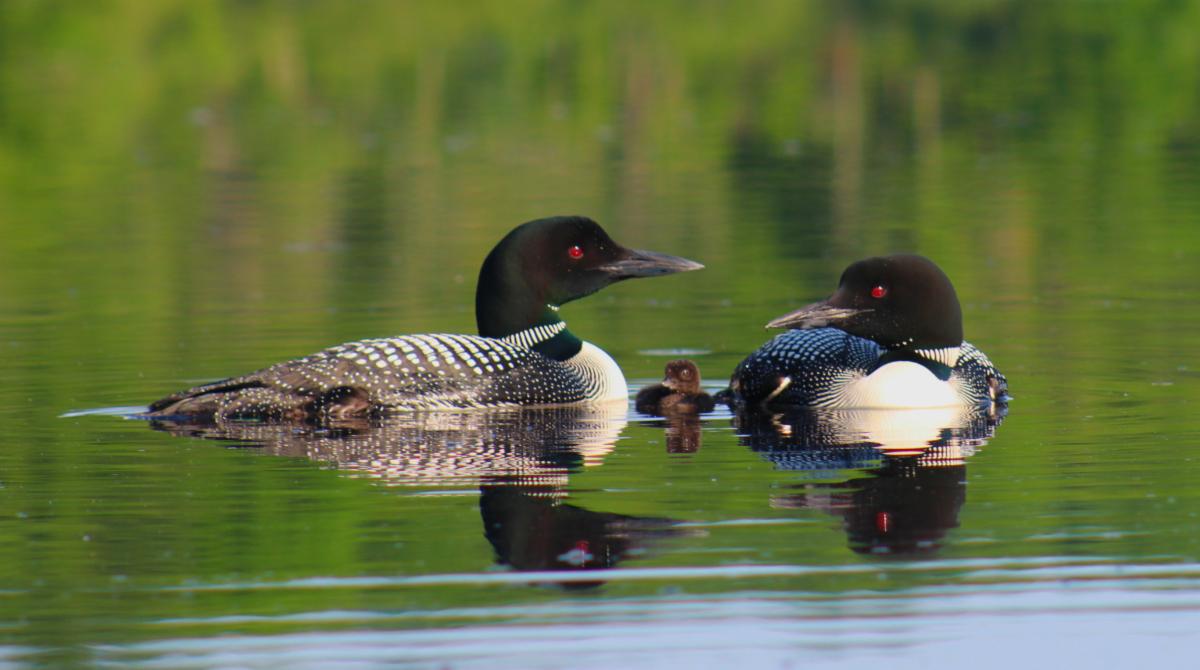
Each year, on the morning of the third Saturday in July, hundreds of Mainers take to their boats to look for loons. Maine's annual loon count (on July 19th this year) is a community science effort that has been in action since 1983, with more than 1,600 volunteers involved in 2024. These volunteers have been instrumental in gathering information about loon distribution and population, and the data has informed decisions about how to help struggling birds and prevent loon mortality. Both Lake Auburn and the Basin have loons this year, and a chick hatched to the Basin pair just last week! Though chicks are immediately able to swim after hatching, they spend a lot of time riding on their parents' backs during their first few weeks of life. This protects them from predators and helps regulate their body temperature. Loon chick mortality is quite high, and only about a quarter of chicks survive their first summer. The good news is that there are many ways you can help loons thrive in Maine! Make sure to use only non-lead fishing gear, and dispose of your line and hooks properly to prevent possible entanglement. Avoid creating a wake when boating close to shore, as the wave you create can flood nests. And if you'd like to be involved in this year's loon count visit the website linked below - Maine Audubon is always looking for volunteers to join!
Photo by Rob Crosby
| |  | |
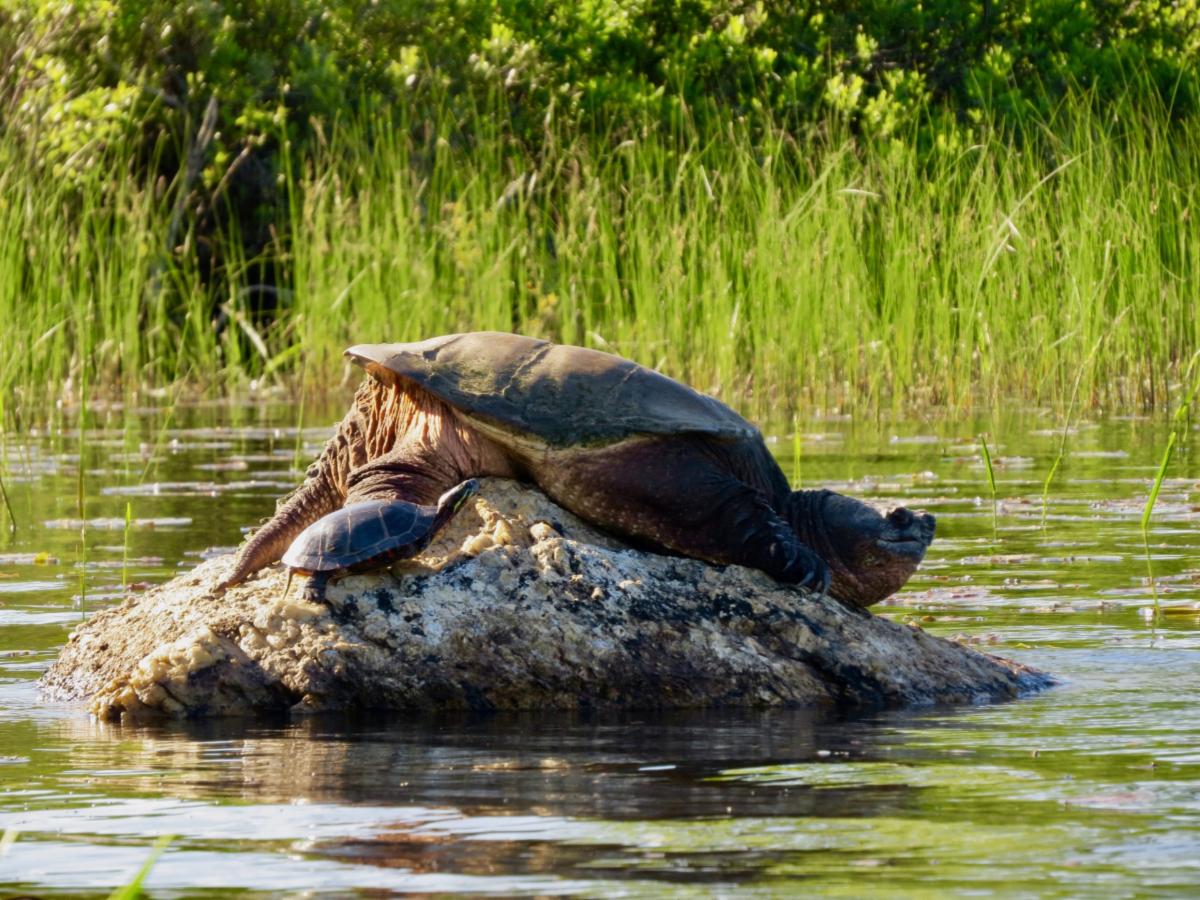
Snapping Turtle
Chelydra serpentina
Snapping turtles may not be an animal you want to get up close and personal with, but they deserve to be appreciated. The painful bite that earned them their name is a defense mechanism: snapping turtles can't pull their heads into their shells like many turtle species, so they need a reliable form of protection when in danger (their other method is to release a stream of foul-smelling urine!). While they can bite if provoked, snapping turtles are generally quite shy and quiet. In June, females come out of the water to lay a clutch of anywhere from 20 to 40 eggs, often returning to the same nesting site year after year. Eggs hatch in late August or early September and the hatchlings head straight for the water, trying to avoid myriad predators along the way. The snapping turtle is one of the species of interest in the Maine Amphibian & Reptile Atlas Project, a community science project that was started in 1984. Reptiles and amphibians are two of the most critically endangered taxa worldwide, and community-gathered data helps biologists make informed conservation decisions about these species. While the snapping turtle is common across Maine and does not currently need special protections, it is still necessary to gather population data to ensure the species continues to thrive. Locally, Hebron and Minot are still without photographic evidence in the state's distribution map, so if you see a snapping turtle in those ares, take a picture and upload it using the website below! Just don't get too close...
Photo by Rob Crosby
| | | |
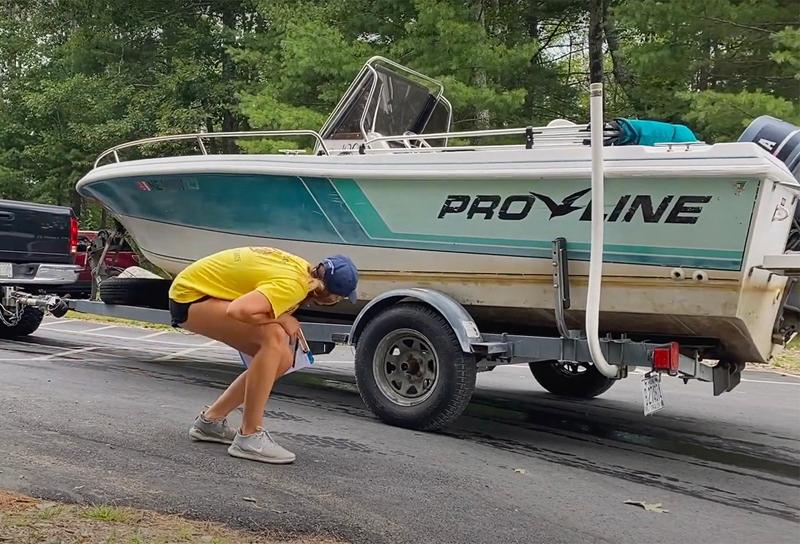
If you've been on any of Maine's lakes or rivers this summer, you've probably seen Courtesy Boat Inspectors (CBIs) greeting you at the boat launch. We briefly mentioned the CBI program in our June newsletter, but wanted to go a bit more in depth about the program's importance to the health of Maine's water bodies.
What's the problem? Invasive species hitching a ride on your boat, trailer, or fishing gear.
Why does it matter? Aquatic invasive species are a huge threat to Maine's water bodies. There are 15 known aquatic invasive plant species in Maine lakes, and multiple invasive species of mollusks (some have spread into Maine, while others are only in neighboring states). Invasive plants crowd out natives, affect fish and wildlife populations, alter water quality, and negatively impact recreation. Invasive mollusks can clog pipes, disrupt food webs, and outcompete native species for food and space. Mollusks are nearly impossible to detect in their larval stage and can be transferred in any undrained water in a boat. In 2023, the Maine legislature passed a law to help curb the spread of invasive species. The law requires boaters to "take specific actions to encourage water to drain from their watercraft prior to entering a water body or leaving a launch site," and makes it illegal to transport any aquatic plant on the outside of a vehicle, boat, trailer, or equipment.
What can I do to help? Talk to the courtesy boat inspectors - they are there to help! Always clean every part of your boat thoroughly, both before and after your time on the water, whether a CBI is present or not. Don't forget to check your trailer, fishing gear, and any other equipment you took out on the water and clean off any debris or organic matter you find, ideally by rinsing with hot water. Drain the motor, bilge, livewell, and other water-containing devices before leaving the boat launch. Finally, dry everything off before you put your boat back in the water (five days on land will be enough time for everything to dry out, or you can wipe areas down with a towel.)
How can I get more involved? Join Lake Stewards of Maine as an Invasive Plant Patrol (IPP) volunteer! IPPs help stop the spread of aquatic invasive plants by surveying local water bodies and providing a better chance of early detection. If you'd like to see more corners of Maine you could also join the IPP Travel Team. These volunteers help conduct surveys on larger or more remote lakes (housing is provided). See the Lake Stewards of Maine website for more details.
Photo courtesy of Coastal Rivers Conservation Trust
| |
Water Quality Spotlight
Turbidity
| |
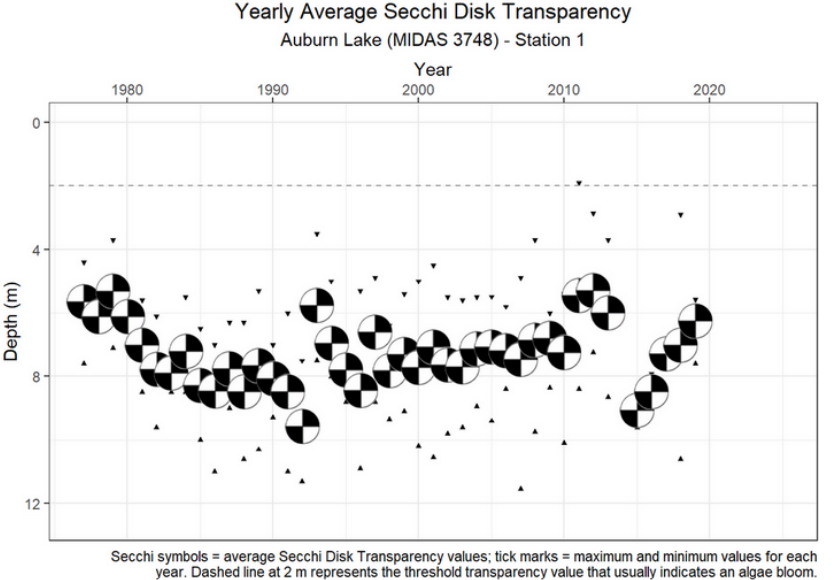
Turbidity is a measure of the cloudiness of water - the higher the turbidity, the harder it is to see through the water. There are many different factors that influence turbidity, including soil erosion, pollen, algae, and storm runoff, so while turbidity measurements are a helpful metric in understanding water quality, they can't paint a full picture on their own. Particularly turbid waters, especially those caused by soil erosion, can have other impacts on water quality. Suspended solids can hurt fish populations by clogging gills, reducing growth rates, decreasing resistance to disease, and preventing egg and larval development. Turbid waters also become warmer as suspended particles absorb heat from sunlight. This can cause dissolved oxygen levels to fall, as warm water holds less oxygen than cool water. Photosynthesis of aquatic plants decreases with less light, lowering oxygen levels even more.
Lake Auburn tends to have low turbidity levels, and the standards for turbidity measurements allowable under the Drinking Water Program are strict. In order to monitor and keep turbidity levels low, water quality staff measure turbidity continuously at the water intake site. During the sampling season, they also measure turbidity weekly at multiple sampling sites on the lake using a Secchi disk. A large black and white disk is lowered into the water until the moment it can no longer be seen - this depth is the "Secchi disk transparency." Clearer water allows the disk to be seen in deeper water, indicating higher water quality. Like many water quality parameters, Secchi disk transparency shows seasonal variation and change over time. Years with heavy rainfall, masting years (when trees produce an abundance of pollen), and natural erosion can all increase turbidity. However, though turbidity fluctuations can be natural, human land use can contribute to turbidity issues as well. Big contributors are eroding dirt roads and driveways, and exposed soil on the water's edge. If you live in the watershed and would like a free consultation about ways to reduce erosion on your property, email lakeauburnshorecorps@awsd.org. Our Shore Corps Steward, Lily, will conduct a site assessment to determine potential areas of erosion and provide you with personalized suggestions for mitigation!
| | | |
Thank You
Lake Auburn Watershed Protection Commission (LAWPC) is incredibly grateful to have community members like you who care about Lake Auburn and support the protection of the watershed. Together, we can protect the drinking water source for tens of thousands of our neighbors in Auburn and Lewiston, provide a multitude of recreation opportunities, and keep Lake Auburn beautiful and clean for many years to come.
| | |
Join Us
If you are interested in becoming more involved with LAWPC, please fill out our
general inquiries form or email us at lakeauburnwater@lakeauburnwater.org. We are always looking for volunteers, and can work with you to find the best fit for your individual or group needs. We look forward to hearing from you!
| | Was this newsletter forwarded to you by a friend? If you’d like to receive our monthly newsletters, sign up here. | |
WE WANT TO HEAR FROM YOU!
If you would like to partner with us, or have ideas for events, volunteering opportunities, or other things you’d like to see happening in the watershed, let us know! Send us an email at lakeauburnwater@lakeauburnwater.org, or fill out our general inquiries form at this link. We look forward to hearing from you!
| | | | | |