| |
|
Organizational
Announcement
| | LETTER FROM ENVIROCERT TO GOVERNOR NEWSOM REGARDING CALIFORNIA STATE WATER BOARD QSP/QSD PROGRAM | | |
10 August 2025
The Honorable Gavin Newsom
Governor of California
1021 O Street, Suite 9000
Sacramento, CA 95814
| | | | IMMEDIATE ACTION NEEDED: STATE WATER BOARD, CONSTRUCTION GENERAL PERMIT (CGP) CHANGES UNDERMINE QUALIFIED STORMWATER OVERSIGHT AND VIOLATE CORE PRINCIPLES OF ENVIRONMENTAL PROTECTION | | |
Dear Governor Newsom,
This letter has been prepared by EnviroCert International, Inc. (ECI), an international 501(c)6 non-profit that has been administering professional certification body in the fields of stormwater for over forty-five (45) years. With over 50,000 certifications awarded, ECI is recognized throughout the U.S. and forty-four (44) countries. My name is Robert Anderson; I am a Professional Civil Engineer licensed in the State of California (and fourteen (14) other States) and the CEO of a private consulting Civil Engineering firm for thirty-two (32) years and serve as a volunteer President/CEO for ECI.
We are writing to register our strong opposition to the State Water Resources Control Board’s recent amendments to the Construction General Permit (CGP). We have made several attempts to have the Water Board address this issue, but to no avail, and it is unfortunate this letter has become necessary. By eliminating the requirement that these roles be filled by a California Licensed Professional Engineer (PE), California Licensed Geologist (PG), Certified Professional in Erosion and Sediment Control (CPESC), or Certified Erosion, Sediment, Certified Professional StormWater Quality (CPSWQ) and Stormwater Inspector (CESSWI), the Board is enabling individuals with no demonstrated technical competence to perform work that directly affects compliance with the Clean Water Act1 and the Porter-Cologne Water Quality Control Act2.
This change is in direct conflict with the legislative intent and statutory mandates of both acts to protect the beneficial uses of the State’s waters. The new requirements, not enumerated in the permit3, only requires an individual of any age with no educational requirements, to attend a 16-hour lecture, with no exam to test a learning objective. The language in the amended Construction General Permit is impermissibly vague and overbroad and will not withstand legal scrutiny. The inclusion of a “prerequisite class” as the sole qualification standard for QSP/QSD eligibility is not authorized under existing law. Neither the Clean Water Act4, the Porter-Cologne Water Quality Control Act5, nor the California Code of Regulations6 grant the State Water Resources Control Board authority to dilute professional competency requirements in this manner. Moreover, the change was implemented without adequate public notice or an opportunity for meaningful comment, in direct contravention of the California Administrative Procedure Act7.
These revisions fundamentally weaken the technical integrity of California’s stormwater program and contradict both the Clean Water Act (33 U.S.C. § 1251 et seq.) and the Porter-Cologne Water Quality Control Act (California Water Code §§ 13000–16104), which require competent oversight to prevent the discharge of pollutants to waters of the United States and waters of the State.
| | |
Key Concerns:
-
Violation of Core Regulatory Intent: The Clean Water Act, through the NPDES permitting program (40 C.F.R. § 122.26), requires that stormwater pollution prevention plans be developed and implemented by individuals with the requisite technical training and experience to ensure compliance. The Porter-Cologne Act reinforces this obligation under California Water Code § 13377. Removing credential requirements conflicts with the intent of both statutes to ensure effective, science-based pollution control.
-
Procedural Deficiency: The SWRCB appears to have implemented this substantive policy change without following the APA’s notice-and-comment rulemaking process,8 bypassing the requirements for public input, economic impact analysis, and Office of Administrative Law (OAL) review. Given the scope of the change and its direct impact on regulatory compliance and environmental protection, this constitutes a procedural violation in addition to the substantive policy concerns
-
Reduced Public and Environmental Protections – The elimination of professional qualifications introduces a substantial risk of inadequate BMP design, installation, and maintenance. This will likely result in increased sediment discharges, pollutant loading, and degradation of sensitive watersheds, in direct conflict with the State’s antidegradation policy9.
-
Regulatory and Legal Risks: Without adequate professional qualifications, QSPs and QSDs may prepare deficient SWPPPs that fail to identify pollutant sources, select appropriate Best Management Practices (BMPs), or achieve compliance with numeric action levels (NALs) and numeric effluent limitations (NELs) established under the CGP10. These failures increase the risk of unauthorized discharges of pollutants in violation of CWA §301(a)11 and Water Code §1337612, subjecting dischargers, and potentially the State, to civil and criminal penalties under Water Code §§13385–1338713 and CWA §§309(b)–(g)14. Additionally, the State risks undermining its NPDES program authority under CWA §402(b)15 if EPA determines that California’s implementation is less stringent than federal requirements. Such a finding could lead to partial or complete withdrawal of delegated authority.
-
Increased Liability and Enforcement Challenges: Professional licensure and recognized certifications carry ethical and legal accountability standards. By allowing unqualified individuals to act as QSPs/QSDs, the State reduces its ability to hold practitioners accountable for noncompliance, potentially leading to violations of the CGP enforceable under California Water Code §§ 13385–13387.
-
Undermining California’s Leadership in Environmental Stewardship: For decades, California has set the national standard for stormwater compliance. States such as Texas have stricter and more effective requirements than California now. Lowering qualification requirements damages the credibility of the program, jeopardizes compliance with federal NPDES mandates, and exposes the State to potential U.S. EPA oversight intervention.
Requested Action:
We strongly urge your administration to direct the State Water Resources Control Board to:
-
Direct the SWRCB to suspend implementation of the new QSP/QSD qualification policy and reinstate the requirement that QSPs and QSDs hold professional licensure (PE) or nationally recognized stormwater certifications (CPESC, CESSWI, or equivalent). The State Water Board rejected previous requests, including offers to assist in correcting these issues. It is worth noting, that Caltrans has taken their own action to implement special requirements to mitigate the Water Boards actions. We are expecting other utility companies to follow Caltrans’ leadership.
-
Reinstate the requirement to maintain underlying License or Certifications. The Water Board has implemented a new policy that underlying licenses and certifications can be dropped after earning them to sit for the QSP/QSD certificate of training. See Executive Briefing as to the perils of such a policy on Page 7.
-
Require the SWRCB to conduct formal rulemaking under the APA with full stakeholder participation rather than special interest membership groups and parties.
-
Ensure all CGP compliance personnel meet demonstrable technical competency standards consistent with federal NPDES expectations and restore professional qualification requirements consistent with the Clean Water Act, Porter-Cologne, and the California Code of Regulations.
-
Conduct a formal public review and stakeholder consultation process before implementing any policy changes that weaken professional qualification requirements.
Governor, the decision to remove these requirements is not a mere procedural adjustment, it is a policy shift with significant and lasting consequences for water quality, public safety, and California’s environmental legacy. I urge you to act swiftly to restore the professional standards that have protected our communities and ecosystems for decades. Failure to act immediately will result in future increased risk to public health and safety and immeasurable damage to the environment, potentially costing the great state of California hundreds of millions of dollars.
Thank you for your attention to this urgent matter. I urge your office to direct the State Water Resources Control Board to immediately suspend this change and initiate a transparent public review process with technical stakeholder input to restore minimum professional qualifications that are consistent with the Clean Water Act, Porter-Cologne, and established California regulations. The protection of California’s water resources demands competence, accountability, and adherence to the law, not the dilution of professional standards by special interest groups.
I am readily available to review and discuss this matter in a collaborative way to assist the State of California in correcting this unfortunate issue. I can be reached at robert.anderson@envirocert.org or 805.766.3950 to discuss this matter or if I can assist provide readily implemented solutions.
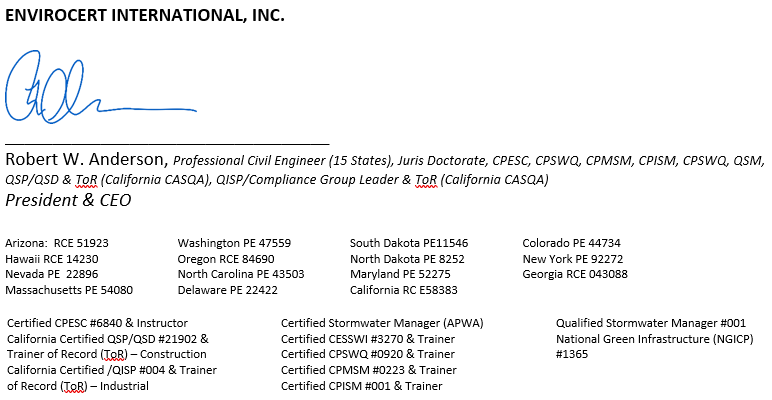
Respectfully,
| | |
Distribution:
Addressee
Nathan Barankin, Office of the Governor Chief of Staff
Brandon Roosenboom, State of California Water Board
Phillip Crader, Deputy Director of Stormwater Quality, State of California Water Board
Yana Garcia, Secretary for Environmental Protection, CALEPA
Dr. Kate Huckelbridge, CEO, California Coastal Commission
Victoria Rome, Director, California Government Affairs, Center for Campaigns & Organizing, NRDC
Karen Cowan, CASQA
Richard Moore, Executive Officer, Board of Professional Engineers, Land Surveyors, and Geologists
Caltrans NPDES Coordinators, Districts 1 through 12
Tracy Quinn, President and CEO, Heal The Bay
Flows to the Bay – 21 Government Agencies
Jennifer Morris Chief Executive Officer, The Nature Conservancy
Amy Hutzel, Executive Officer, California State Coastal Conservancy
LA Stormwater Partners, 29 Government Agencies
Dr. Chad Nelsen, CEO, Surfrider
Mike Vollmer, Executive Director, Tahoe Resource Conservation District
Tahoe Regional Planning Agency
CA Regional Water Boards, 1 through 9
All California County Public Works Directors and Stormwater Coordinators
ECI Retention Records
ECI BOD
|
| |
Fact Sheet: Risks of Removing Professional Qualification Requirements for QSPs/QSDs
Attachment to Letter Regarding Construction General Permit Changes
| | |
Background
The State Water Resources Control Board recently amended the Construction General Permit (CGP) to remove the requirement that Qualified SWPPP Practitioners (QSPs) and Qualified SWPPP Developers (QSDs) hold professional licensure (e.g., Professional Engineer, Professional Geologist) or nationally recognized stormwater certifications (e.g., CPESC, CPSWQ, CESSWI). The previous 2009 CGP State Permit required individuals to have earned one of these licenses or certifications. Historically, Professional Engineers have been delegated the authority to administer SWPPP activities and plans.
Previously, these roles required verified technical expertise to ensure compliance with the Clean Water Act and the Porter-Cologne Water Quality Control Act. The change now allows individuals without professional credentials, any previous experience, or education necessary to perform these critical functions.
| | Relevant Legal Requirements | | | | | Impact of Removing Qualifications | | |
Clean Water Act (33 U.S.C.
§ 1251 et seq.) – NPDES Program
Porter-Cologne Water Quality Control Act (Water Code
§§ 13000–16104)
State Water Board Resolution 68-16 – Antidegradation Policy
California Water Code
§§ 13385–13387
| | |
Requires SWPPPs be developed/implemented by qualified personnel (40 C.F.R. § 122.26)
Requires protection of waters of the State from degradation
Maintains high-quality waters through prevention of pollution
Provides for penalties for noncompliance
| | |
Increases risk of improper BMP design and pollutant discharges
Weakens ability to ensure competent pollution control
Raises likelihood of violations due to poor technical oversight
Reduces enforceability when oversight is by unlicensed individuals
| | |
Executive Briefing: Risks of Allowing a Qualifying Certification to Lapse
Purpose:
To highlight the significant consequences—regulatory, operational, financial, and reputational—of not maintaining a qualifying certification.
| | |
1. Regulatory & Legal
- Non-Compliance: Loss of certification may violate state, federal, or industry regulations.
- Contractual Breach: Many contracts require certified status; lapse may trigger termination or penalties.
- Costly Reinstatement: Renewal after lapse often requires re-testing, retraining, and higher fees.
2. Operational Disruption
- Loss of Authority: Inability to sign, seal, or approve required technical or compliance documents.
- Project Delays: Work stoppages or missed deadlines if certified personnel are required by law or contract.
- Outdated Practices: Loss of continuing education leads to reduced technical currency.
3. Financial Impact
- Revenue Loss: Ineligible for bids, grants, or contracts requiring certification.
- Higher Costs: Recertification expenses exceed routine renewal fees.
- Insurance Risk: Potential premium increases or reduced coverage due to elevated liability profile.
4. Reputational Damage
- Credibility Erosion: Signals to clients and regulators a lapse in quality and oversight.
- Competitive Loss: Reduced ability to differentiate in proposals and marketing.
- Talent Retention Risk: Top professionals prefer employers who support certification maintenance.
5. Risk Management
- Increased Liability: Lack of certified oversight can lead to costly errors and non-compliance.
- Regulatory Scrutiny: Greater risk of audits and inspections.
Recommendation:
Maintain all qualifying certifications proactively. The cost of annual renewal is minimal compared to the compounded risks of a lapse.
Bottom Line:
The small investment in maintaining certification protects revenue, compliance, reputation, and operational continuity.
|
| |
1 33 U.S.C. §1251 et seq.
2 Cal. Water Code §13000 et seq.
3 Order 2022-0057-DWQ, Part V.F.4 and V.F.5 “Any prerequisite course approved by the State Water Board’s Division of Water Quality Deputy Director in accordance with Section V.G” and “Any prerequisite course approved by the State Water Board’s Division of Water Quality Deputy Director in accordance with Section V.H”
4 33 U.S.C. § 1251 et seq. (Clean Water Act); see especially § 1342(b) governing NPDES state program authority.
5 Cal. Water Code §§ 13000–14958; see § 13263 (waste discharge requirements must ensure protection of water quality).
6 See Cal. Code Regs. tit. 23, §§ 2200–2231 (Board authority and limitations on permit conditions).
7 Cal. Gov’t Code §§ 11340–11361; see § 11346.4 (public notice requirements) and § 11346.8 (public comment procedures).
8 Cal. Gov’t Code §§11340–11361 (California Administrative Procedure Act)
9 State Water Board Resolution 68-16
10 CGP, Order 2009-0009-DWQ (as amended), Parts VII and X.
11 CWA §301(a), 33 U.S.C. §1311(a).
12 Cal. Water Code §13376.
13 Cal. Water Code §§13385–13387.
14 CWA §§309(b)–(g), 33 U.S.C. §§1319(b)–(g).
15 CWA §402(b), 33 U.S.C. §1342(b)
| | EnviroCert International, Inc. | 19 August 2025 | | | | |