| |
|
| |
Volume 18. Issue 3. June 2018 |
|
|
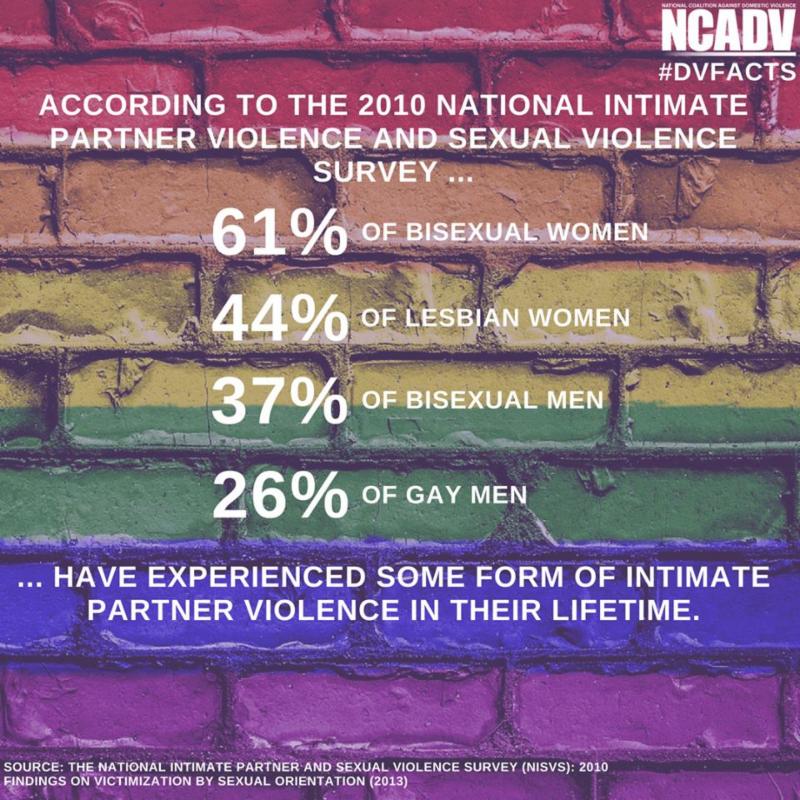
June is LGBTQI+ Pride month. Did you know that People who identify as lesbian, gay, bisexual, transgender & queer often face increased rates of domestic violence & have a harder time accessing support?
- Abuser may threaten to out the victim's sexuality / gender identity to family, friends or colleagues
- Friends or family may have rejected the victim because of their sexuality / gender identity, leading to increased emotional & financial vulnerability
- Abuser may tell the victim no one will help them because of their sexuality / gender identity
- Abuser may demean the victim's sexuality or gender identity
- Abuser may try to turn supportive friends & family away from the victim
- Unsupportive friends or family may blame the victim for the abuse, saying "that's what happens when you are LGBTQ"
- Abuser may try to prevent victim from getting legal parental status for children in common
- Abuser may refuse to use the preferred name or pronouns of their trans partner
- Abuser may try to keep their trans partner from accessing medical care related to their transition
|
|
| |
| |
|
Recap of NYSCADV's Legislative Day of Action
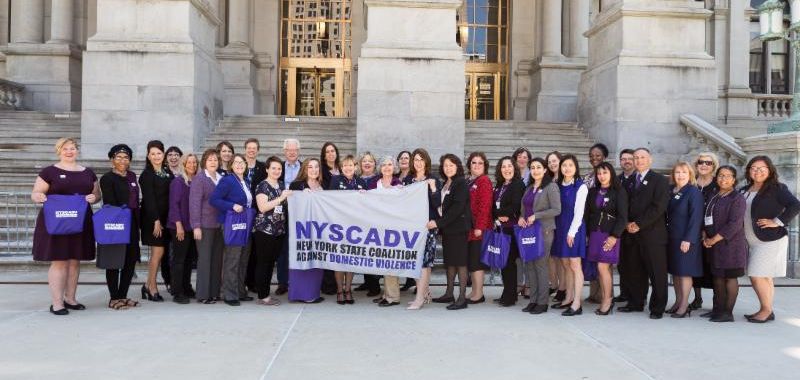
Domestic violence advocates, allies and survivors
joined with the New York State Legislature to raise awareness of domestic violence issues throughout the state and support measures to provide critical resources and services for victims. The activities included:
- Passage of resolutions in both the NYS Assembly and NYS Senate proclaiming May 8, 2018, as Domestic Violence Awareness and Prevention Day in New York State, sponsored by Assemblywoman Aridia Espinal and Senator Joseph Robach;
- Introductions of NYSCADV staff on the floor of each chamber by Assemblywoman Helene Weinstein and Senator Joseph Robach, along with a discussion of NYSCADV's work on behalf of member programs throughout the state;
- The Assembly's passage of 11 bills aimed at strengthening protections for survivors of domestic violence and offering support for survivors seeking to reclaim their lives;
- A sea of legislators and staff wearing purple ties, suits, jackets and ribbons, signifying their support for domestic violence-related issues;
- The convergence of nearly 200 domestic violence advocates, allies and survivors in the state Capitol to call on the New York State Legislature to support intervention initiatives to respond to domestic violence when it happens and increase state funding to prevent domestic violence from occurring in the first place;
- A presentation by special guest Kelli Owens, Governor Cuomo's Director of Women's Affairs, during which she noted the Administration's concern for the experiences of domestic violence survivors and their families and responded to questions about the most pressing concerns and needs of domestic violence survivors and programs across the state;
- A breakfast for advocates, allies and survivors with Assemblywoman Helene Weinstein, who has championed the rights of domestic violence survivors throughout her legislative career and crafted meaningful legislation to provide essential services to individuals in highly traumatic circumstances; and,
- Meetings with dozens of Assembly and Senate representatives to raise awareness and seek support for measures to strengthen responses to domestic violence and also prevent it from happening in the first place.
"This was a magnificent display of support for domestic violence survivors and an unusual show of unity in the Assembly and Senate," said Connie Neal, executive director of NYSCADV. "When we pass laws and fund initiatives to support survivors of domestic violence and their children, encourage healthy behaviors across our state, and improve the quality of life for all people, social norms begin to change. Only then will we see a reduction in the incidence of domestic violence and increase the level of safety for individuals and families across New York."
|
|
|
DV advocates hope Schneiderman revelations will propel legislation, funding
Advocates are hopeful that increased awareness around domestic violence in the wake of the stunning physical abuse allegations against former Attorney General Eric Schneiderman will spur new legislation and resources.
Revelations
in The New Yorker of Schneiderman's alleged mistreatment of three romantic partners and another woman, followed by his abrupt resignation three hours later, preceded the New York State Coalition Against Domestic Violence's annual
legislative action day on May 9, when hundreds of domestic violence advocates and service providers descended on the Capitol.
The Assembly, as it does every year, passed a slew of measures to address domestic violence, and sent the bills to the Senate for consideration. Both houses passed resolutions declaring May 8 Domestic Violence Awareness and Prevention Day in New York.
Legislators were at the Capitol last Wednesday wearing purple ties, jackets and ribbons to signal their support for victims of domestic violence, a symbolic gesture that had been planned weeks in advance. Still, the scandal was not acknowledged on May 9, but advocates say there was an air of somberness during legislative procedures that day.
"We really are hoping that this can be a turning point," said Connie Neal, executive director of the domestic violence organization. "When we learn about these really hard-to-read situations and these horrific experiences, it's a call to action. We have to do something."
For the third year in a row, the state has had the greatest unmet demand for domestic violence services in the nation, according to an annual
one-day survey by National Census of Domestic Violence Service.
There were 1,390 unmet requests for domestic violence services in a single day in 2016, with more than half of the requests for housing, according to the review, which collected data from 101 domestic violence service providers in the state from a 24-hour period. Other denied requests included those for emergency shelter, transportation, childcare and legal advocacy.
"Programs across our state simply cannot respond to so many requests for help and support, because they don't have the resources to respond to those situations," Neal said.
|
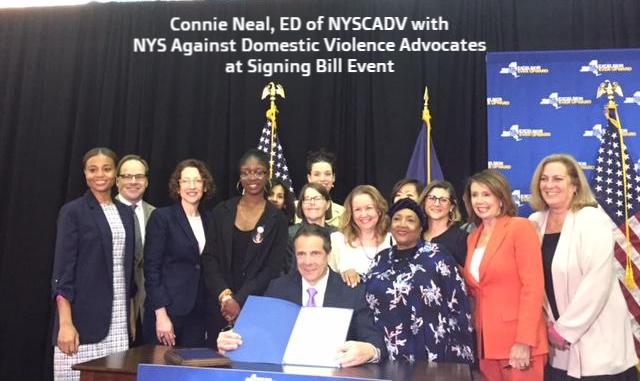
Gov. Cuomo signs bill that bans domestic abusers from owning guns
Gov. Cuomo, joined by House Minority Leader Nancy Pelosi and Florida school shooting survivor Aalayah Eastmond, signed a bill to take firearms out of the hands of domestic abusers.
The governor hailed the law as a step toward national "common-sense gun reform," and said "50% of the women killed with a gun in this country were killed by an intimate partner.
Cuomo told the approximately 200 politicians and activists at John Jay College of Criminal Justice in Midtown the law will require domestic abusers to surrender all types of firearms.
|
Recap of the 2018 NYSCADV Annual Membership Meeting
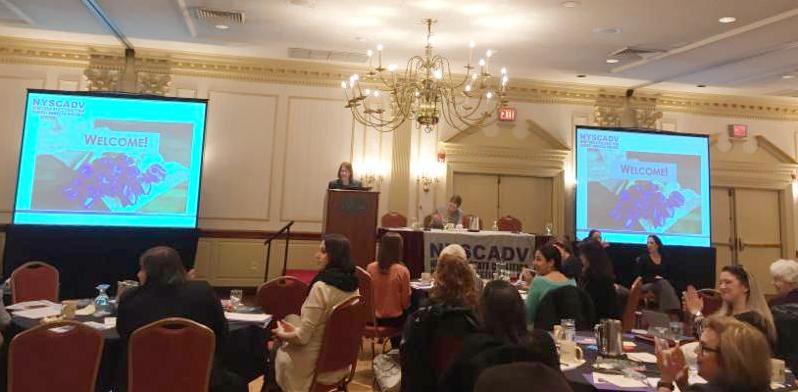
On Monday, March 19, 2018, the New York State Coalition Against Domestic Violence (NYSCADV) held its annual membership meeting. This was an occasion for the Coalition members, partners, and friends to discuss the work they are doing to respond to and prevent domestic violence as well as learn, share, educate, and motivate one another.
The annual meeting included a brief business meeting convened by Ann Ellsworth, NYSCADV Board Chair, a presentation of activities throughout the year by NYSCADV staff and key note presentations by Kelly Miller, Executive Director of the Idaho Coalition Against Sexual Assault and Domestic Violence and Gloria Terry, CEO of the Texas Council on Family Violence. The day concluded with a panel discussion on best practices for serving immigrant and undocumented survivors.
|
Proposal would add "X" category to NYC birth certificates
People born in New York City who do not identify their gender as either male or female would have the option of choosing a third category for their birth certificates under a new proposal.
Mayor Bill de Blasio and City Council Speaker Corey Johnson said the new category of "X" would be available through the proposal, which is expected to be introduced by Johnson shortly with public hearings to be held later this month.
Currently, if parents of a newborn do not want to identify a sex, they can say the sex of the child is undetermined or unknown. The X category would be something adults could choose for their own birth certificate.
If it passes, New York City would join California, Oregon and Washington in having the third category on birth certificates, while Washington, D.C. allows it on driver's licenses.
|
NY's lawmakers are failing sex trafficking victims in a big way
Prosecuting pimps who sell kids for sex may seem like an open-and-shut trafficking case - but not in New York.
Weak state laws are keeping traffickers out of prison, and lawmakers are failing vulnerable kids by refusing to change them, prosecutors and cops told The Post.
New York is one of just three states - along with Alabama and Ohio - that requires attorneys to prove that an underage victim was forced, defrauded or coerced into prostitution to make a trafficking case, even though minors can't legally consent to sex with an adult.
"We can bring other charges - we can bring promoting prostitution charges - but if it's your first arrest and you're looking at one to three years on that charge, you can end up with probation for what is essentially child rape for profit," said Laura Edidin, chief of the Brooklyn District Attorney's Human Trafficking Unit.
The state's unusually high burden of proof often means the only witnesses who can prove the children weren't willing participants are the victims themselves. And as survivors, advocates and law enforcement officials have explained in
The Post's three-part series on the scourge of sex trafficking in New York City, the victims often don't see themselves that way - or they're simply too traumatized to take the stand.
|
New York Just Passed A Bill Banning Cops From Having Sex With People In Custody
State lawmakers in New York passed a
bill to prohibit cops from having sex with people in custody, closing a legal loophole that has let police avoid sexual assault convictions by claiming sex with detainees was consensual. The bill was introduced in response to allegations that two on-duty New York City Police Department officers raped a handcuffed woman in their police van in September.
In February, BuzzFeed News
reported that New York was one of 35 states that do not explicitly deem encounters between cops and those in their custody as sexual assault. In the weeks since, legislators in at least six states have introduced or begun drafting bills to change these statutes.
The loophole in New York law first drew public attention after an 18-year-old woman, who uses the pseudonym Anna Chambers, reported she was sexually assaulted by two detectives who'd detained her after finding weed and loose pills in the car she was in. DNA from a rape kit matched narcotics detectives Eddie Martins and Richard Hall. Both have pleaded not guilty to rape and other charges and are awaiting trial.
|
|
June is LGBTQI+ Pride Month
Because the majority of the domestic violence awareness movement has focused on heterosexual relationships, members of the LGBTQ community have been largely left out of the movement. However, recent research shows that LGBTQ members fall victim to domestic violence at equal or even higher rates compared to their heterosexual counterparts.
There are several aspects of intimate partner violence which can be unique to the LGBTQ community. "Outing" or threatening to reveal one partner's sexual orientation/gender identity
may
be
used
as
a
tool
of
abuse
in violent relationships and may also be a barrier which reduces the likelihood of help-seeking for the abuse. Prior experiences of physical or psychological trauma, such as bullying and hate crime, may make
LGBTQ
victims
of
domestic
violence
less likely to see help.
Although the response to LGBTQ victims of domestic violence is gradually improving, the LGBTQ community if often met with ineffective and victimizing legal responses. Forty-five percent of
victims
do
not
report
the
violence
they
experience
to
police
because they believe it will not help them. Further more, members of the LGBTQ community may be denied assistance and domestic violence services as a result of homophobia, transphobia, and biphobia.
Read more on National Coalition
Against Domestic Viole
nce about
"Domestic Violence and the LGBTQ Community".
|
|
"June 15" is Elder Abuse Awareness Day
"June 15" marks
World Elder Abuse Awareness Day (WEAAD),
a time to honor survivors of elder abuse and raise awareness about this global social issue that impacts the health and human rights of older persons worldwide. Definitions about who is an elder may differ, but most organizations, tribes, and states use a minimum age threshold somewhere
between 50 and 70
. Likewise, definitions of elder abuse often vary. The
National Clearinghouse on Abuse in Later Life (NCALL)
defines
elder abuse
as any "physical, sexual, or psychological abuse, neglect, abandonment, or financial exploitation of an older person" either within a trusting relationship or when an older person is targeted based on age or disability.
Abuse in later life
is distinct in that it is "perpetrated by someone in an ongoing relationship (e.g., spouse, partner, family member, or caregiver) with the victim."
|
LGBTQ Immigrant Detainees Reported Sexual Assault At Higher Rates
Immigration and Customs Enforcement detained transgender women in all-male facilities and locked them up on average for more than twice as long as immigrants overall, according to figures the agency provided to Rep. Kathleen Rice (D-N.Y.).
The figures ICE shared with Rice shed light on how LGBTQ immigrants are treated in such facilities at a time when the Trump administration is seeking to dramatically expand detention including for asylum-seekers and LGBTQ people who may be uniquely vulnerable to sexual abuse.
ICE doesn't publish annual reports on allegations of sexual assault or treatment of LGBTQ people within its detention centers but provided figures to Rice in response to her requests.
Self-identified LGBTQ people made up only about 0.14 percent of the immigrants detained last fiscal year by ICE, but accounted for more than 12 percent of the alleged victims of sexual abuse and assault, according to the figures.
|
|
NNEDV Statement on the Death of Congresswoman Louise Slaughter
"Congresswoman Louise Slaughter was a tremendous advocate for women, especially for victims and survivors, and we all feel this loss deeply," said Kim Gandy, president and CEO of the National Network to End Domestic Violence (NNEDV). "She was an original co-sponsor of the Violence Against Women Act (VAWA), which, upon its passage in 1994, became the cornerstone of our nation's response to domestic violence, sexual assault, dating violence, and stalking."
Congresswoman Slaughter has been a staunch supporter of VAWA ever since, having supported every reauthorization, and she recently hosted an event in her district urging swift passage of the 2018 reauthorization ahead of its expiration this year. In 2013, she joined us in the effort to ensure that VAWA included expanded protections for LGBTQ, Native American, and campus victims.
"Her leadership ensured that VAWA delivered on its promise of empowering survivors and funding critical programs that to help victims achieve safety and security," said Gandy. "The nation has lost a dedicated champion who was committed to ending domestic violence. After more than 30 years in Congress, she leaves a legacy of leadership that will live for generations."
|
One of the students killed in the Santa Fe school shooting reportedly turned down romantic advances from
Dimitrios Pagourtzis, the suspect in the deaths of 10 people and wounding of at least another 10.
Shana Fisher's mother, Sadie Rodriguez, told the Associated Press Shana "finally stood up to him and embarrassed him". Speaking to the
Los Angeles Times, Rodriguez said: "A week later he opens fire on everyone he didn't like."
|
Fewer Immigrants Are Reporting Domestic Abuse. Police Blame Fear of Deportation
For years, she slept with a gun under her pillow, living in fear of a boyfriend who beat her, controlled her life and threatened to kill her and her children. Domenica, who came to this country illegally from Mexico in 1995 and became part of the booming immigrant community in Houston, said her partner was a United States citizen, and often reminded her that she could be deported if she went to the police.
"He told me nobody would help me, because I don't have papers," said Domenica, 38, who has a son and daughter with her boyfriend, and asked that her last name not be used in order to protect them. "I was with him like that for a pretty long time. I felt like there was no help for me."
In August of last year, fearing for the safety of her children, Domenica decided to flee. She never called the police. She said she would rather go into hiding than appear in court and risk being separated from her children, or sent home to Mexico.
"That scene is happening all the time," Houston's police chief, Art Acevedo, said in an interview. Though Houston's immigrant population is one of the fastest-growing in the country, the city last year saw a 16 percent drop in domestic violence reports from the Hispanic community - a decline that the police blame on a tough new immigration enforcement law in Texas and the increasingly hostile political climate across the country surrounding the issue of illegal immigration.
The Houston police recorded 6,273 domestic violence reports from Hispanics in 2017, compared with 7,460 the year before.
Police departments in several cities with large Hispanic populations, including Los Angeles, Denver and San Diego,
also experienced a declinein reports of domestic violence and sexual assault in their Hispanic communities. In Houston, Latino domestic violence reports went down even as the city's Hispanic community, now 44 percent of the population, grew significantly.
Follow the link to read the full article
"Fewer Immigrants Are Reporting Domestic Abuse. Police Blame Fear of Deportation".
|
|
Violence against women at 'epidemic' levels worldwide, say experts
T
he UK government has announced plans to toughen up laws on domestic violence, including tagging perpetrators and forcing them to attend alcohol or addiction treatment programmes.
Anyone breaching these tough new orders imposed by the courts could face jail.
Unveiling the plans, prime minister Theresa May highlighted the toll on the two million women in the UK
subject to domestic abuse.
"Domestic abuse takes many forms, from physical and sexual abuse, to controlling and coercive behaviour that isolates victims from their families and has long-term, shattering impacts on their children," she said.
While the situation in the UK is bad, around the world it is worse. The
World Health Organization (WHO) described the scale of violence against women as a "global health problem of epidemic proportions."
WHO data revealed that one in three women - 35.6 per cent - across the world have experienced violence, amounting to more than 800 million women worldwide.
The health effects of this violence are stark. Women who have experienced violence are 16 per cent more likely to have a low birth weight baby; are more than twice as likely to have an bortion; are almost twice as likely to experience depression; and, in some regions, are one and a half times more likely to become infected with HIV.
|
|
Men kill women in four of five domestic violence homicides
A new report has found that women are overwhelmingly the victims in fatal domestic violence cases, with the first three months after they leave their male partner the most dangerous.
Men killed women in 80% of domestic violence murders in Australia between 2010 and 2014, and about one in three killed a former partner.
A
report, published on Thursday by the Australian Domestic and Family Violence Death Review Network, found almost half of those homicides of former female partners occurred within three months of the relationship ending. According to the
Domestic Violence Prevention Centre, women attempt to leave an abusive relationship on average between five and seven times before successfully and permanently doing so, and the time when a woman leaves her abusive partner is also when she is in most danger of being harmed.
The offenders and victims identified in the report were parents either together or separately to at least 107 children at the time of the homicide.
|
|
My Sisters' Place: A Haven for Hope and Help
A Not for Profit Providing Local Support to Victims of Domestic Violence & Human Trafficking
It's a non-descript building in downtown White Plains, steps from the Metro-North station, but for people served by the non-profit My Sisters' Place (MSP), it is a beacon of hope. It is a safe haven where victims of domestic violence (DV) and human trafficking can finally begin to change their lives.
Founded more than 40 years ago, MSP offers residential, support and legal services for victims of abuse and trafficking. The non-profit also offers educational and preventative programs for students in middle school and high school. In addition, MSP advocates for legislation protecting victims and provides training for healthcare professionals and law enforcement personnel. In short, MSP is a comprehensive agency that provides direct services, legislative advocacy, and prevention education to 15,000 people a year in Westchester County.
Domestic violence is the leading cause of injury to women in the US and up to 10 million children witness some form of domestic violence annually. Although 84% of the victims of abuse and human trafficking that MSP helped last year were female, they also provide services to a small percentage of men or transgender individuals. Last year MSP provided counseling to 130 children and emergency housing for more than 175 adults and children at two confidential full-service shelters located in Westchester.
|
|
NYSCADV PREVENTION PROJECT TOOLKIT
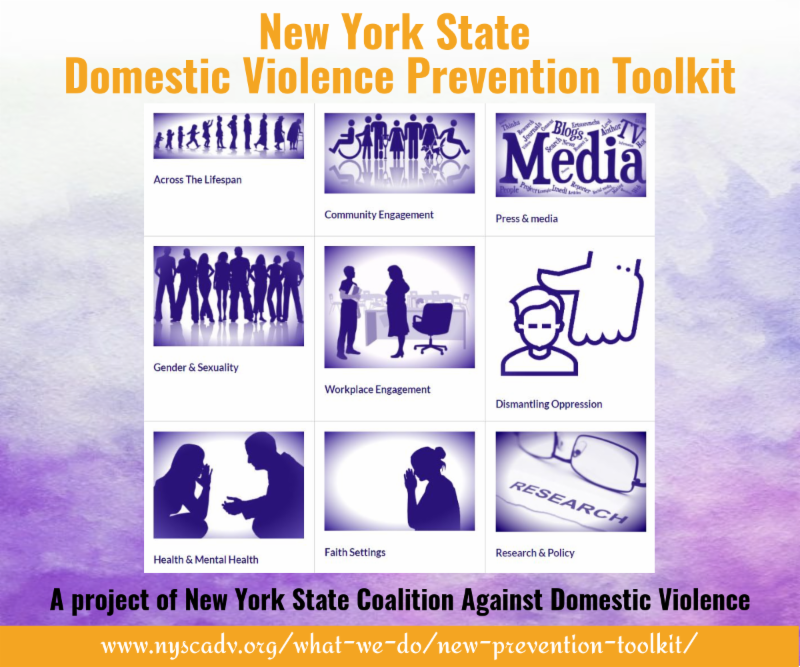
In NYSCADV domestic violence prevention toolkit, you will find a compendium of tools, resources and strategies that can be utilized to support prevention strategies on a local, regional and statewide level. Tools and resources are carefully chosen, based on emerging evidence, lessons learned from the New York State DELTA Project and successes from local domestic violence programs throughout the state of New York and across the nation and from dialogue with national partners in prevention.
You will find traditional prevention resources and strategies, such as curricula that can be conducted in school-based settings, as well as public health approaches that engage communities around issues of health and wellness (addressing health disparities.) You will also find community organizing techniques that engage and nurture groups to address inequities that stem from systemic oppression such as racism, heterosexism, from an intersectional, social justice framework (increasing access to resources, opportunities, and education.) Lastly, you will find a growing body of research that describes emerging evidence of prevention approaches that promote factors and conditions that can protect vulnerable populations from being victimized and strive to stop people who are at risk of perpetrating from ever doing so in the first place.
|
|
Workplaces Respond to Domestic Violence and Sexual Assault
The #MeToo and #TimesUp movements demonstrate the overdue need for employers to shift toward prevention and culture change to make safer, more respectful, and more equitable workplace environments in which all employees can thrive. In solidarity with these movements,
Workplaces Respond is pleased to enhance its prevention-oriented resources to help employers, survivors, coworkers, and advocates change workplace culture to better prevent and respond to sexual harassment and violence.
The new National Resource Hub interactive tools include:
- Referrals to supportive services and legal resources;
- Fact sheets and research on the prevalence and impacts of workplace sexual harassment and violence;
- Access to "Top Ten" lists to help victims, employers, unions, and men address sexual harassment in the workplace;
- "Decision Trees" to help guide victims and coworkers through important initial considerations when confronting sexual harassment in the workplace;
- Model Workplace Training modules that adopt cutting-edge adult learning approaches to shift the training paradigm away from liability prevention and toward workplace equity and accountability; and
- A "How-To" guide to help employers develop workplace climate surveys in order to assess their workplace and employee's experiences and needs.
|
|
Hundreds of Apps Can Empower Stalkers to Track Their Victims
Telephone apps like KidGuard, mSpy and Spyzie market themselves as a way for parents to maintain tabs on their kids. They can be used for a more nefarious purpose, however, which the companies market in weblog postings titled "Learn how to Learn Deleted Texts on Your Lover's Telephone" or "catch dishonest girlfriend iPhone."
As digital instruments with the ability to collect cellphone information to monitor kids, associates or misplaced telephones have grown, so have the choices for individuals who abuse these capacities and use them to trace others without consent.
Today, there are more than 200 apps and companies that provide would-be stalkers with a capabilities ranging from primary location monitoring to harvesting texts and even secretly recording video. More than two dozen companies promote their products as surveillance instruments for spying on romantic companions.
Digital monitoring of a partner or accomplice can represent unlawful stalking, wiretapping or hacking. However legal guidelines and regulation enforcement have struggled to keep up with technological modifications, though stalking is a prime warning signal for attempted murder in home violence instances.
"We misunderstand and reduce this abuse," mentioned Erica Olsen, director of the Security Web Mission on the Nationwide Community to Finish Home Violence. "Folks assume that if there's not a right away bodily proximity to the sufferer, there won't be as a lot hazard."
|
|
Facebook asks users to upload 'intimate' photos to fight 'revenge porn' in new pilot program
Facebook is announcing a
new pilot program to try to combat 'revenge porn' or 'non-consensual pornography.' On Tuesday, the social media network announced it would begin testing the program in the U.S., U.K., Australia and Canada starting this week.
In this age of technology, dating and intimate relationships are quickly changing and not just limited to adolescents.
"Maybe it's your husband of 25 years and you're trying to spice things up. People share flirty photos," explained Cindy Southworth, Executive Vice President of The National Network to End Domestic Violence and Founder of the Safety Net Project.
People who worry someone may want to harm them by sharing 'intimate' images can contact those two groups to request a form. Facebook says the person will be sent a one-time upload link for the victim or potential victim to upload the images they think may be shared. The images will be reviewed by "a handful of specifically trained members of our Community Operations Safety Team" to create a unique digital fingerprint, or hash, to "identify future uploads of the images without keeping copies of them on our servers," explained Antigone Davis, Facebook's Global Head of Security.
Follow the link and read the full article
"Facebook asks users to upload "intimate" photos to fight "revenge porn" in new pilot program".
|
|
Uber changes course, will not push sexual assault victims into arbitration
In a major policy change for its US operations,
Uber
has announced it's ending mandatory arbitration for individual claims of sexual assault or sexual harassment by Uber drivers, riders or employees.
It is also ending the requirement that victims sign a confidentiality provision preventing them from speaking about the sexual assault or sexual harassment they suffered - saying survivors will now have the option to settle their claims with Uber without having to agree to being publicly silenced in order to do so.
Last month a group of women alleging sexual violence from Uber drivers sent an open letter to the company's board asking to be released from the mandatory arbitration clause in the Uber app's terms of service.
|
|
Funding Available to Provide Discretionary Training and Technical Assistance for VOCA Victim Assistance Grantees
The purpose of this solicitation is to fund VOCA Victim Assistance Program state administering agencies (SAAs) or outside organizations who partner with existing SAAs to provide training within the applicant's state.
Activities funded through this program may include, but are not limited to-
- the establishment or enhancement of state victim assistance academies (SVAAs),
- statewide training initiatives,
- crime victim-related conferences,
- basic training for new programs, or
- scholarships to attend conferences and/or training for service providers and others who work with victims of crime.
OVC expects to make up to 30 awards of up to $1.5 million each, with an estimated total amount awarded of up to $12 million. The anticipated period of performance will be from the award date through September 30, 2021.
OVC will conduct a pre-application webinar on May 22, 2018, from 1 p.m. to 2 p.m. e.t. to review requirements and have a question and answer session.
|
|
DOMESTIC VIOLENCE & INDIGENOUS PEOPLES
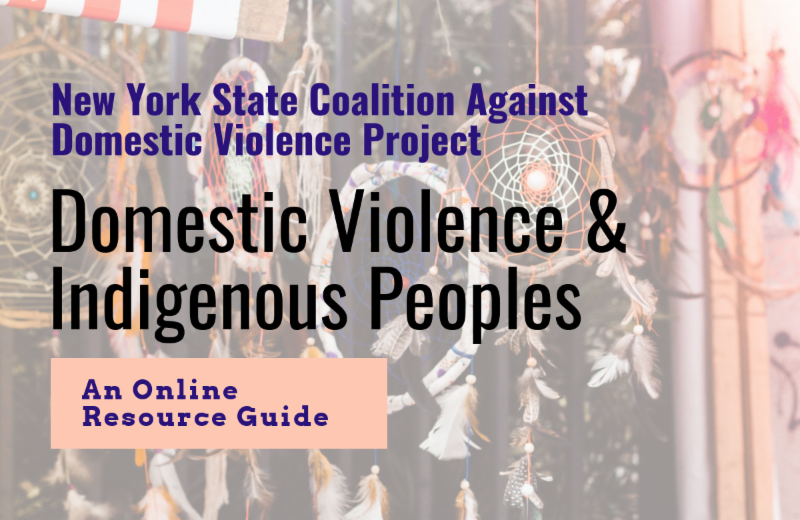
Domestic violence and intimate partner violence occurs in all communities. However, various causes can affect the level, intensity, and prevalence of violence. Studies indicate that violence against women-including domestic abuse and sexual assault-is higher among Native American communities.
In all communities, it is possible to intervene in domestic violence situations early on, and even prevent them from happening in the first place. The New York State Coalition Against Domestic Violence (NYSCADV) aims to support and facilitate the path to domestic violence prevention. NYSCADV's Domestic Violence and Indigenous Peoples Project, funded through the
New York State Office of Children and Family Services, provides training, listening sessions, and resources related to Indigenous Peoples for domestic violence service provider programs of New York State. This resource guide is a collection of research, best practices, articles, and resources for advocates and domestic violence survivors.
|
|
Your Voice, Your Choice: A Survivor Media Guide From EVAW International
The voices, faces and stories of survivors of gender-related violence are critical to creating lasting social and legal change - and the media can help us amplify those voices in powerful ways. But how can survivors speaking to the media do so most effectively? What things do you need to consider before agreeing to take part in a journalistic story? How do you weigh the risks versus the rewards of coming forward? What are effective strategies for using individual stories to illuminate systemic injustices? What new challenges will survivors encounter in our social media-driven world?
"Your Voice, Your Choice" was created to help survivors and their allies think through questions like this, while preparing survivors for strategic media engagement.
|
 Abuse in Later Life Education Series: New Resource for DV and SA Advocates
|
|
The Results of a 10-Year Study of the Impact of Intimate Partner Violence Primary Aggressor Laws on Single and Dual Arrest
Arrest as a preferred response to incidents of intimate partner violence has had some unintended consequences, not the least of which is an increase in dual arrests. Arresting both parties may mean that the victim is getting arrested along with the assailant, which is clearly problematic. To discourage dual arrests, many states have enacted legislation to mandate that responding officers determine the primary or predominant aggressor. But have these laws been effective?
Until now no comprehensive research has examined this issue.The presenters will discuss a 10-year study of the impact of intimate partner violence primary aggressor laws on single and dual arrest. The study took into account such factors as seriousness of offense and the disparate impact on White and non-White and heterosexual and same-sex couples. Presenters will discuss their results as well as policy implications.
|
New Destiny Housing Website
New Destiny is a New York City nonprofit founded in 1994 to provide housing and services to one of the City's most vulnerable homeless populations - victims of domestic violence and their children.
With nearly one-third of all homeless families in New York City citing domestic violence as the cause of their homelessness, the need for permanent housing with services is greater than ever before. Without access to affordable permanent housing domestic violence survivors remain homeless - entering the general homeless system, risking their safety by doubling up with friends or family or worse still, returning to their abusers.
|
Publications on U Visa Certification By Judges and Custody Cases Involving Immigrant Victims and Children
This article discusses the role of state court judges as U visa certifiers based on the U visa statute, regulations, legislative and regulatory history and U.S. Department of Homeland Security (DHS) publications. A review of published opinions on U visa certification by judges revealed many instances in which courts issued decisions without considering or giving deference to DHS regulations and DHS' published policies and guidance on U visa certification. This article discusses judges' roles as U visa certifiers and addresses common myths and misconceptions about U visa certification evidenced by a review of case law and directs readers to legally accurate information about U visa certification.
This article discusses a wide range of topics that arise in custody cases involving immigrant parents, immigrant children and children living in families with mixed immigration status. Topics include: language access, immigration relief for victims of domestic and sexual violence and child abuse; Special Immigrant Juvenile Status findings by state courts; VAWA confidentiality and family court discovery, issues that arise for immigrant victims with regard to protection orders, custody, economic relief, and child welfare cases.
|
Webinars, Events & Trainings
(descriptions are taken directly from the host's event announcements)
|
Community Engagement Makes the Difference: Effective Outreach for LGBTQ Survivors of Abuse Webinar
National Coalition Against Domestic Violence
June 12, 2018 1:00pm EST
During LGBTQ Pride month, The NW Network of Bi, Trans, Lesbian and Gay Survivors of Abuse will join NCADV to discuss the "Why & How" of community engagement: do you want to reach out to LGBTQ people? Want to demonstrate your organization's love for LGBTQ community? Want to become a trusted resource for LGBTQ survivors? Community engagement makes the difference! Whether your program is a general DV agency or works in a specific community, whether you serve mostly LGBTQ survivors or just a few, turn intention into action by getting out of the office and into the neighborhood.
|
Assessing and Responding to Men Who Pose High Risk to their Intimate Partners
June 13, 2018 | 12:00 - 1:30pm PST
Founded in 1977, Emerge has pioneered effective and culturally relevant abuser education strategies as well as those for abusers in same-sex relationships. David Adams, Co-Director of Emerge, will describe innovative practices in assessing and responding to risk in batterer intervention programs. This webinar will describe a new protocol, developed and piloted in Massachusetts, for assessing risk of men who attend batterer intervention programs. David Adams will also discuss risk management strategies for different types of high risk clients, drawing from his clinical practice as well as his research about men who killed their intimate partners. David has led groups for abusers for over 40 years and currently coordinates two federally funded training projects; the National Risk Assessment and Management Training Project, and Recognizing Responsibility and Risk of Abusers in Court. His book, Why Do They Kill? Men Who Murder Their Intimate Partners was published by Vanderbilt University Press in 2007.
Framing the Issues: Looking at the Opioid Epidemic in the Context of Trauma and Domestic Violence
June 13, 2018 | 12:00 - 1:30pm PST
This timely and important webinar will provide an overview of what is known about the opioid epidemic and will focus on the specific concerns of Indian communities and tribal domestic violence programs and shelters. It will lay the foundation for the exploding opioid epidemic and will examine the intersections between trauma, domestic violence and the opioid epidemic and explore innovative approaches to addressing these complex issues.
|
Responding to Elder Financial Abuse Training
June 15, 2018 8:30 AM - 11:00 AM
Albany, NY
Please join Albany County District Attorney's Seniors and Law Enforcement Together Taskforce (SALT) on World Elder Abuse Awareness Day for a FREE informative presentation and panel discussion led by topic experts about strategies to recognize and respond to financial abuse of older adults.
|
|
SUNY Spectrum Conference
June 18-21, 2018
Albany, NY

The Sexual & Interpersonal Violence Prevention Education, Capacity Building, and Training in Response for Underserved Sexual and Gender Minorities is a proposed week-long comprehensive, research-based training during the summer of 2018. The conference will provide the most cutting-edge, prevention and response training to enhance the knowledge and skills of attendees through training to faculty, staff, medical professionals, and community and state agency service providers to turn the dial on sexual and interpersonal violence against sexual and gender minorities, while providing the most trauma-informed, and culturally-competent response and care when incidents do occur.
Sessions are designed to promote public awareness and engage key-stakeholders, while fostering a multi-disciplinary approach at the campus, community, and regional level to promote long-term, and sustained change in sexual and interpersonal violence prevention and response for sexual and gender minorities. The conference will run in Albany, NY from June 18-22nd and include prevention and response education specifically tailored to addressing the disproportionate impact of sexual and interpersonal violence against sexual minorities on college campuses domestically, and abroad.
The summit goes beyond the baseline of compliance, with intensive training on prevention, and response, creating space to learn best practices, and the opportunity to engage in discourse on practical applications of prevention programming, and trauma-informed response for LGBTQ+ students and community members.
|
|
Fusion Pride Party, NYC Anti-Violence Project
June 20, 2018
New York City
Celebrate the 2018 Pride season with Anti Violence Project in New York City.
New York City Pride Parade 2018
June 24, 2018
New York City
The March is a celebration of our lives and our community. In 2017, we were joined by over 450+ unique marching contingents, representing a vast array of nonprofits, community organizations, corporate partners, small businesses, political candidates and activists! With over 110 floats making the trek down Fifth Avenue, last year's March was one of the largest and most exciting in history.
Learn more about New York City Pride Parade 2018.
|
|
Community-Level Indicators: Advancements in Evaluating Sexual, Domestic, and Other Forms of Violence Prevention Webinar, Prevent Connect
June 20, 2018- 2:00-3:30 PM
Decreases in violence are often incremental and require a long-term commitment and comprehensive strategies. Because of this, evaluating social change can seem daunting and not always feasible. How do we measure if our efforts are contributing to the changes we want to see in communities? What are community-level indicators and how do we evaluate them in feasible ways? This web conference will explore these questions, including the types of indicators to measure and examples of measuring them. Join us as guests share their research and experience in the field of evaluating community-level violence prevention.
Housing First & Rapid Re-Housing for Survivors: Creating and Supporting Safe and Stable Housing for Survivors Domestic and Sexual Violence Webinar
June 27, 2018- 2:30-4:00 PM ET
This webinar will examine how new approaches employed by a growing number victim service programs can support safe and stable housing for survivors and explore how modifications to the Rapid Re-Housing model can boost its effectiveness for survivors.
Presented by NASH, WSCADV and Collaborative Solutions.
|
|
National Training Institute on Protection Order Practice for Attorneys and Advocates
August 20-22, 2018
Washington, DC
The goal of the training is to provide participants with information and resources to enhance their advocacy and trial skills. Participants will examine the roles of the advocate and the attorney in working with victims of intimate partner violence. Through the use of scenarios, demonstrations, interactive discussion, role-play, and mock hearings, participants will enhance their advocacy and trial skills. Topics will include full faith and credit, interstate custody, domestic violence related firearm prohibitions and other issues relevant to the issuance, service, and enforcement of protection orders.
Protection Order Practice for Prosecutors and Law Enforcement
August 23-24, 2018
Washington, DC
The goal of the training is to allow prosecutors and law enforcement to gain valuable information regarding full faith and credit and the evidence necessary to prosecute a defendant for violating a protection order, while recognizing the dynamics of stalking, and the role that multiple violations of orders can play in creating and substantiating a stalking charge.
This training will focus on law enforcement and prosecutors gaining valuable insight into the role that protection order violations play, whether the resulting charge is stalking (based on the protection order violations) or charging the violation of the order of protection.
|
|
Unity Through Diversity, The Power of Unity Conference, In Our Own Voices
October 4-7, 2018
Albany, NY
The focus of the 2018 Unity through Diversity, National LGBT People of Color Health Conference is "The Power of Unity." The purpose of the conference is to lift up the voices of Lesbian, Gay, Bisexual and Transgender People of Color (LGBT POC), while promoting social justice, healthy sexuality, violence-free living, social activism and safe spaces.
|
Employment Opportunities
(descriptions are taken directly from the host's employment announcements)
|
|
|
|
| |
|