|
|
Follow FREE Research at MATASII.com
|
|
Gordon T Long Research exclusively located at MATASII.com
|
|
BIS WARNS: LIQUIDITY v SOLVENCY!
The Bank of International Settlement is once again warning that the period of :Liquidity" is ending, and the next phase of the crisis about "Solvency" concerns, is now beginning. This is something we have been preparing for since we initially released the April LONGWave video entitled " Solvency v Liquidity".
Since then we have witnessed the rapid easing of stress in corporate credit markets which has culminated in record low junk bond yields.
|
|
This seeming paradox (despite corporate leverage hit record highs) is perfectly understandable in light of the Fed's backstop of the entire corporate bond market. As the BIS highlights:
"We should be expecting more bankruptcies going forward yet credit spreads are quite low by historical standards, and indeed while banks are pricing risk more carefully we don’t see the same in capital markets."
With over $18.0 trillion worth of bonds now carrying negative yields many money managers are being pushed into ever increasing riskier assets.
|
|
THE CHINESE CREDIT IMPULSE
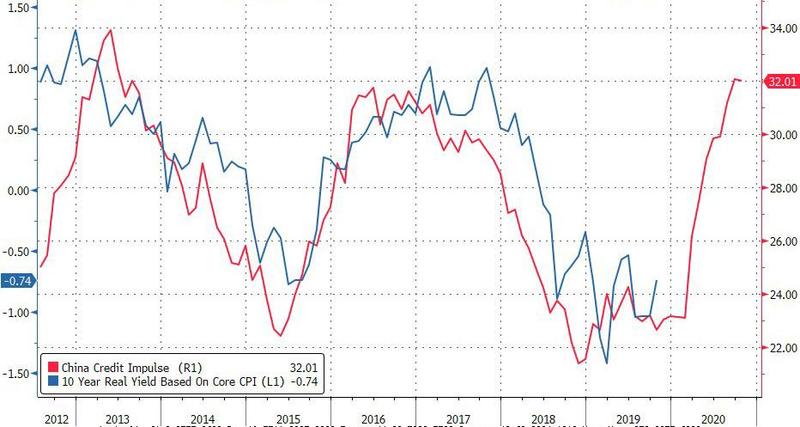
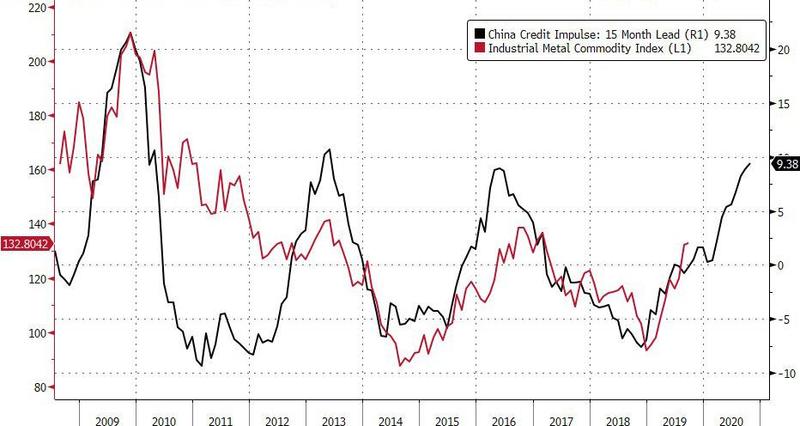
What is going on here is that China already has a massive Solvency problem within its SOEs and has now begun "papering it over" with large and expanding credit infusions.
Examples:
- The unexpected default of the recently AAA-rated Yongcheng Coal and Electricity Holding Group, a state-owned mining company in Central China’s Henan province which until recenty was seen as sacrosanct due to its explicit government support and which sold new debt only last month. 1 billion yuan ($151 million) of the company's bonds have defaulted.
- Chinese chipmaker and a major car manufacturer announced debt defaults, expanding a list of distressed state-linked firms that have roiled China’s credit market. According to Bloomberg, Tsinghua Unigroup said it wasn’t able to to repay a 5.6%, 1.3 billion yuan ($197 million) privately issued onshore bond, citing tight liquidity and after failing to win immediate approval from creditors to delay full repayment on the note.
- Brilliance Auto Group Holdings, a Chinese automaker linked to BMW, also announced that it has defaulted on 6.5 billion yuan ($987 million) of debt
-
The recent near-death experience of China's most-indebted property developer, China Evergrande, which obtained a last minute liquidity injection, has sparked speculation of a "Systemic Crisis".
Chinese "bail-outs" and forced liquidity injections are now significant in size that they are effectively reflating the global economy. This may may appear positive in the short term, but is potentially problematic in the intermediate to longer term.
|
|
"TOO BIG TO FAIL", "TOO MANY TO BAIL"
Neither China nor the US could even hope to cope with layoffs associated with the bankruptcies of their large domestic employers while concurrently attempting to handle the fallout from the industry wide Covid-19 destruction in sectors such as Travel, Leisure, Hospitality and Small Business
What we have therefore is China trying to halt the onslaught of bankruptcies through its massive Credit Infusions with the US doing the same through the Federal Reserves SMCCF (Secondary Market Corporate Credit Facility) Program.
What this is creating is a growing list of Zombie Corporations and a new category called Vampires (not only do they not have enough cashflow to cover interest expense which defines Zombies, but they don't have any cash flow period and burn cash outright as they have negative EBITDA).
- ZOMBIES
- 20% of all US Russell 3000 corporations Are Now Zombies,
- America’s Zombie Companies Have Racked Up $1.4 Trillion of additional Debt during the Pandemic.
-
VAMPIRES (also called SUPER ZOMBIES)
- These are the companies which Hyman Minsky would define as engaging in Ponzi Finance, which is the state of financialization right before the infamous Minsky Moment pushes the cycle into the Bust phase, and where companies have to rely on new debt merely to fund operations. When mature, formerly profitably companies with little to no growth and massive debt loads start burning cash, that's when things get ugly.
- According to Bloomberg, the number of companies with junk-rated debt coupled with negative EBITDA reached a staggering 47 in the third quarter. That's nearly double the level seen in the second quarter out of a universe of 600 junk-rated borrowers.
-
Unsurprisingly, many of these "super-zombies" operate in the airline, cruise line, and hospitality industries. Companies such as Delta, Royal Caribbean and United Airlines Holdings are among those that have seen trailing-twelve-month EBITDA turn negative in the third quarter.
|
|
CONCLUSIONS
The Economic Recovery is quickly occurring and profits margins for 2021 are satisfying analysts. P&L's may look good for earnings short term, however, there are major problems continuing to grow on the Balance Sheets. These problems leave heavily leveraged corporations fragile and vulnerable to any post Q1-Q2 2021 global economic slowing (See below: "Longer-Run Economic Consequences of Pandemics") or a new shock!
Periods like this are attractive for Precious Metals and value in select Commodities.
|
|
"Debt markets may not be paying enough attention to the risk of cash and financing running out. Even if the pandemic ends sometime next year, businesses will have to deal with their growing debt levels and an economy that may look very different after Covid-19. (That's ok though: by then the Fed will likely push rates negative allowing bankrupt companies to issue 2%-yielding debt and stay alive) We’ve got companies where we don’t know if they’re functionally okay or not because we don’t know what the economy looks like on the other side of Covid. You’ve got companies that need a fast solution to figure out how to make their debt levels work, and absent that, those are companies that over the course of the next year may need to file for bankruptcy."
|
|
-
XAU - Weekly - Elliott Wave Count >>> SUBSCRIBER LINK
DECEMBER - LONGWave Video
|
|
ADDENDUM TO THE DECEMBER LONGWave VIDEO |
|
SIMPLY "PAPERING OVER" THE PROBLEM
CHINA
China has discovered the game of "Extend & Pretend" which the developed economies have perfected! How much longer can Beijing pretend that the economy is remarkably strong... if only there was a few hundred billion more in liquidity sloshing around. Probably at least until the January inauguration event. After that, non-quantum reality may finally have to reassert itself.
Rabobank's Michael Every put it best when discussing the quantum states of the global news flow (China's economy surging in one collapse of the wave function; China's economy desperate for liquidity in the other), writing the following:
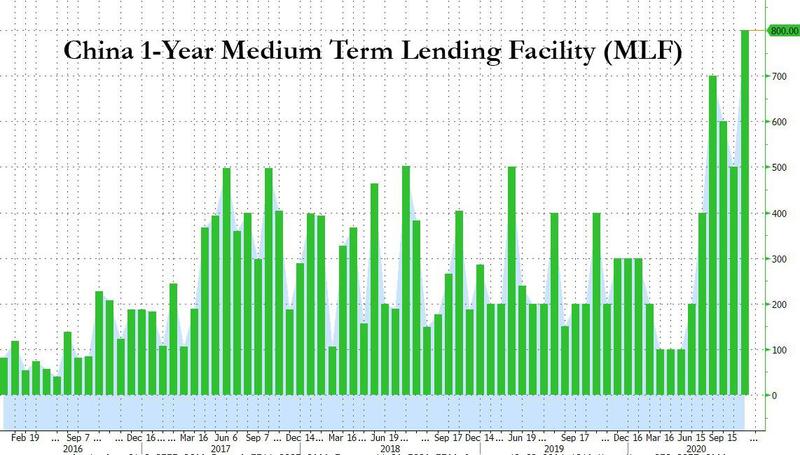
China’s economy continues to power ahead, with bumper net exports and capital inflows and industrial profits all being recorded: and yet the PBOC just had to inject CNY200bn (USD30bn) in MLF a month ahead of the end of the year to ease liquidity tightness, and that on the back of CNY800bn two weeks ago. Yes, this is gross not net: but why the need for so much PBOC help when everything is going so well? Perhaps because Chinese banks are still trying to repay CNY3.7 trillion of short-term interbank debt and purchase CNY1 trillion of government bonds and repay maturing MLF injections,…and are worrying about SOE bond defaults.
As Every rhetorically summarizes "everything is going so well though: there just isn’t any cash as a result"
USA
|
|
2 - GOLD STOCK CORRECTION MATURES |
|
Well followed Gold expert Adam Hamilton outlined in his latest missive some of his thinking and experience on how to trade Gold in a Bull Market with its notorious volatility. The volatility I suggested with take Courage to hold Gold. I have highlighted below just some of his key points in a very long report. I encourage serious traders of Gold to read the full missive.
-
Periodic selloffs really multiply the potential gains available in bull markets,
- Between mid-January 2016 to early-August 2020, the major gold stocks soared 256.7% higher during this 4.5-year span. That leveraged gold’s own parallel bull run by 2.9x, on the high side of major gold stocks’ normal range running from 2x to 3x.The gains won in GDX’s four individual uplegs added up to 396.6%. Those were further amplified by the increased buying power from holding cash through corrections.
-
Traders selling relatively-high at upleg toppings were able to buy more shares of the same fundamentally-superior gold miners at correction bottomings, accelerating their overall gains.
|
|
-
A great proxy for overboughtness and oversoldness is looking at prices relative to their trailing 200-day moving averages. On August 5th, GDX closed at an extreme 1.448x its 200dma!
-
That was a flashing warning sign that gold stocks’ last mighty upleg was increasingly at risk of giving up its ghost. And the necessary resulting correction to rebalance sentiment and technicals certainly didn’t tarry. Over the next four trading days, GDX plunged 12.2% formally entering correction territory at a 10%+ selloff. That sharp drop stopped us out of many of our gold-stock-upleg trades with enormous realized gains
- Like exact correction bottomings, exact upleg toppings are unpredictable and unknowable in real-time. But extreme overboughtness and universal popular greed are big warnings that toppings are nearing.
-
So rather than selling gold-stock positions outright after riding uplegs to massive gains, it is prudent to stay deployed while ratcheting up the percentages on trailing stop losses. These are fantastic trading tools.
-
Gold stocks are a crazy-volatile sector, making the big-and-fast gains possible which give the miners their allure. Using trailing stops strips all emotion from sell decisions.
- Following corrections after gold stocks have been beaten down, new trades can be added with loose trailing stops. They increase odds traders won’t be prematurely whipsawed out of positions early in uplegs before they can mature into big gains.
- Late in uplegs when GDX stretches far above its baseline 200dma, downside risks greatly multiply. So as prevailing greed and overboughtness mount after major uplegs, trailing stops should be tightened to lock in more of the unrealized gains when the selling inevitably arrives. Brokers automatically exit those very-profitable positions when the tighter percentage losses are hit, preventing traders from dithering.
-
But trading corrections is never easy, as they are cunning. These rebalancing selloffs are punctuated by some of the sharpest rallies seen in bull markets. Those deceive traders into staying deployed which maximizes their losses. These blistering countertrend surges convince people that either corrections are over or milder high consolidations are instead happening.
-
Gold uplegs and corrections are the tide on which the gold-stock boats float, as the fortunes in the yellow metal overwhelmingly drive the profitability and hence stock prices of the miners. This whole sector rises during gold uplegs, and all the gold stocks fall during gold corrections. So adding new gold-stock trades early in corrections before any signs of bottoming is a fool’s errand. That all but guarantees big losses fast.
-
By November 24th GDX’s total correction had extended to 24.9% over 3.6 months, right in line with my original 25% target from early September. Even better, it had blasted GDX well under its 200dma which is again the strongest support zone in bull-market corrections. GDX closed that day at just 0.945x that key metric, which is oversold. Early August’s extreme greed and overboughtness had finally fully reversed!
- That was enough evidence that the necessary sentiment and technical rebalancing had probably been accomplished. So that very GDX-low day, I started layering in new fundamentally-superior gold-stock trades in our newsletters to ride the next bull upleg. That campaign grew to include more new trades early this week. Thanks to its latest correction, this sector is unloved and back down to relatively-low levels.
-
Just like upleg toppings, exact correction bottomings are impossible to discern in real-time. Gold stocks could definitely still head even lower extending GDX’s correction. Or they could grind sideways consolidating low. But after a 24.9% selloff over 3.6 months forcing this gold-stock benchmark well under its 200dma and killing greed, odds are the great majority of downside risk is behind us. Upside potential outweighs it.
-
The prudent way to game a probable correction bottoming is to gradually redeploy your capital over time in fundamentally-superior gold stocks. The idea is to add new trades straddling the likely actual absolute low. The earlier ones could grind lower before the next upleg really starts, while the later ones could get added after it is underway. But layering in new trades over time lowers risks and ups odds of catching a bottom.
-
Buying low and selling high can only be accomplished if there is plenty of uncertainty when those trades are being executed. By the time major correction bottomings or upleg toppings are readily apparent to all well after the fact, the best gains have already been won. Even if this latest gold-stock correction doesn’t prove over yet, it has definitely really matured and accomplished its mission. Thus we can game its bottoming.
BOTTOM LINE
- The bottom line is recent months’ necessary and healthy gold-stock correction is maturing. The leading GDX gold-stock benchmark has finally fallen far enough and long enough to reverse greed to fear, with last summer’s universal bullishness vanishing. And the heavy selling finally forced this sector back down to oversold levels, with GDX hammered well under its 200dma which is relatively-low within ongoing bulls
- All this greatly increases the odds that the lion’s share of this correction’s essential work is now behind us. While this total selloff could still deepen, waning downside risks are increasingly being outweighed by big upside potential in this gold-stock bull’s next upleg. So we can start gaming this correction’s bottoming by gradually layering in new positions in fundamentally-superior gold stocks, now trading at relatively-low prices.
|
|
MATASII'S STRATEGIC INVESTMENT INSIGHTS |
|
THE LONGER-RUN ECONOMIC CONSEQUENCES OF PANDEMICS |
|
- WE WILL SEE LOW REAL RATES OF RETURN
- We can expect low returns for assets for a protected period of time since pandemic impacts persist for decades.
- Real Rates of Return are substantially depressed, in stark contrast to what happens after wars. Capital is destroyed in wars, but not in pandemics. Pandemics instead may induce:
- Relative Labor Scarcity
- Excess capital per unit of surviving labor
- A shift to greater Precautionary Savings.
- Heightened desires to save, possibly due to an increase in precautionary saving or a rebuilding of depleted wealth
REALITY SUPPORTS THEIR CONCLUSIONS
- Higher Inflation with nominal rates will be held down by the effective nationalization of sovereign bond markets (available fixed instrument float is dramatically shrinking due to government buying) which will deliver low real rates and therefore low rates of return.
- Labor Scarcity in the current Covid-19 pandemic is a direct function of "lockdown" fallout and possible further ongoing policy lockdown reactions. Going forward labor scarcity will be centered around corporate need for very highly skilled "specialists" (a PhD will be the norm) not todays trade or college certified labor. Entrepreneurs will be restricted by available capital and regulatory hurdles while "Mom & Pop" businesses will be the domain of fewer conglomerate corporate franchisers.
- Mass unemployment will be due to new business restrictions, Zombie / Vampire (Super Zombies) bankruptcies, Nationalism v Globalism and accelerating advanced AI robotics.
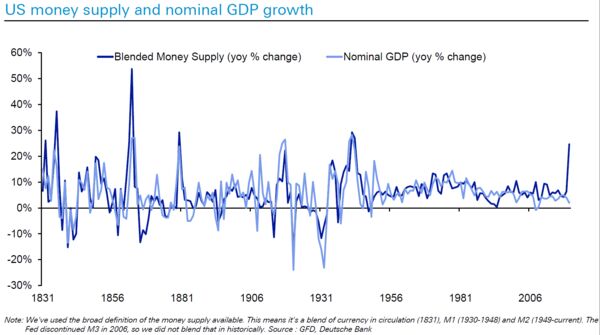
The square area outlined below by the red box highlights the Fed's "Longer-Run period within the illustration we highlighted in this month's LONGWave video.
|
|
THE XAU'S ELLIOTT WAVE COUNT |
|
We are within a corrective Wave (4) which is part of a rising Wave (3 Circled) below. Gold has a long way to go but will take courage as the legs will take courage and strong analytics. |
|
Your LIVE DESK TOP / TABLET / PHONE
MACRO ANALYTIC Video Chart Link: SUBSCRIBER LINK
NOTE: Any Problems with this Chart: E-Mail lcmgroupe2@comcast.net
|
|
LONGWave Video - DECEMBER 2020 |
|
IMMEDIATELY AVAILABLE TO NON-SUBSCRIBERS ON A PAY-PER-VIEW BASIS
CLICK RIGHT FOR PREVIEW
|
|
|
VIDEO LINK: SUBSCRIBERS LINK
TRANSCRIPTION: SUBSCRIBER LINK
|
|
The Most Insightful Macro Analytics On The Web |
|
PO Box 1224,
Norton, MA 02766
(508) 285 2213
|
|
|
|
|
|
|
|