Update Notice -
Resending for correction to our team contact table!
| |
Registration for the next Produce Safety Grower Training is open! | |
|
CONFERENCE REGISTRATION CLOSES JANUARY 17th
The 2025 Arkansas Grown Conference & Expo will be held at the Hot Springs Convention Center, January 30 to February 1, 2025.
Register now! Hope to see you in the spa city!
Topics covered from our team include:
- Farm and Food-Resources at Your Reach
- Post-Harvest Handling of Vegetables
- U.S. Department of Agriculture Local Foods Program Panel
- Introduction to Produce Safety Audits and Inspections
- New Preharvest Ag Water Rule Requirements for Produce Growers
- Local Food Supply Chain Development – Market and Grower Panel
- Home-Based Value-Added Product Development
Check out the online agenda for times, speakers, and details here.
| | |
|
USDA Urban Agriculture and Innovative Production Grants
The USDA is offering up to $2.5 million in grants to support urban farming and innovative agriculture. Funding is available for both planning and implementation projects to enhance local food access, provide education, support new farmers, and address urban agriculture challenges. Applications are due by March 10, 2025. See the press release here.
Visit the USDA website application guidelines or read this FAQ sheet for additional details.
| |
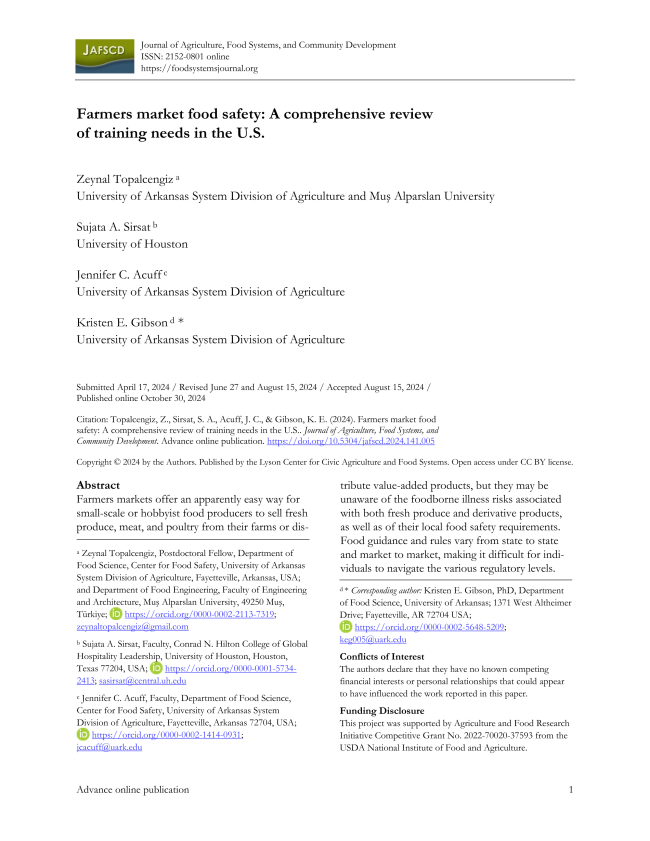
Farmer's Market Food Safety Publication
Catch up on the latest publication from the University of Arkansas Department of Food Science on Farmer's Market Food Safety!
| |
This review highlights the current research and guidelines related to food safety at farmers markets, drawing from both peer-reviewed studies and practical recommendations. It covers key areas such as facilities and supplies, regulations, education and training, and Good Farmers Market Practices designed to improve food safety at these markets, which play an essential role in local and regional food systems. The review also identifies common barriers to implementing food safety practices and emphasizes the need for collaboration among local regulatory authorities, market managers, vendors, and consumers to overcome these challenges.
Read full review here!
| | | |
|
High Tunnel Grower Survey - STILL OPEN
Do you produce crops in high tunnels? As Arkansas produce growers, it's essential to assess and improve practices to ensure crop safety and quality. Please consider taking our survey. We hope to better understand the challenges you face in implementing food safety practices, particularly in high tunnel production.
Your fully confidential responses will help identify areas where additional support, training, or resources are needed, such as in water quality, soil amendments, and post-harvest handling.
| |
Micro-Agricultural Systems Approach
The growth of small-scale and home-based, diversified agricultural production is transforming local food systems, creating innovative opportunities for both producers and consumers. Micro-agriculture, ranging from home kitchens to small farms, allows producers to tap into niche markets, offering fresh, locally grown products while fostering community connections.
However, these small-scale operations face unique challenges as they grow. Many producers operate with limited resources and infrastructure, often working independently or with minimal oversight. This can make understanding best production and management practices and scaling up difficult, particularly when transitioning from small-scale, direct-to-consumer models to more formal commercial operations.
To better understand these challenges, an Arkansas-based needs assessment is currently underway. The study is focused on non-traditional producers, including those operating out of home kitchens, small farms, and institutional settings like schools. By gathering insights from service providers and producers, the assessment aims to inform new strategies that can help micro-agriculture thrive.
As a result of these findings, new workshops and outreach programs are being developed. These initiatives are designed to support producers by offering tailored guidance on everything from navigating complex regulations to scaling their operations effectively. The goal is to provide the tools and knowledge needed for producers to grow their businesses, build local food networks, and succeed in an evolving agricultural landscape.
The rise of micro-agriculture represents a dynamic shift in how we produce and consume food. With the right support, these small-scale operations have the potential to transform communities and create more resilient, sustainable food systems.
Stay tuned and follow our work here.
| |
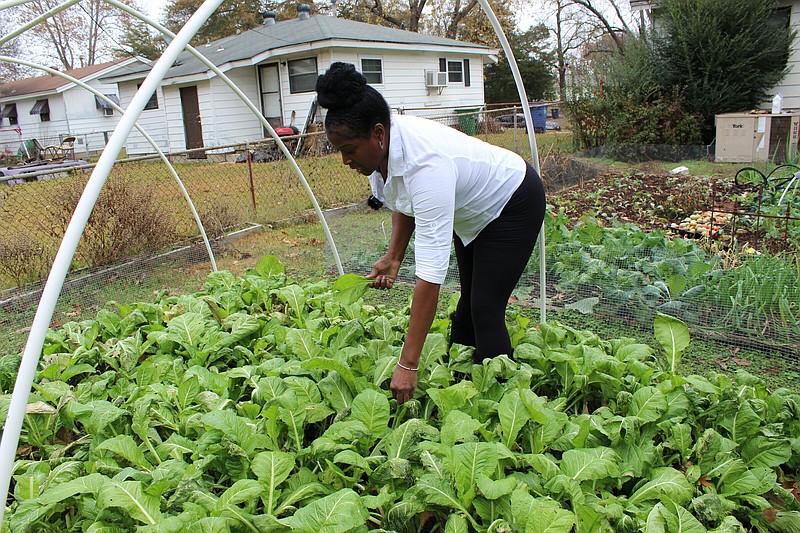
Kesha Cobb prepares her fall garden for winter in her backyard on Dec. 9. Cobb said her garden produces enough food for herself, with enough leftover to sell or share with others. (Arkansas Democrat-Gazette/Cristina LaRue) |
‘Micro-agriculture’ is how Arkansas’s small, urban growers are making the food system more resilient, Arkansas Democrat Gazette
Excerpt from the story featured on the micro-agriculture approach below...
...North Little Rock backyard gardener Kesha Cobb started growing food 11 years ago, and now grows roughly 2,000 pounds of produce, with more than 100 fruits and vegetables, in her roughly 5,000 square-foot garden in a low-income neighborhood and food desert. Cobb is president and chief executive officer of the nonprofit National Women in Agriculture's Arkansas chapter and chief executive officer of The Sustainability Project, Inc.
"I wasn't a second or third generation farmer, so I didn't have land to start with -- I didn't even have a house to start with, so I started growing at my mom's place or at a friend's place," Cobb said.
When Cobb was diagnosed with Type 2 diabetes several years ago, growing her own fresh food, especially leafy greens, became a critical priority to improve her health, and today, she enjoys sharing the fruits of her labors with her neighborhood. Cobb's property is registered as an urban farm with U.S. Department of Agriculture and she can accept SNAP benefits at a pop-up farmers market she sets up in her carport.
| |
|
"I feel like there's a really strong desire for people to regain more control over what they grow and what they eat," Stephen Grace said. Grace became involved in the University of Arkansas at Little Rock's campus garden shortly after it was created in 2012 when one of his students was part of a group that initially created the space as a pollinator garden.
Asked about their experience, some students at UALR's campus garden mentioned learning gardening from their grandparents, Grace said.
"It's almost like in a generation, those basic skills were lost and now people want it back," Grace said. "They are willing or at least curious enough to find out what it takes, to see if it will be feasible for them to do, and I hope to convince them that it is. Start small, have realistic expectations but yes, you can absolutely grow your own food -- and there's no greater satisfaction than when you eat something you grew yourself."
Full Micro Ag Story in the Arkansas Democrat Gazette from December 29, 2024
| |
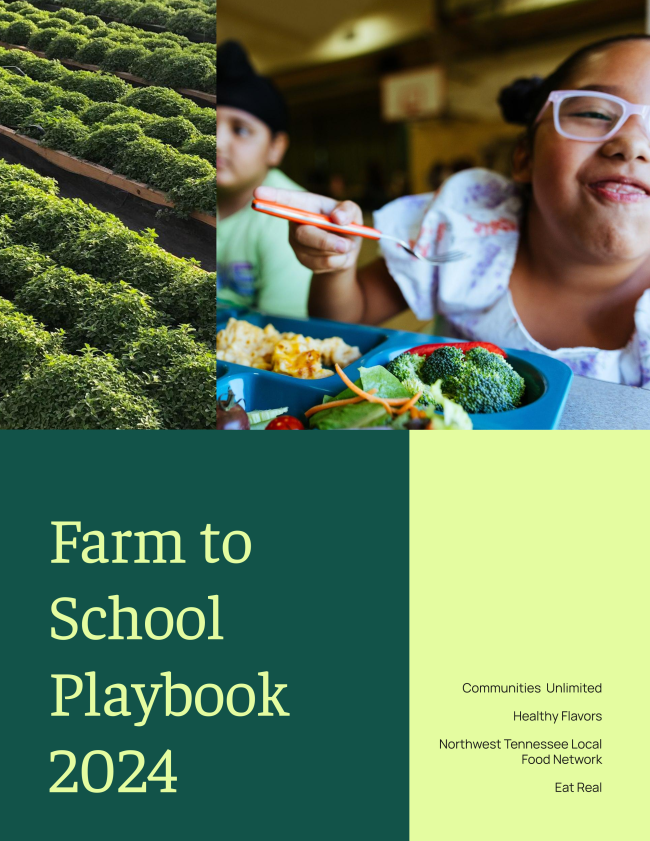
Farm to School Playbook 2024
The 2024 Farm to School Playbook showcases collaborative efforts to strengthen farm-to-school programs across the Mid-South, particularly in Arkansas, Tennessee, and Mississippi. The initiative, supported by a USDA Farm to School grant, focuses on connecting local farmers with school nutrition programs to foster healthier meals and vibrant local economies.
Key components include:
- Stakeholder Engagement: Building relationships between farmers, schools, and community organizations.
- Visioning Workshops: Sessions to spark interest and gather feedback from Child Nutrition Directors.
- Farmer and School Support: Guidance on local procurement, infrastructure needs, and marketing strategies to integrate fresh, local foods into school meals.
- Celebratory Gatherings: Events that highlight program successes and foster community pride.
This playbook provides actionable steps and templates for those seeking to grow farm-to-school efforts, emphasizing collaboration, resource-sharing, and sustainable impact.
To access the full report, click here.
| | | |
Meet the Organizations behind the Farm to School Playbook! | |
|
Meet the Arkansas Food Safety Team
Small-scale and home-based agricultural production systems are developing in Arkansas and with this growth comes new concerns regarding food safety and regulatory compliance. While these micro agricultural systems offer innovative opportunities, they also introduce risks related to contamination, sanitation, and food handling. Many producers operate with limited oversight and resources, which increases the likelihood of unsafe practices, especially as they transition from small-scale to commercial production.
The Arkansas Food Freedom Act of 2021 has expanded the types of products that can be made and sold to the public from a home kitchen. Because of that expansion, the need for scientifically based food safety tools and information has increased as well. The Food Science and Horticulture Departments of the University of Arkansas Division of Agriculture Research and Extension and the Arkansas Departments of Health and Agriculture work together to provide those tools and information.
The Food Safety team helps individuals, food processors, and farms have access to those food safety tools and information. Product development, value-added food processing, produce safety training, and process authority approval is just a small example of the services and information available.
If you have questions or need assistance, contact an Arkansas Food Safety team member using the table below.
| | | |
| Services | Name and Title | Contact Info | | On-Farm Food Safety | |
| | Produce Safety, Processing, Infrastructure, and Regulatory Guidance | Dr. Amanda Philyaw Perez, Associate Professor, Extension Horticulture | P: 501-671-2228
E: aperez@uada.edu | | Produce Safety, Packinghouse Cleaning and Sanitation | Dr. Kristen Gibson, Professor, Food Science | P: 479-575-6844
E: keg005@uark.edu | | Pecan Post-Harvest Safety | Dr. Jennifer Acuff, Assistant Professor, Food Science | P: 479-575-2108
E: jcacuff@uark.edu | | Produce Safety, Food Safety Modernization Act Regulations and Inspections | Greg Alexander, Program Manager, Arkansas Department of Agriculture | P: 501-225-1598
E: gregory.alexander@agriculture.arkansas.gov | | Manufactured Valued-Added Support | |
| | Process Authority for Manufactured Foods, Better Process Control School for Commercial Canning | Dr. Sun Ferreira, Assistant Professor, Food Science | P: 479-575-3137
E: sunfer@uark.edu | | Start-Up Commercial Product Development, Product Testing, Labeling, Commercial Kitchen | John Swenson, Arkansas Food Innovation Center Manager (Northwest Arkansas Kitchen) | P: 479-575-3095
E: afic@uark.edu | | Co-Packing, Commissary Kitchen, Product Testing, Labeling, Recipe Development, Commercial Kitchen | Dr. Darryl Holliday, Executive Director, Arkansas Food Innovation Center @ Market Center of the Ozarks (Northwest Arkansas) | P: 479-575-4316
E: aficmco@uada.edu | | Fruit and Beverage Value-Added Manufacturing | Dr. Renee Threlfall, Associate Professor, Food Science | P: 479-575-4677
E: rthrelf@uark.edu | | Start-Up Commercial Product Development, Product Testing, Labeling, Commercial Kitchen | David Hill, Share Grounds Manager, (Central Arkansas Kitchen) | P: 501-671-2048
E: dhill@uada.edu | | Regulatory Inspection Guidance, Food Recalls, Emergency and Disaster Response | Philip Fruechting, Wholesale / Manufactured Foods | P: 501-661-2171
E: adh.freesale@arkansas.gov | | Home-Based Value-Added Support | |
| | Start-Up Home-Based Product Development, Product Testing, Labeling | David Hill, Share Grounds Manager, (Central Arkansas Kitchen) | P: 501-671-2048
E: dhill@uada.edu | | Regulatory Inspections and Compliance (Retail, Food Freedom/Home-Based, Farmer’s Market) | Jeff Jackson, Public Health Section Chief II, Retail Food Section Standardization/Quality Assurance Officer, Arkansas Department of Health | P: 501-661-2171
E: jeff.jackson@arkansas.gov or adh.ehs@arkansas.gov | | |
|
David Hill
Program Associate
Home + Commercial Value-Added
dhill@uada.edu
(501) 671-2048
| |
|
Sarah Bakker
Program Associate
Produce Safety + Infrastructure
sbakker@uada.edu
(501) 671-2012
| |
|
Thank you for reading our newsletter!
Please reach out if you have any questions or need support with your local food efforts!
Sincerely,
Amanda Philyaw Perez, DrPH, MPH
Associate Professor,
Food Systems and Food Safety Specialist
Department of Horticulture,
Cooperative Extension Service
University of Arkansas System,
Division of Agriculture
2301 S. University Ave, Little Rock AR 72204
Office: 501.671.2228 | Email: aperez@uada.edu
| | |
Follow, Like, Subscribe, Watch + Connect Today! | |
| | | |