League of Women Voters of Oak Park & River Forest Newsletter August 2026 Volume 14 Issue 1


Presidents' Letter

Women in the American Revolution


During our celebration of America 250, we review of the accomplishments of founding fathers George Washington, Benjamin Franklin and Thomas Jefferson. But as historians emphasize, the American Revolution was not won solely by generals and statesmen but by the labor, sacrifice, and political participation of thousands of women.

This was driven home to me watching the Ken Burns’ PBS series, “The American Revolution” that examined the often-overlooked experiences of women, as well as enslaved Black and Native Americans. A 2004 book by the late journalist Cokie Roberts, “Founding Mothers: The Women Who Raised Our Nation,” features women who helped win independence. It tells the story of basic survival, running farms, wartime spying, fighting at doorsteps and organizing boycotts against British goods. It’s the first of Roberts’ two books about women in the early days of the republic.

Abigail Adams is famous for urging her husband, future president John Adams, to “remember the ladies” when creating the new government. Mercy Otis Warren wrote satirical plays and political commentary attacking British officials and Loyalists. After the war, she published one of the earliest histories of the Revolution, establishing her as one of the first female political historians in the United States. Phillis Wheatley, an enslaved African-born poet in Boston published poetry that gained international recognition.

Thousands of women traveled with the Continental Army as “camp followers.” These women cooked, washed clothing, repaired uniforms and nursed the wounded. General Washington sometimes viewed camp followers as a burden, but he acknowledged the army depended on their labor. Historians estimate that as many as 10,000 women accompanied the army at different times during the war. 

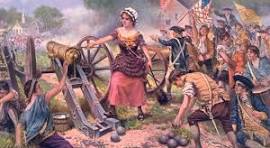
Although women were officially barred from military service, several became famous for joining the battle. Deborah Sampson disguised herself as a man and enlisted in the Continental Army under the name Robert Shurtliff. She fought in combat and reportedly treated her own wounds to avoid discovery. After the war, she received a military pension, one of the few women to do so. Margaret Corbin took over her husband’s cannon after he was killed during the Battle of Fort Washington in 1776. She continued firing until she was severely wounded. She later became the first woman in the United States to receive a military pension from Congress. 

Women were effective spies because they were so underestimated. Women carried messages, hid documents, gathered intelligence and smuggled supplies. Some Loyalist and Patriot women used their social connections to gather information from officers and politicians.

One mysterious Revolutionary known only as “Agent 355” reportedly worked with a spy ring that supplied intelligence to George Washington. Her identity remains unknown, but she symbolizes the hidden contributions of female intelligence operatives.

The Revolution affected Black women depending on whether they were enslaved or free. Some enslaved women sought freedom by escaping to British lines after Britain promised emancipation to those who supported the Crown. Others supported Patriot families while remaining enslaved. Elizabeth Freeman sued for her freedom in Massachusetts after the Revolution began. She argued that the state constitution’s statement that “all men are born free and equal” applied to enslaved people as well. Her successful case contributed to the end of slavery in Massachusetts. 

Many women remained loyal to Britain. They sheltered British soldiers, passed intelligence to the Crown, lost homes and property after Patriot victories, then faced harassment, confiscation or exile. Thousands of Loyalists fled to Canada, Britain or the Caribbean after the war.

With women participating in politics, economics and war, they increasingly questioned why a nation founded on liberty excluded half its population. For many years, histories of the American Revolution focused primarily on its male founders. Modern scholarship has expanded the story to include women, African Americans, Native Americans and ordinary civilians.


--Beverly Tuck

Voter Service Meeting

On Monday, August 17, at 6:30pm, the LWV OPRF Voter Service Committee will meet at Maze Branch Library, 845 Gunderson, Oak Park. We will be in the lower level meeting room. You are invited to attend if you have been a member of this committee in the past or are just joining us as a new member. We will discuss opportunities to help with voter registration at various locations this fall and passing out flyers to businesses for online voter registration. Our target areas will be in Oak Park, River Forest, Forest Park, Berwyn, and Elmwood Park. There will be volunteer opportunities for those members that are Deputy Registrars and also for members that just want to pass out information. Can't make this meeting? Please email Peggy Kell or Suzanne Poisl of your continued interest in volunteering for the Voter Service Committee.

June Convention Wrap-up

The LWV US biennial National Convention from June 25-28 in Columbus, Ohio, adopted a program for the next two years, “Defending Democracy Under Siege.” It includes voting rights, protecting elections, redistricting, individual rights and the presidency (which includes both National Popular Vote and abolishing the electoral college by Constitutional Amendment). In addition, the Convention approved a board recommended concurrence with the Washington State study of the rights of immigrants.


Our chapter sent four delegates: Barbara Paterick, Jo-Ella Podagrosi Spratt, Mary Chris Jaklevic and Peggy Kell. Here are some of their takeaways.


Barbara reported that a resolution to support advocating for the National Popular Vote Interstate Compact, in coordination with members advocating for the Electoral College abolishment was adopted overwhelming. Barb has worked for years on the National Popular Vote as an acceptable interim solution until the Electoral College is replaced by the direct election of the president.


Jo-Ella attended a program on recruiting women to run for office led by Erin Loos Cutraro, CEO and founder of She Should Run, a nonpartisan group that works to increase the number of women who run for elected office. She learned it typically takes two years from the time a person initially thinks about running for office to commit to it. Building skills, connections, coalitions and community awareness during those two years is key to a successful run. Jo-Ella also attended a program on building and growing effective State Lobby Corps. The session inspired a group of attendees to launch a new ad hoc networking group.


Mary Chris was impressed with a session about a mapping project of voter turnout rates in Ohio. The project was initiated by a league leader in Dayton who taught mapping at a community college. The project found that low voter turnout correlated with factors such as low income and high percentage of renters. The main takeaway was that registering people to vote is easy and getting them to the polls is hard. Identifying geographic areas of low turnout allows the League to focus its efforts by reaching out to community organizations, learning what issues voters care about and motivating them to go to the polls. 

Call for Candidates

The League of Women Voters Lake Michigan Region is now recruiting the slate of officers for 2026-2027. The Nominating Committee is tasked with slating the offices of President, Vice President, Nominating Committee Chair, and Nominating Committee members.


LWV OPRF members are eligible to submit their names because we pay dues to LWV-LMR. Self-nominations are welcome. Email your nominations to lwvlakemichigan@gmail.com as soon as possible. Please include "2026-27 Nominations" in the subject line and provide your phone number and preferred email address.


The LWV Lake Michigan Region 2026 Annual Meeting and Conference will take place this fall in Wisconsin. Stay tuned!

Rain, Rain

This summer has brought some extreme rain events. Where does that water go? At one point this summer some of the MWRD reservoirs were at capacity. Here are two ways to learn more about what happens to our water. Read a guide to learn how the Chicago area combined sewer system works, why it was designed this way and what you can do to help reduce flooding risk. And check out a new video that explains how the MWRD and Chicago’s Department of Water Management (DWM) work together to protect Chicago’s most important natural resource: water. They clarify that the DWM supplies and distributes clean drinking water and maintains the city’s sewer system, while the MWRD owns and operates intercepting sewers, treats wastewater and manages regional stormwater along with the Tunnel and Reservoir Plan (TARP, aka “Deep Tunnel”).

Recyling

Thanks to recent state legislation, it's now prohibited to put batteries into a landfill. This is great news for the environment. And it's now easy to do the right thing.

You can drop off all household batteries (primary and rechargeable) at the River Forest Village Hall, 400 Park Ave., River Forest. And please tape over the battery terminals to prevent fires. Go here for more information.

Mark your calendars now for the September 17 Fall Kickoff, "Getting out the Vote", at the Oak Park Main Library.

Democracy Wins

A federal judge ruled that Trump's expansive pardon of January 6 rioters does not apply to a Virginia man accused of planting two pipe bombs in Washington, DC, the night before the 2021 US Capitol insurrection.


A second federal judge blocked the U.S. Postal Service from changing its election policies to follow Trump’s March executive order.


In a win for underrepresented voters in Florida, a court dismissed an anti-voting lawsuit challenging the methodology used in the 2020 Census — which plaintiffs argued disadvantaged Republicans in the state.


Read more democracy wins here.


Facebook
 
Instagram